Cancún's Other Side: The City That Keeps the Hotel Zone Alive
In 1970, the barrier island that is now Cancún’s Hotel Zone had exactly three residents. Today, nearly a million people live on the mainland side of the lagoon—the workers, migrants, and families who keep Mexico’s biggest tourism machine running. This is the story of that city.

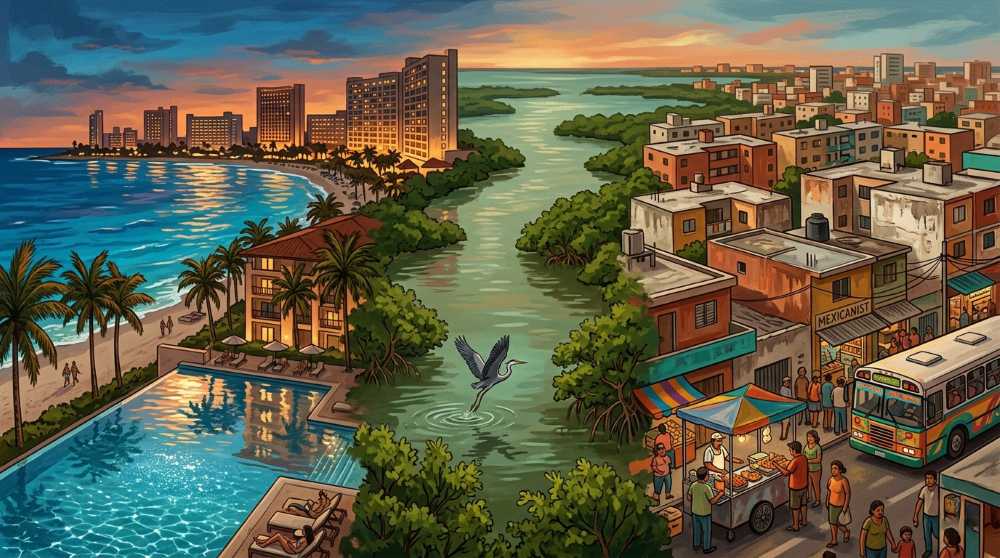
There is a moment, just after the baggage carousel spits out the last suitcase at Cancún International Airport, when the illusion begins. You step outside into the wall of Caribbean humidity, slide into a shuttle van plastered with pictures of turquoise water and pyramids, and the driver pulls onto Boulevard Kukulcán. For the next forty-five minutes, you see nothing but golf courses, shopping malls, and the skeletal silhouettes of condominium towers rising from a sandbar that didn’t exist as a city until Richard Nixon was in the White House.
This is the Cancún that 9.7 million international visitors came to see in 2024[1]. The Cancún of swim-up bars and catamaran Instagram, of people doing body shots off strangers at Coco Bongo at 2 a.m. It is real, and it generates billions of dollars a year for Mexico’s economy. But it is only half the story.
The other half lives west of the Nichupté Lagoon, in a city of nearly a million people that was never supposed to be a city at all. It was supposed to be a “service corridor”—a place where the maids and bartenders and gardeners who keep the Zona Hotelera humming could sleep between shifts. Instead, it became one of the fastest-growing urban areas in Latin America, a chaotic, vibrant, often contradictory place where Mayan street vendors sell cochinita pibil next to Oxxo convenience stores, where the smell of achiote paste mingles with diesel exhaust, and where the Caribbean Sea—the whole reason anyone is here—feels impossibly far away.
This is the Cancún tourists never see. And it is, by almost every measure, the more interesting one.
A City Invented from Nothing
The most extraordinary thing about Cancún is not its beaches. It’s that the place shouldn’t exist. In January 1970, the barrier island that now forms the Hotel Zone had a population of three people—all caretakers of a coconut plantation[2]. The surrounding mainland was jungle, marsh, and mosquito. There were no roads, no electricity, no running water. The nearest city of any size was Mérida, three hours and a hundred years away across the Yucatán Peninsula.
Then the Mexican government had an idea.
INFRATUR, a state-run trust fund later absorbed into FONATUR (the National Fund for Tourism Development), identified the site as a potential “tourist pole”—a deliberately manufactured paradise designed to capture American dollars the way a funnel captures rain. The logic was brutally straightforward: Mexico had sun, sand, and cheap Indigenous labor from the impoverished southern states of Oaxaca, Chiapas, Tabasco, and the Yucatán itself[3]. What it lacked was infrastructure. So the government built it. The first hotels opened in 1974 with just 332 rooms[4]. Within four years, the population had exploded from nearly zero to 40,000 inhabitants[5].
The speed of growth was staggering and, from an urban planning standpoint, nearly unmanageable. Architect Mario Schjetnan, writing in Landscape Architecture magazine in 1977, described a place where “land uses and construction controls as devised by the planners—actually very rigidly—could not be preserved.” Families would buy lots, build homes, and convert the garage into a store or beauty parlor. Tradesmen who came as carpenters and masons put down roots, and their wives opened improvised restaurants. The gridded, triangular layout that INFRATUR had so carefully drawn on blueprints was swallowed by the organic chaos of human settlement[5].
By 2020, Cancún’s population had swelled to 934,189 inhabitants—a 37.9% increase from 2010[6]. Today, the city is the most populous in Quintana Roo and the economic engine of southeastern Mexico. But that engine runs almost entirely on one fuel: tourism. And the people who stoke the fire live on the other side of the lagoon.
The Supermanzanas
Cancún’s Triangular Grid
If you want to understand why the “real” Cancún feels so different from the tourist strip, start with its geometry. The city’s older residential core is organized into supermanzanas—super blocks—which are large, roughly triangular precincts containing U-shaped interior streets. The design was intentional: by funneling traffic onto the main avenues on the perimeter of each block, the planners hoped to keep noise and congestion out of the residential interior. It was a modernist dream of order, imported directly from the planning schools of Mexico City.
On the ground, it works—sort of. Each supermanzana functions like a self-contained neighborhood. Every one has its own school, park, convenience store, laundromat, and a handful of small restaurants. Local vendors pass through on foot or bicycle, selling tamales, sharpening knives, offering to fix your plumbing. As one longtime resident described it: “Once you get to know your neighbors you find that you rarely have to walk more than ninety seconds out your door to find general everyday things.”[7].
The architecture is modest and functional—one- to three-story concrete-block homes with tile floors, designed to stay cool in the tropics without air conditioning. Each owner has added personal touches over the decades: a coat of bright paint, a jardiniere of bougainvillea, a shrine to the Virgen de Guadalupe near the front door. The overall effect is not ugly, but it is profoundly ordinary—which is precisely what makes it so striking against the manicured artifice of the Hotel Zone.
Villas Otoch Paraíso
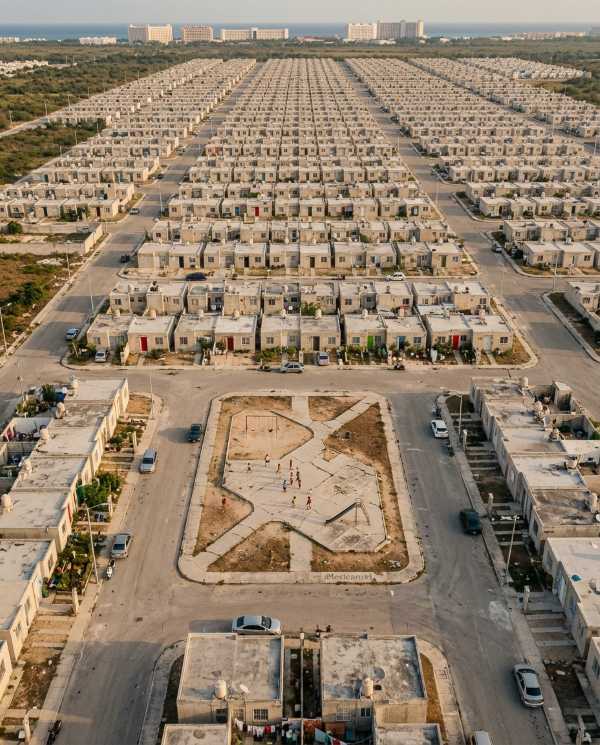
Not every supermanzana is quaint. On the western fringes of the city, far from both the beaches and the downtown center, sits Villas Otoch Paraíso—a housing development built in 2007 that is home to about 40,000 people and is widely considered Cancún’s most dangerous neighborhood[8]. From above, the 14,000 identical homes—each just 35 square meters—create a rigidly symmetrical grid that gives an impression of order. At ground level, the street furniture is decaying, public spaces have been surrendered to gang members, and drug dealers who operate in the tourist zone maintain a quiet but persistent presence.
The development was originally designed as affordable housing for construction and tourism workers, many of them internal migrants from Chiapas, Tabasco, and Oaxaca, as well as immigrants from Guatemala and Cuba. These are the people whose labor built the very resorts they can never afford to stay in. Yazmín Terán, a 41-year-old schoolteacher and community leader who moved to Villas Otoch from Oaxaca fifteen years ago, remembers her initial excitement: “You see the beaches, the tourist places and the hotel zone on television and you say ‘wow!’ But when you come here to Cancún you realize that it’s not all like that.”[8].
Violence has increased in the neighborhood since 2018, driven by turf wars between rival cartels and the steady flow of weapons into the region. Cultural manager Sofía Ochoa, who has worked in Villas Otoch since 2022, estimates that 40% of children in the area do not attend school. Many don’t even know the beach; for them, the Hotel Zone is “the last frontier—very far to reach.”[8].
Mercado 23 & Mercado 28
Every real city has a place where you can taste its soul. In Paris, it’s the produce stalls of the Marché d’Aligre. In Tokyo, it’s the tuna auctions of Tsukiji. In Cancún, it’s Mercado 23.
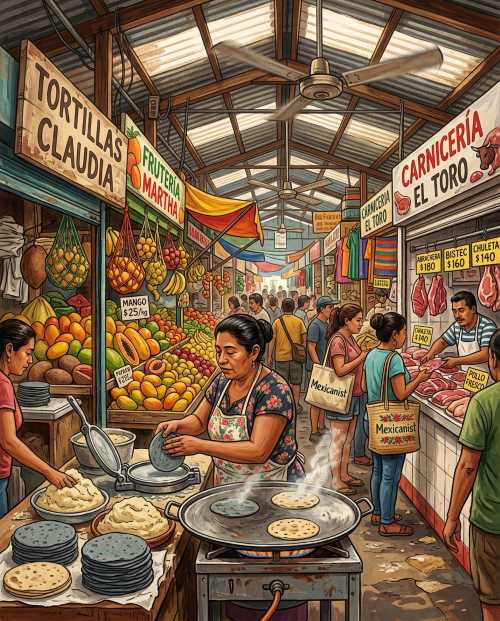
Mercado 23 is the oldest market in Cancún, tucked into the northeastern corner of Supermanzana 23, just behind the central bus station[9]. It is not a market built for tourists—and that is exactly why it matters. This is where Cancún’s working families come to buy fresh produce, handmade tortillas, cuts of meat hung from hooks, and the thousand small necessities of daily life. The stalls are cramped, the aisles narrow, the haggling in rapid Spanish. You will not find a single Starbucks here, but you will find a woman hand-pressing corn tortillas while her grandson watches telenovelas on a phone propped against a stack of Coca-Cola crates.
Mercado 28, a few blocks south, is the more “tourist-friendly” of the two—a sprawling open-air market where you can buy everything from traditional Yucatecan clothing to ceramic jaguar figurines and, yes, a T-shirt that says “I Survived Cancún.” But even here, the tourist veneer is thin. Wander past the souvenir stalls and you’ll find the same food vendors, the same aromas of chile-lime and charred corn, the same rhythm of daily life that has nothing to do with happy hours and poolside DJs.
These markets are more than commercial spaces. They are social infrastructure—the places where neighbors run into each other, where gossip is exchanged over a plate of sopes, where the informal economy that sustains so many families hums along at full volume. When writers describe the “real Mexico” hidden behind the resorts, this is what they mean: the stubborn, sensory, unphotographable reality of ordinary people doing ordinary things in a place that the world insists on seeing only through the lens of vacation.
The Nichupté Lagoon
There is a body of water that most tourists glimpse only from the window of an airport transfer van and never think about again. It separates the Hotel Zone from the mainland like a moat, a vast, shallow lagoon system spanning thousands of hectares of mangroves, seagrass beds, and brackish channels. This is the Nichupté Lagoon, and it is one of the most ecologically significant urban wetlands in the Americas.
The protected area within the lagoon system covers 8,673 hectares and shelters endangered species including crocodiles, manatees, and dozens of species of migratory birds[10]. It is, as Mexico’s National Commission of Natural Protected Areas (CONANP) describes it, “a well-preserved area in the middle of the urban and tourist infrastructure of Cancún—practically an urban mangrove with ecological connectivity to the Nichupte lagoon system and the surrounding reef communities.”[11].
But the lagoon is also Cancún’s most potent symbol. It is the physical barrier between the two cities—the tourist city and the working city—and it has functioned, for fifty years, as both a boundary and an eyesore. From the Hotel Zone side, the lagoon is a backdrop for romantic sunset dinners and kayaking excursions marketed to visitors. From the mainland side, it is a neglected frontier where mangroves have been cleared for development, where water quality has suffered from decades of urban runoff, and where scientists have documented alarming levels of anthropogenic contamination[12].
The duality is almost too neat. On one shore: five-star hotels charging $2,000 a night. On the other: families who need about 500 pesos ($30) just to spend a single day at the beach, which represents a significant chunk of the average monthly salary of roughly 7,500 pesos ($450)[8]. The lagoon doesn’t judge. It just sits there, green and still, reflecting both skylines.
The Daily Commute
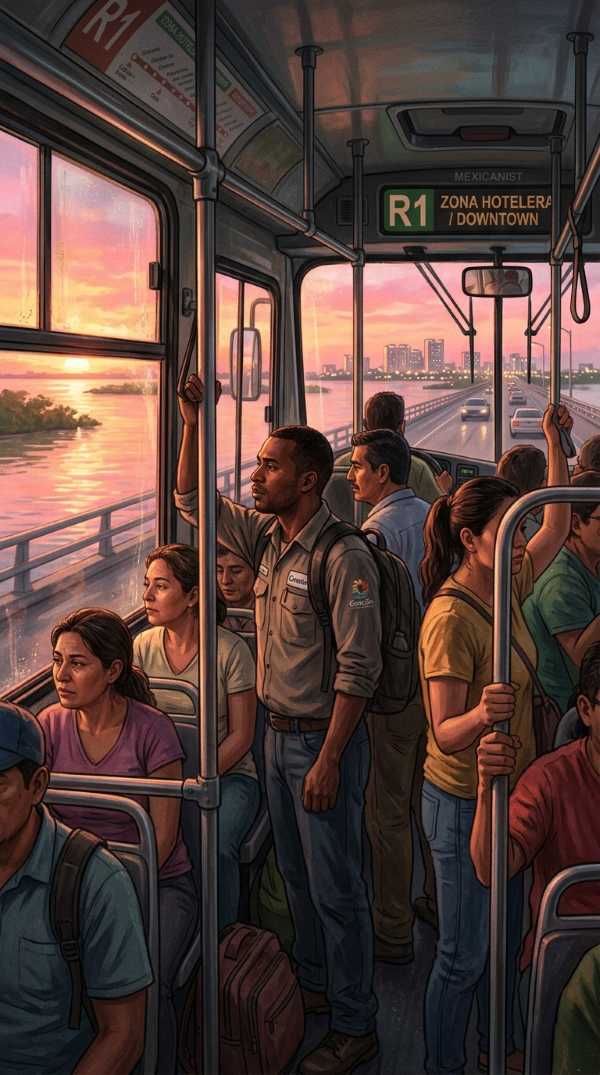
Every morning, thousands of Cancúnenses perform a ritual that no travel brochure will ever mention: the commute to the Hotel Zone. It starts before dawn, in neighborhoods scattered across the mainland, with workers catching the R1 or R2 bus routes—the two main public transit lines that shuttle people between downtown and the tourist strip. The buses run every five minutes during peak hours, and a single ride costs about 12 pesos (less than $1 USD)[13].
The R1 runs directly past the ADO bus station on Avenida Tulum before crossing the bridge to the Hotel Zone. The R2 takes a slightly different path through Avenida Coba. Both routes terminate deep in the tourist district, depositing workers at the back entrances of mega-resorts whose front gates open onto the Caribbean. The journey takes twenty to thirty minutes in good traffic. During peak season—Christmas, Spring Break, Easter—it can take an hour or more.
Many of the larger resort chains operate their own private shuttle buses, picking up staff from centralized collection points at fixed hours. But for the vast majority of hotel workers, restaurant staff, street vendors, and gig-economy drivers who keep the tourism machine running, the public bus is the only option. It is crowded, it is slow, and it is a daily reminder of the distance—both geographic and economic—between where they live and where they work.
Voices from the Barrio
The statistics tell one story. The people tell another.
Rosalina Gómez is 36 years old. She came to Cancún from the southern state of Chiapas, fleeing poverty and an abusive father. She works as a cleaner at Cancún International Airport. Her main interaction with the tourism industry is scrubbing the floors of the terminal that 30 million passengers passed through in 2024. “Sometimes tourists give you clothes, a tip, a soda or say thank you because the bathroom’s clean,” she told RFI/AFP. “That’s what I like the most.”[8].
Gómez has a fifteen-year-old daughter, Perla del Mar, who has cerebral palsy. She last visited the sea four years ago. “I don’t feel comfortable going to have fun at the beach knowing that I have a bedridden daughter,” she said. Her hope now rests on her seventeen-year-old son Ricardo, who is studying food and beverages. She dreams that once he graduates and gets a job in tourism, she can stop working and care for her daughter full-time[8].
Then there is Yazmín Terán, the schoolteacher from Oaxaca, who estimates that her family visits the beach about five times a year. “Those of us who live and work here hardly have time to go and enjoy the beach and sea,” she says. The beaches are technically public, but in practice, access is controlled by the hotels. Without a car—and many families in the outer neighborhoods don’t have one—the logistics of simply reaching the sand become a small odyssey of bus transfers and hidden costs[8].
These are not exceptional stories. They are the norm. And they expose the central paradox of Cancún: a city that sells the Caribbean dream to the world while reserving it for those who can pay.
It’s Not All Black and White
It would be easy—and journalistically lazy—to paint Cancún as a simple tale of exploitation: rich tourists on one side, poor workers on the other, with nothing in between. The reality, as always, is messier.
A Real Middle Class Exists
Cancún does have a thriving middle class, particularly in the older supermanzanas near the city center. These are families who have lived in the city for generations, who own their homes, who send their children to university, and who shop at the same malls and eat at the same chain restaurants as their counterparts in Guadalajara or Monterrey. The city has hospitals, private schools, golf courses, and a Costco. To pretend that the entire mainland is a slum would be as reductive as pretending the entire Hotel Zone is a paradise.
Tourism as Upward Mobility
For many migrants from southern Mexico and Central America, Cancún represents genuine economic opportunity. A hotel job pays more than agricultural work in Chiapas or Oaxaca. The Mexican tourism industry created millions of direct and indirect jobs, and Cancún remains the engine of that economy[14]. The flow of money earned in Cancún back to rural communities in the Yucatán has, as scholar Alicia Re Cruz has argued, fundamentally reshaped the social and economic fabric of the entire region[3]. Cancún is not just a resort—it is a remittance economy.
Security and Violence
The violence in neighborhoods like Villas Otoch cannot be ignored. Since 2018, the flow of weapons and turf wars between the Sinaloa Cartel and the Jalisco New Generation Cartel (CJNG) have made parts of the city genuinely dangerous. Shootings, extortion, and gang recruitment are daily realities in the outer neighborhoods. To write about Cancún’s working-class communities without acknowledging this would be dishonest. The tourism economy creates jobs, but it also creates lucrative targets for organized crime, and the workers who serve tourists are caught in the crossfire.
The Cancún That Matters
Cancún’s Hotel Zone is one of the most successful tourism projects in human history. That is not in dispute. In 2024, Cancún International Airport processed 30.4 million passengers, making it the busiest airport in Mexico[1]. Tourist spending generates billions of dollars annually. The resort strip attracts visitors from every corner of the globe, and for many of them, it delivers exactly what it promises: sun, sand, and relief from the grind of daily life.
But there is another Cancún—the one that exists on the other side of the lagoon, in the supermanzanas and the markets and the cramped apartments where the people who make the magic happen actually live. It is a city of nearly a million souls, built in a single generation from nothing, fed by migration and ambition and the relentless demand for more hotel rooms, more restaurants, more experiences to sell.
That city is not a tourist attraction. It is a place. A real, flawed, complicated, sometimes dangerous, often beautiful place, full of people who are doing the best they can with what they have. It has parks that need fixing and schools that need funding and lagoons that need protection and neighborhoods that need investment. It also has some of the best street food in Mexico, a street art scene that would make Brooklyn jealous, and a cultural energy that comes from being a city where everyone is, in some sense, from somewhere else.
Next time you go to Cancún, take the R1 bus. Sit in the back. Ride it past the last resort, across the bridge, and into the supermanzanas. Eat something at Mercado 23. Walk along the lagoon at dusk and watch the hotel lights flicker on across the water. You won’t regret it.
You might even come back.
References
[1] Hotelagio – Cancún Tourism Statistics (2025)
[2] JSTOR Daily – Cancún and the Making of Modern Gringolandia (2024)
[3] Castellanos, M.B. – The Transnational Construction of Mayanness
[4] Cancún Shuttle – History of Cancún
[5] Schjetnan, M. – Landscape Architecture (1977), via JSTOR Daily
[6] DataMéxico – Cancún Profile
[7] Marginal Boundaries – Streets of Cancún: Local Neighborhoods
[8] RFI/AFP – For Some Residents of Mexico’s Cancún, Beach Seems World Away (May 2024)
[9] Perceptive Travel – Mercado 23 or Mercado 28 in Cancún, Mexico
[10] CONANP – Manglares de Nichupté Protected Area
[11] CONANP – Nichupté Lagoon System
[12] MDPI – Anthropogenic Contamination in Nichupte Lagoon (2024)
[13] GoCancúnGuide – R1, R2, and R10 Routes in Cancún
[14] Emerald Publishing – Impacts of Tourism on Employment in Mexico