What the Tren Maya Could Destroy Before Anyone Sees It
Two calcified skulls shattered by tourist-dropped cameras. A cave sealed for 1,000 years and opened to reveal 200 untouched artifacts. 137 children’s handprints in red and black, a coming-of-age ritual from the age of drought. The Yucatán’s cave paintings are an archive in crisis.

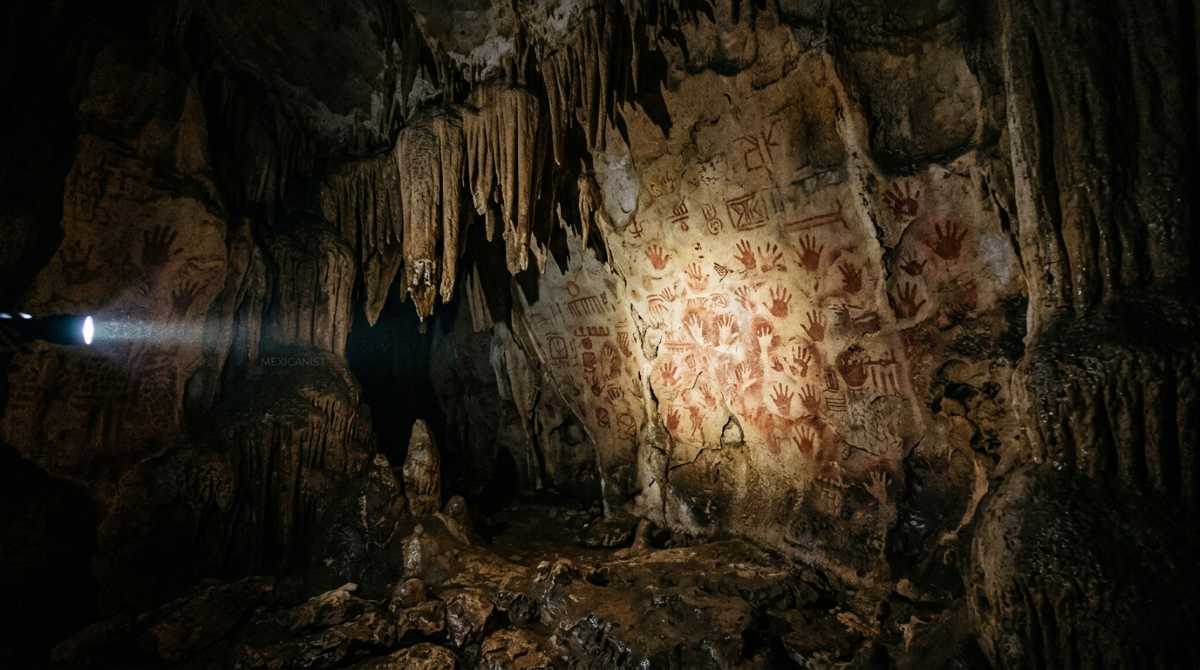
Step inside a cave in the Yucatán and the first thing you notice isn't the paintings. It's the silence. And I don't mean the gentle, contemplative kind—I mean the dense, pressurized hush of a place that hasn't needed to be loud in eleven thousand years. Then your guide swings the flashlight, and the walls light up in red. Red handprints. Red deer. Red geometric spirals that could be maps or prayers—or, honestly, the world's oldest abstract expressionism. Who knows. The Maya who made them are gone. The Spanish who burned their books are gone. The tourists who dropped cameras on sacred skulls, well, some of them are still around, but we'll get to that.
Cave paintings in the Yucatán Peninsula aren't one tidy thing. They're a sprawling, uneven, occasionally heartbreaking archive that stretches from the Paleoindian era, roughly 10,000 BCE, all the way through the Terminal Classic period around AD 900. Some of these sites are famous, at least among archaeologists. Loltún draws visitors on the Puuc Route. Actun Tunichil Muknal in Belize has been ranked by National Geographic as the number-one sacred cave destination on Earth. But the vast majority of Yucatán cave art lives in the shadows—undocumented, mostly unpromoted, and in some cases deliberately unpublicized because the moment a cave goes viral, someone with a chisel shows up.
This essay is a journey through what the walls remember: red ochre, children's handprints, jaguars and serpents painted in darkness—and the delicate, infuriating question of what survives when a cave meets the modern world. And yeah, it's a story about loss too. The sea has swallowed entire cave systems. Flood damage has closed Loltún since 2020. Two skulls in a Belizean ceremonial chamber were shattered by tourist-dropped cameras. The Tren Maya bores through karst limestone as you read this. What the walls have held for millennia, the twenty-first century can undo in an afternoon.
The Deep Archive
If the Yucatán's cave art had a flagship, it would be Loltún. Located about seven kilometers south of Oxkutzcab in the Puuc Hills, Loltún is the cave that has everything: 145 documented mural paintings, 42 petroglyphs, a warrior bas-relief with Olmecoid features, stone columns that chime like bells when struck, and a fossil record that includes mammoth bones. It is the longest continuously occupied cave site in northern Yucatán, with a human presence stretching back to approximately 9000 BCE. In cave years, that is the equivalent of a building that has been lived in since the Stone Age, through the Bronze Age, through the Renaissance, and is still standing.
The first modern visitor of record was Teoberto Maler, a Mayanist born in Italy to German parents, who came to Loltún in 1886 and 1892 and made prints and paintings of what he found inside. Edward H. Thompson, the same man who later dredged the Sacred Cenote at Chichén Itzáfor the Peabody Museum, excavated here between 1888 and 1891. Henry C. Mercer of the University of Pennsylvania visited 29 caves in the Puuc range in 1895, looking for evidence of early human occupation comparable to European cave sites. He did not find it, or at least he did not know he had found it, because the concept of Paleoindian occupation in the Americas was still decades away. It was not until INAH archaeologist Ricardo Velázquez Valadez began formal excavations in 1978 that Loltún's true depth began to emerge.
The warrior bas-relief at the Nahkab entrance is the site's most analyzed artwork. It shows a well-dressed warrior standing barefoot with a spear in vertical position, a cartouche of glyphs ending in the numeral three. The figure has what scholars politely call a "clear Mayan profile" but with "thick lips recall Olmec sculptures and Chalcatzingo reliefs." Dated to roughly 300-250 BCE, it is one of the earliest pieces of figurative Maya art in any cave, and it wears its cultural influences on its sleeve, or rather, on its face. The Olmec connection isn't just decorative trivia. It suggests Loltún sat at a cultural crossroads where highland and lowland traditions met and mingled.
Then there are the handprints. Negative stencils, made by pressing a hand against the wall and blowing pigment around it. The technique is universal in global rock art, from Argentina's Cueva de las Manos with its 2,000-plus prints to the caves of Sulawesi. But at Loltún, the handprints belong to a larger visual vocabulary that includes human faces, geometric designs, and what appear to be abstract compositions whose meaning has been lost to time. Andrea Stone, the art historian whose 1995 book Images from the Underworld essentially founded the field of Maya cave painting studies, noted that the Puuc-area cave art has "a relatively coherent style and subject matter" distinct from the Southern Maya Lowlands. Loltún is the anchor of that Puuc tradition.
As of this writing, Loltún is closed. Flood damage in 2020 forced INAH to shut the site indefinitely, with tentative hopes of reopening in 2026. The irony is almost too neat: a cave that survived eleven millennia of human activity, including a meteorite airburst layer dated between 10,878 and 10,707 BCE, has been laid low by water. In the Yucatán's tropical karst environment, humidity is both the preserver and the destroyer. Calcite deposition can fuse bones into crystalline beauty, as the Crystal Maiden of ATM Cave demonstrates. It can also obscure paintings, promote biological growth—or just turn a tourist-accessible gallery into a flooded hazard. Loltún will likely reopen. What condition its paintings will be in when it does is another question entirely.
Where Bones Turn to Crystal
Strictly speaking, Actun Tunichil Muknal is not in Mexico. It is in the Cayo District of Belize, near San Ignacio, within the Tapir Mountain Nature Reserve. But it belongs to the same cultural universe as the Yucatán's caves: the Maya lowlands, the limestone karst, the cosmological framework where caves weren't geological features—they were portals. The Maya called the underworld Xibalba, and every cave was a doorway into it. ATM, as everyone calls it, is the doorway that became a tomb.
The name translates to "Cave of the Stone Sepulcher" or "Cave of the Crystal Sepulchre," depending on your translator, and both are accurate. Maya first entered the cave around AD 300-600, using the entrance areas for what appears to have been limited ritual activity. The deep ceremonial use came later, during the Late and Terminal Classic periods, roughly AD 700-900, when the Maya were under increasing stress from drought, warfare, and political collapse. What went on inside ATM wasn't casual. Fourteen complete skeletons have been found: seven adults, seven children, plus many more partial remains. Most were killed by blunt-force trauma to the head. These were sacrificial victims, offered to the lords of Xibalba in exchange for rain, harvest, survival.
The most famous of these is the "Crystal Maiden," a 17-year-old whose bones have fused with calcite over the centuries, creating a sparkling, almost jewel-encrusted appearance. She lies spread-eagled in the main ceremonial chamber, and she is the image that launched a thousand Instagram posts. The "Maiden" label turns out to be questionable; later analysis suggested the individual may have been male. But the calcite effect is real, and it is stunning. Centuries of mineral-rich water percolating through the limestone have essentially turned human bone into a geode. It's beautiful. It's also a person who was almost certainly sacrificed.
Then there's the camera situation. ATM was opened to the public in 1998, and for years tourists were allowed to bring cameras into the cave. This went about as well as you would expect. Two calcified skulls were shattered by tourist-dropped cameras. Not damaged. Shattered. The cave was temporarily closed, and cameras are now banned entirely. Tour groups must swim, wade, and climb through the cave to reach the ceremonial chamber, which creates ongoing risk of physical contact with artifacts and remains. National Geographic's ranking of ATM as the world's top sacred cave destination is a double-edged sword: it brings essential tourism revenue to Belize, and it brings essential tourism to a fragile, irreplaceable archaeological site. Access versus preservation—every archaeological site wrestles with it. But ATM makes the stakes unusually vivid. You can see the cracked skulls. You can see where the calcite has been worn away by thousands of bare feet. You can see, if you are honest with yourself, that the thing you came to experience is being diminished by the experience of coming.
The Lesser-Known Walls
The Handprint Capital
If Loltún is the flagship, Cueva Acum is the specialist. Located near Oxkutzcab in the same municipality, Acum holds the largest concentration of hand images in the Maya area: more than 150, including both positive prints and negative stencils. The researcher Matthias Strecker has spent over thirty years documenting these hand images, and what he has found is genuinely weird, in the best archaeological sense. There are six-fingered handprints. Not artistic license—deliberate depictions of hands with six digits. In Maya cosmology, extra fingers could reference supernatural beings or ritual body modification. There are also black stencil handprints arranged to form animal heads, with the little finger creating the "ear." Strecker has argued that the hand images in the Oxkutzcab caves "exhibit unique features not found in global rock art," which is a bold claim in a world that includes Lascaux and Chauvet, but the evidence is on his side.
Acum also has a constructed door built at a constriction in the tunnel, suggesting controlled ritual access. Not everyone was allowed deeper in. The cave was not an open gallery; it was a threshold, and someone decided who could cross it. That detail, more than any individual handprint, tells you something about how the Maya understood these spaces. A cave wasn't a museum. It was a sanctum.
Sealed for a Thousand Years
In 2018, National Geographic Explorer Guillermo de Anda led a team into Balamkú, a cave beneath Chichén Itzáthat local farmers had known about for roughly fifty years but that had remained sealed and undisturbed. What they found stunned even seasoned archaeologists: approximately 200 untouched artifacts including incense burners, plates, water carriers, and pots, arranged in seven offering caches. Many of the incense burners featured depictions of Tlaloc, the Central Mexican rain god, while their lids bore images of the jaguar. The cave had been sealed for roughly 1,000 years, since the Terminal Classic period.
Balamkúmatters for what's inside—and for how it was handled. De Anda's team documented everything, then re-sealed the cave. This is the Balamkúmodel: a cave can be studied without opening it to tourism, without getting it trampled or looted. It is a radical idea in a region where archaeological sites are routinely treated as revenue streams first and cultural heritage second. Archaeology magazine named Balamkúone of its Top 10 Discoveries of 2019, and the recognition was well deserved. The cave may help explain the rise and fall of Chichén Itzáitself, a city whose relationship with water and the underworld was written in incense smoke and jaguar imagery a kilometer below the plaza where tourists now pose for selfies.
Children of the Drought
In 2021, archaeologist Sergio Grosjean announced the discovery of a cave near the northern tip of the Yucatán Peninsula, roughly 33 feet below a large ceiba tree, the sacred tree of the Maya. Inside were 137 handprints, most made by children, dated to approximately AD 800. The prints came in two colors: red, symbolizing war or life, and black, symbolizing ritual death. Other artifacts included a carved face and six painted relief sculptures dated between AD 800-1000, a period of severe drought across the Maya world.
Grosjean interpreted the handprints as part of a coming-of-age ceremony, a ritual marking the transition from childhood to adulthood. Analysis of hand size confirmed that most were indeed made by children. The duality of red and black is pure Maya cosmological thinking: life and death aren't opposites—they're companions, and a child entering puberty is crossing a threshold between states of being, just as the cave itself is a threshold between the world above and Xibalba below. The timing is also significant. AD 800-1000 was not a gentle era in the Maya world. Droughts were severe, political structures were collapsing, and the pressure on ritual life must have been immense. Children were being initiated into a world that was falling apart. Their handprints on the cave wall? A prayer and a record, both at once.
The Others and the Unnamed
Not every cave gets a headline. Aktún Usil, a seldom-explored cave system in Yucatán, contains a petroglyph depicting a monkey, a relatively rare subject in Yucatán cave art. Balankanché, located six kilometers from Chichén Itzá, contains over 100 incense burners, many decorated with Tlaloc imagery, evidence of cultural exchange with highland Mexico. It was excavated in 1959 by INAH, back when caves were mapped by hand in the dark and artifacts were routinely removed from sites, a practice that would be considered archaeological malpractice today. In 2018, a team of archaeologists discovered a major cache of Maya cave paintings in eastern Yucatán, on a rock face approximately 15 meters wide by 5 meters high, characterized by geometric designs, handprints, and warrior figures. The discovery was kept partially confidential because archaeologists feared that publicizing the location would lead to looting. They were probably right.
Naj Tunich in Guatemala, while outside the Yucatán proper, is the cave that changed everything. Discovered in 1979 when a hunter named BernabéPop's dogs chased a peccary into the entrance, it contains the highest number of hieroglyphs of any Maya cave, and its paintings and inscriptions "rocked the world of Maya archaeology," to quote the standard phrasing. It also suffered looting and vandalism almost immediately after discovery, which is the standard phrasing for what happens when a spectacular cave becomes known. Andrea Stone's 1995 book on Naj Tunich established cave art as a major subfield within Maya archaeology. It is a field that has been growing ever since, and it is a field that operates under a permanent paradox: the caves that need the most attention are the caves that attention will destroy.
The Blood That Stays
Red ochre is the workhorse pigment of global rock art, and the Yucatán is no exception. Composed of hematite (Fe2O3), an iron oxide mineral, it produces the deep, earthy red that dominates cave walls from South Africa to Australia to the Puuc Hills. The Maya also used cinnabar (HgS, mercury sulfide) for a brighter, more vivid red, but cinnabar is toxic, and the preference in cave contexts seems to have been hematite-based ochre, ground to a fine powder and mixed with a binding agent, potentially plant resins, animal fats, or water.
In Maya cosmology, red, or chak, was one of the most potent colors, symbolizing life, vitality, and the blood of sacrifice. Red was associated with the east, with the sun, and with deities representing war and creation. When a Maya ritual specialist placed a red handprint on a cave wall, the color wasn't decorative—it was theological. Red ochre also symbolized purification, and for many Native American traditions, red body paint offered a bond with nature, the paint transferred power to the wearer. In the Yucatán handprint cave, the distinction was explicit: red handprints referenced war or life, black ones referenced ritual death. The palette was a cosmological statement.
Then came the discovery that rewrote the timeline. In 2020, a study published in Science Advances announced the first Paleoindian ochre mines in the Americas, found in submerged cave systems along the Quintana Roo coast. These mines, including the site known as La Mina, were dated to approximately 10,000-12,000 years ago, predating the Maya by millennia. The evidence includes mining pits, extraction tools, and navigation markers made from arranged speleothems. These weren't artists decorating walls. They were miners, some of the earliest inhabitants of the Americas, extracting red ochre from the earth by the light of torches in caves that are now underwater due to post-Pleistocene sea level rise. The ochre mines of Quintana Roo mean that the Yucatán's relationship with red pigment is vastly older than the Maya civilization that made it famous. The walls were already red before the Maya arrived. The Maya just kept doing what someone started way back in the deepest antiquity.
Handprints: Hello From 1,200 Years Ago
There is something about a handprint that bypasses the intellect and hits the emotions directly. A jaguar painting impresses you. A hieroglyphic inscription tells you something. But a handprint—especially a child's handprint—hits different. Someone stood here. Someone pressed their hand against this wall. Someone breathed pigment across their fingers and left a silhouette that outlasted their civilization. The negative stencil technique, placing a hand against the wall and blowing pigment around it, is the most common handprint method in Maya caves, just as it is worldwide. Positive handprints, made by pressing a pigment-coated hand directly onto the surface, also appear but are less frequent.
The numbers tell a story. Cueva Acum has over 150 hand images. The cave near Mérida has 137, most from children, dated to approximately AD 800. Loltún has multiple handprints among its 145 total paintings. Actun Uayazba Kab in Belize has negative handprints from the Protoclassic to Terminal Classic periods. Each site has its own character. At Acum, there are six-fingered prints and handprints arranged to form animal heads. At the Mérida cave, the red-and-black duality encodes a cosmological system. At Loltún, the handprints sit alongside faces, warriors, and geometric designs in a visual program that we can only partially read.
Globally, the handprint champion is Argentina's Cueva de las Manos, with over 2,000 prints. The Yucatán examples are smaller in number but distinctive for their Maya cultural context and, in several cases, their interpretation as coming-of-age rituals. Matthias Strecker's three decades of work on the Oxkutzcab caves have shown that the hand images there are not random graffiti but structured, intentional compositions, sometimes organized in patterns, sometimes paired with other motifs, sometimes placed at specific points in the cave's architecture. A handprint on a cave wall is more than a handprint. It's a statement of presence, a claim on the space, a marker of transformation. When a Maya child pressed their hand against the limestone and an adult blew red ochre across their fingers, they were not making art. They were making themselves visible to the underworld.
The Animals That Appear Most
Three animals dominate Maya art, including cave art: jaguars, serpents, and eagles. In the Yucatán caves, the hierarchy holds, with jaguars at the top and deer, monkeys, and turtles filling out the roster. Each animal carries a specific cosmological weight, and none of them are decorative. The Maya didn't paint animals because they were pretty. They painted them because they were powerful.
The jaguar is the most pervasive and powerful animal symbol in Maya cosmology, associated with night, the underworld (Xibalba), royalty, and shamanic transformation. The Jaguar God of the Underworld, known as God L, is a major deity. Two of the most significant cave discoveries in recent years, Balamkúand Balankanché, have jaguar-themed names: "Cave of the Jaguar God" and "Throne of the Tiger Priest," respectively. Jaguars appear on incense burner lids from Balamkúcave. In the Popol Vuh, the Maya creation narrative, jaguars are forces of the night, predators of the dark, and the cave, as a space of darkness, is their natural domain. When you paint a jaguar on a cave wall, you are acknowledging whose house you are in.
The serpent is the other great cave animal. The Feathered Serpent, Quetzalcoatl in Nahuatl, Kukulkan in Yucatec Mayan, is one of the most important Mesoamerican deities, and serpents symbolize transformation, rebirth, and the connection between earth and sky. In cave contexts, serpents may also represent the underworld passages themselves. A cave tunnel is a serpent's body. Enter it and you're swallowed. Emerge and you're reborn. The bird-serpent composite imagery of the Feathered Serpent connects celestial and terrestrial realms, which is precisely what a cave does: it bridges the world above and the world below.
Deer appear as symbols of sacrifice and the hunt. The Hero Twins of the Popol Vuh were associated with deer hunting, and at Loltún, Pleistocene fauna deposits suggest that deer were processed by early inhabitants thousands of years before the Maya gave them mythological significance. Eagles symbolize the sky, the sun, and war. Monkeys appear on the Aktún Usil petroglyph and are associated with artisans and the Hero Twins' transformation. Turtles turn up as ritual artifacts in ATM Cave and symbolize the earth and creation; in Maya cosmology, the world tree grows from a turtle shell. Even Tlaloc, the Central Mexican rain god with his goggle eyes, appears on censers in Balankanchéand Balamkú, a figure who is not quite animal but carries animal attributes, a reminder that the Yucatán's cave art was never isolated from the broader Mesoamerican world.
What Survives, What Doesn't
The enemies of cave art are familiar: water, time, humans, and other humans. In the Yucatán, humidity is the constant threat. The tropical karst environment means naturally high moisture levels, and Loltún's flood-induced closure is a case study in what happens when the water wins. Post-Pleistocene sea level rise has completely submerged many cave systems along the Quintana Roo coast; the Paleoindian ochre mines discovered in 2020 are only accessible to cave divers, and there are certainly more sites that will never be found because they are buried under meters of ocean. Calcite deposition, which creates the gorgeous Crystal Maiden effect, can also obscure paintings and artifacts under layers of mineral deposits, preserving them but making them invisible.
Tourism damage is the category that makes archaeologists grind their teeth. ATM Cave's shattered skulls are the most infamous example, but the problem is systemic. Balankanchéwas fitted with artificial lighting for tourist tours, which promotes algae growth and degrades pigments. Physical contact from visitors who must swim, wade, and climb through caves threatens fragile artifacts and remains. Loltún's tourist route, approximately one kilometer of lit pathways with guided tours, is relatively controlled, but the site has been closed since 2020, so the question of tourist impact is currently moot. When it reopens, the question will return.
Looting and vandalism have hit some sites hard. Naj Tunich has suffered significant damage since its 1979 discovery. Many Yucatán cave sites remain deliberately undocumented because archaeologists fear that publicizing locations would lead to looting. The 2018 Yucatán cave painting discovery was kept partially confidential for exactly this reason. Hell of a predicament: you can't protect what you don't know exists, but you can't study it without risking its destruction.
Infrastructure development is the newest threat. The Tren Maya project, a 1,500-kilometer railway running through the Yucatán Peninsula, has threatened cenotes and cave systems along its route. Cenote Xlacah at Dzibilchaltún has been closed for restoration and Tren Maya construction works. Conservationists and archaeologists have raised alarms about the potential for the railway to damage or destroy undocumented cave sites. The Great Maya Aquifer Project, directed by Guillermo de Anda, is racing to document submerged cave sites before they can be damaged, and researchers from UC San Diego are using LiDAR, structure-from-motion photogrammetry, and 3D scanning to create digital twins of Maya cave architecture in Quintana Roo. The ISPRS published work in 2017 on "Digital Preservation of Ancient Maya Cave Architecture," and the timing was not accidental. The Tren Maya was coming, and the caves needed to be recorded before the drills arrived.
The Balamkúmodel, document and re-seal, offers one path forward. Strict access controls, camera bans, and limited tourist numbers offer another. Digital preservation provides a safety net, but a digital twin isn't a cave wall, and a photo isn't the same as standing in the dark watching red handprints glow in the flashlight beam. What survives is what we can protect. What is lost is everything else, and there is no getting it back.
Sources
Instituto Nacional de Antropología e Historia (INAH). Grutas de Loltún. https://lugares.inah.gob.mx/en/node/4433
Stone, Andrea J. (1995). Images from the Underworld: Naj Tunich and the Tradition of Maya Cave Painting. University of Texas Press.
Stone, Andrea J. (1997). "Regional Variation in Maya Cave Art." Journal of Cave and Karst Studies, 59(1).
Prufer, Keith M. & Brady, James E. (eds.) (2005). Stone Houses and Earth Lords: Maya Religion in the Cave Context. University Press of Colorado.
Strecker, Matthias (2015). "Hand Images in Maya Caves." ResearchGate/Academia.edu.
Reinhardt et al. (2020). "Paleoindian ochre mines in the submerged caves of the Yucatán Peninsula." Science Advances, 6(38), eaba1219.
Reuters (2021). "Mexico ancient Maya cave reveals mysterious painted hand prints." https://www.reuters.com/lifestyle/mexico-ancient-maya-cave-reveals-mysterious-painted-hand-prints-2021-05-01
Smithsonian Magazine (2019). "Cave Full of Untouched Maya Artifacts Found at Chichén Itzá." https://www.smithsonianmag.com/smart-news/cave-full-untouched-maya-artifacts-found-chichen-itza-180971622
National Geographic (2019). "Maya ritual cave at Balamkústuns archaeologists." https://www.nationalgeographic.com/culture/article/maya-ritual-balamku-cave-stuns-archaeologists
Archaeology Magazine (2020). Top 10 Discoveries of 2019: Balamkú. https://archaeology.org/issues/january-february-2020/collection/mexico-chichen-itza-cave
Ancient Art Archive. Naj Tunich Pictographs. https://www.ancientartarchive.org/naj-tunich-pictographs
Ancient Origins (2018). "Cave Paintings in Yucatán." https://www.ancient-origins.net/news-history-archaeology/yucatan-cave-paintings-0010475
Griffin, P. et al. (2017). "Digital Preservation of Ancient Maya Cave Architecture." ISPRS Archives, XLII-2/W5, 613-618.
Yucatán Magazine (2021). "Handprints found in Yucatán cave are the vestige of a Maya ceremony 1,200 years ago." https://yucatanmagazine.com/handprints-found-in-yucatan-cave-are-the-vestige-of-a-maya-ceremony-1200-years-ago
Brady, James E. Google Scholar profile. https://scholar.google.com/citations?user=1SLMpbEAAAAJ
National Geographic Explorers: Guillermo de Anda. https://explorers.nationalgeographic.org/directory/guillermo-g-de-anda
SciELO (2016). Fossil amphibians and reptiles from Loltún Cave. Revista Mexicana de Ciencias Geológicas.
Wikipedia. Loltún Cave. https://en.wikipedia.org/wiki/Loltun_Cave
Wikipedia. Actun Tunichil Muknal. https://en.wikipedia.org/wiki/Actun_Tunichil_Muknal