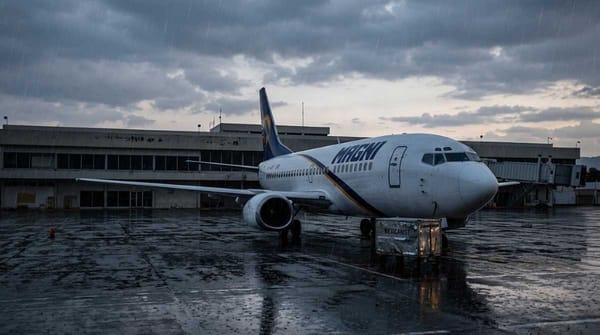
GONE DARK: Mexico's 'Tourist Airline' Just Pulled the Plug on All Its Flights. 'Logistical Problems,' They Say. Sure.
Mexico's 'Tourist Airline' just vanished. Five Boeing 737-300s, all parked. Twenty-seven destinations, all dark. Thousands of passengers holding worthless tickets. The official reason: 'logistical problems.'

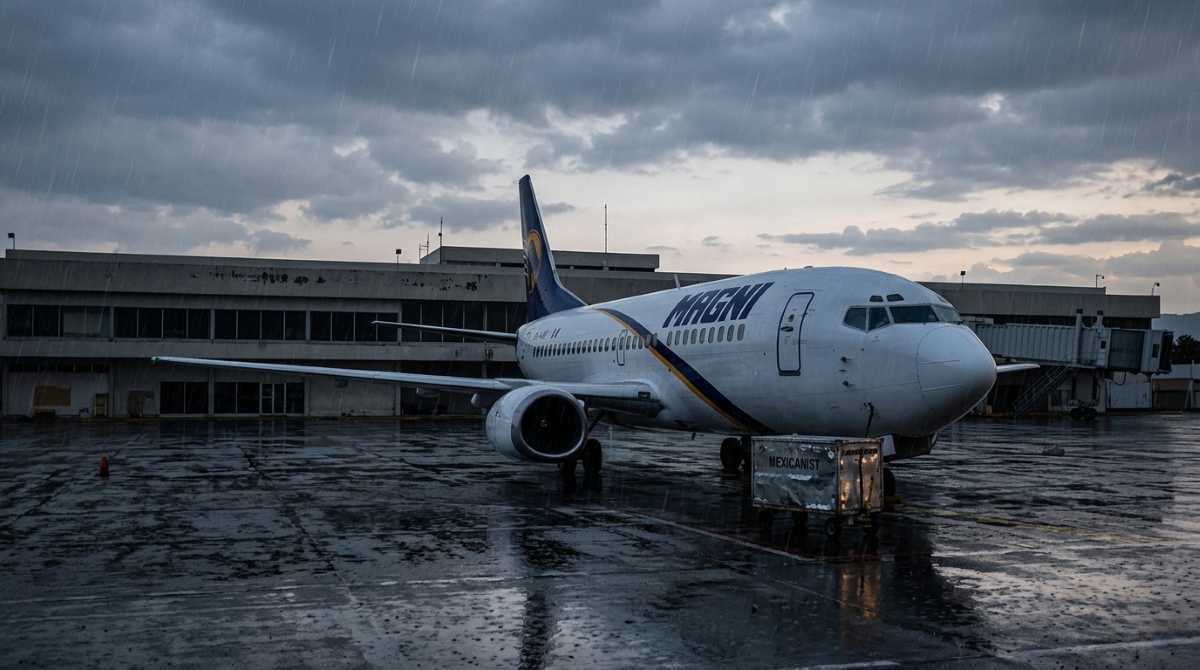
On Saturday, April 11, Magnicharters — 'La Aerolínea Turística de México' — announced it was grounding its entire fleet for two weeks. No warning. No details. Just a phone number and an apology. In a country where tourism is the second-largest GDP contributor and Cancún alone handles 29 million passengers a year, an airline vanishing overnight isn't an inconvenience. It's a symptom.
What We Know (which Isn't Much, and That's the Story)
Saturday, April 11, 2026. Mexico City. Magnicharters issues an official communiqué — the kind that's usually written by lawyers at 2 AM with a bottle of tequila within arm's reach.
The statement, as reported by the Diario de Quintana Roo, says the airline is 'suspending all scheduled air operations for the next two weeks due to logistical problems that prevent compliance with itineraries.'
That's it. That's the whole explanation. 'Logistical problems.' The airline equivalent of a teenager saying 'stuff came up.'
The communiqué continues: Magnicharters 'is working with due diligence to resolve the inconveniences and normalize service as soon as possible.' Inconveniences. As if grounding your entire fleet and stranding thousands of ticketed passengers across 27 destinations is a minor scheduling hiccup.
The airline — which the statement reminds us has '30 years in the national market' and has 'striven to provide the best standards of quality, comfort, and security' — left affected customers with exactly one lifeline: a customer service phone number. 55-5141-1351. Good luck getting through.
What 'Logistical Problems' Actually Means
Here's the thing about airline communications: when everything is fine, they tell you it's fine. When something is wrong but fixable, they name the problem — weather, technical issue, crew scheduling. When they say 'logistical problems' with zero specificity? That's corporate code for 'we can't tell you the real reason because either (a) it's embarrassing, (b) it's legal, or (c) we don't fully understand it ourselves yet.'
In the airline industry, 'logistical problems' is the Swiss Army knife of corporate euphemisms. It can mean:
· We can't afford fuel
· Our planes failed safety inspections
· Our maintenance contractor walked away
· The AFAC (Mexico's civil aviation authority) told us to park it
· We're out of money and don't want to say 'bankruptcy' out loud
Any of these. All of these. Take your pick. The airline isn't saying, which means you should assume the worst until proven otherwise.
The Airline You've Never Heard of That Flies Your Neighbor to Cancún
Let's back up. If you're not Mexican, you've probably never heard of Magnicharters. That's fine — they weren't flying to JFK. But in Mexico's domestic tourism market, they're a fixture. Here's the resume:
· Founded: 1994 by the Bojórquez family, originally as the in-house airline for travel agency Magnitur (est. 1984)
· First flight: January 1995
· Fleet: 5 Boeing 737-300s, each configured for 140 passengers
· Destinations: 27, including Cancún, Cozumel, Huatulco, Puerto Vallarta, Los Cabos, Mérida, Acapulco, and others
· Operating bases: Mexico City (AICM) and Monterrey
· Also listed as an operating base at Cancún International Airport — Mexico's second-busiest
· Claim to fame: First Mexican airline to hire a woman pilot. Also, Lucha Libre liveries in 2017. Seriously.
· Parent: Grupo Aéreo Monterrey S.A. de C.V.
Magnicharters is what aviation people call a 'niche leisure carrier.' They don't do business routes. They don't do connecting hubs. They fly Mexicans to beaches. That's the entire business model. Mexico City to Cancún. Monterrey to Puerto Vallarta. León to Huatulco. Package tourism on wings.
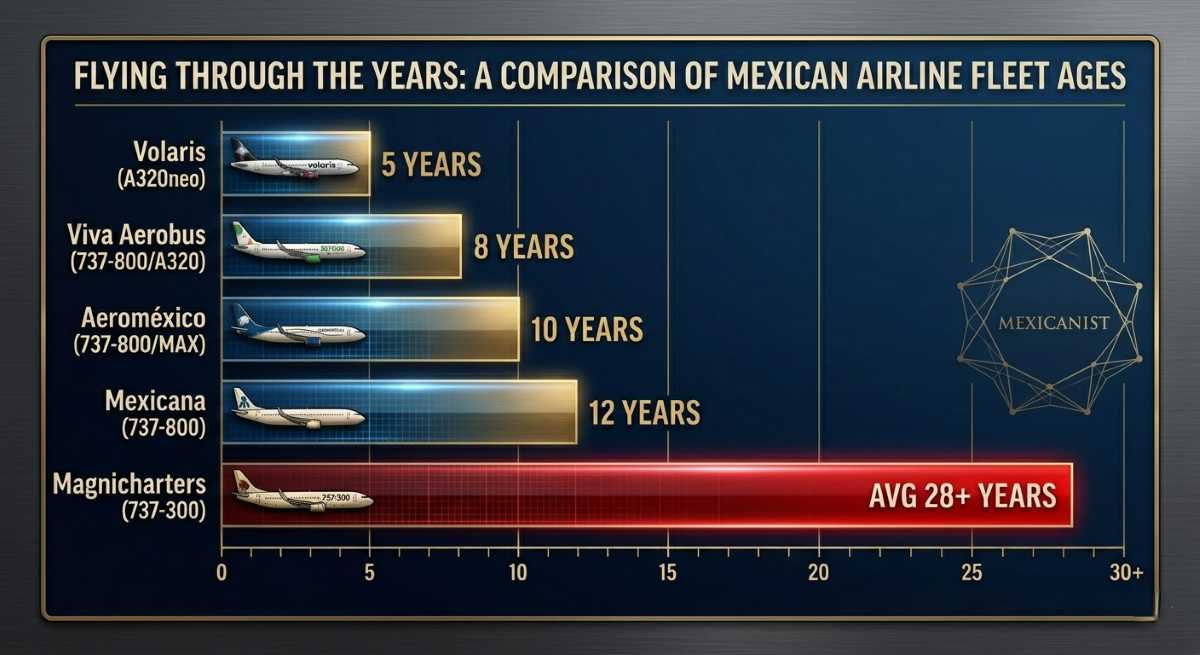
It's a good business when it works. Mexico's domestic tourism market is massive — the country is the 6th-most-visited on Earth, and a huge chunk of that is Mexicans visiting their own coastline. The problem is: it's a terrible business when your planes are 25+ years old and your competitors fly Airbus A320neos.
Five Planes Older Than Your Nephew
Let's talk about those five Boeing 737-300s.
The Boeing 737-300 is what aviation nerds call a '737 Classic.' It entered service in December 1984 with Southwest Airlines. Production ended in the year 2000. Boeing built 1,113 of them. Most major airlines retired theirs a decade ago.
Magnicharters' fleet of five is — and this is an educated estimate based on the secondary market where these aircraft circulate — between 25 and 35 years old. Each.
For context: Southwest Airlines, the world's largest 737 operator, retired its last 737-300 in September 2017. That's NINE YEARS AGO. They moved to the 737-700, -800, and MAX. United, American, Delta — all gone from the -300 years ago. The aircraft is so old that Boeing stopped making parts for it.
Now, old planes don't automatically mean unsafe planes. Aviation maintenance is rigorous, and a well-maintained 35-year-old airframe is perfectly capable of safe flight. But 'well-maintained' costs money. A LOT of money. And that maintenance gets more expensive every year as parts get scarcer and mechanics who know the systems retire.
Magnicharters' Safety Record
And here's where it gets spicy. The 737 Classics in Magnicharters colors have had, shall we say, some memorable moments:
· September 14, 2007: Landing gear collapse on Flight 582 at Guadalajara. Boeing 737-200 (XA-MAC), arriving from Cancún with 103 passengers and 6 crew. Engine fire after crash. Everyone evacuated. No fatalities, but that's a career's worth of excitement in one landing.
· April 27, 2009: ANOTHER landing gear failure on Flight 585. Same route (Cancún-Guadalajara), same result: belly landing. Boeing 737-200 (XA-MAF), 108 passengers, 8 crew. No serious injuries. Two gear failures in 20 months on the same route. At some point, it's not luck — it's a pattern.
· November 26, 2015: Landing gear problem on a 737-300. Left main leg failed — structural failure, not just a collapsed gear. Aircraft swerved. No injuries.
· December 2014: Pilot fired for letting singer Esmeralda Ugalde sit in the pilot's seat and pose with the controls during a commercial flight. She posted photos on Twitter. The pilot was not, shall we say, a stickler for protocol.
· December 2014: PROFECO (Mexico's consumer protection agency) suspended Magnicharters' commercial operations for failing to publicly disclose its pricing. Hidden fares. On an airline. In 2014.
So we have: an aging fleet, multiple gear failures, a pilot discipline problem, a consumer protection suspension, and now a sudden two-week grounding for 'logistical problems.' If this were a dating profile, you'd swipe left so hard your phone would crack.
A Tradition of Spectacular Collapses
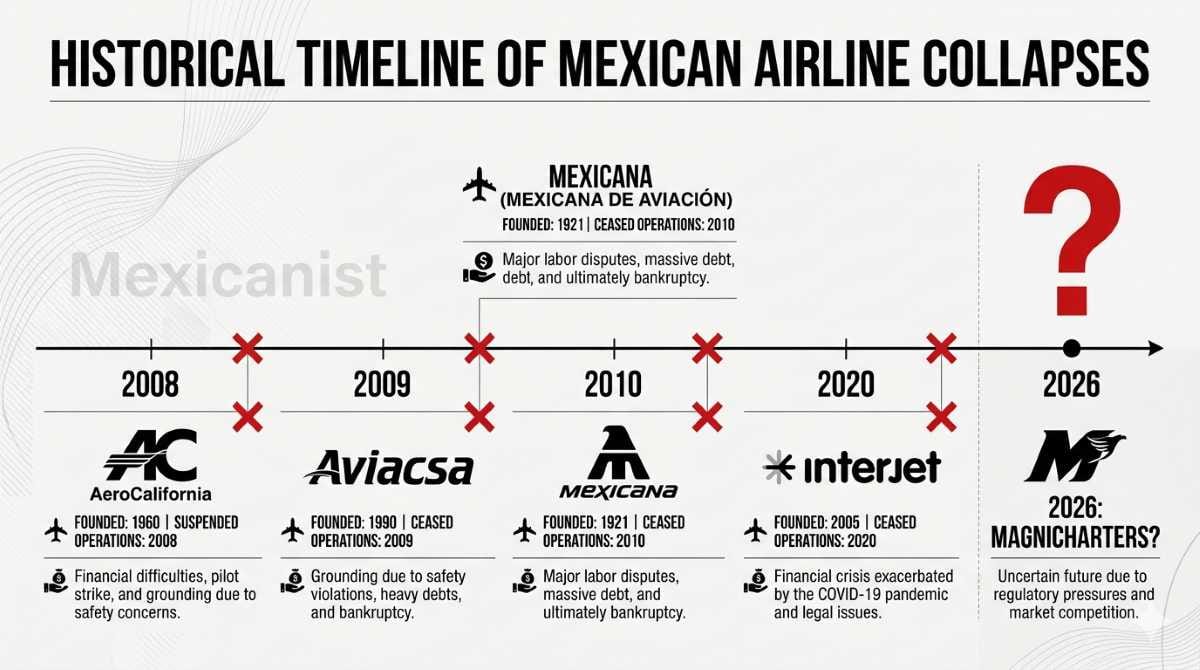
Here's the thing about Mexican aviation: airlines don't quietly fade away. They explode. In slow motion. On live television. With passengers still holding boarding passes.
Mexicana de Aviación (1921–2010).
The granddaddy of them all. Mexico's flag carrier, founded in 1921 — the fourth-oldest continuously named airline in the world. Operated for 89 years. Member of Oneworld. Then, in August 2010: bankruptcy. Operations suspended overnight. 69 aircraft grounded. Thousands stranded. The company filed for Concurso Mercantil (Mexican Chapter 11) and US Chapter 15. Assets liquidated in 2014. Brand bought by the Mexican government in 2023, relaunched under military management as a state airline — which, as of 2026, is still trying to figure out what it is.
If Mexicana can die, anyone can. That's the lesson.
Interjet (2005–2020).
The 'JetBlue of Mexico' — their words. Operated Airbus A320s and Russian Sukhoi Superjets (yes, really). By 2018, they were cannibalizing four Superjets for parts to keep the others flying. By 2020, they couldn't pay for fuel. Cancelled all flights on November 1. Then again in December. Stranded passengers at Cancún airport paid up to 5,000 pesos ($250) for last-minute tickets on other airlines. PROFECO had to step in. IATA suspended them. The website went dark. The airline simply... ceased to exist.
Sound familiar? 'Logistical problems.' 'Working to normalize service.' Two-week suspension. Interjet said all the same things.
Aerocalifornia, Aladia, Aviacsa, Aero California...
The list of defunct Mexican airlines reads like a war memorial. Each one followed the same pattern: financial trouble → vague public statements → sudden cancellations → PROFECO complaints → government intervention → collapse. The playbook is well-established. Magnicharters is on page three.
Mexico's Airline Body Count (Recent)
Airline | Operated | Fleet at Peak | How It Died |
Mexicana de Aviación | 1921–2010 (89 yrs) | 69 aircraft | Bankruptcy, overnight suspension |
Interjet | 2005–2020 (15 yrs) | ~80 aircraft | Fuel debts, IATA suspension, collapse |
Aerocalifornia | 1960–2008 (48 yrs) | ~25 DC-9s | Safety violations, fleet grounding |
Aviacsa | 1990–2009 (19 yrs) | ~25 737s | Debt, AFAC grounded fleet |
Aladia | 2006–2008 (2 yrs) | ~5 aircraft | Never profitable, collapsed |
Magnicharters has been flying since 1995. That's 31 years. Impressive longevity by Mexican airline standards. But longevity is not a guarantee of survival — Mexicana had 89 years and still imploded.

The $22 Billion Question
Let's put some numbers on the table, because this isn't just about one small airline.
Mexico's Tourism Numbers.
· Mexico is the 6th-most-visited country on Earth (UNWTO)
· Tourism is the second-largest contributor to Mexico's GDP
· Quintana Roo's GDP: MXN $447 billion (~US$22.2 billion, 2022)
· Quintana Roo population: 1,857,985 (2020 census)
· Cancún International Airport: 29.3 million passengers in 2025, making it Mexico's #2 and Latin America's busiest for international traffic
· Of those 29.3 million: 19.4 million were international passengers
Magnicharters sits at the intersection of two critical flows:
· Domestic tourism: flying Mexicans from Mexico City, Monterrey, León, Querétaro, Guadalajara, and Chihuahua to Cancún, Cozumel, Huatulco, Puerto Vallarta, and Los Cabos
· Tourism connectivity: these are not luxury travelers flying Aeroméxico business class. These are middle-class Mexican families going to the beach. Price-sensitive. Brand-loyal. And now holding worthless tickets.
When Magnicharters goes dark, the ripple effects are immediate:
· Hotels lose bookings (these are often package-deal travelers)
· Ground transportation loses fares
· Restaurants, tours, activities lose revenue
· Competing airlines (Volaris, Viva) can price-gouge stranded passengers
· Consumer confidence in Mexican domestic aviation takes another hit
ASUR — the airport operator that runs Cancún, Cozumel, and seven other southeastern airports — reported US$1.68 billion in revenue for 2024 with net income of US$753 million. Cancún alone handles 29.3 million passengers. Every airline that parks its planes at Cancún is a revenue contributor. When one disappears, even a small one, the ecosystem feels it.
Four Theories Ranked by Plausibility
Theory 1: Regulatory Grounding (Probability: HIGH).
The AFAC (Agencia Federal de Aviación Civil) may have effectively grounded the fleet. Mexico's aviation regulator has been under enormous pressure from the US FAA, which downgraded Mexico to Category 2 from May 2021 to September 2023 — a move that barred Mexican airlines from launching new US routes. The Category 2 downgrade forced Mexico to clean up its oversight. AFAC has been more aggressive since. If Magnicharters' 25-35-year-old 737-300s failed inspections, AFAC could have pulled the airline's operating certificate until compliance is met. The airline calls it 'logistical problems.' AFAC calls it 'safety.' Tomato, tomahto.
Theory 2: Financial Distress (Probability: HIGH).
Five planes. Twenty-seven destinations. A business model built on package tourism in a post-COVID world where costs are up, competition is fierce (Volaris and Viva fly newer, more efficient A320s and 737 MAXes), and fuel prices have been volatile. Magnicharters' revenue per seat-mile is almost certainly lower than its competitors' because its aircraft burn more fuel and require more maintenance. If the Bojórquez family can't inject capital — and there's no indication of external investment in years — the math eventually stops working.
Here's the Interjet comparison that should worry everyone: Interjet also cited 'operational difficulties' before its collapse. It also couldn't pay for fuel. It also left passengers stranded at Cancún. The pattern is well-documented.
Theory 3: Maintenance Crisis (Probability: MEDIUM-HIGH).
Boeing 737-300 parts are getting scarce. The aircraft hasn't been in production since 2000. Maintenance providers are winding down Classic support. A single airworthiness directive (AD) — a mandatory safety fix issued by regulators — could ground an aircraft for weeks if parts aren't available. If Magnicharters received multiple ADs simultaneously, or if their maintenance provider walked away, 'logistical problems' would be an accurate (if dishonestly vague) description.
Theory 4: Strategic Pause / Restructuring (Probability: LOW-MEDIUM).
The most optimistic reading: the airline is using a quiet period (post-Easter, pre-summer) to restructure operations, renegotiate contracts, or arrange financing. Two weeks is oddly specific — long enough to be disruptive, short enough to suggest they expect to return. But airlines that announce 'two-week suspensions' have a nasty habit of extending them. Indefinitely.
What to Watch
1. Does the Two-Week Deadline Hold?
If Magnicharters is back in the air by April 25, this might genuinely be a logistics hiccup. If the suspension extends — even by a day — assume the worst. Extended suspensions in the airline business are like extended goodbyes: they usually end with someone crying.
2. Does AFAC Issue a Statement?
If the regulator is involved, they'll have to say something. If AFAC is silent, it's either not a regulatory issue (which means it's financial — worse) or AFAC is negotiating behind closed doors (which means it's regulatory — also bad). Silence is not reassuring.
3. What Happens at PROFECO?
Mexico's consumer protection agency is the canary in this particular coalmine. When Interjet collapsed, PROFECO was the first government agency to publicly advise passengers not to book. If PROFECO issues a warning about Magnicharters, start writing the obituary.
4. Does the Bojórquez Family Speak?
The family has run this airline for 31 years. If the founders go quiet — no interviews, no social media, no public appearances — that's a very bad sign. Visible leadership during a crisis is crisis management 101. Invisible leadership means the lawyers have taken over.
5. What Do Competitors Do?
Watch Volaris and Viva. If they launch emergency capacity on Magnicharters routes (Mexico City-Cancún, Monterrey-Cancún) within days, they know something the public doesn't. Competitors always smell blood first.
6. The Aircraft.
Flight tracking sites (FlightRadar24, FlightAware) will show whether Magnicharters' five 737-300s are actually parked. If they've been ferried to maintenance bases or, worse, to aircraft boneyards, the story writes itself.
Mexico's Aviation Market Is a Mess
Zoom out. Magnicharters is a symptom, not the disease.
Mexico's aviation market has structural problems that no single airline can fix:
· Fleet age: Mexican airlines operate some of the oldest commercial aircraft in Latin America. The Boeing 737 Classics, the Airbus A319s approaching 20 years, the cargo aircraft older than their pilots — it's a geriatric fleet held together by mechanic's tape and prayer.
· Regulatory whiplash: The FAA's Category 2 downgrade (2021-2023) was a humiliation. It was lifted, but the underlying weaknesses — insufficient safety oversight, under-resourced regulators — haven't been fully addressed.
· Competition: Volaris and Viva (now merged under the Viva brand) dominate the low-cost market with newer aircraft and better economics. Mid-tier carriers like Magnicharters are squeezed between the budget giants and the full-service Aeroméxico. There's no room for a 5-plane airline with 30-year-old Boeing 737s.
· State-owned disruption: The relaunch of Mexicana de Aviación as a military-run state airline adds a wild card. If the government subsidizes Mexicana to compete on domestic routes, it distorts the market further. Private airlines die while the state airline loses money with impunity.
· Infrastructure: Mexico City's airport situation is a saga unto itself. AICM is at capacity. AIFA (Felipe Ángeles) is underused. The Tren Maya was supposed to help but is running behind projections. Connectivity is fragile, and when one piece breaks, the whole network stumbles.
The Mexican airline graveyard keeps growing. Magnicharters might survive this. But the pattern — old fleet, vague excuses, sudden grounding, stranded passengers — is the same sequence that preceded every collapse in the last two decades. The only question is whether this is the intermission or the final act.
A 31-year-old Mexican airline with five aircraft older than most Millennials just grounded its entire fleet with zero warning and one sentence of explanation. In a country where tourism drives the economy and airline collapses are practically a tradition, 'logistical problems' doesn't pass the sniff test.
The smart money says one of three things: (1) AFAC found something that scared them, (2) the maintenance bill came due and nobody could pay it, or (3) the Bojórquez family is deciding whether to fund another decade or fold.
Two weeks. That's what they promised. The clock is ticking. And in Mexican aviation, when the clock stops, it usually doesn't restart.
SOURCES
1. Diario de Quintana Roo — April 12, 2026, Year XL, No. 13,764 — Primary source: Magnicharters official communiqué, suspension announcement, page 1 and page 3A. https://www.dqr.com.mx
2. Magnicharters — Wikipedia — Founded 1994, fleet of 5 Boeing 737-300, 27 destinations, operating bases Mexico City and Monterrey. IATA: UJ, ICAO: GMT. https://en.wikipedia.org/wiki/Magnicharters
3. Boeing 737 Classic — Wikipedia — 737-300 entered service December 1984, production ended 2000. 1,113 -300s built. Magnicharters fleet configured for 140 passengers. https://en.wikipedia.org/wiki/Boeing_737_Classic
4. Cancún International Airport — Wikipedia (citing ASUR data) — 29,345,538 passengers in 2025 (19.4M international). Mexico's second-busiest airport. Magnicharters listed as operating base. https://en.wikipedia.org/wiki/Canc%C3%BAn_International_Airport
5. Grupo Aeroportuario del Sureste (ASUR) — Wikipedia (citing annual report) — Revenue US$1.68 billion (2024), net income US$753 million. Operates 9 airports in SE Mexico. https://en.wikipedia.org/wiki/Grupo_Aeroportuario_del_Sureste
6. Quintana Roo — Wikipedia (citing INEGI 2020) — Population 1,857,985. GDP MXN 447 billion (US$22.2 billion, 2022). https://en.wikipedia.org/wiki/Quintana_Roo
7. Tourism in Mexico — Wikipedia (citing UNWTO) — Mexico ranked 6th most-visited country globally. Tourism is second-largest GDP contributor. https://en.wikipedia.org/wiki/Tourism_in_Mexico
8. Interjet — Wikipedia — Ceased operations December 2020. Fuel debt, IATA suspension, cannibalized Sukhoi Superjets for parts. Stranded passengers at Cancún. https://en.wikipedia.org/wiki/Interjet
9. Mexicana de Aviación (1921–2010) — Wikipedia — 89 years of operation, bankruptcy August 2010, assets liquidated 2014. Brand relaunched by government 2023 under SEDENA. https://en.wikipedia.org/wiki/Mexicana_de_Aviaci%C3%B3n_(1921%E2%80%932010)
10. List of Airlines of Mexico — Wikipedia — Active carriers: Aeroméxico, Volaris, Viva, Magnicharters, Mexicana (state), TAR, Aerus, Señor Air, others. https://en.wikipedia.org/wiki/List_of_airlines_of_Mexico
11. Aviation Safety Network — Magnicharters incidents: Flight 582 (Sept 2007, gear collapse), Flight 585 (April 2009, belly landing), November 2015 gear failure. https://aviation-safety.net
12. PROFECO / DQR Archives — December 2014 PROFECO suspension of Magnicharters for undisclosed pricing. Pilot incident same month (Esmeralda Ugalde cockpit photo). https://www.profeco.gob.mx