Infrasound: The 18 Hz Frequency That Makes People See Ghosts
There is a frequency so low your ears cannot detect it—but your eyeballs can vibrate to it. Around 18 Hz, infrasound triggers nausea, dread, and visual distortions that look exactly like ghost sightings. And it is passing through your walls right now.


It was late. The lab was empty. The machines were off. And Vic Tandy—a level-headed British engineer with zero time for the supernatural—was absolutely convinced he was about to die.
This was the mid-1980s, in a medical equipment factory in Warwick, England. Tandy was working late, alone, when a cold sweat broke across his skin. A sickening wave of dread rolled through his chest like a slow tide. The air felt thick, heavy, wrong. And then, at the very edge of his peripheral vision, he saw it: a shapeless grey figure, hovering between him and the door. It had no face, no features—just a smudge of presence that radiated malice. When Tandy whipped around to confront it, the apparition dissolved into nothing.
He didn’t sleep that night. But Tandy was an engineer, not a mystic, and by morning he’d started looking for a mechanical explanation. What he eventually found would rewrite our understanding of so-called haunted places, launch a new field of acoustic psychology, and accidentally confirm something the military had been quietly researching for years: there is a frequency of sound so low you cannot hear it, so powerful it can make your eyeballs vibrate, and so deeply unsettling it can produce symptoms indistinguishable from a full-blown paranormal encounter. That frequency is roughly 18 Hz. And it is everywhere.
This is the story of infrasound—the invisible, inaudible vibration that lives below the floor of human hearing. It travels through walls, across oceans, and through solid rock. It is generated by earthquakes, wind turbines, ocean storms, and the very organ pipes in centuries-old cathedrals. It has been weaponized by militaries, blamed for mass hysteria, and documented in peer-reviewed journals as a cause of anxiety, nausea, hallucination, and dread. Most people have never heard of it. But infrasound has been messing with your body your entire life, and you never knew.
The Audible Floor and What Lies Beneath
Human hearing is remarkably limited. We occupy a slim acoustic band between roughly 20 Hz and 20,000 Hz—a tiny slice of the enormous spectrum of vibrational energy that surrounds us at all times. Above 20 kHz lies ultrasound, the province of bats, dolphins, and medical imaging. But below 20 Hz, in the rumbling darkness beneath audibility, lies infrasound: sound waves so long, so slow, and so low that your ears simply cannot process them. The wavelengths stretch from 17 meters (at 20 Hz) to kilometers in length at the lowest frequencies, making them physical forces as much as acoustic phenomena.
The scientific definition is straightforward: infrasound refers to any sound wave with a frequency below the lower limit of human audibility, typically 20 Hz. In practice, researchers study infrasound from about 0.001 Hz (one cycle every 1,000 seconds) up to roughly 19 Hz. These waves are not silent in the sense that they carry no energy; they are packed with physical power. At sufficient amplitude, infrasound can rattle buildings, vibrate internal organs, and create profound physiological responses in living tissue. The problem is that you cannot hear it coming.
The concept was first formally identified in the 19th century, though humans have likely felt the effects of low-frequency vibrations for millennia. Early scientists including the English polymath John Tyndall studied infrasonic phenomena in the context of laboratory acoustics and atmospheric science. But it was not until the mid-20th century, with the advent of more sensitive microphones and pressure sensors, that infrasound became a serious subject of scientific inquiry. During the Cold War, both the United States and the Soviet Union invested heavily in infrasound detection technology as a means of monitoring nuclear explosions across vast distances—a capability that remains central to the Comprehensive Nuclear-Test-Ban Treaty's International Monitoring System today.
Here is where infrasound gets genuinely unsettling. Even though your ears cannot detect frequencies below 20 Hz, your body absolutely can. The human body is roughly 60 percent water, and water is an excellent conductor of vibrational energy. When an infrasonic wave passes through your body, it physically displaces tissue, oscillates organs, and stimulates mechanoreceptors embedded throughout your skeletal system, your inner ear (specifically the vestibular system responsible for balance), and even your skin. The result is a sensation that is felt rather than heard—a subliminal throb that can register as pressure in the chest, vibration in the stomach, or an inexplicable sense of unease.
Scientists at the French National Centre for Scientific Research (CNRS) have described infrasound as“sound waves that nothing can stop.”Because of their enormous wavelengths, infrasonic waves are absorbed far less by the atmosphere than audible sound. They diffract around obstacles, pass through walls and solid ground, and can propagate over thousands of kilometers with relatively little energy loss. Ocean swells generate continuous infrasound around 0.5 Hz with wavelengths on the order of a kilometer. Earthquakes shake the planet with infrasonic energy from 0.01 Hz to tens of Hertz. Volcanic eruptions, thunderstorms, and even the collective motion of massive weather systems pump infrasound into the atmosphere around the clock. You are, at this very moment, being bathed in a sea of inaudible vibration.

18 Hz and the Science of Haunting
Let us return to that haunted laboratory in Warwick. After his terrifying nocturnal encounter, Vic Tandy—then an engineer and part-time lecturer at Coventry University—began a systematic investigation. He noticed something odd: a foil blade on his desk was vibrating ever so slightly. As an engineer, he recognized the signature of a standing wave—a pattern of resonance created when a sound wave bounces between two parallel surfaces and reinforces itself. Using a frequency analyzer, Tandy traced the source to a recently installed extractor fan in the lab, which was producing a steady, silent tone at precisely 18.98 Hz.
The frequency was a near-perfect match for the resonant frequency of the human eyeball. At roughly 19 Hz, the vitreous humor—the gel-like substance filling the eye—begins to oscillate, causing the eyeball itself to vibrate at a microscopic but perceptible level. This vibration produces a smearing effect at the edges of your visual field, exactly where peripheral vision is most sensitive to motion. The result is an optical illusion: a grey, indistinct blur that appears at the periphery of your vision and vanishes when you turn to look at it directly—precisely the behavior attributed to ghostly apparitions across centuries of folklore.
Tandy published his findings in 1998 in the prestigious Journal of the Society for Psychical Research, co-authored with psychologist Dr. Tony Lawrence, under the title“The Ghost in the Machine.”The paper argued that a 19 Hz standing wave, under the right physical conditions, could create sensory phenomena“suggestive of a ghost.”It was not claiming that all ghost sightings were acoustic illusions—but it demonstrated, with hard engineering data, that at least some reports of paranormal activity could be explained by entirely natural, measurable physical forces. The paper sent shockwaves through both the scientific and paranormal communities and remains one of the most widely cited studies in the field of acoustic psychology.
If Tandy’s lab experiment was intriguing, what happened next was definitive. In 2003, psychologist Richard Wiseman (now Britain’s first Professor of the Public Understanding of Psychology) teamed up with composer and engineer Sarah Angliss to stage one of the most unusual experiments in the history of music. They organized two contemporary music concerts at London’s Purcell Room, and secretly laced four of the musical pieces with infrasound at frequencies below 20 Hz—sound that was physically present but completely inaudible to the audience.
The audience of approximately 750 people did not know which pieces contained infrasound. After each performance, they were asked to complete questionnaires about their emotional and physical state. The results were striking: during the infrasound-laced pieces, audience members reported 22 percent more“unusual experiences”than during the control pieces. These experiences included“shivering on my wrist,” “an odd feeling in the stomach,” “a sense of coldness,” “nervous feelings of revulsion or fear,” “deep sorrow,”and“an increased heart rate.”The experiment was double-blind—even the physicists monitoring the equipment did not know which pieces contained infrasound until after the concert. As Wiseman told the British Association science conference:“These results suggest that low-frequency sound can cause people to have unusual experiences even though they cannot consciously detect infrasound.”
The implications were profound. Here was controlled, peer-reviewed evidence that infrasound could alter human perception and emotion in a measurable, reproducible way—without the subjects having any conscious awareness that they were being exposed to anything unusual. It was not suggestion, not hypnosis, not the power of imagination. It was raw physics acting on biology, producing genuine subjective experiences of dread, sorrow, and anomalous perception.
What 18 Hz Actually Does to You
The physiological effects of infrasound exposure have been documented across dozens of studies and span a wide range of systems in the human body. The research paints a picture of a stimulus that does not merely annoy—it infiltrates.
Vestibular disruption: The vestibular system in the inner ear, which governs balance and spatial orientation, is acutely sensitive to low-frequency vibration. Infrasound can overstimulate vestibular hair cells, producing dizziness, vertigo, and a generalized sense of unsteadiness. This is why many people exposed to infrasound report feeling“off-balance”or describe the room as“spinning”even when standing still.
Cardiovascular stress: A major peer-reviewed study published in 2021 in Frontiers in Public Health found that exposure to infrasound above 100 dB“negatively interferes with cardiac function, even as soon as one hour after exposure.”The mechanism involves calcium metabolism disruption, mitochondrial damage, and oxidative stress in cardiomyocytes (heart muscle cells). The research group recommended setting the maximum tolerable limit for chronic infrasound exposure at no higher than 80 dB—a standard that many industrial and environmental settings currently exceed.
Anxiety, dread, and depression: Multiple studies have linked infrasound exposure to elevated cortisol levels, increased anxiety, and mood disturbance. The hypothalamic-pituitary-adrenal (HPA) axis—the body’s central stress response system—appears to be activated by infrasonic stimulation, producing a neurochemical stress response even in the absence of any conscious threat perception. Subjects exposed to infrasound in laboratory settings consistently report feelings of unease, foreboding, and an inexplicable sense that“something is wrong.”
Respiratory effects: Research by Jürgen Altmann at Dortmund University documented that exposure to low-frequency sound between 50 and 100 Hz (bordering the infrasonic range) caused chest-wall vibration and respiratory rhythm changes in human subjects, accompanied by sensations of“hypopharyngeal fullness”—essentially, a gagging reflex. At higher amplitudes in the infrasonic range, these respiratory effects intensify, producing shortness of breath and a feeling of pressure in the chest.
Visual disturbances: As Tandy demonstrated, frequencies near 18–19 Hz can cause the human eyeball to resonate, producing peripheral visual smearing, optical distortion, and the perception of movement or apparitions at the edge of the visual field. NASA reports have corroborated that whole-body vibration in this frequency range can produce comparable visual anomalies.
A Brief History of Acoustic Weaponry
The idea that sound itself could be weaponized is ancient—from the biblical trumpets of Jericho to the terrifying war drums of indigenous armies designed to induce panic before a single arrow was fired. But the systematic military exploitation of low-frequency sound is a distinctly modern phenomenon, rooted in the acoustic science that emerged during and after the Second World War.
During the Cold War, both American and Soviet research programs explored the potential of infrasonic weapons. Soviet scientists were rumored to have developed a“focusing infrasound device”capable of producing a beam of low-frequency energy powerful enough to cause nausea, disorientation, and even organ damage at considerable range. These claims were never independently verified, and many were likely exaggerated for propaganda purposes, but they reflected a genuine scientific interest in the area. In the United States, the Department of Defense funded studies into the bioeffects of low-frequency sound exposure, focusing on thresholds for discomfort, incapacitation, and tissue damage.
The reality, according to the most comprehensive assessment to date—a detailed analysis published in the journal Military Medicine in 2007—is that true infrasonic weapons have never been successfully fielded. The physics of generating focused, directional beams of infrasound at lethal or incapacitating levels are extraordinarily challenging. Infrasonic wavelengths are simply too long to be easily directed or contained; the energy tends to spread in all directions rather than forming a coherent beam. As the authors concluded:“The potential for weaponization of acoustic devices has likely been overstated.”That said, the report acknowledged that acoustic devices operating in the low-frequency (not strictly infrasonic) range had practical applications for crowd control and communication.
The LRAD
The most prominent acoustic device in contemporary military and law enforcement use is not technically an infrasonic weapon at all—it is the Long Range Acoustic Device (LRAD), developed by the LRAD Corporation in the early 2000s. Originally designed for the U.S. Navy as a long-range hailing and communication tool, the LRAD is essentially a highly directional speaker array capable of projecting intelligible voice commands or ear-splitting alarm tones over distances exceeding 500 meters. At maximum output, it can produce sound pressure levels of up to 160 dB at one meter—enough to cause permanent hearing damage at close range.
The LRAD operates primarily in the audible range (roughly 2–5 kHz for voice, with deterrent tones spanning a broader spectrum), not in the infrasonic band. However, it has been frequently and inaccurately described in media reports as an“infrasonic weapon”or“sonic cannon.”The device has been deployed by U.S. forces in Iraq and Afghanistan, by commercial shipping companies as an anti-piracy measure off the Horn of Africa, and by police departments around the world for crowd control—including at the 2004 Republican National Convention in New York City, the 2009 G20 summit in Pittsburgh, and numerous Black Lives Matter protests.
The MoMA in New York included the LRAD in its 2013“Design and Violence”exhibition, noting that it represented a“niche device specifically developed for the U.S. military and law enforcement agencies”and tracing its conceptual lineage to the psychological warfare operations of the Vietnam era, where loudspeakers were used to broadcast unsettling sounds into enemy territory. Critics argue that the LRAD’s capacity to cause permanent hearing loss at close range makes it a violation of international norms against weapons that cause superfluous injury or unnecessary suffering.
The Havana Syndrome
No discussion of acoustic weapons and mysterious sound would be complete without the bizarre saga of“Havana Syndrome.”Beginning in late 2016, American and Canadian diplomats stationed in Havana began reporting a constellation of alarming symptoms: persistent headaches, dizziness, cognitive fog, nausea, insomnia, tinnitus, and difficulty concentrating. Several victims described hearing a strange, localized high-pitched sound—variously described as“grinding,” “buzzing,”or“mechanical.”By 2017, the U.S. State Department had evacuated multiple staff and expelled Cuban diplomats, alleging a deliberate“sonic attack.”
The media frenzy was immediate. Headlines around the world screamed about“sonic weapons”and“acoustic attacks.”But the scientific community was deeply skeptical from the outset. In February 2018, Scientific American published a detailed analysis concluding that“‘sonic weapon attacks’on U.S. Embassy don’t add up—for anyone.”A study published in the Journal of the Royal Society of Medicine pointed out that a genuine acoustic weapon powerful enough to cause brain damage from outside a building would also be powerful enough to shatter windows and deafen anyone nearby. No evidence of such destructive acoustic energy was ever found.
Subsequent investigations by the U.S. intelligence community, including a comprehensive assessment released in 2023, found no evidence that any foreign power had used an acoustic weapon against U.S. personnel. The leading explanations now include mass psychogenic illness (a well-documented phenomenon in which stress and suggestion produce real physical symptoms that spread through a social group), pre-existing conditions, conventional environmental factors, and the nocebo effect (the inverse of the placebo effect, in which the expectation of harm produces real symptoms). While the Havana Syndrome cases remain deeply serious for those affected, they serve as a cautionary tale about the gap between public perception and scientific evidence when it comes to the mysteries of sound.
Earthquakes, Volcanoes, and the Planet
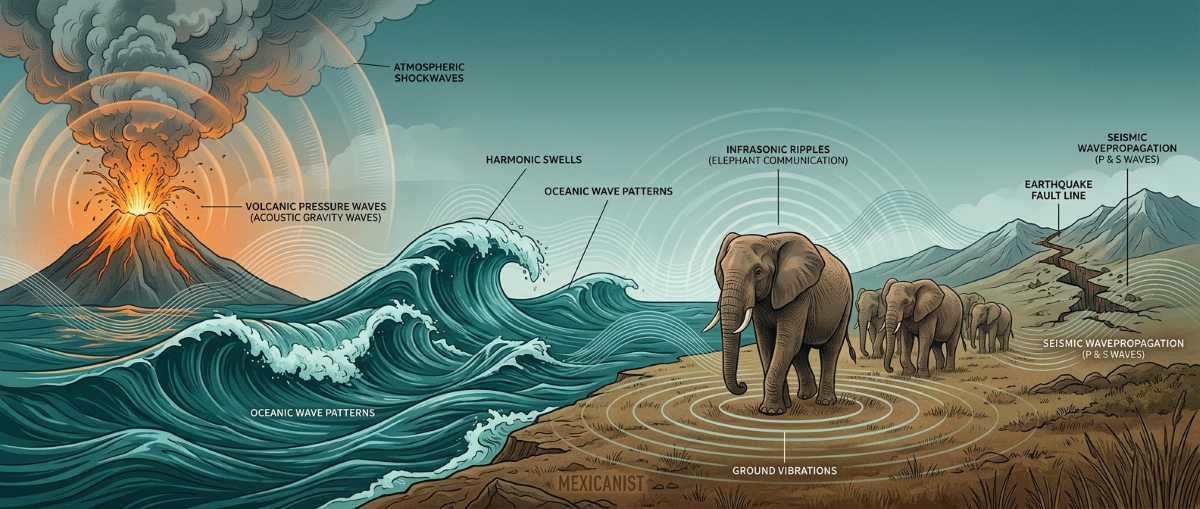
The Earth itself is one of the most powerful sources of infrasound on the planet. When tectonic plates shift along a fault line, the resulting earthquake generates seismic waves with frequencies ranging from 0.01 Hz up to several tens of Hertz, with the most common energy concentrated between 2 and 8 Hz. These waves travel through the Earth’s crust and can be detected by sensitive instruments on the far side of the globe. Strong earthquakes can produce infrasonic signals that last for several hours, with surface waves exhibiting long, dispersive trains of energy that propagate over enormous distances.
Volcanic eruptions are even more dramatic sources of infrasound. The 1883 eruption of Krakatoa in Indonesia generated an infrasonic pressure wave that circled the Earth at least four times—a feat recorded by barographs worldwide and still cited as one of the most powerful acoustic events in recorded history. Modern infrasound monitoring stations, maintained by the Comprehensive Nuclear-Test-Ban Treaty Organization, regularly detect volcanic eruptions, avalanches, and meteorites entering the atmosphere—all through their infrasonic signatures, often from thousands of kilometers away. These natural events remind us that infrasound is not a human invention; it is a fundamental feature of a dynamic, geologically active planet.
The world’s oceans are a continuous source of infrasound. Ocean swells—the long-period waves generated by distant storms and wind systems—produce a persistent infrasonic signal around 0.5 Hz. This signal is essentially the sound of the entire ocean breathing, and it is present at all times, everywhere on Earth. The interaction of waves with the coastline, the breaking of surf, and the oscillation of massive water masses during storms all contribute to an infrasonic background that is as constant as gravity. Researchers at CNRS have noted that this ocean-generated infrasound is a“permanent source”that contributes to the ambient infrasonic environment in which all land-dwelling organisms, including humans, have evolved.
Atmospheric phenomena are prolific infrasound generators. Thunderstorms produce infrasonic pulses from lightning strikes. Severe weather systems, including hurricanes and typhoons, generate continuous infrasonic radiation as their massive wind fields interact with the Earth’s surface. Even ordinary wind—particularly when it flows over mountain ranges, buildings, or other obstacles—can produce sustained infrasonic energy. Seasonal winds like the Mistral in France and the Föhn in the Alps have been associated with measurable infrasound levels and, anecdotally, with changes in mood and behavior among populations living in their path.
Perhaps the most poetic dimension of infrasound is its role in animal communication. Some of the largest and most socially complex creatures on Earth have evolved to use infrasonic frequencies as their primary communication channel. African elephants produce rumbles with fundamental frequencies between 15 and 35 Hz—well within the infrasonic range—that can travel through the ground and air over distances exceeding 10 kilometers. These infrasonic calls allow elephant herds to coordinate movements, maintain social bonds, and signal reproductive readiness across vast distances, often without any visible or audible cue to human observers.
Blue whales—the largest animals ever to have lived—communicate using low-frequency vocalizations in the 10 to 30 Hz range, producing calls that can propagate across entire ocean basins. A blue whale off the coast of Argentina can, in theory, be heard by another blue whale near the coast of South Africa. Alligators, hippos, giraffes, and rhinoceroses also produce or detect infrasonic vocalizations. The natural world, it seems, has been communicating in infrasound for hundreds of millions of years. Humans, with our relatively limited acoustic range, are simply the last to notice.
How Infrasound Travels
The single most important property that sets infrasound apart from audible sound is its wavelength. At 20 Hz (the threshold of audibility), a sound wave has a wavelength of approximately 17 meters—roughly the width of a six-lane highway. At 1 Hz, the wavelength stretches to 340 meters. At 0.1 Hz, it is 3.4 kilometers. These enormous wavelengths mean that infrasound does not interact with the world the way audible sound does. Ordinary obstacles—walls, trees, buildings, hills—are simply too small to block or scatter waves that are hundreds of meters long. Infrasound diffracts around them, over them, and through them with negligible attenuation.
This is why infrasound can travel such extraordinary distances. A study published in the Journal of the Acoustical Society of America demonstrated that infrasonic signals from subsurface geological events could propagate across hundreds of kilometers of atmosphere with minimal energy loss. The key mechanism is the atmospheric waveguide—a layered structure in the upper atmosphere that traps and channels low-frequency sound waves, allowing them to propagate around the curvature of the Earth. Temperature inversions, wind gradients, and the reflection properties of the thermosphere all contribute to this waveguide effect, which is most efficient for frequencies below about 10 Hz.
Because of its long wavelengths and low absorption rate, infrasound passes through most building materials with remarkable ease. A standard residential wall might attenuate audible sound by 30–50 dB, but its effectiveness against infrasound is dramatically lower—often less than 10 dB of reduction. This is why people living near wind turbines, industrial facilities, or heavy traffic corridors sometimes report feeling vibrations or experiencing symptoms even inside their homes, where audible noise levels may be entirely manageable. The infrasound component of the environmental acoustic energy passes through walls virtually unimpeded.
Research published in the journal Applied Acoustics has shown that when infrasound from external sources enters a building, it can excite structural resonances in walls, floors, and ceilings, converting the airborne infrasonic wave into secondary vibrations that radiate inward. This“structure-borne”infrasound can actually be more perceptible to building occupants than the original airborne wave, because it creates localized vibrations in the surfaces and objects around them—a floor that hums, a window that rattles, a chair that buzzes. It is an insidious feedback loop: the building amplifies and redistributes the very energy it was supposed to block.
One of the most underappreciated properties of infrasound is its tendency to persist. A study in Geophysical Journal International found that the duration of infrasonic signals recorded at ground level actually increases with distance from the source. This is counterintuitive—we expect sound to fade as it travels—but it is a direct consequence of the waveguide effect and the way atmospheric scattering stretches and disperses infrasonic wave packets. In practical terms, a brief infrasonic pulse (from an explosion, a thunderclap, or a seismic event) can become a sustained, low-level rumble that persists for hours at distant monitoring stations. For human exposure, this means that the physiological effects of infrasound are not limited to acute, high-intensity events. They can also accumulate from chronic, low-level, long-duration exposure—precisely the conditions created by wind farms, industrial infrastructure, and urban environments.
The Wind Turbine Question
No discussion of infrasound and human health would be complete without addressing the wind turbine controversy—one of the most polarized and scientifically contested environmental health debates of the 21st century. As wind energy has expanded globally, communities living near wind farms have reported a cluster of symptoms including headaches, sleep disturbance, tinnitus, vertigo, anxiety, and cognitive impairment—a constellation sometimes referred to as“Wind Turbine Syndrome.”Proponents argue that low-frequency noise and infrasound from turbine blades is the culprit. The wind energy industry and many public health agencies disagree.
The evidence is complicated. A 2017 review by the Netherlands National Institute for Public Health and the Environment (RIVM) concluded that while low-frequency sound and infrasound from wind turbines“might have other effects than‘normal’sound has,”these effects are“highly unlikely at sound levels typical for wind turbines.”The review noted that infrasound from wind turbines is simply too weak to be perceived at residential distances. Brain imaging studies, the review noted, show that low-frequency and infrasound are processed in the same parts of the brain as normal sound, and there is no evidence that infrasound elicits any special reaction at sub-audible levels.
However, research published in the journal Renewable and Sustainable Energy Reviews in 2023 offered a more nuanced picture. The study found that wind turbine infrasound has a distinctive“signature”—short, frequent episodes of infrasonic energy that persist over extended periods—and that this pattern of exposure is“particularly annoying”compared to other environmental infrasound sources. The study also noted that infrasound attenuation is complex: it initially decreases with distance from the source (getting quieter, as you would expect), but can actually increase over still greater distances, meaning it gets louder again. This non-linear behavior makes it extremely difficult to predict exposure levels at any given residential location.
The debate remains unresolved, but it highlights a critical broader point: our understanding of chronic, low-level infrasound exposure and its effects on human health is still remarkably incomplete. Most existing safety standards and environmental regulations are based on audible noise metrics (A-weighted decibel measurements that effectively ignore frequencies below about 20 Hz). If infrasound has effects that operate through different mechanisms than audible sound—and the evidence reviewed in this article suggests it does—then our current regulatory framework may be systematically underestimating the true impact of environmental acoustic energy on human well-being.
Skepticism, Limitations, and the Nocebo Effect
Any responsible account of infrasound’s effects on humans must acknowledge the significant limitations and controversies in the existing literature. The field is young, the data are incomplete, and the potential for confounding variables is enormous.
Perhaps the most difficult challenge in infrasound research is disentangling direct physiological effects from the power of suggestion. Humans are extraordinarily suggestible creatures, particularly when it comes to ambiguous physical sensations. If you tell someone that a room is haunted, they are significantly more likely to interpret any unusual sensation—a draft, a creak, a flicker of peripheral vision—as evidence of supernatural activity. The same dynamic applies to infrasound. If subjects know (or believe) they are being exposed to infrasound, their anxiety, arousal, and symptom reporting increase dramatically, regardless of whether actual infrasound is present.
The Wiseman-Angliss concert experiment partially addressed this by using a double-blind design, but many other studies have not been as methodologically rigorous. The nocebo effect—where the expectation of harm produces real symptoms—is well-documented across medicine and psychology, and it almost certainly plays a role in some infrasound-related complaints. This does not mean infrasound’s effects are“all in your head”; it means that the psychological context of exposure modulates the physiological response, making it extremely difficult to isolate cause and effect in real-world settings.
Human sensitivity to infrasound varies enormously. Some individuals appear to be highly susceptible to infrasonic stimulation, experiencing symptoms at exposure levels that leave others entirely unaffected. Age, body size, existing health conditions, psychological state, and even genetic factors may all contribute to this variability. Studies of infrasound exposure at allegedly haunted sites, including a 2014 experiment conducted at Mary King’s Close in Edinburgh, found that“while infrasound can enhance the frequency and intensity of unusual perceptions, its effects vary among individuals.”This variability makes it very difficult to establish universal exposure thresholds or to predict which populations are most at risk.
While the core findings of Tandy and Wiseman have been broadly supported by subsequent research, not every study has produced clear-cut results. Laboratory conditions rarely replicate real-world exposure scenarios, and the effects of infrasound may be highly dependent on contextual factors (room geometry, standing wave patterns, concurrent audible stimuli, individual expectation) that are difficult to standardize across experiments. The field would benefit enormously from large-scale, multicenter studies with standardized protocols—studies that, as of 2026, have not yet been conducted. Until they are, the science of infrasound and human health remains suggestive rather than conclusive.
Living in a Sea of Unheard Sound
Infrasound is not a curiosity. It is not a party trick for physicists, a plot device for ghost hunters, or a footnote in acoustics textbooks. It is a pervasive, powerful, and poorly understood environmental force that is present in every building, every landscape, and every moment of your life. It comes from the ocean beneath you, the sky above you, the ground beneath your feet, and the machines that surround you. It passes through walls, propagates across continents, and interacts with your body in ways that science is only beginning to map.
What we know so far is enough to demand attention. We know that infrasound can cause anxiety, dread, nausea, dizziness, and visual disturbances. We know that it can trigger cardiac stress responses and respiratory discomfort at exposure levels well above environmental baselines but below current regulatory thresholds. We know that it can produce subjective experiences—including anomalous perceptions consistent with paranormal encounters—in controlled laboratory conditions. And we know that military organizations around the world have investigated its potential as a tool of influence and coercion.
What we do not yet know is equally important. We do not know the long-term health effects of chronic, low-level exposure to environmental infrasound. We do not know why individual sensitivity varies so dramatically. We do not know how infrasound interacts with other environmental stressors (noise, vibration, electromagnetic fields) to produce compound effects. And we do not know how much of the ambient infrasound in our environment is natural, how much is anthropogenic, and how much is increasing as our machines grow larger, faster, and more powerful.
The implications for public policy are significant. Current environmental noise regulations in most countries use A-weighted decibel measurements that effectively filter out infrasound, meaning that an industrial facility, wind farm, or transportation corridor could be in full regulatory compliance while simultaneously exposing nearby populations to levels of infrasonic energy that research suggests may be harmful. This regulatory blind spot needs to be addressed, and it needs to be addressed with better science: large-scale epidemiological studies, standardized exposure metrics, and updated safety thresholds that account for the unique properties of low-frequency sound.
In the meantime, infrasound remains one of the great invisible forces of the natural and built environment—a reminder that the world is full of phenomena operating just beyond the reach of our senses, shaping our perceptions, our health, and our experience of reality in ways we are only beginning to understand. The next time you feel an inexplicable chill, a sudden unease in an empty room, or a wave of nausea with no apparent cause, consider the possibility that it is not a ghost. It is physics. And it is all around you.
References
[3] Guardian Science (2003).“Silent Sounds Hit Emotional Chords.”The Guardian, September 8, 2003..
[8] Article 36 (2020).“Acoustic Weapons.”Briefing Paper..
[9] Scientific American (2018).“‘Sonic Weapon Attacks’on U.S. Embassy Don’t Add Up.”.
[10] CNRS (2023).“Infrasound, Sound Waves That Nothing Can Stop.”.
[11] Britannica (2025).“Infrasonics.”Encyclopaedia Britannica..
[13] Langbauer, W.R. et al. (1991).“Elephant Infrasounds: Long-Range Communication.”ResearchGate..
[15] RIVM (2020).“Health Effects Related to Wind Turbine Sound: An Update.”Report 2020-0150..