Iran Just Closed the World's Most Important Waterway and Mexico's Farms Are About to Starve
Iran closed the world's most critical shipping lane. Urea prices in Mexico just hit ,000 per ton — up 82% in two months. Farmers are cutting fertilizer. Crops will suffer. And the food on your table just got more expensive.

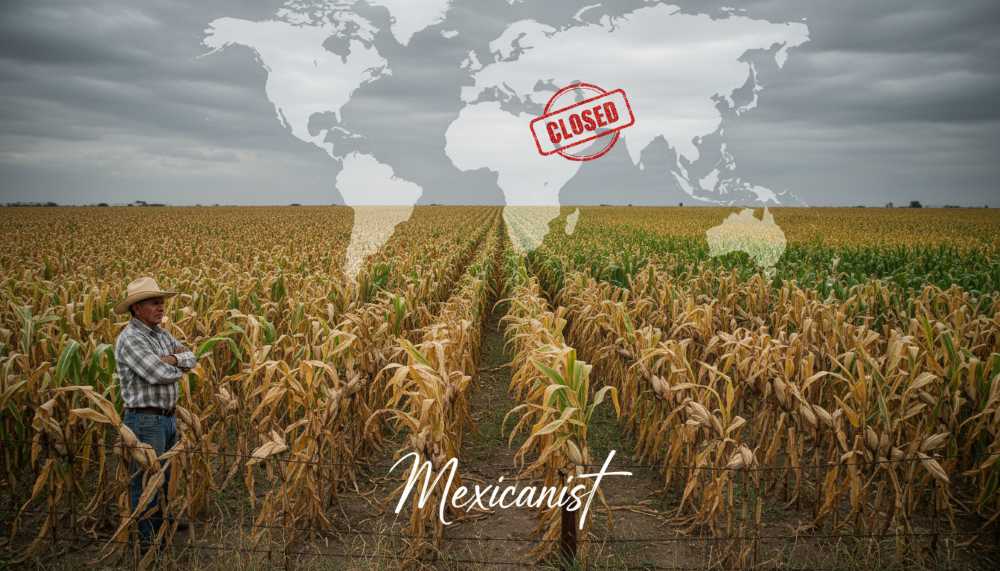
The Strait of Hormuz carries 49% of the world's urea exports. Iran closed it again yesterday. In Mexico — where 70% of fertilizer is imported — the price of urea just hit $1,000 per ton. That's 82% more than February and 92% more than a year ago. Farmers are already planning to use less fertilizer. Less fertilizer means smaller harvests. Smaller harvests mean higher food prices. And nobody in the English-speaking press is connecting these dots.
Here's the chain of causation that should terrify anyone who eats food in Mexico, the United States, or anywhere that imports Mexican agricultural products:
Iran closes the Strait of Hormuz to pressure the United States and Israel → cargo ships carrying urea and ammonia can't transit → global fertilizer supply shrinks → Mexico, which imports more than 70% of its fertilizer, sees prices spike → farmers apply less fertilizer to save money → crop yields fall → food prices rise → inflation accelerates → the Bank of Mexico holds interest rates higher for longer → the peso weakens → and the Mexican economy, already reeling from the worst manufacturing employment decline in 17 years, takes another hit.
This isn't speculation. Every link in this chain is already happening.
Why Mexico Gets Hit First and Hardest
On Saturday, Iran announced it had reclosed the Strait of Hormuz — barely hours after briefly reopening it. The closure is conditional: Iran says the strait will remain blocked as long as the United States maintains its blockade of Iranian ports. Two commercial vessels reported being attacked while attempting to transit.
US President Donald Trump warned that Iran "cannot blackmail" Washington and claimed they are "talking with them." Iranian parliament speaker Mohammad Baqer Qalibaf, who represented Iran in the April 11 dialogue with the US, said "progress has been registered" but a final agreement "remains far."
The strait is the world's most critical energy and commodity chokepoint. Through it passes approximately 20% of the world's oil, 20% of liquefied natural gas, and — critically for this story — up to 49% of global urea exports, 30% of ammonia exports, and the natural gas that is the primary feedstock for nitrogen-based fertilizers.
Mexico is uniquely vulnerable to a fertilizer supply crisis because of one stubborn fact: the country produces almost none of its own.
More than 70% of Mexico's fertilizer demand is met through imports. The country's domestic fertilizer industry was essentially dismantled during decades of neoliberal economic policy — PEMEX's petrochemical division, which once produced significant volumes of ammonia and urea, was systematically underinvested and partially privatized into irrelevance. The Con.modelo fertilizer plant in Veracruz, once the backbone of Mexican production, has operated at a fraction of capacity for years.
The result: Mexico's agricultural sector — which feeds 130 million people and exports $45 billion in agricultural products annually to the United States alone — is structurally dependent on imported fertilizer. And a huge share of that imported fertilizer comes through or from the very supply chains that Hormuz controls.
Rogelio García Moreno, vice president of agriculture at the Consejo Nacional Agropecuario (CNA) — Mexico's national agricultural council — laid it out in stark terms: "Importers are offering urea in Mexico at $1,000 per ton. That's 81.8% more than February and 91.9% more than April of last year."
He added: "This is terrible. Poor farmers who are planting spring-summer crops and vegetables. What do I think will happen? A farmer will say, 'Last year I applied 200 kilograms of urea per hectare to my sorghum; this year I'll apply 150.'"
The Crops in the Crosshairs
The timing couldn't be worse. Mexico's spring-summer planting season — the largest agricultural cycle of the year — is getting underway right now. The crops most at risk:
- Corn in Chihuahua and Jalisco — Mexico's staple grain, already under pressure from drought and water scarcity in the north. Less fertilizer means lower yields in the states that produce the most.
- Berries in Guanajuato — Mexico is the world's largest exporter of berries (strawberries, blueberries, raspberries, blackberries), almost all of which go to the US market. Berry production requires rapid growth cycles and constant fertilizer application. Cut the fertilizer, and you cut the export revenue.
- Vegetables across the Bajío — The green belt of central Mexico feeds both domestic consumers and the US market. Tomatoes, peppers, cucumbers — all require significant nitrogen inputs.
- Sorghum in Tamaulipas and Nuevo León — A key animal feed crop. Lower sorghum yields mean higher livestock feed costs, which means more expensive meat and dairy.
The cascading effects don't stop at the farm gate. Lower crop yields → lower agricultural GDP → reduced rural employment → increased migration pressure toward urban centers and the United States. In a country where agricultural employment supports roughly 13 million people, a fertilizer crisis is an economic crisis is a social crisis.
Manufacturing Is Already Bleeding
The fertilizer shock lands on an economy that's already weakened. Data from INEGI (Mexico's national statistics institute) shows that manufacturing employment suffered its worst decline in 17 years in the first two months of 2026 — a 2.54% annual drop, the deepest since the 8.91% plunge in early 2009 during the global financial crisis.
Eighteen out of 21 manufacturing subsectors lost jobs. Transportation equipment manufacturing fell 6.01%. Machinery and equipment dropped 5.54%. Textiles declined 4.39%. Only three sectors added workers: computing and communications equipment (+2.88%), petroleum products (+0.46%), and beverages and tobacco (+0.33%).
The official explanation is that automation and nearshoring are restructuring Mexican manufacturing — companies are investing in capital equipment rather than labor. But the result is the same: fewer factory jobs at exactly the moment when agricultural employment is about to take a fertilizer-driven hit.
If you're reading this in the United States, this isn't just Mexico's problem. Mexico supplies roughly:
- 90% of US avocado imports
- 80% of US tomato imports
- 70% of US berry imports
- 60% of US pepper imports
Higher fertilizer costs in Mexico → lower yields → reduced export volumes → higher prices at American grocery stores. The Federal Reserve's fight against inflation just got a new variable that Jerome Powell can't control: Iranian geopolitical strategy affecting the price of your guacamole.
And it's not just Mexico. The American Farm Bureau Federation reports that 70% of US farmers say they won't be able to afford the higher fertilizer prices either. The Hormuz closure is hitting both sides of the agricultural equation simultaneously.
By the Numbers
- $1,000/ton — Current urea price in Mexico (up 82% from February, 92% from April 2025)
- 70%+ — Share of Mexico's fertilizer demand met by imports
- 49% — Share of global urea exports transiting the Strait of Hormuz
- -2.54% — Manufacturing employment decline, Jan-Feb 2026 (worst since 2009)
- -6.01% — Transportation equipment manufacturing job losses (annual)
- 17.32 MXN/USD — Peso exchange rate (April 19, 2026)
- $82.59/bbl — Oil price (down $8.58, reflecting demand fears)
- 18 of 21 — Manufacturing subsectors that lost jobs in Jan-Feb 2026
Sources: Excelsior Finanzas, Luces del Siglo, INEGI, Consejo Nacional Agropecuario, AFBF
What Happens Next
There are three scenarios:
Scenario 1: Hormuz reopens within weeks. Iran and the US reach a provisional understanding. Fertilizer shipments resume. Prices gradually decline from panic levels. Mexican farmers absorb a temporary hit but salvage the spring-summer cycle. Food prices blip upward but don't spiral. Probability: 30%. Neither side has shown much interest in compromise.
Scenario 2: Hormuz stays closed for months. The strait remains blocked through the critical spring-summer planting window. Mexican farmers apply 20-30% less fertilizer. Crop yields fall 10-15%. Agricultural GDP contracts. Food inflation accelerates from its current level toward 6-7%. The Bank of Mexico is forced to choose between supporting growth and fighting inflation. The peso weakens further. This is the most likely scenario — probability: 50%.
Scenario 3: Escalation. The Hormuz closure triggers military confrontation. Energy prices spike. Global fertilizer markets seize. Mexico faces a full agricultural emergency. The government is forced to subsidize fertilizer purchases or watch the spring-summer harvest collapse. Food rationing becomes a political discussion. Probability: 20%. Nobody wants this, but nobody wanted the strait closed either.
The Mexican government's agricultural self-sufficiency rhetoric — the cry of "food sovereignty" that has been a staple of every administration — has been exposed as hollow. You cannot have food sovereignty when 70% of your fertilizer comes from abroad and the world's most important shipping lane is controlled by a country that is actively hostile to your largest trading partner.
Mexico's food security just became a geopolitical hostage. And the ransom is measured in tons of urea.
Sources: Luces del Siglo — "Sube 82% precio de urea en México" (April 17, 2026); Luces del Siglo — "Cierran Irán Ormuz y atacan embarcaciones" (April 19, 2026); Luces del Siglo — "Sufre empleo manufacturero peor caída en 17 años" (April 16, 2026); Excelsior — financial data (April 19, 2026)