The Cenotes Nobody Visits: Quintana Roo's Undocumented Sacred Sites
Thousands of cenotes lie undocumented beneath Quintana Roo's jungle, deliberately kept off every map by Maya communities who understand that the fastest way to destroy a sacred site is to tell people where it is.

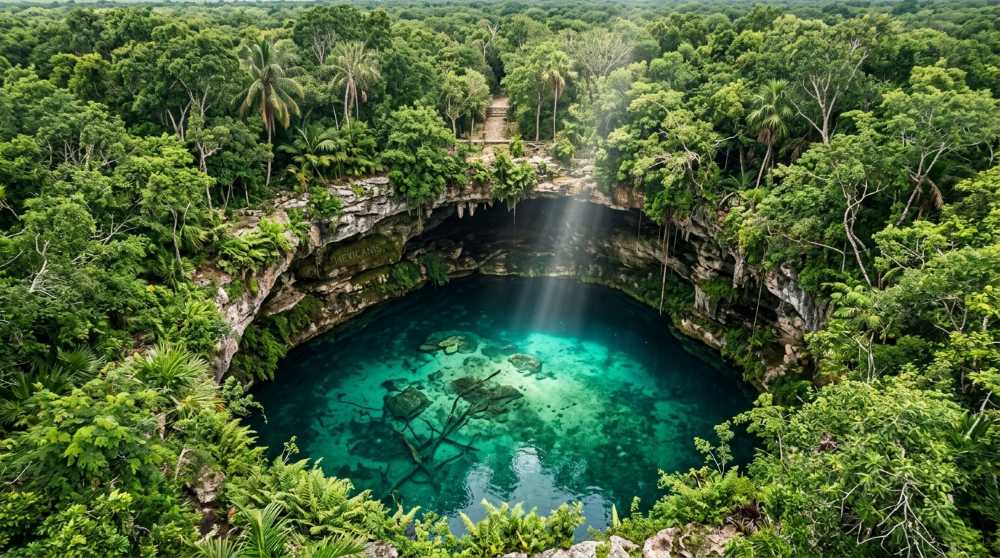
You are shoulder-deep in water so clear it does not exist, somewhere beneath the jungle canopy of Quintana Roo, and the only sound is the drip-drip of limestone weeping overhead. No ticket booth. No gift shop. No sunscreen-slick tourists Instagramming their way through someone else's sacred space. Just you, the dark, and a hole in the earth that the Maya have been quietly protecting for longer than most countries have existed. Welcome to the cenotes nobody visits, the ones that do not show up on any tourist map, the ones that communities deliberately keep off the grid because, frankly, that is the only way they survive.
The Yucatan Peninsula is riddled with these natural sinkholes, openings to the world's largest submerged cave system, and the numbers are staggering. Scientists estimate there are roughly 8,000 to 10,000 known cenotes across the region, but that is almost certainly the tip of the limestone column. Some researchers put the real figure closer to 30,000, the vast majority undocumented, unmapped, and deliberately unnamed in any public register. UNESCO, which added the Ring of Cenotes around the Chicxulub crater to its tentative World Heritage list, notes that the 2,241 cenotes so far registered likely represent only about 70 percent of what actually exists. Do the math: there are potentially thousands of cenotes that no government agency, no tourism board, and certainly no travel blogger has ever laid eyes on.
And that, as it turns out, is exactly how the Maya communities who live above them want it.
Why Some Cenotes Stay Hidden
For more than 2,500 years, the Maya have regarded cenotes as portals to Xibalba, the sacred underworld where deities dwell and the spirits of ancestors congregate. This is not some dusty archaeological footnote; it is a living, breathing belief system that continues to shape daily life in Maya communities across Quintana Roo and the broader Yucatan Peninsula. The BBC documented in 2024 that entering a cenote still requires asking permission and performing rituals, a practice that predates European contact by millennia. These are not swimming pools with a spiritual backstory tacked on for marketing. They are active ceremonial sites, period.
The secrecy around certain cenotes is not accidental or a byproduct of rural isolation. It is a strategy. Maya communities have long practiced what anthropologists call "protective secrecy," a deliberate withholding of information about sacred sites from outsiders, not out of hostility but out of necessity. The logic is brutally straightforward: if you tell people where a cenote is, they will come. If they come, they will contaminate the water, damage the formations, trample the offerings, and turn a sacred portal into a tourist attraction with a gift shop. The community's response? Simply do not tell anyone. No GPS coordinates. No Google Maps pins. No social media posts. The cenote exists in oral tradition, passed from elder to elder, and that is the only map that matters.
This is not paranoia. It is pattern recognition. As The Ringer documented in its deep dive on geotagging, the moment a pristine natural site gets tagged on Instagram, its destruction accelerates at a pace that would make a Hollywood disaster movie blush. The New York Times reported the same phenomenon in 2018: conservationists were already sounding alarms that precise geotags on social media were putting fragile ecosystems at risk. Multiply that by the cultural and spiritual significance of cenotes, and you begin to understand why a community might choose silence over sharing.
The Maya were also using cenotes to hide sacred objects from Spanish colonizers, a practice documented in academic research on the social history of cenotes on the Yucatan Peninsula. The tradition of concealment is not new. It evolved. What began as hiding ritual objects from conquistadors became hiding entire cenotes from tourists, developers, and government agencies. The method changed; the motive stayed the same: protection through obscurity.
21 Million Tourists and Counting
Here is where the numbers start to hurt. In 2000, Quintana Roo was already a tourism heavyweight, but nothing like what was coming. By 2019, the state was pulling in 16.7 million visitors annually. Last year? Twenty-one million. That is not a typo. Twenty-one million people, many of them funneling through Cancun and spreading down the coast to Playa del Carmen and Tulum, all of them within striking distance of the cenotes that dot the region like a subterranean constellation. The math is unforgiving: more visitors mean more pressure on an aquifer that was never designed to handle sunscreen, sewage, and the accumulated footsteps of mass tourism.
National Geographic sent a team down in 2025 and what they found was not pretty. Agricultural runoff, residential sewage, the usual suspects, had been eating away at cenotes for decades. But the Tren Maya, Mexico's billion-dollar rail megaproject, cranked the damage into overdrive. The same investigation zeroed in on biologist Roberto Rojo, who co-founded Cenotes Urbanos back in 2018 with fellow activists Talisman Cruz and Ximena Chavez because nobody else was going to do it. What started as a citizen-science cleanup effort has since grown into a full-blown operation: volunteer networks, drones mapping cenote geology in 3D, and actual measurable improvements. Several sites have seen algae blooms shrink and water clarity return. It works. It just requires people willing to wade into polluted water and do something about it.
And then there's the contamination. When scientists from the journal Science of the Total Environment looked at what was actually in the groundwater during the COVID-19 lull, they found sunscreens and antibiotics leaching into the aquifer even with tourist numbers cratered. Resident wastewater just kept pumping. Researchers writing in MDPI's Applied Sciences tried to tally up how much sunscreen tourists alone were dumping into cenotes, beaches, and water parks, and the chemical load they came up with would make your skin crawl, no irony intended. Another team, publishing in Springer's Environmental Monitoring and Assessment, tested water samples and pinpointed the source of nutrient overloads right back to domestic sewage from nearby towns. By 2025, TravelPulse was reporting that Cancun's cenotes had hit record-high contamination: wastewater, garbage, phosphorus, coliform bacteria, fecal matter, the works. Not exactly the pristine swimming holes of the brochures.
Concrete Through the Cathedral
If tourist contamination is a slow bleed, the Tren Maya is a tourniquet applied to the wrong artery. Section 5 of the project, which runs from Cancun to Tulum, has been the most controversial, and for good reason. Causa Natura Media reported that there have been perforations and the filling of at least 10 caves due to the construction of this section alone. Steel pillars driven through fragile cave roofs have ruptured the geological formations that took millions of years to develop. Where there should be crystal-clear freshwater, there is contamination. Contractors sank concrete columns through caverns to support the train tracks above, filling some caves with cement entirely.
TIME did not mince words. In 2024, they called the whole thing an "environmental disaster," pointing out that the peninsula's 10,000 known cenotes sit inside a limestone karst so fragile that running a freight train over it qualifies as geological malpractice. Dive Magazine followed the thread further, laying out how every new stretch of development would funnel more pollution into the cave systems, with ripple effects that could reach the southern coast. And researchers at the University of Twente mapped out the worst-case scenario: construction vibrations thinning the bedrock until semi-flooded caves literally collapse, while all that freshly disturbed geology lets contaminants seep into the freshwater aquifer that keeps a few million people hydrated. You know, the one they drink from.
Roberto Rojo, who also co-founded the activist group Selvame del Tren (Save Me From the Train), has become one of the most visible faces of cenote resistance. A photograph published by National Geographic showed Rojo kneeling in despair, immersed in the murky, polluted waters of a once-pristine cenote south of the train route. Yucatan Magazine profiled him as "The Cave Guardian," documenting his journey from television presenter introducing Mexico's biodiversity to tireless environmental activist fighting a megaproject backed by the full weight of the Mexican government. His message is simple: a cenote is not a pretty swimming hole. It is the beating heart of the Yucatan aquifer, and every tourist dollar can either keep that heart pumping or help stop it.
When Cenotes Get Legal Rights
So what happens when protection through secrecy is not enough? Some Maya communities are trying something radical: giving cenotes legal personhood. In December 2024, the Associated Press reported that a lawsuit had been filed in Mexico seeking personhood status for the Ring of Cenotes, a group of hundreds of subterranean lakes in the Yucatan Peninsula. The case, initiated in 2022, could affect 52 communities within the Ring of Cenotes if successful. The logic is elegant in its simplicity: if a cenote is a legal person, then anyone who damages it is not just committing an environmental violation, they are committing assault.
El Pais broke the story in 2022, reporting that over 20 communities had begun litigation through the legal organization Indignacion, and that granting legal personhood to the Ring of Cenotes could unify the different protection efforts under a single legal framework, leading to more effective and coordinated conservation. The VOA reported that a Yucatan state judge had already begun reviewing the case, and the Eco Jurisprudence project at the intersection of indigenous rights and environmental law has been tracking the case as a landmark example of the Rights of Nature movement. The Völkerrechtsblog, an international law blog, published an analysis in February 2025 examining the environmental challenges threatening the cenotes and the legal innovations being deployed to protect them.
This is not as far-fetched as it sounds. New Zealand granted personhood to the Whanganui River in 2017. Ecuador wrote Rights of Nature into its constitution in 2008. Colombia's Constitutional Court granted the Amazon personhood rights in 2018. The Maya communities of the Yucatan are not inventing a new legal concept. They are applying a globally emerging framework to a local crisis, and they are doing it with the weight of 2,500 years of spiritual and ecological stewardship behind them.
To Map or Not to Map
Here is the knot at the center of this whole story: the very act of documenting a cenote can destroy it. This is not a metaphor. It is a causal chain with a body count. Step one: a researcher, cave diver, or well-meaning citizen scientist maps a previously unknown cenote and enters it into a database, publishes a paper, or posts the coordinates online. Step two: that information becomes accessible, and in the age of the internet, accessible means permanently accessible. Step three: tourists, developers, or government agencies use that information to find the cenote. Step four: the cenote is irreversibly altered, contaminated, commercialized, or destroyed. The Tren Maya's route was determined using geological surveys that identified the very cave systems the train then proceeded to puncture.
This creates an excruciating dilemma. You cannot protect what you do not know exists, full stop. The Great Maya Aquifer Project, profiled by World Archaeology and The Past, is built entirely on the premise that mapping the submerged world beneath the Yucatan is the first step toward saving it. Cenotes Urbanos runs drones to build 3D models of cenote geology, feeding predictive tools that flag likely sinkhole collapses before they happen and steer urban planners away from the most fragile zones. Researchers at the Harte Research Institute are enlisting citizen scientists to fan out across the peninsula and catalog what they find, because there are simply too many cenotes for any single team to cover solo. Every one of these efforts depends on the same thing: knowing where the cenotes are.
But flip that coin over and every new data point is a potential weapon. A 2025 study in MDPI's Diversity journal laid out species maps across the Ring of Cenotes, Caribbean Cave, and Cozumel Island clusters, exactly the sort of ecological inventory that a hotel developer or highway engineer would love to get their hands on. The Association for Mexican Cave Studies, a scrappy nonprofit that has been exploring and cataloging Mexico's caves for decades, lives in this uncomfortable middle ground every single day: document enough to understand, but not so much that you hand a roadmap to the people most likely to pave over it.
Some communities have reached their own equilibrium. They allow researchers to visit and document cenotes under strict conditions: no GPS coordinates in publications, no photographs that could identify the location, and all research findings shared with the community before any public release. It is a fragile compact, one that depends entirely on trust, and it breaks down the moment a single researcher violates the terms. The Terralingua organization documented one such community-based conservation effort in Yucatan, where biocultural preservation strategies explicitly incorporate traditional knowledge and secrecy as valid conservation tools, not obstacles to be overcome.
What Happens When the Secret Gets Out
The fear is not hypothetical. There are cautionary tales littered across the Yucatan Peninsula like limestone rubble. Cenotes that were once known only to local Maya communities are now tour-bus destinations with parking lots and admission fees. The transformation is always the same: first come the adventurous backpackers who hear about the spot through word of mouth. Then come the travel bloggers who post about their "hidden gem" discovery. Then come the tour operators who smell a profit. Then come the paved roads, the ticket booths, the changing rooms, and the steady degradation of the water quality that made the cenote worth visiting in the first place.
The ResearchGate study on cenote conservation in Yucatan documented the changes that community informants have observed: declining water quality, increased contamination from solid waste, and the steady encroachment of tourism infrastructure. A Facebook post from the Riviera Maya community forum captured the dilemma with painful clarity: "Many times when I come across hidden cenotes like this, I'm struck by a core question: should they remain protected by the wilderness, or shared?" The answer, for many Maya communities, is not complicated. Protect first. Share never. Or at least, share only with those who understand that a cenote is not a recreational facility but a living relative.
The Mexican government's own data underscores the urgency. Mexican environmental authorities have seized over 2,500 hectares of land in Quintana Roo due to illegal clearing and unauthorized changes in land use, much of it connected to tourism development and infrastructure projects. Quintana Roo tourism officials launched a Sustainable Cenote Route in Tulum in early 2026, aiming to boost education and prevent degradation, but critics argue that any initiative that funnels more visitors toward cenotes, however well-intentioned, ultimately increases the pressure on sites that were never designed to accommodate human traffic at scale.
Communities Who Choose Silence
Behind every undocumented cenote, there is a community making an active, ongoing decision to keep it that way. This is not passive neglect or a failure to modernize. It is a sophisticated, culturally rooted conservation strategy that has been refined over centuries and is now being deployed against 21st-century threats. The Maya communities of Quintana Roo are not sitting around waiting to be discovered. They are actively, deliberately, and at considerable personal risk, choosing to keep their sacred sites invisible.
The personhood lawsuit is one front. Community-based monitoring and cleanup operations, like those run by Cenotes Urbanos and its Playa del Carmen chapter, are another. Traditional ceremonial practices that restrict access to cenotes based on gender, status, and ritual preparation are a third. Each of these strategies operates on a different scale, from the legal heights of constitutional litigation to the ground-level work of picking trash out of polluted water, and each is essential. The lawsuit provides the legal framework. The cleanup operations provide the physical maintenance. The ceremonial restrictions provide the cultural legitimacy that no government decree can replicate.
What makes these communities' approach so effective is precisely what makes it so difficult for outsiders to understand: it is not a conservation program. It is a way of life. The Maya do not protect cenotes because they read a policy paper about ecosystem services. They protect cenotes because these are the places where their gods dwell, where their ancestors reside, and where their water comes from. Take away the spiritual dimension, and you have stripped the protection of its motive force. This is why well-meaning environmental organizations sometimes struggle to work effectively with Maya communities: they want to secularize a relationship that is fundamentally sacred, and the communities know, with the certainty of long experience, that a cenote protected by a legal decree is never as safe as a cenote protected by a prayer and a promise of silence.
So where does this leave us? The romantic narrative says: leave the cenotes alone, let the Maya protect them in peace, and stop treating the natural world as a commodity to be cataloged, monetized, and consumed. The technocratic narrative says: map everything, regulate everything, and trust that good governance and scientific management will prevent the worst outcomes. The real version, as usual, is messier than either extreme.
The truth is that some cenotes need to be documented to be protected. Without scientific data on water quality, species distribution, and geological stability, conservation arguments lack the empirical foundation that legal and policy systems require. The personhood lawsuit depends on evidence that cenotes are living systems with ecological integrity worth protecting, and that evidence comes from the very mapping and documentation that communities fear. Cenotes Urbanos' drone mapping and 3D modeling have already helped predict sinkhole collapses and guide urban planning decisions that keep development away from the most vulnerable sites. The Great Maya Aquifer Project's exploration of the submerged world beneath the peninsula has revealed archaeological and paleontological treasures, including evidence of the asteroid impact that killed the dinosaurs, that strengthen the case for cenote preservation on the global stage.
But the truth is also that some cenotes need to remain undocumented to survive. The ones that are known only to the communities that steward them, the ones that have no coordinates in any database, no photographs in any archive, and no mention in any publication, these are the ones that are still pristine. Their protection does not come from a legal framework or a government agency. It comes from the deliberate, disciplined, and collectively maintained decision of a community to keep quiet. And that decision, however it may frustrate researchers and puzzle tourists, is itself a form of conservation science, one that has been peer-reviewed by centuries of results.
The challenge for anyone who cares about the future of Quintana Roo's cenotes is to hold both truths simultaneously: documentation can save a cenote, and documentation can destroy one. The art is in knowing which is which, and in trusting the communities who have been making that distinction for far longer than any of us have been asking the question.
Sources
Associated Press. "Indigenous Mayans want their sacred cenotes to have personhood." December 9, 2024.
BBC Travel. "The hidden wonders of Mexico's sacred underwater world." June 28, 2024.
Causa Natura Media. "Collapse of filled caves and cenotes, the balance of Section 5 of the Maya Train." 2024.
Dive Magazine. "Below the Line: Mexico's Tren Maya is destroying Yucatan's cenotes." 2024.
Eco Jurisprudence. "Yucatan (Mexico) Court Case: rights of the Ring of Cenotes." 2024.
El Pais. "The rights of cenotes: The last attempt to rescue Mexico's sacred sites." May 14, 2022.
Harte Research Institute. "Research and Citizen Science Aim to Preserve Cenotes." June 26, 2023.
InDepth Magazine. "Cenotes on the Edge: Preserving Mexico's Underwater Heritage." July 2, 2025.
MDPI Applied Sciences. "Impact of Tourist Behavior on the Discharge of Sunscreen Contamination in Aquatic Parks, Sinkholes and Beaches of the Mexican Caribbean." 2021.
National Geographic. "The fight to preserve Mexico's enchanting cenotes." August 19, 2025.
National Geographic Magazine. "Secrets of the Maya Otherworld." 2013.
ResearchGate. "Restoring the environment, revitalizing the culture: cenote conservation in Yucatan, Mexico." 2018.
Rutas Mexico. "Yucatan Peninsula Cenotes: Complete Guide to the 15 Best." August 5, 2025.
Science of the Total Environment. "Analysis of sunscreens and antibiotics in groundwater during COVID-19." 2023.
Springer Environmental Monitoring and Assessment. "Use of Microbiological and Chemical Data to Evaluate the Effects of Tourism." 2023.
Terralingua. "Can the Cenotes be Saved? Biocultural Conservation in Yucatan, Mexico." September 8, 2018.
The New York Times. "Is Geotagging on Instagram Ruining Natural Wonders? Some Say Yes." November 29, 2018.
The Ringer. "Loved to Death: How Instagram Is Destroying Our Natural Wonders." November 3, 2016.
TIME. "Mexico's Maya Train Is An Environmental Disaster." 2024.
UNESCO World Heritage Centre. "Ring of cenotes of Chicxulub Crater, Yucatan." Tentative List No. 5784.
University of Twente. "From Impacts to Perceptions: Exploring the Maya Train's Effect." 2024.
VOA Learning English. "Mayans Ask Mexican Court to Recognize Lakes as Legal Persons." December 16, 2024.
Völkerrechtsblog. "A Ring of Hope." February 25, 2025.
WilderUtopia. "Sacred Cenotes of the Yucatan Maya Underworld." 2020.
World Archaeology. "The Great Maya Aquifer." July 21, 2022.
Yucatan Magazine. "The Cave Guardian: What Drives Roberto Rojo Underground." 2025.
Yucatan Magazine. "Preserving the sacred waters of Yucatan cenotes." March 9, 2025.