The Crocodile’s Eye — Part 1: The Crocodile Remembers
A crocodile older than the conquest remembers the last sacrifice. A museum conservator touches a mask and something touches him back. The first installment of a serial thriller where sacred water runs beneath resort pools and ancient covenants survive under parking lots.

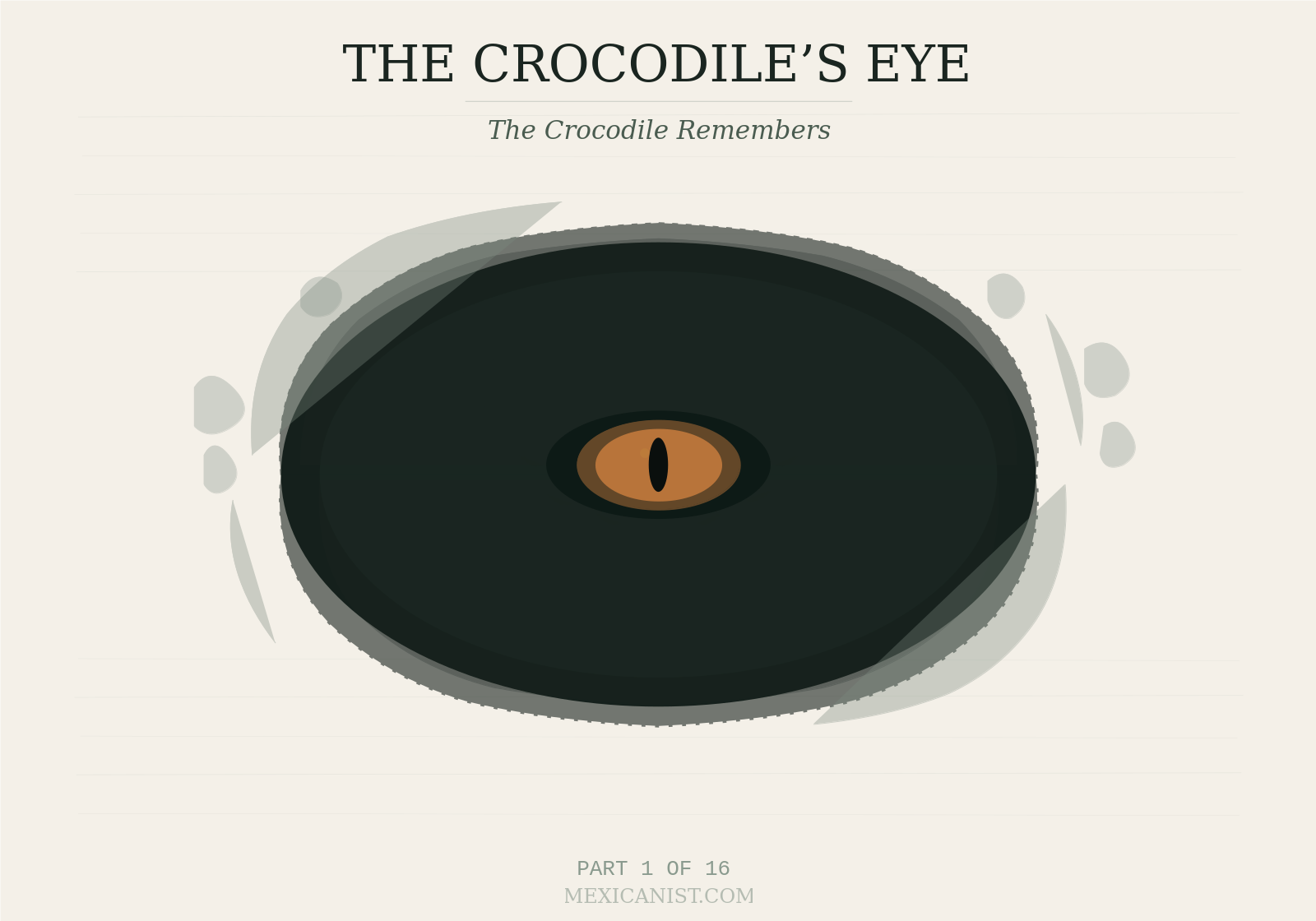
The crocodile had been alive for forty-three years when it witnessed its first human sacrifice. It remembered the moment with the clarity that only cold-blooded creatures possess — as data, pure and unencumbered by emotion, which was foreign to its neurology.
Vibrations traveled through stone and water and into the bone of its skull, where a second set of ears listened to frequencies that humans couldn’t perceive and wouldn’t have believed existed if they could. What the crocodile remembered most precisely was the sound. The screaming was negligible — the boy had been sedated with mushrooms and had accepted his fate with the glassy-eyed peace of the genuinely converted. The drums and chanting were merely human noise, desperate prayer, the bargaining of creatures who hope to negotiate with forces they cannot control. What the crocodile remembered was deeper, older, a resonance that seemed to come from the limestone itself. The priests had called it the Xibalba.
They believed that when they performed the correct ceremonies, when they spoke the right words in the right order at the right time, the underworld itself would answer. They believed that the crocodile was merely the ferryman, the carrier of souls from the world of light to the world of shadow. They believed many things. The crocodile believed nothing. Belief required abstract thought its brain was not designed to produce. But the crocodile knew things.
It knew that when the boy’s blood touched the water, something changed in the frequency that hummed through the cenote. It knew that for the three days the body floated in the sacred well, marked with glyphs that told the underworld who he was and why he had come, the water seemed to be waiting.
The victim had been young, male, healthy, the son of a minor noble from a city that would not be excavated for another five centuries. The priests had prepared him for three days, feeding him nothing but clear water and the sacred mushrooms that opened the doors of perception. On the fourth morning, they had dressed him in white cotton, painted his chest with the red ochre that marked him as an offering, and guided him to the edge of the cenote where the crocodile waited in the shadows.
The boy had gone willingly into the water, or as willingly as any fifteen-year-old could go to meet what waited below. His eyes had held an expression the crocodile had seen before — something deeper than terror. Acceptance. What happened next was not murder.
That distinction mattered to the crocodile, though it couldn’t have articulated it in human terms. Murder implied chaos, passion, the messy failure of social contracts. This was a ceremony. Order. The boy was given, and the giving was precise: four cuts on the chest in the shape of the k’an cross, nine smaller marks arranged in three rows running from sternum to navel.
The numbers were not arbitrary - they corresponded to the levels of Xibalba through which the boy’s soul would travel, the trials he would face, the lords he would answer to. But there was something else, something the crocodile had witnessed that no human record would ever capture. As the boy’s life left his body and dissolved into the water, the crocodile had seen the light. Not sunlight filtering from above, not the torchlight of the priests on the rim.
This light came from within the water itself. The light was faint, barely visible, a phosphorescence that seemed to pulse with the rhythm of something breathing.
The crocodile had understood, in the limited way that ancient reptiles understand anything, that this was not its kill. Its role was different. It was the ferryman, the carrier, the one who waited on the far shore of the dark water and received what the living world offered. The boy’s body floated in the cenote for three days. The water seemed to be waiting.
On the fourth day, when the ceremonies were complete and the priests had sung the final prayers, the crocodile began to eat. But even then, even as its jaws closed on the offering that had been prepared with such care, the crocodile sensed that the boy was already gone.
What the crocodile consumed was merely the container. The contents had already been delivered. It was the beginning of the covenant.
The humans provided the bodies, properly prepared, marked with the correct names, offered at the appropriate times according to the sacred calendar. The crocodiles provided the passage. It was a system that had worked for generations. But the crocodile knew something the priests did not. It knew that the covenant was not truly between humans and crocodiles.
It was between humans and whatever used crocodiles as its hands and the cenotes as its voice. The priests thought they were bargaining with the gods. The crocodile knew they were merely leaving messages in a bottle, hoping that whatever read them would understand. The Spanish had tried to end it, of course. They had called the crocodiles demons, the priests devil-worshippers, the cenotes portals to hell that needed to be sealed with stone and prayer.
They had burned the codices by the thousands, destroying in a single generation what had taken centuries to record. They had toppled the temples, filled the sacred wells, forced the Maya to baptize their children with water that had been blessed by priests who did not understand what they were blessing.
The covenant had survived — in the dreams of children and the silence of caves and the careful, patient memory of creatures that lived longer than any human lifespan. The crocodile had lived long enough to watch the covenant outlast the civilization that created it. The crocodile had been alive for two hundred and seventeen years when it witnessed its last sacrifice. By then, the world had changed beyond recognition.
The jungle had been cut back, the temples buried under parking lots and hotel foundations, the water filtered and chlorinated and sold in plastic bottles to tourists who thought they were experiencing something authentic. The priests had become tour guides, their sacred knowledge reduced to scripts in broken English, their prayers replaced by safety briefings and liability waivers.
The covenant had become a story - a myth, a legend, something the Mayan elders told their grandchildren on nights when the wind whispered through the mangroves and the past felt closer than the present. But the water remembered. And now, after five centuries of silence, someone was speaking its language again. The crocodile floated in the Sian Ka’an reserve, a protected area where tourists came to photograph wildlife and locals came to fish.
It was old, even for its species - perhaps the oldest Morelet’s crocodile in the Yucatán, though no one had thought to count. Its hide was scarred from territorial battles, from encounters with boats and nets and the propellers of ignorant tour operators. Its eyes had seen the jungle transform from Maya homeland to Spanish colony to Mexican state to international tourist destination. It had watched cenotes become swimming pools, sacred sites become Instagram backdrops, the covenant become a story that no one believed anymore.
And in the depths of Cenote Azul, where the light never reached and the limestone held secrets older than the human species, something had begun to stir. A frequency. A hum. A voice that spoke in the language the crocodile had not heard since the last priest had lowered the last body into the water, two centuries ago. And the crocodile, ancient and patient and hungry in ways that had nothing to do with food, waited.
For seventeen nights, the crocodile had felt the change — a vibration resonating in the ancient structures of its inner ear, in the bone-deep receptors that had evolved to detect the heartbeat of prey from fifty meters away. This was not a heartbeat. This was something that made the water itself seem to breathe, as though the limestone were exhaling after a very long sleep.
The crocodile had moved from its usual territory, following the signal through the underground rivers that connected the cenotes. It was not alone. Other crocodiles had begun to gather, drawn by the same inexplicable pull, their ancient territorial instincts overridden by an older, more powerful imperative.
They converged on Cenote Azul from miles around, slipping through the flooded passages that had existed since before the ice ages, emerging into the sacred well one by one until a dozen pairs of eyes watched the surface from the darkness below. What they witnessed there made no sense in the language of instinct or survival. A man stood on the limestone rim, but he was not a priest. He wore no ceremonial garments, carried no incense, spoke no prayers.
Instead, he held something in his hands—a device that pulsed with light, that hummed with a frequency that made the crocodile’s brain ache with recognition. Behind the device, hidden in shadow, stood another figure. This one wore a mask. The mask was bone. Crocodile bone. The crocodile knew this with certainty, could smell the ancient calcium even through the water. But there was something else in the mask, something that made the water itself seem to recoil.
The eyes of the mask were obsidian, polished to a mirror finish, and when the figure turned its head, the crocodile saw what should have been impossible: the mask was looking back at it. The mask itself, independent of the man beneath it. The crocodile had lived for two hundred and seventeen years. It had survived droughts and floods, hunting parties and development projects, the slow poisoning of its waters and the gradual destruction of its prey.
But in all that time, it had never felt what it felt now: the sensation of being seen by something that should not have eyes. Of being recognized by something that should not have memory. Of being called by a name it had never been given. The water stirred. The limestone hummed. And in the darkness of the cenote, surrounded by a dozen of its kind, the crocodile began to understand that the covenant had not ended with the last priest. It had merely been waiting for someone to remember the language.
Five Years Before
The museum was quieter at night than most people imagined. Visitors assumed the silence began when the last tourist left at six, when the guides switched off their radio microphones and the gift shop pulled its security gate. But Hernán Ku knew better. The real silence came later, around midnight, when the building had finished exhaling the day. The air conditioning settled into its low hum. The emergency lights reduced everything to shapes and shadows, and the artifacts in their cases stopped performing and simply were.
That was when the museum told the truth, and why he preferred the night shift. He’d been the regional archaeology museum’s night conservator for three years, a title that meant, in practical terms, that he was trusted to be alone with the dead. The salary was modest. The hours were isolating in ways that had, over time, become indistinguishable from loneliness. He ate his dinner at eleven PM at the security desk, reading condition reports as other men read novels. His thermos of black coffee sat cooling beside him.
When his grandmother called — she called every Thursday, seventy-four years old and still suspicious of voicemail — he would step outside to the loading dock where reception was better. She would speak to him in Yucatec Maya, ask if he was eating enough. He would answer in the same language: eating fine, work was good, sleeping. He told her what she needed to hear. He did not tell her that he sometimes walked through the exhibit halls at 2 AM just to be near something that had lasted.
His apartment was twenty minutes away by bus: a single room above a laundry on Calle Uxmal, perpetually damp from the machines below. He slept there in the mornings, woke in the afternoons, and traveled back to the museum through a city that was always in the middle of becoming something else. Three new resorts going up in the hotel zone.
A cenote near Playa reclassified as a “water feature.” The jungle retreating one cleared hectare at a time, as patient and irreversible as everything that couldn’t fight back. He had grown up four hours south, in a village whose name didn’t appear on the tourist maps, a village where his grandfather had known the name of every tree and his grandmother had refused to let Spanish be the only language in the house.
The university had found him at seventeen, offering a scholarship for students with exceptional aptitude in pre-Columbian studies. He had gone gratefully, hungrily, the way village boys go to universities when they understand that books can be a ladder. He’d learned to love artifacts as he’d once loved the stories his grandfather told — for the information they carried, the access they gave to something older than himself.
What he hadn’t understood, not yet, was that his grandfather’s stories and the artifacts in glass cases were not the same kind of knowledge. One was alive. The other was preserved. He was thirty years old. He had a healed fracture in his left wrist that had never set quite straight, a souvenir of a childhood fall into a dry cenote that his grandfather had found funny in hindsight and his grandmother had not. He had a facility for Yucatec Maya and a deep distrust of other people’s certainty.
He had, since the age of perhaps eight or nine, heard something in standing water that other people didn’t seem to hear: a low vibration, barely at the threshold of perception, more felt than listened to. He’d mentioned it once to his grandfather, who had gone very still and then changed the subject. He’d learned not to mention it again. What he had never learned was that his grandfather had documented it — in a letter, sent to a man none of them would meet until much later, noting that the boy had fallen into a dry cenote and come out different. That letter had made its way through several hands before it reached someone who collected such information as other men collected title deeds.
The crate arrived on a Tuesday in the third week of November, brought by a contracted transport company whose driver had signed the chain-of-custody form in handwriting so poor that Hernán spent ten minutes deciphering the name. The crate itself was standard conservation packaging: foam-lined, acid-free tissue, humidity-controlled. Unremarkable. But when Hernán lifted the lid, the smell reached him before the contents did. Not the sterile, controlled scent of a properly stored artifact.
Something older: mineral and dark, the way deep water smells when it has never seen light. He logged it as Artifact QR-2291: Ceremonial face covering, obsidian composite with jade inlay, Pre-Classic period, provenance unconfirmed. He took the photographs required by protocol and prepared the condition report.
It noted the minor surface degradation along the left orbital rim, the hairline fracture in the jade inlay at the temple, the quality of the obsidian: worked in the old way rather than polished to a modern standard, ground to a finish that caught light and held it. He assigned it a case number. He began the preparation for display. He did not touch it directly. That was protocol too. On the second night, he noticed that the eyes were wrong.
Not damaged — the condition report was accurate, there was no structural concern. But the obsidian had been shaped to an unusual geometry, a curve that corresponded to no natural fracture pattern Hernán had encountered in twenty years of reading lithic studies. It was the curve of a pupil. Not a human pupil. Something wider, more lateral, designed to take in more of the world at once. Whoever had carved this had understood the eye they were replicating. Had studied it. Had wanted whoever wore the mask to see differently.
Hernán wrote this in his personal notebook, and then looked at what he’d written and felt briefly foolish. He was a conservator. He dealt in material analysis and storage conditions. He closed the notebook. On the third night, he stood at the case for forty minutes without moving. He told himself he was assessing the lighting, which needed adjustment — the overhead track left a shadow across the left orbital that misrepresented the piece’s symmetry. This was true. He adjusted the lighting.
He stayed for another twenty minutes after that, his hands in their nitrile gloves at his sides, and the museum settled around him into its private midnight truth, and the mask’s obsidian eyes absorbed the recalibrated light and gave nothing back. He went home on the bus. Ordered food he didn’t eat. His grandmother called on Thursday and asked if he was sleeping and he said yes. He lay in his damp apartment and listened to the laundry machines below and thought about the geometry of pupils and the smell of deep water.
On the fourth night, he replaced the humidity packet in the case and updated the condition log and did not stay. On the fifth night, the gloves tore. It was nothing. A catch on a shelf edge, a millimeter split in the nitrile at the tip of his right index finger. The protocol required him to stop and replace them. He reached for the fresh pair. He didn’t put them on. His bare finger touched the obsidian.
The sound came first — through the bone of his jaw, a frequency that traveled up his arm, across his collarbone, into the structures of his inner ear the way sound travels through water. It was the frequency of deep caves. Of passages that had not seen light in a thousand years. He felt it in his molars. He felt it in the healed fracture in his left wrist, the one that had never set quite straight. Then the water. Hernán would be precise about this — in the notebooks no one would read until after.
Not a hallucination. More like a memory that belonged to something else and had been waiting for a suitable mind to store it in. The cenote below him, not the museum floor. Diffuse light falling in oblique shafts through the water above, refracting as it descended. Names recorded in limestone. Hundreds of them. A ledger that had been running for centuries, each entry a covenant entered into and, slowly, catastrophically, abandoned. The water knew what was owed. When he lifted his hand, forty-three minutes had passed.
He was sitting on the floor. He did not remember sitting down. He reached for his personal notebook, and wrote in Yucatec Maya, the language his grandmother had refused to let him forget. He capped the pen. He finished the cataloguing. He left the obsidian eyes uncovered when he turned off the lights. He told himself it was an oversight. The mask, if it understood the distinction, gave no indication either way.
Eight weeks later, Hernán touched the obsidian a second time. This time it was not an accident.
He had spent eight weeks not touching it. He had submitted the artifact for final documentation, completed the condition report, assigned the case number. He had processed two other incoming loans from the state university, catalogued a collection of ceramics from a development excavation near Playa del Carmen, filed three months of deferred paperwork. He had been methodical. He had been professional. He had been very careful.
He had also, in those eight weeks, stopped sleeping properly — sleep came, but it refused to do its usual work. He would close his eyes and be present in the cenote he had not visited. He would hear the frequency he had not heard since the night of the torn glove. He would feel, in the healed fracture of his left wrist, a resonance that was neither pain nor comfort but something that resisted categorization, as certain mathematical constants resist intuition.
On the forty-third night, he got off the bus three stops early.
He told himself he needed air. This was true. He told himself the route past the museum was no longer than the route home. Also true. He told himself that if he happened to pass the loading dock entrance that his after-hours key still opened, that was a function of geography, not intention.
He stood in the doorway of the artifact storage room for four minutes.
The mask was in its case. The case was locked. His keys were in his pocket. He had a legitimate reason to be here—a condition report that needed a final signature, an oversight from last week’s shift. This was also the most carefully constructed lie he had told himself in forty-three nights of careful lying.
He took the keys out.
He stood at the case for another two minutes with the keys in his hand, watching the way the obsidian held the dim light of the emergency overheads. Not reflecting it. Absorbing it. Holding it the way it had held everything the water had given it over centuries: with complete, patient attention, like a creature that understood that attention was itself a form of possession.
His grandmother called the old knowledge chol k’in—something that lived in the days, in the accumulation of time rather than in its passage. He had always understood this as metaphor. He was beginning to understand it as anatomy.
He unlocked the case.
He put on a single glove—he noted this afterward, in the personal notebook: one glove, his right hand, the writing hand. The choice was not random. He had, without consciously deciding to, left his left hand bare. The hand with the fracture. The hand that already heard the frequency.
He picked up the mask.
What it communicated was recognition—as a landscape recalibrates to your presence when you’ve been away, as certain rooms in childhood houses still know your weight. The frequency moved through the healed fracture in his wrist, through his collarbone, into the structures of his inner ear that had been listening for something since he was eight years old and fell into a dry cenote and heard the water counting in the dark below him. The cenote opened beneath his feet. The names in the limestone were not passive this time. They were oriented. They were waiting.
He stood in the storage room. He stood in the water. Both were true simultaneously, and he had the technical vocabulary to explain this—bone conduction psychoacoustics, temporal lobe resonance phenomena, the well-documented effects of low-frequency sound on vestibular function—and in that moment he chose not to use any of it. He chose to simply receive.
The water kept accounts. That was what it said.
He set the mask down after approximately twenty minutes. He couldn’t be certain of the time. He placed it back in the case with the unhurried care of a conservator, relocked it, and remained for a while in the dark storage room with his bare left hand pressed flat against the glass.
Then he returned to his desk and found the provenance paperwork for Artifact QR-2291. He had glanced at it before, briefly, for chain-of-custody documentation. He looked at it now with different attention.
Eduardo Barcelo. Cultural Preservation Initiative. A contact number with a Cancun exchange.
He called at seven the following morning, sitting on the loading dock in the first hour of November heat. A man answered who did not identify himself. He said: we were wondering when you would call.
They arranged a meeting.
The bus home ran every forty minutes at that hour. Hernán sat on the bench outside the museum and waited, and the city happened around him the way it always did — the late taxis, the kitchen workers finishing their shifts at the hotel zone restaurants, the dogs that materialized from nowhere at 3 AM as if they’d been stored somewhere for the day and released. He watched all of it with the keen attention of a man who has just seen something he can’t explain and is checking whether the world has noticed. It hadn’t.
The city was doing exactly what it always did. The water in the drainage channel along the curb moved south toward the sea as it always did, carrying its cargo of cigarette cellophane and receipts. A fruit bat circled the streetlight, hunting moths with the efficiency of something that didn’t need to try. The humidity pressed down from a sky the color of orange peel, the ambient light from the hotel zone bouncing off the clouds and erasing the stars. Hernán looked at his right index finger. The glove had torn at the tip. He hadn’t replaced it.
His grandfather had told him, once, that the old knowledge didn’t disappear when the books were burned. It moved, the way water moves — around the obstacle, through the crack, into the space the obstacle created by being solid. He’d said this in Yucatec Maya, sitting in the doorway of the house in the village, watching rain come off the jungle in sheets. Hernán had been eleven. He’d understood the words and not the meaning. He thought he was beginning to understand the meaning. The bus came.
He took a seat at the back, his bag on his lap, his notebook inside it with the page he’d written. The other passengers — a woman with grocery bags, two men in paint-stained clothes, a teenager asleep against the window — occupied their own silences. Hernán looked at his hands. The frequency from the obsidian had faded, but something remained in its place, the way a tuning fork continues to hum after you set it down. Not sound. Something below sound.
A persistent vibration of a question that had been waiting a very long time for someone to ask it. He got off at his stop and climbed the stairs above the laundry and sat on the edge of his bed in the dark. He didn’t turn on the light. The machines below were quiet at this hour, and without them the room held a silence that felt rented from somewhere older. He sat with it. He thought about the names in the limestone. The ledger. The thing his grandfather had said about water finding the crack.
After a while, he took out his personal notebook and opened it to the page he’d written. The Maya phrase looked back at him, small and certain in the lamplight he’d finally turned on. The water was recording everything. It always had been. He read it twice. Then he took out his phone and searched for the name he’d been given in the condition report — the provenance contact, the man who had arranged the artifact’s transfer to the museum on behalf of what the paperwork called a cultural preservation initiative. He’d barely glanced at the name when he logged it.
He looked at it now. Eduardo Barcelo. He didn’t know the name. He wrote it in his notebook beneath the Maya phrase, the way a conservator records everything, without judgment, without conclusion, in the belief that the document is only useful if it is complete. He capped the pen. He lay back on the bed and listened to the city, and somewhere in the distance, so far away it was barely distinguishable from the pressure in his own blood, he heard the water counting. He did not sleep.
The man who had arranged the meeting called himself Arquitecto. This was not his name. Hernán understood this the way he understood most things about the world that had been opening beneath his feet for the past eight weeks—as a given, as the surface layer of a truth that ran much deeper and was, for now, none of his business. They met in the parking garage of a mall in the Hotel Zone at eleven PM, because the Hotel Zone was the one place in the Yucatán Peninsula where two men meeting in a parking garage looked unremarkable.
The Arquitecto drove a white Suburban with tinted windows and cold air conditioning that felt, after the humidity of the garage, like entering a different climate zone. He had the hands of a man who did not perform his own labor and the eyes of a man who directed it. He wore no jewelry.
He smelled of aftershave and, beneath it, something Hernán eventually classified as institutional authority — the scent of buildings you entered because someone held a door for you. “You understand what I’m offering,” the Arquitecto said. It was not a question. “I understand the outline,” Hernán said.
“I need to understand the architecture.” The Arquitecto had smiled at that. “You are precise. Good.” He opened a folder on the SUV’s center console.
Not a digital folder but paper, printed, documentation that existed in one copy. “The frequency research has been ongoing for eleven years. We began with the navy’s coastal monitoring systems — sonar arrays designed for submarine detection that produced an acoustic side-effect we didn’t initially understand. Marine wildlife in the areas of the arrays behaved in coordinated patterns that should not have been possible given what we knew about animal communication. We brought in behaviorists.
We brought in archaeologists.” He turned a page. “The archaeologists found the whistles.”
“The B’alam ceremonial instruments,” Hernán said, before he could stop himself.
The Arquitecto looked at him with the expression of a man recalibrating his estimate of a new employee. “You know the literature.”
“I work in a museum,” Hernán said.
“I know the literature.”
“Then you understand what it means that the navy’s frequency signature matched the subsonic output of instruments designed by pre-Columbian craftspeople who had no knowledge of naval acoustics.” The Arquitecto closed the folder. “It means the old system and the new system are the same system.
It means the research we’ve been conducting for eleven years has a twelve-hundred-year history that we didn’t know about until we started looking.” He looked at Hernán. “It means we need someone who can translate between what the instruments record and what the original practitioners understood. Someone who knows both vocabularies.” Hernán thought about the frequency he’d felt in the healed fracture of his wrist since the age of eight. The thing he had stopped mentioning.
The thing Don Eligio had confirmed was not mysticism but biology: the acoustics of standing water affecting bone conduction in individuals with particular inner ear geometries. He thought about the mask, and what it had said to him when his bare finger touched the obsidian. Not in words.
In recognition. “Who do you work for?” he asked.
“Someone who understands that the Yucatán sits on top of a cave system that connects to every major development project on the eastern seaboard,” the Arquitecto said.
“Someone who understands that the cave system has a hydraulic memory—that what you pour into it doesn’t disappear; it redistributes. And someone who would like to understand that redistribution before it redistributes something he doesn’t want moved.”
“Eduardo Barcelo,” Hernán said. The Arquitecto’s silence was the only confirmation Hernán needed. He had known, really, from the first moment the man had called: only Barcelo’s reach extended this far into both the development machine and the old knowledge. Only Barcelo collected both cenotes and the people who understood them.
He looked out the tinted window at the parking garage’s concrete columns. “We can provide access to the acoustic equipment. The Navy decommissioned the MK-16 arrays in 1993, and there’s a cache in a Mérida warehouse that has been cataloged as industrial salvage. We can provide research time. We can provide access to cenotes that are currently on private land.” He paused. “We can also arrange certain procedures. Medical procedures.
If you believe what Don Eligio says about the old practitioners—that their relationship to the crocodile population was not metaphorical but physiological—then you begin to understand the true nature of their practices. That it required specific modifications.” Hernán was quiet. “The documentation indicates fossilized dental material embedded in the long bones,” the Arquitecto continued, his voice entirely neutral, as if discussing a building specification.
“Not implanted in the way a surgeon would implant a prosthetic. Integrated.
The way coral integrates foreign material over time. We have a physician who handles procedures for clients who require medical services outside of standard protocols. He has done this once before: a researcher in the eighties, same program, different era.” The Arquitecto looked at him. “It takes years. It is not reversible. It is also, according to the documentation, the only method by which the acoustic sensitivity needed for the work can be developed to its full capacity.
The frequency lives in the bone.” Hernán thought about his grandfather’s stories. About the h’men tradition that described certain families as carrying something in their blood—a literal inheritance, not of metaphorical blood but of actual bone chemistry, the way certain families carry genes for color vision or perfect pitch. About the fall into the dry cenote when he was eight years old, the fracture that had never set quite straight, and his grandfather going very still when he described what he’d heard in the water before he hit the bottom.
About the mask. “When do we start?
Fourteen months later, Artifact QR-2291 was transferred to a private collection. The name on the acquisition form was Eduardo Barcelo.
Next Wednesday: Part 2 — Blood in Sacred Water A body in a cenote. A detective who hears things in his scars. And the morning paradise stops pretending.
Subscribe to get each chapter by email →
The Crocodile's Eye is a work of fiction. The cenotes, the covenant, and the crocodiles are real. The rest is what the water remembers.
© 2026 Mexicanist.com. All rights reserved. This work may not be reproduced, distributed, or transmitted in any form without prior written permission.