The Crocodile’s Eye — Part 2: Blood in Sacred Water
A tourist's body surfaces in Cenote Azul, tangled in ceiba roots. Detective Miguel Manito sees the marks on the chest and knows this wasn't an animal attack. It was a message — carved in a language the police don't speak. The investigation begins where the guidebooks end.

Previously: A crocodile older than the Spanish conquest remembered the covenant — the ancient agreement between humans and the water, between offerings and passage. In a museum in Cancún, a conservator named Hernán Ku touched a mask he shouldn't have touched. Something looked back.
Present Day
Miguel Manito’s apartment was a box of heat and silence. He’d rented it five years ago, when the transfer came through—exile, really, though his captain in Mexico City had called it a “strategic reassignment.” The building faced the lagoon, which was supposed to be a selling point. “Water views,” the landlord had said, gesturing at the murky expanse where mangroves crouched like prehistoric animals.
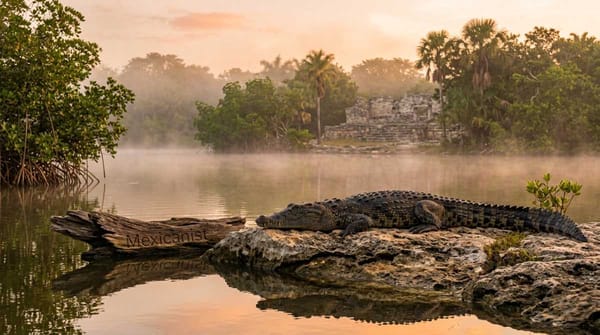
What he hadn’t mentioned was the humidity that crept through the walls each morning, the geckos that multiplied in every corner. Miguel had stopped noticing most of it. He’d stopped noticing a lot of things. His morning routine had calcified into ritual: wake at six, make café de olla in the clay pot his mother had given him, stand at the window and watch the water. The lagoon was never still. Even on windless days, something moved beneath the surface — a ripple, a disturbance, the shadow of Viejo, the ancient crocodile who lived in the deeper channels and surfaced each morning to sun himself on the limestone shelf across the way. Viejo was Miguel’s only regular companion. The crocodile didn’t ask questions about the Mexico City case. Didn’t care about his exile, his reputation.
The crocodile simply existed, a patient presence that had outlasted empires and would outlast Miguel too. This morning, Miguel poured his coffee and thought about the phone call that hadn’t come. His ex-wife was getting remarried next month. He hadn’t responded to the email. The apartment held evidence of a life interrupted. A kitchen with matching dishes for two. A bed too wide for one person. He touched the scar on his palm without thinking.
His mother had stitched it closed with red thread, telling him that wounds were just words the body hadn’t learned to speak yet. Outside, Viejo slid into the water with a quiet splash. The morning was beginning. Miguel’s phone sat silent on the counter, a black mirror reflecting nothing. He drank his coffee, waited for the day to need him, and tried not to think about how long he’d been waiting.
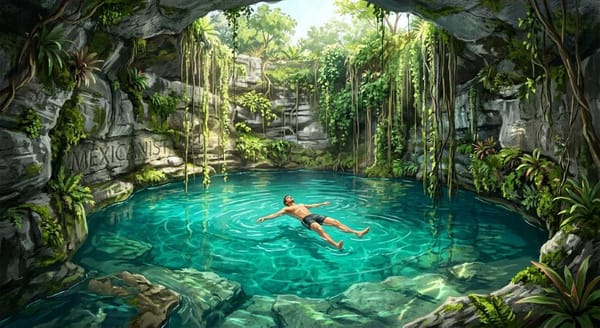
Seven meters below Cenote Azul’s limestone rim, sunbeams pierced the water in pale shafts. Claire Brooks watched them dance—emerald, sapphire—through water so clear it felt like swimming through the sky. It was November 1, the new moon. By right, the water should have been at its darkest, yet the surface glowed. She had seen this view on a dozen travel blogs: #CenoteAzul, #TulumParadise, #SwimWithTheMayas. The reality lived up to every filtered promise. The Yucatán had a way of doing that. Reality here was saturated, immediate, sharper than anywhere else she’d been.
Her husband, Nathan, dropped into the water with a whoop that reverberated off the ancient walls. The sound startled a pair of motmots from the tangled jungle above; their blue tails flashed as they vanished into the heat-shimmering canopy. Claire watched them go, one hand on the wooden ladder, the other adjusting her snorkel mask. Around her, tourists chattered in a polyglot of English, German, and what sounded like Russian.
A guide in a faded polo shirt explained, in heavily accented English, the Maya underworld—how these sinkholes were portals to Xibalba, demanding respect and caution. Claire had stopped listening. The water called to her, cool and clear, promising relief from the oppressive November heat pressing down even here, in this partial cave. She stepped off the ladder. The cold seized her breath, then released her into the water.
Beneath her, the limestone floor fell away into depths the sunlight barely touched. She saw fish—tiny, silver flashes—and the occasional turtle. She didn’t see the body caught in the submerged tree roots fifteen meters to her left, not yet. What she saw instead was Nathan, treading water near the far wall, his movements suddenly wrong—too still, too careful, the way her husband went still when he was working something out. He surfaced with a strange half-laugh.
“Honey,” he called, his voice bouncing off the cavern walls.
“There’s something down there that looks like—”
Then his face changed. The laugh died. He was staring at the water between them, at something Claire couldn’t see from her angle, and the expression on his face made her pull up her mask and look.
The blood was not much. Just a tendril, curling up from the depths like smoke, dispersing in the clear water. A faint, rust-colored cloud that caught the light and turned it wrong. Claire saw it at the same moment as the German couple to her left, at the same moment as the Russian woman who had been photographing the root formations. Everyone went still. The whole cenote went still, the way water goes still.
It was the guide who broke the spell. Claire heard him before she saw him—a shout in Spanish from the wooden platform above, his careful tourist-briefing voice entirely gone, replaced by something older and more urgent.
“¡Salgan del agua! ¡Todos, ahora!”
He was waving his arms, his face pale in the limestone light, his eyes fixed on the shadow below the blood—the shadow that Claire was now seeing, now understanding, the shape among the roots that her brain had been refusing for the last thirty seconds.
“Get out! Get out now!”
Something brushed Claire’s leg and she screamed—a high, thin sound that broke the last of the stillness—and then everyone was moving, splashing, thrashing toward the ladders, the water turning chaotic with foam and fear. Nathan grabbed her arm, pulling her toward the nearest wooden platform. Behind them, as Claire climbed the ladder with shaking hands, she heard the guide already on his phone, his voice low and rapid and nothing like the warmth of an hour ago. A German tourist’s iPhone hovered at the cenote’s edge, its screen catching the light—recording, always recording, the sacred water now framed as content.
The call connected.
Detective Miguel Manito’s phone rang exactly seventeen minutes after he poured his first coffee of the day - café de olla, with cinnamon and piloncillo, the way his mother used to make it. He let it ring twice - his ritual - before answering. “Manito.”
“Detective, it’s Officer Torres.” The voice on the other end was young, tight with tension. “We have a body. Cenote Azul, just off the 307. A tourist found it. It’s bad. They say it’s a crocodile attack.” Miguel tightened his grip on the phone.
His mother used to say that old wounds spoke up when the body was paying attention. The skin never lies. “Who’s on scene?”
“Local municipal police, but it’s in our jurisdiction. Captain Silva wants you there before the press gets wind. You know how it is with tourists.” Miguel knew it. A dead tourist eaten by a crocodile meant panic, headlines, and questions about whether the state police could keep tourism’s golden goose safe. Never mind that the crocodiles had been here first.
Never mind that they’d been here for millions of years. “I’ll be there in forty minutes,” Miguel said, though he knew it would be closer to thirty. He’d learned the back roads that GPS didn’t acknowledge. He dressed quickly - simple gray button-down, dark pants, worn leather boots that had seen more cenotes than most tourists had seen swimsuits. He strapped on his holster automatically, the weight familiar as breath.
As he left, he glanced at the framed photo by his door: himself younger, standing before UNAM’s law building, his mother’s hand on his shoulder. She’d been a translator. He’d inherited her facility with languages, though the Mexico City case had taught him that some divides couldn’t be crossed with words alone. The drive to Cenote Azul took him along Highway 307, the artery that pumped life through the Riviera Maya. To his right, the jungle pressed close, a wall of green, impenetrable until you knew where to look.
To his left, resorts rose like pastel fortresses, infinity pools hiding bulldozed ceiba trees. The tension was palpable even through the car’s closed windows - the weight of ancient limestone beneath the pavement, the spirits of the Maya that some said still guarded these waters, and the hunger of tourism that consumed everything in its path.
A hunger personified by developers like Eduardo Barcelo, whose name appeared in the fine print of every controversial zoning variance and offshore shell company Miguel had encountered since his ‘exile’ began. Barcelo was always profiting from the machine of the Riviera Maya - his Palladium Resort had swallowed three cenotes and a Maya village - never seen until you looked for him. He turned off at the sign for Cenote Azul, the handmade letters already fading.
The parking lot was a chaos of rental cars and tourist vans, a rental scooter on its side like an insect. Uniformed officers were already stringing yellow tape, their movements practiced but their faces showing the grimace of local cops who knew this was about to become something bigger than them. Officer Torres met him at the entrance, a young man whose mustache was patchy and earnest. “Detective. The, uh, the body’s still in the water. We thought - given the nature - you’d want to see it in situ before recovery.” Miguel nodded. Smart.
Few of the municipal officers would have thought of that. They’d have dragged the body out, destroyed evidence, and tried to make the problem go away. “Witnesses?”
“Group of tourists. They’re shaken up. The guide is with them, trying to keep them calm. And we have the ones who found the body - they’re over there.” Torres gestured toward a thatched-roof palapa where a cluster of pale, shocked faces stood clutching water bottles they weren’t drinking.
“Names?”
“Nathan and Claire Brooks. From Colorado. They contacted the US Embassy already. Or she did. On her phone, while we were still calling it in.” Miguel suppressed a sigh - the Americans were always quick to invoke their embassy. Of course they had, as if a dead body in a Mexican cenote required immediate diplomatic intervention. He made a mental note to call Captain Silva about containing the narrative before it spiraled. “Keep them here,” Miguel said.
“Don’t let them leave, but don’t make it feel like detention.
Offer them coffee, water, whatever. I want to see the scene first.” He walked toward the cenote’s edge, his boots crunching on the limestone gravel. The air changed as he approached, growing cooler and heavier with moisture. The sounds of the highway faded, replaced by the drip of water on stone and the rustle of jungle leaves. Even now, with yellow tape and uniformed officers, there was something sacred about the space. He stopped at the wooden railing that overlooked the water. The cenote was a perfect circle, maybe forty meters across, its surface as smooth as glass except where a fallen branch disturbed the reflection.
The water was so clear he could see the limestone shelves that terraced down into the depths, each shelf descending into deeper blue until depth consumed light and the water turned to absolute black. At the edges, tree roots snaked down the walls like gnarled fingers reaching for the water. “There,” said a voice beside him. One of the local officers, a man whose name tag read Gutiérrez. He was pointing toward a cluster of roots on the far side, about three meters down. “We can see him from here.
Him, or what’s left.” Miguel followed his gesture. At first, he saw only the play of light on water, the natural beauty that had drawn millions of tourists to these cenotes. Then his eyes adjusted - or perhaps his brain did - and he saw the shadow. It was indeed roughly human-shaped, curled among the roots in a way that suggested both embrace and entrapment. Even from this distance, he could see the dark cloud that still leaked from it, staining the pristine water. “How long?”
“Guide says they went in at ten.
Noticed the blood around ten-thirty. We got the call at ten-forty-two, and were on scene by eleven-fifteen.” So the body had been in the water at least two hours, maybe longer. In this heat, decomposition would accelerate. But the blood suggested recent trauma. Miguel’s mind was already working through the possibilities - each one a thread he would pull until the truth unraveled. “Get me Dr. Vásquez,” he said.
“I want her here before we move anything. And I need a dive team.
Not just anyone - get the team from Playa, the ones who work the reefs. They know how to preserve evidence underwater.” Gutiérrez nodded and moved off, already speaking into his radio. Miguel remained at the weathered wooden railing that overlooked the main pool of Cenote Azul, his eyes never leaving that shadow submerged near the limestone overhang. The air grew heavy - charged with something static, electrical. His scar began to pulse.
Suddenly, the old wound flared - a cold spark jumping the gap where barbed wire had once torn through childhood skin. His hand went to his left palm unconsciously, rubbing the raised tissue. The scar never forgets. It hadn’t pained him in years, but now it throbbed in time with a low buzzing in his ears, like a radio tuned between stations. He shook his hand out, dismissing it as humidity-induced arthritis - the kind that settles into old wounds in the Yucatán heat. He focused back on the water. Crocodile attack, they’d said. It was possible.
Morelet’s crocodiles were common in this region, though they typically avoided areas with this much human activity. But the dry season was approaching, and food could be scarce. A large male might venture into a cenote, especially one connected to the underground river system. It happened. But the details were already nagging at him. The body was intact enough to recognize as human. Crocodiles didn’t do that. They disarticulated, they dismembered, they left feeding signs that were unmistakable. And they rarely left their kills in the water.
They dragged prey to shore, secured it, and consumed it at leisure. The details were wrong. He turned his attention to the tourists in the palapa. The Americans - Brooks and his wife - sat apart from the others, their faces the shade of shock that Miguel associated with those who’d never encountered death unprepared. The wife was crying silently, her husband’s arm around her shoulders. He looked angry, not sad - angry at the violation, at the way this horror had intruded on their carefully curated adventure.
Miguel approached them, his movements deliberate, unthreatening. He’d learned early - in the streets of Iztapalapa, in the corridors of Mexico City - that his intensity could be intimidating, and while that had its uses, this wasn’t one of them. “Señor Brooks? Señora Brooks? I am Detective Manito. I need to ask you some questions.” The husband looked up, his eyes red-rimmed but focused. “You’re the lead investigator?”
“Yes.”
“We already told the other officers what we saw.”
“And I will need you to tell me as well.
Sometimes details emerge in the retelling. It helps.” Miguel pulled up a plastic chair, ignoring the way it wobbled on the uneven ground. He took out a small notebook - a simple police issue pad with blue lines. “Take your time. Start from when you arrived.” Claire Brooks wiped her eyes and began to speak, her voice thinned by trauma. “We got here at nine-thirty. Maybe nine-forty. We’d read about the cenotes, and wanted to see one that wasn’t completely overrun.
This one was supposed to be quieter.” “Quieter than the main ones,” Nathan added.
“Less Instagrammed. More authentic.” Miguel noted this without comment. The quest for authenticity had brought more people to these sacred sites than any marketing campaign. The irony was never lost on him. “How many people were here when you arrived?”
“Maybe ten? The guide, some other tourists. A family with kids. Europeans, I think.” Claire’s hands were trembling. “We got in the water. It was beautiful. So clear. I could see all the way to the bottom.
And then Nathan -” “I saw the shadow,” Nathan interrupted, wanting, Miguel recognized, to be the one in control of the narrative.
“Under the water, near those big roots on the far side. I thought it was just a log or something. But then Claire screamed, and I looked down and saw the blood. Just this little puff of it, like smoke. And I knew. I just knew.”
“What did you know?”
“That it was a body. That someone had died down there. You can just… you can feel it, can’t you? When something is that wrong.” Miguel could.
It was what made him good at this work, the ability to sense when the details of a scene were out of harmony. “Did you see anyone else? Anyone hanging around the edges, watching?” They hadn’t. They’d been too focused on the water, on their experience, on capturing the moment. Miguel asked a few more questions, gathering times, descriptions, the mundane details that would eventually form the architecture of his investigation.
When he finished, he gave them his card - plain, official, with the Quintana Roo State Police seal - and told them not to leave Tulum without informing him. As he walked back toward the cenote, Dr. Marisol Vásquez was arriving, her medical kit in one hand, a camera in the other. She was a compact woman in her mid-forties, her graying hair pulled back in a severe bun that seemed to Miguel like a statement of purpose.
She wore cargo pants and a breathable fishing shirt, practical clothes for work in the jungle heat. “Miguel.” She nodded, her dark eyes already scanning the scene. “Another day in paradise. Though I use that term loosely when there’s a body waiting for me.”
“Marisol.” He fell into step beside her. “They say crocodile attack. Body’s still in the water, caught in roots about three meters down on the far side.
I want to see it before your team moves it.”
“Of course you do.” She set her kit down on a stone bench that had been carved for tourists to sit on while they adjusted their snorkeling gear. “Walk me through what we know.” They stood together at the railing, and Miguel pointed out the shadow, the blood, the position. Marisol raised a pair of field glasses to her eyes, her expression giving away nothing.
She watched for a long minute, her breath steady. “That’s not crocodile feeding behavior,” she said finally, her voice crisp with professional certainty.
“Crocodiles take prey into a death roll. Disarticulates limbs. This body is intact enough to see the basic form. And the blood - if a croc had done that, there’d be more. Much more. This looks like post-mortem laceration, maybe some scavenger activity after death.”
“So he died elsewhere, was placed there?”
“Or died there, but the wounds aren’t the cause of death.
I need to get him out to be sure.” She lowered the binoculars. “But Miguel, there’s something else. I can see what looks like patterning. On the visible skin. Almost like marks. Deliberate marks.” Miguel felt the tightening in his chest. The details were accumulating, each one a thread pulling him away from the simple explanation of animal attack and toward something far more complicated. “What kind of marks?”
“Symmetrical. That would be unusual for random trauma.
Almost like” She paused, choosing her words carefully. “Almost like ritual scarification. But I need a closer look.” The dive team arrived then, four men in black wetsuits carrying equipment that seemed too modern for this ancient place. They spoke quietly with Marisol, planning the recovery. Miguel stepped back, his eyes moving over the scene with a methodical precision he’d learned in his criminal psychology courses and honed in the field.
He noted how the tourists clustered, how the local officers kept glancing at the body, how the jungle pressed in at the edges, indifferent to human drama. He noted the small shrine tucked into a natural alcove in the limestone wall. It held offerings: coins, a few peso notes, a wilting marigold, and a small wooden crocodile, crudely carved but recognizable. If Hudson were here, Miguel thought, he would see the pattern — a statement, not just a carving.
The absence of the American profiler felt heavier than the humidity; it made Miguel feel like a tool left out in the rain - a weapon without its scabbard. The details told him this wasn’t a random death. They told him the location mattered, that whoever had died here had died for a reason, even if that reason was currently hidden in the shadowy depths of the cenote. As the dive team prepared to enter the water, Miguel’s phone buzzed in his pocket. He glanced at the screen: Captain Silva. He silenced it.
Whatever the captain wanted, it could wait until they had the full picture. He turned back to the water. The body broke the surface, and the day seemed to grow darker. Miguel closed his notebook and took a step forward. The weight of what they had found pressed on his chest, his mind already turning the details over and over, searching for the pattern that would explain why a man had died in this beautiful, terrible, sacred place. He opened his message app. “Keep this quiet as long as you can. The governor’s office is already asking questions.
The Mayor needs to sleep tonight.” The third line flickered into existence, a notification that shouldn’t have been necessary. “Some things cost more to investigate than they do to ignore. Close the file, Miguel. It’s safer for everyone.” Miguel didn’t respond. He opened his message app anyway, typing and deleting: “Captain’s orders: keep it quiet.” Then he set the phone down screen-face up. If he had been working alone, he would have deleted it. With Hudson coming, it was part of the puzzle. A puzzle needed two hands to solve.
He watched as the first diver slipped into the water, barely disturbing the surface. The body would be recovered. Evidence would be collected. Statements would be taken. And somewhere in the accumulation of data, in the methodical sifting of fact from assumption, Miguel would find the truth. But even as he watched the diver approach the shadow among the roots, he felt the weight of something older pressing down.
The Maya had used these cenotes for sacrifices, offering bodies to the water gods, to the crocodile spirits that ferried souls to the underworld. Water that gave life could also take it. The diver reached the body. Through the water, Miguel could see him signal to his team. They had it. They were bringing it up. Miguel pulled out his notebook and began to write, his handwriting small and precise. He noted the time, the position, the witnesses’ names, the details that could be measured and quantified.
But in the back of his mind, he wondered about the look he’d seen in the guide’s eyes - not just shock, but recognition. As if this death, in this place, had a meaning that went beyond a simple animal attack. The crocodile, if there had been one, was nowhere to be seen. But the water kept its secrets. Miguel had a feeling he would need to learn to speak its language before this case was through.
Next Wednesday: Part 3 — The Man Who Reads the Dead An FBI profiler lands in Cancún with a pattern he's seen on another continent. He and Miguel have history. Now they have a case that rewrites both their frameworks — starting in the morgue.
Subscribe to get each chapter by email →
The Crocodile's Eye is a work of fiction. The cenotes, the covenant, and the crocodiles are real. The rest is what the water remembers.
© 2026 Mexicanist.com. All rights reserved. This work may not be reproduced, distributed, or transmitted in any form without prior written permission.