What the Maya H’men Knows That Your Doctor Doesn’t
A single h’men’s pharmacopeia may include more than 400 plant species. Prescriptions specify nine plumeria flowers, not eight or ten, because the number 9 is associated with women, and 13 with men. The h’men is not just a herbalist. He is a pharmacist with a cosmological dosing system.

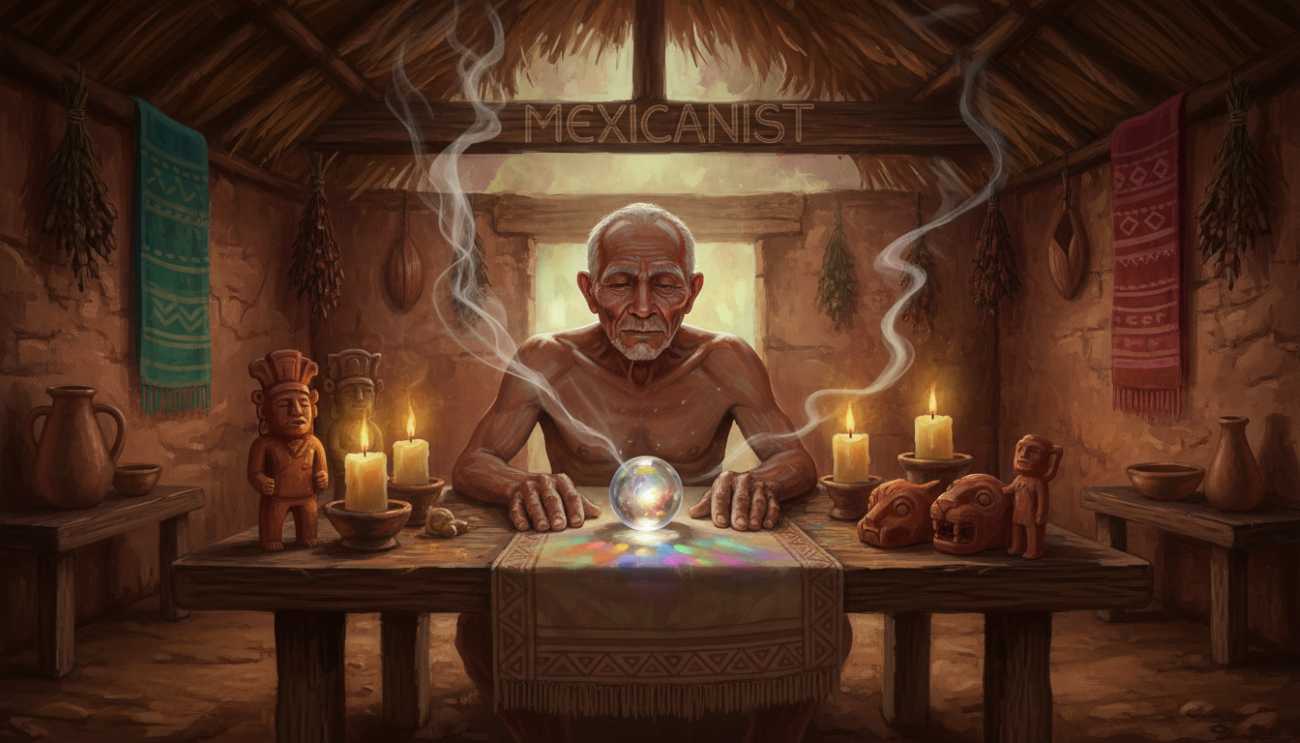
If you wander into a Yucatán village on a Wednesday or a Friday, you might notice an older man sitting in a modest home, waiting. He looks like any other grandfather in the community—white cotton shirt, sandals, a face lined by decades of milpa sun. But something is different. On his table, next to a glass of water, sits a clear glass marble the size of a walnut. He is an h’men, and that marble—a zaz tun, or “clear rock” —is his stethoscope, his MRI, and his hotline to the invisible world, all rolled into one. The h’men (also spelled j’men or h-men) is the Yucatec Maya spiritual practitioner, and he has been doing this work since long before the Spanish showed up with crosses and contracts. He is still doing it now.
The h’men is not a museum piece. He is not a relic preserved in amber for the benefit of cultural tourists with good intentions and better cameras. The h’men is a working professional—healer, diviner, agricultural ceremonialist, and spiritual mediator—who gets paid in chickens and cash to keep the border between the visible and invisible worlds from fraying. As Juan Lavadores Canto, a practicing j’men born in 1939 in Oxkutzcab, puts it:“To be a J-meen means finding peace between the visible and invisible aspects of the world.”That’s not a metaphor. That’s a job description.
What a H’men Actually Does
The term h’men translates literally from Yucatec Maya as “he who makes” or “he who does” —which, if you think about it, is the most pragmatic job title ever coined. No mystification, no grandiosity. Just: the one who gets things done. The female form is x-men (“she who makes”), and practitioners of both genders are collectively known as h-meno’ob. The h’men’s portfolio is sprawling: agricultural ceremonies to ensure rain and harvest, healing of both spiritual and physical illnesses, divination to diagnose what ails you, protection from evil winds (kakaz iko’ob) and sorcery, and community mediation between the human and spirit realms. Think of him as a GP, a meteorologist, a therapist, and a priest—except all four at once, and paid considerably less.
Wednesdays and Fridays are designated h’men days—the two days of the week when you can expect to find practitioners at home, available for consultation. The rest of the time, most h-meno’ob are working in the fields, because—and this is a detail that tends to get lost in the romanticization—they cannot live by their spiritual practice alone. As the linguist David Bolles, who spent years living among h-meno’ob in Yucatán, dryly notes:“Because H-Menoob must often work at other things it has become a custom to have Wednesday and Friday designated as H-Men days.”Even shamans have day jobs.
When a patient arrives, the h’men’s diagnostic toolkit is remarkably diverse. The most iconic method is zaz tun divination: the practitioner holds a clear glass marble, 2–5 centimeters in diameter, and reads the patterns of air bubbles and light trapped inside, aided by ritual chants. Some h-meno’ob always carry their zaz tun in a small pouch called a pauo. Others use padz (therapeutic massage) to physically feel the patient’s body for the site of illness. A few employ cards or dice—a European import that got folded into Maya practice with the same pragmatism that absorbed Catholic saints. But the truly powerful h-meno’ob, Bolles writes,“will know the site and type of ailment even before the patient enters to see the H-Men.”You walk in the door; he tells you what’s wrong before you open your mouth. That’s the gold standard.
The Maya concept of disease centers on imbalance between body and soul. Physical ailments—diabetes, asthma, snakebite, wounds, diarrhea—are treated with an extraordinary pharmacopeia of over 400 plant species documented by researchers. But the h’men also treats spiritual illnesses that no clinic can touch: mal aire (bad air/wind from kakaz iko’ob), mal de ojo (evil eye), susto (fright-induced soul loss), and pul ya (illness caused by sorcery). For these, you don’t go to the hospital. You go to the h’men. The two systems coexist without much friction; certain illnesses are understood as requiring the h’men, others the doctor. Some h-meno’ob use both traditional remedies and pharmaceuticals—penicillin alongside herbal infusions. It’s not either-or. It never was.
How the Role Is Inherited
Here’s where it gets genuinely weird—and by weird, I mean fascinating. There are three distinct paths to becoming an h’men, and they map onto three completely different theories of knowledge: you’re either born with it, called to it, or you learn it the hard way.
The Born H’men. When a baby starts kicking in the womb, a mother who knows the h’men tradition can read those movements. If the kicks carry the right signature, the mother buries a zaz tun—that same clear glass marble used for divination—in the back of the kitchen patio. When the child takes its first steps, legend says it will go directly to the buried marble and dig it up. That’s the sign. The child is destined to become an h’men and will need no further education, being born with the knowledge already inside them. Bolles, the scholar who documented this in detail, adds a characteristically dry observation:“The child born in the above situation is born into a family already strong in the H-Men tradition even if there is no practitioner in the family... It seems safe to say that for those ‘born’ H-Menoob who succeed that it is a case of self-fulfilling prophecy.”In other words: if you grow up in a household where everyone expects you to be a shaman, you become a shaman. The marble trick is just the universe’s way of making it official.
The Called H’men. Juan Lavadores Canto, the j’men from Oxkutzcab, was not born to the role. He was chosen. As a child, he was working in the milpa—the family cornfield—when a mysterious man appeared to him and instructed him in the spiritual path. This is the divine calling: dreams, visions, encounters with spirit beings that arrive uninvited and refuse to leave. The scholar Barbara Tedlock, who has spent decades studying Maya dream practices, documented that “little old men” appear to male healers in dream visions and “little old women” to female healers—spiritual guides who deliver diagnoses, treatment instructions, and initiation knowledge while the practitioner sleeps. The dream is not a symbol. It’s a conference call.
The Apprentice (Idzat). For those without womb-signs or visitations, there’s the hard road: years as an idzat, an apprentice and helper to a master h’men. The idzat learns through observation, through helping prepare medicines and set up ceremonies, through conversations with the master over months and years. Crucially, there is no formal graduation ceremony. Bolles writes:“I have yet to learn at what point an idzat graduates from his position and becomes acceptable to his community as a H-Men.”You don’t get a diploma. You simply reach a point where the community starts coming to you instead of your teacher. The people decide when you’re ready. It’s the original peer review.
The Ceremonies That Survive
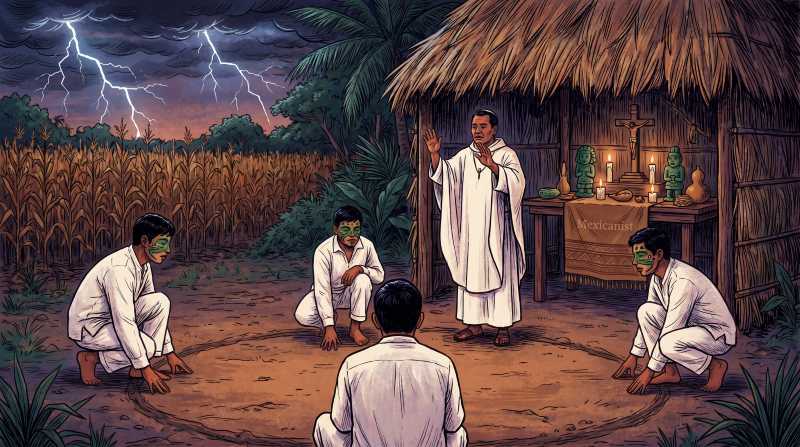
The h’men’s ceremonial calendar is not a list of fading customs performed for folklore festivals. These are working rituals, requested by real communities for real needs—and in the case of the Ch’a Cháak, experiencing an unexpected 21st-century revival driven by climate change.
The Rain Ceremony
This is the big one—the most elaborate communal ceremony in the h’men’s repertoire, and the one that makes the clearest case that we are not dealing with a museum exhibit. The Ch’a Cháak is a petition to Chaak, the Maya rain deity, and it is performed only in response to “crucial need that strikes simultaneously at everyone: the common anxiety produced by drought,”as Robert Redfield and Alfonso Villa Rojas wrote in their foundational 1934 ethnography, Chan Kom: A Maya Village. This is not routine. This is emergency prayer.
The ceremony lasts three days—compared to a few hours for other rituals—and requires the participation of every man in the village. The preparation is staggering: women grind corn all night to make masa and sikil (pumpkin seed paste); men dig an underground cooking pit (pib) lined with heated limestone blocks. The h’men and his apprentice erect a temporary ceremonial hut from freshly cut sticks with a huano palm-leaf roof, and inside it, they build the mesa—the ritual altar, a scaffold platform of saplings lashed together with vine, its center roofed with an arch of fresh jabin branches, leaves still attached.
On the first day, the men trek to a sacred cenote deep in the forest to collect zuhuy ha— “virgin water” —from a source that can be reached only by crawling through a dark, slippery tunnel about 30 meters long. Women are forbidden from this cenote. The h’men tells the men that this is where the chaacs—the rain spirits of the four cardinal directions—come to fill their calabashes before watering the young maize. Animal sacrifice follows: a turkey and four chickens, their blood offered to the gods in exchange for rain. Copal incense burns. Prayers invoke Chaak alongside Catholic saints—San Isidro, Santa Clara, San Lorenzo—in a fusion so seamless it makes the word “syncretism” feel too clinical. All of this is documented in the earliest detailed account by Thomas Gann, recorded in 1915.
And here’s the part that should make you sit up: in 2024, the Ch’a Cháak came back with a vengeance. Record drought—only 1.3 millimeters of rain fell in parts of Yucatán from May 1 to June 7, with temperatures hitting 43.7°C—drove communities in Yaxcabá and Sotuta to revive the ceremony with urgent intensity. J’men Idelfonso Yah Alcocer, 51, performed the rite in Sotuta and publicly condemned “fake” tourist shamans who perform diluted versions for paying visitors.“The erosion of our beliefs in front of our eyes is heartbreaking,”he told Mongabay.“If we fail to maintain our connection with the spirits who protect us, we will suffer the consequences.”Climate change, it turns out, is the most effective preservation program for endangered ceremonies. The gods are being called back by the heat.
Other Surviving Ceremonies
Beyond Ch’a Cháak, the h’men’s ceremonial portfolio includes the U Hanlí Kol (also called Wahil Kool), a field-blessing ceremony where the mesa is set with 13 drink offerings—four gourds of balché(sacred mead fermented from the bark of Lonchocarpus longistylus, honey, and zuhuy ha) placed at the four corners, plus nine cups of saka’(a maize drink)—the sacred number 13 echoing the 13 levels of the Maya sky. There’s the Jets ’Lu’um, a ceremony to “calm the land” before construction, increasingly performed when land is sold to outsiders—because, as Yucatán Today reports,“it is known and observed that if these ceremonies and offerings are not performed, the endeavors on these lands are often doomed: animals are lost, family and community problems come up.” The K’ex ceremony offers a chicken’s life“ in exchange” for a patient’s. The Looj purifies communities. The Táa’jche’ kindles sacred new fire. Each has its own prayers, its own mesa configuration, its own logic. None of them are optional—not if you want the world to keep working.
A Portable Cosmos
Every h’men ceremony revolves around the mesa—but calling it an “altar” is like calling the Sistine Chapel a ceiling. The mesa is a temporary, freshly constructed microcosm of the three-level Maya cosmos, built anew for each ceremony from saplings and vine. Its arch of jabin branches above represents the sky (Kan). Its surface, where offerings are placed, represents the earth (Kab). Below it lies the underworld (Xibalba). The four corners connect to the four cardinal directions and their associated Chacs, the rain spirits who hold up the sky like the Bacabs of Maya cosmology.
The objects on the mesa tell the entire story of Maya spirituality in miniature. A wooden cross with floral decorations and INRI lettering—the focal point of the arrangement—sits alongside pre-Columbian clay figurines (balamo’ob, or “sacred beings”) that were unearthed during road construction and claimed by h-meno’ob. Small homa gourds contain balchéor medicinal potions. Chuyub rings of bejuco vine support calabashes. Copal resin (pom) from the Protium copal tree burns on charcoal in an incense burner. The zaz tun sits ready for divination. Zip che brooms (Bunchosia glandulosa) are used to “sweep” sickness during the santiguar cleansing ritual. Virgin vigil candles are lit— “almost any spiritual act requires the lighting of at least one vigil candle,”Bolles writes. The total effect is not Catholic, not pre-Hispanic, and not some halfway compromise. It is something new: a 500-year-old conversation between two worlds, conducted on a tabletop built of fresh-cut branches.
Plants, Numbers, and the Doctrine of Signatures
A single h’men’s pharmacopeia may include more than 400 plant species. That is not a typo. Four hundred. Documented across centuries by researchers from Narciso Souza Novelo, whose Farmacopea Maya was the first formal record of Maya medicinal plant knowledge, to the Scientific Research Center of Yucatán (CICY), which continuously documents recipes and planting recommendations today. What makes Maya plant medicine distinctive is not just the species, but the system behind them.
The doctrine of signatures—the idea that a plant’s appearance reveals its medicinal use—operates with elegant consistency. Yellow-flowered plants treat “yellow” diseases like K’an chik’in (jaundice). Red-toned plants treat “red” ailments like Xeej k’i’ik’(vomiting blood). Plants with “Kaan” (snake) in their Maya names are used for snakebite. But the numerological dimension is where it gets truly intricate: remedies specify exact quantities—nine plumeria flowers, nine basil leaves, nine corn grains—because the number 9 is associated with women, and 13 with men. Infusions are boiled for 7 or 13 minutes. Prescriptions specify a particular day of the week (usually Fridays), time of day, or lunar phase. The h’men is not just a herbalist. He is a pharmacist with a cosmological dosing system.
Table 1: Key Medicinal Plants in H’men Practice
Maya Name | Scientific Name | Use |
Pool Kuts | Asclepias curassavica | Cancer, toothache, skin rashes, wounds |
X-k’anan | Hamelia patens | Pimples, rashes, scabies, smallpox |
Nej miis | Heliotropium angiospermum | Diarrhea, gastroenteritis, evil eye |
X-kakaltun | Ocimum micranthum | Fevers, diarrhea, measles; wound disinfectant |
Pichi’ | Psidium guajava | Diarrhea, skin rashes; stimulates breast milk |
Cabal muk | Rauvolfia tetraphylla | Hemorrhages, fungi, warts, infections |
X-tu’ja’abin | Senna atomaria | Fever, hemorrhages, night sweats, bad air |
Pomol che’ | Jatropha gaumeri | Wounds, stomachache; blood coagulant |
Dreaming with the Saints
If you attend an h’men ceremony and hear invocations to Dios, Santa Clara, San Isidro, and San Lorenzo mixed seamlessly with appeals to Chaak, the Chacs, and the Yuumtsilo’ob (Lords of nature), you might conclude that the Maya simply pasted Catholic saints over their old gods and called it a day. That’s the lazy version. The real story is stranger and more interesting: the Maya integrated Catholic ritual into their cosmology rather than replacing their beliefs. The cross on the mesa? The Maya foliated cross predates Christianity by centuries and represented the world tree (Yaxche, the ceiba). When Catholic crosses arrived, they were readily adopted—not because the Maya abandoned their own symbolism, but because the two symbols were already speaking the same visual language.
The Virgin of Izamal—the most important Catholic figure in northern Yucatán, patroness and healer during natural disasters—has clear connections to the pre-Conquest deity Itzamna, who was revered at the same site. Vigil candles, which Bolles notes are “a common feature of Yucatecan rituals and ceremonies... not limited to being used by H-Men alone,”bridge both traditions effortlessly. The h’men’s chants mix Maya and Spanish/Latin invocations in a single prayer. As Nicholas Wallace’s study of Izamal demonstrates, syncretism in Yucatán operates through four mechanisms: saint veneration, festival mapping (Maya ceremonies mapped onto Catholic feast days), ritual fusion, and pilgrimage to shared sacred sites. This is not hybridization. It is a 500-year operating system update that never crashed.
The numbers back this up, at least directionally. Mexico’s 2020 census shows 77.7% of the national population identifies as Catholic, but in Maya communities, dual religious practice is not the exception—it is normative. The Joshua Project describes Yucatec Maya as “almost entirely Roman Catholic” while also maintaining“pre-Columbian practices that have been integrated with Catholic ritual.”No quantitative survey has ever measured the exact percentage of Maya who practice both traditions simultaneously, because in the communities themselves, the question doesn’t quite make sense. You don’t “practice both.” You practice.
The Dark Mirror
Every tradition has its shadow, and the h’men’s is the ajpuul yaaj—literally,“one who throws illness.”But here’s the twist: the ajpuul yaaj is not a separate tradition. It is a j’men who has, as the Yucatán Magazine reported in 2025,“crossed to the dark side.”Same knowledge, same training, same toolkit—applied to harm instead of healing. The ajpuul yaaj can transform into a wáay, a spirit animal: wáay chivo (goat), wáay koot (eagle), wáay peek’(dog), wáay toro (bull, the most feared), wáay mis (cat, the snoop). In trance, the practitioner enters the animal’s perception; injury to the animal affects the human body directly.“My grandfather was a brujo and I would see him suddenly in his hammock, starting to twist and turn,”one local recalled.“At that moment it was because he was seeing through his animal, through his wáay.”
The methods of harm are specific and unsettling: wax images of victims stuck with needles, an X-Tun (sharpened stingray stinger or bone awl) “thrown” to pierce a victim’s organs from a distance, circles of plumeria flowers placed on paths for harmful incantations. The anthropologist Alberto Velázquez Solís of the Intercultural University of Campeche, who has documented this tradition extensively, notes that there are “some versions that say to succumb to the shadow, one must even kill.”Fewer than 50 active ajpuul yaaj practitioners remain, most over 50 years old. Their knowledge is being transmitted less and less to new generations. Even the dark side is dying.
A Tradition in Peril
Here is the data, and it is not cheerful. No precise census of practicing h-meno’ob exists—they are not counted as an occupational category in Mexican censuses, and the registries maintained by INPI (National Institute of Indigenous Peoples) and IMSS are incomplete. PAHO/WHO reports that Mexico has a national registry of approximately 2,500 traditional medical practitioners across all ethnic groups, but this covers curanderos, sobadores, parteras, and hueseros nationwide—not h-meno’ob specifically. The exact number of h’men practitioners is, in the words of a 2023 Nature Scientific Reports paper,“currently unknown.”
What we do know is that the linguistic substrate supporting the tradition is eroding. Yucatec Maya speakers in Yucatán state fell from 537,618 in 2010 to 482,667 in 2020—a decline of 10.2%, or nearly 55,000 speakers lost in a single decade. Across the peninsula, approximately 757,623 Maya speakers remain. Yucatán has the highest percentage of indigenous language speakers in Mexico at 39.7%, and 65.4% of the population self-identifies as indigenous. But the direction of travel is clear.
Table 2: Maya Language Speakers in the Yucatán Peninsula (INEGI 2020)
State | Maya Speakers (2020) | Decline Since 2010 |
Yucatán | 482,667 | -10.2% (-54,951) |
Quintana Roo | 190,446 | — |
Campeche | 84,510 | — |
Peninsula Total | ~757,623 | — |
National Total (Maya) | 774,755 | — |
In March 2024, the Autonomous University of Yucatán (UADY) declared Maya traditional medicine “in danger of extinction” due to “the shortage of traditional Mayan doctors caused by globalization itself and the migration of apprentices.”Herbal medicine knowledge is concentrated in people over 35. And the occupational shift is devastating:“If they are bricklayers, they will not do the Ch'a 'Cháak ceremony for rain; their work no longer needs this ceremony,” as one researcher studying Huhíput it. When you stop farming, you stop needing the rain ceremony. When you stop needing the rain ceremony, you stop needing the h’men. The logic is brutally simple.
On the legal front, Mexico’s Constitution Article 2 recognizes indigenous peoples’ right to preserve their languages, knowledge, and cultural identity. The General Health Law acknowledges traditional medicine as a valid option for prevention and care. In February 2026, legislators introduced a bill to recognize and regulate indigenous healing practices, and Senator Susana Harp spearheaded a reform to protect traditional midwifery. In August 2025, the first Indigenous Traditional Clinic opened at an IMSS Bienestar Hospital in Vícam, Sonora—for the Yaqui Nation. Yet no Yucatán-specific state law recognizing h-meno’ob, and no formal health system integration program for Yucatán’s traditional healers, has been established. The state with the highest concentration of Maya speakers in Mexico has the least institutional infrastructure to support them.
Climate Change and the Return of Ch’a Cháak
If there is a paradox in this story, it is that climate change—the same force driving young people from the milpa to the construction site—is also reviving the very ceremonies that urbanization threatens. The 2024 drought was the worst in 50 years. Parts of Yucatán received just 1.3 millimeters of rain over five weeks. Crops failed. Farmers despaired. And the h-meno’ob were called. J’men Idelfonso Yah Alcocer in Sotuta, community leader Eliezer Mendez Díaz in Yaxcabá, and J’men Abelardo Tut Uicah all performed Ch’a Cháak ceremonies documented by Mongabay. The ritual, which a few decades ago was performed at the four cardinal points of every village, had dwindled to “one or two rituals a year” in neighboring communities. Desperation brought it back.
But the revival comes with a complication: tourism. Chichén Itzádrew approximately 2.6 million visitors in 2024. Some hotels employ j’meno’ob for welcome rituals; Chablé Hotels and Hermano Maya in Izamal offer healing experiences to visitors. Hacienda Chichén’s Sacred Ceremonial Center, donated to the KUCH KAAB Y’ÉETEL J’MEN MAAYA’OB council, is listed among National Geographic Travel’s Top Wellness Centers. The economic incentive is real: tourism provides income that makes it possible for some h-meno’ob to continue practicing. But the distortion risk is equally real. Alcocer’s condemnation of “fake” shamans performing tourist versions of the Ch’a Cháak was not abstract concern. It was a warning from a man watching his sacred tradition become entertainment for paying visitors, performed by people who never crawled through a 30-meter tunnel to collect virgin water from a sacred cenote. There is a word for what happens when a ceremony loses its meaning while retaining its form. The word is “theater.”
The h’men tradition is not dead. Let’s be clear about that. H-meno’ob are present in almost all Maya communities. The KUCH KAAB council, presided over by Don Valerio Canché Yah, continues to organize ceremonies and teach young Maya their healing arts. The Intercultural Maya University of Quintana Roo has collaborated with j’men Juan Lavadores Canto since 2007, creating an institutional pathway for knowledge transmission that doesn’t depend solely on the birth-apprentice-dream triad. UADY students have enlisted their elders to document and preserve traditional knowledge. The Maya Foundation In Laakeech supports preservation efforts.
But the math is unforgiving. The tradition is transmitted orally, practitioner to apprentice, across generations that are growing shorter. Most active h-meno’ob are elderly. The ajpuul yaaj tradition is dying even faster—fewer than 50 practitioners, all over 50. Language loss, urbanization, and occupational shift are doing what 500 years of colonial pressure could not: making the h’men unnecessary in the eyes of his own community’s children. Not because the ceremonies don’t work. Because the world they were designed for—a world of milpas, sacred cenotes, and communities that live and die by the rain—is disappearing.
The 2024 drought revival of the Ch’a Cháak suggests a stubborn, adaptive resilience. The tradition has survived the Conquest, the Inquisition, the Caste War, and the construction of the Cancún hotel zone. It is surviving climate change, too, in its way. But survival is not the same as flourishing. The h’men will continue as long as there are Maya communities that need rain, fear bad winds, and believe that some illnesses cannot be cured by pills alone. How long that is—well, that depends on how long the milpa lasts, and how long the rain keeps not falling, and how long it takes before even the most skeptical farmer decides that maybe, just maybe, the old man with the glass marble deserves one more chance.
Sources
Bolles, David.“The Shamans of Yucatan, Mexico.”Mexicolore, 2021. https://www.mexicolore.co.uk/maya/home/maya-shamans-of-yucatan-mexico/1000
Bolles, David. FAMSI Grant Report: H-Men Chants. Foundation for the Advancement of Mesoamerican Studies. https://www.famsi.org/reports/96072/index.html
Love, Bruce. Maya Shamanism Today: Connecting with the Cosmos in Rural Yucatan. Labyrinthos, 2004 (rev. ed. Mesoweb, 2012). https://www.mesoweb.com/publications/Love/Shamanism-lores.pdf
Love, Bruce.“Wahil Kol: A Yucatec Maya Agricultural Ceremony.”Estudios de Cultura Maya, 2013. https://www.academia.edu/128604984/
Redfield, Robert & Villa Rojas, Alfonso. Chan Kom: A Maya Village. Carnegie Institution of Washington, 1934.
Gann, Thomas.“The Chachac or Rain Ceremony.”Proceedings of the Nineteenth International Congress of Americanists, 1915/1917.
Kunow, Marianna Appel. Maya Medicine: Traditional Healing in Yucatán. University of New Mexico Press, 2003.
Roys, Ralph. Ethnobotany of the Maya. 1931.
Souza Novelo, Narciso. Farmacopea Maya. Instituto Técnico Agrícola Henequenero.
Tedlock, Barbara.“The Role of Dreams and Visionary Narratives in Mayan Cultural Survival.”Ethnos 20:4, 1992.
Wallace, Nicholas A.“A Syncretic Religion: Maya and Catholic Practice at Izamal.”HistoricalMX. https://historicalmx.org/items/show/209
Rosado-May, Francisco & Lavadores Canto, Juan.“Un Jmen Colaborando con la Universidad Intercultural Maya de Quintana Roo.”2018. https://www.researchgate.net/publication/329896333/
Mongabay.“Record Drought in Yucatán Prompts Revival of Ancient Maya Rain Ceremony.”August 29, 2024. https://news.mongabay.com/2024/08/record-drought-in-yucatan-prompts-revival-of-ancient-maya-rain-ceremony/
Yucatán Today.“Guardians of the Invisible: The J-meenes or Maya Medicine Men.”https://yucatantoday.com/en/blog/the-j-meenes-or-maya-medicine-men
Yucatán Today.“Traditional Maya Medicine in Yucatán.”https://yucatantoday.com/en/blog/traditional-maya-medicine-in-yucatan
UADY.“Traditional Mayan Medicine in Danger of Extinction.”March 2024. https://en.uady.mx/noticias/url/traditional-mayan-medicine-in-danger-of-extinction
Velázquez Solís, Alberto. In Yucatán Magazine,“The Dark Side of Maya Magic: Understanding the Ajpuul Yaaj.”November 17, 2025.
Berger-González, M. et al.“Maya Healers’Conception of Cancer.”PMC/NIH. https://pmc.ncbi.nlm.nih.gov/articles/PMC5495444
INEGI. Censo de Población y Vivienda 2020. https://www.inegi.org.mx
PAHO/WHO. Legal Status of Traditional Medicine and Complementary/Alternative Medicine. https://www.paho.org/sites/default/files/pm-whotraditional_medicines_legal_status_0.pdf
Flores Guido & Balam.“Importance of Plants in the Ch’a Chaak Maya Ritual.”Journal of Ethnobiology 17(1), 1997.
Boccara, M.“El arte suhuy de Juan Cob, h-men de Yaxcabá.”Salud Colectiva/SciELO. https://www.scielosp.org/article/scol/2017.v13n3/429-442/
Kuk, Eduardo (ed.). Entre el ajpuul yaaj y el jmeen. Astra Editorial, 2025.
Faust, Betty.“Cacao Beans and Chili Peppers: Gender Socialization in the Cosmology of a Yucatec Maya Curing Ceremony.”Sex Roles Vol. 39, Nos. 7-8, 1998.