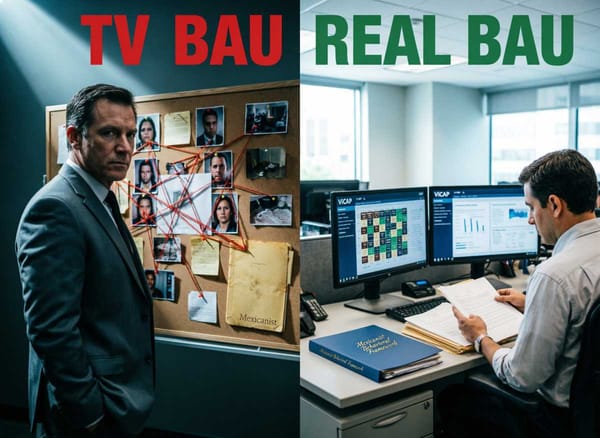
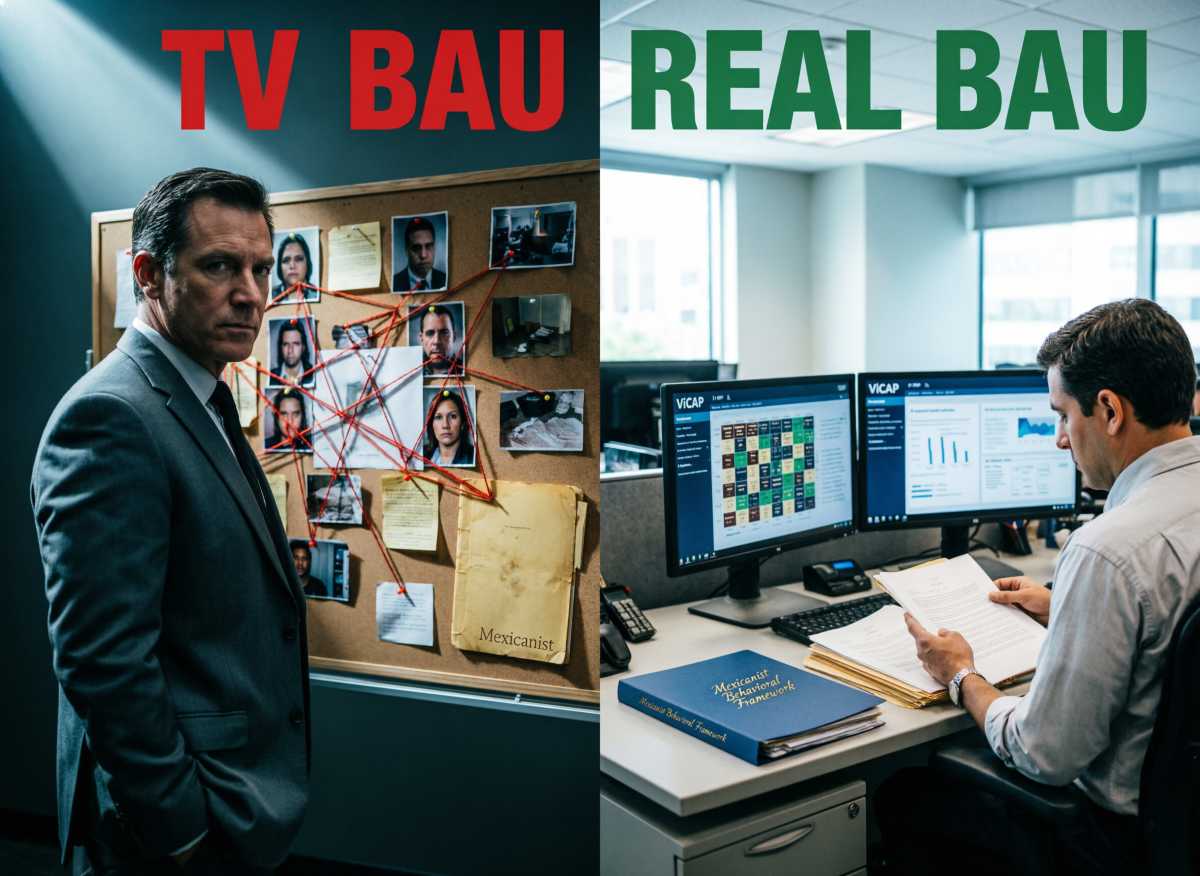
What Does an FBI Behavioral Profiler Actually Do? The Real BAU vs. the TV Version
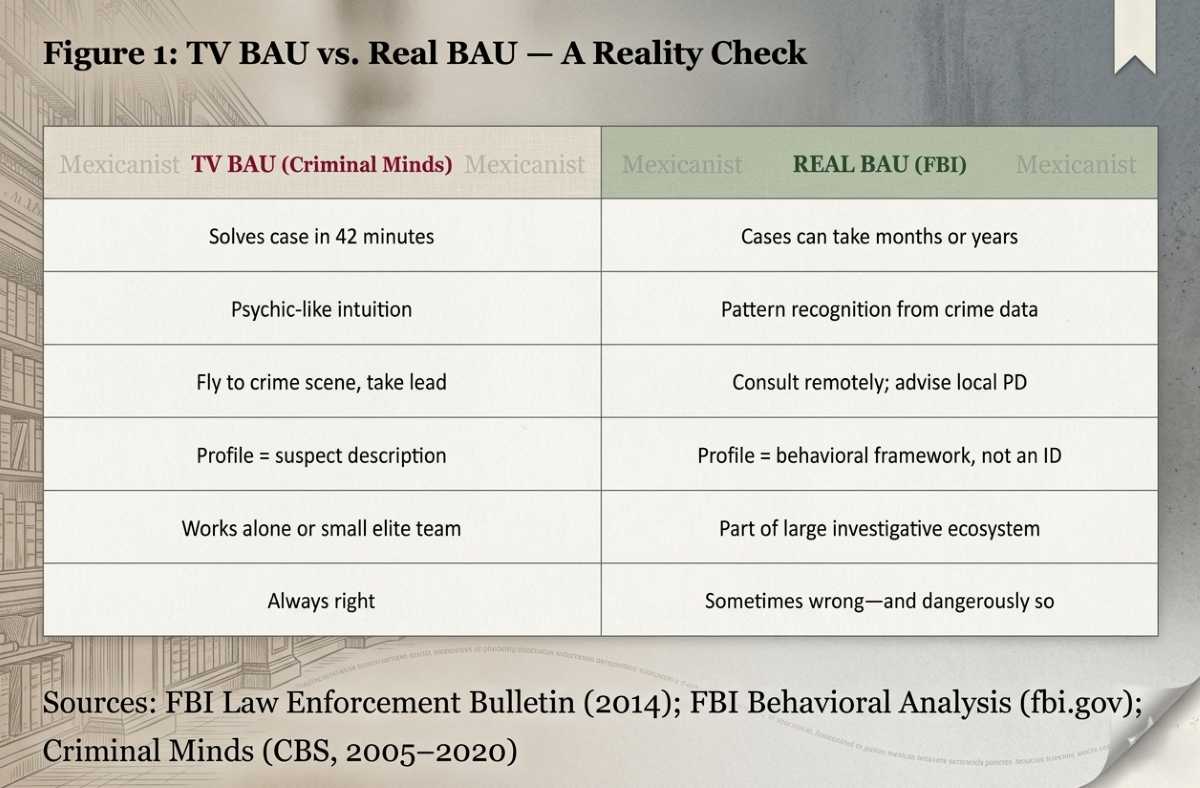
TV profilers solve crimes in 42 minutes. Real ones sometimes don’t solve them at all. FBI profilers aren’t psychic detectives—they’re data analysts who narrow the search. And when they’re wrong, the consequences are lethal.

You just read that an FBI profiler helped track down a cartel boss. The subtext of that headline? That behavioral science is a scalpel—precise, incisive, almost clairvoyant. The reality is closer to a flashlight in a very dark room. FBI profilers don't catch criminals. They narrow the search. Sometimes they narrow it to the wrong person.
That distinction—between the Hollywood profiler who stares at a crime scene photo and announces the killer's zip code, and the actual analyst who spends weeks poring over case files to produce a behavioral framework—is the difference between compelling television and credible law enforcement. And if you're following organized crime in Mexico, understanding that gap isn't academic. It's the difference between informed skepticism and dangerous faith.
The "Wait, What?" Moment
Profiling isn't prediction. It's pattern recognition. And patterns lie.
The FBI's own Law Enforcement Bulletin—the Bureau's internal training publication—addressed this directly in a 2014 article written by two behavioral analysts: "The Behavioral Analysis Team led by Aaron Hotchner on Criminal Minds gives viewers the false impression that each character on the show possesses some unique, specialized—perhaps, bordering on psychic—insight into offenders' minds." The authors, J. Amber Scherer and Dr. John P. Jarvis of the FBI's Behavioral Research and Instruction Unit, were not trying to be cute. They were trying to correct a misunderstanding that had been calcifying for three decades, ever since Thomas Harris published The Silence of the Lambs in 1988 and Jonathan Demme's 1991 film adaptation made Clarice Starling a cultural icon.
The FBI's Behavioral Analysis Unit (BAU)—created in 1972 as the Behavioral Science Unit—does not do what television shows depict. According to the FBI's official description, BAU experts provide three core services: criminal investigative analysis (examining offender motivation, victim selection, and crime sequence); interview strategy (applying behavioral principles to interrogations); and threat assessment (analyzing whether an individual is moving toward violence). Notice what's missing: there is no “I can tell you what the unsub looks like” service. The BAU builds behavioral frameworks—not suspect sketches. These frameworks help local police prioritize leads, not replace detective work.
So what does this mean for readers following cartel news? When a headline says “profiling helped catch X,” the reality is usually that behavioral analysis was one thread in a massive investigation—one that included wiretaps, informants, forensic evidence, and old-fashioned police work. Profiling was never the hero. It was the compass—and compasses, as any sailor will tell you, point in a direction, not to a destination.
How It Actually Works
Criminal profiling has three recognized methodologies, each with distinct philosophical underpinnings and real-world applications. Understanding them is essential for evaluating any claim about behavioral analysis—whether it's applied in Virginia or Veracruz.
1. Criminal Investigative Analysis (CIA) — The FBI's Method. Developed by FBI agents John Douglas, Robert Ressler, and Ann Burgess in the late 1970s, this is the approach most Americans think of when they hear “profiling.” It classifies offenders by analyzing key features common to their crimes—building on the famous “organized vs. disorganized” offender typology. The FBI's Violent Criminal Apprehension Program (ViCAP), established in 1985, is the operational backbone: a national database that enables analysts to compare violent crime cases, link serial offenses, and identify behavioral patterns across jurisdictions. In the US, UK, and Spain, CIA-style profiling is estimated to be used in approximately 1,000 cases per year, though the vast majority involve serial or sexual violence—not organized crime.
2. Investigative Psychology (IP) — The Academic Approach. Developed by British psychologist David Canter in the 1990s, IP relies on empirical data and statistical rigor rather than clinical intuition. It uses a five-factor model to analyze criminal behavior: Interpersonal Coherence (how the offender interacts with others), Significance of Time and Place, Criminal Characteristics, Criminal Career, and Forensic Awareness. IP uses tools like Multidimensional Scaling (MDS) to map behavioral patterns mathematically. It's less dramatic than the FBI's method—but it's more grounded in actual science.
3. Crime Action Profiling (CAP) — The Pragmatic Approach. Developed by Australian forensic psychologist Richard Kocsis, CAP draws on forensic psychology and personality theory but only deploys profiling when it directly benefits an investigation. It's the most conservative of the three—appropriate, perhaps, for skeptics who want the tool used sparingly and with caution. In Latin American contexts, where institutional trust is often fragile, CAP's restraint-first philosophy has theoretical appeal.
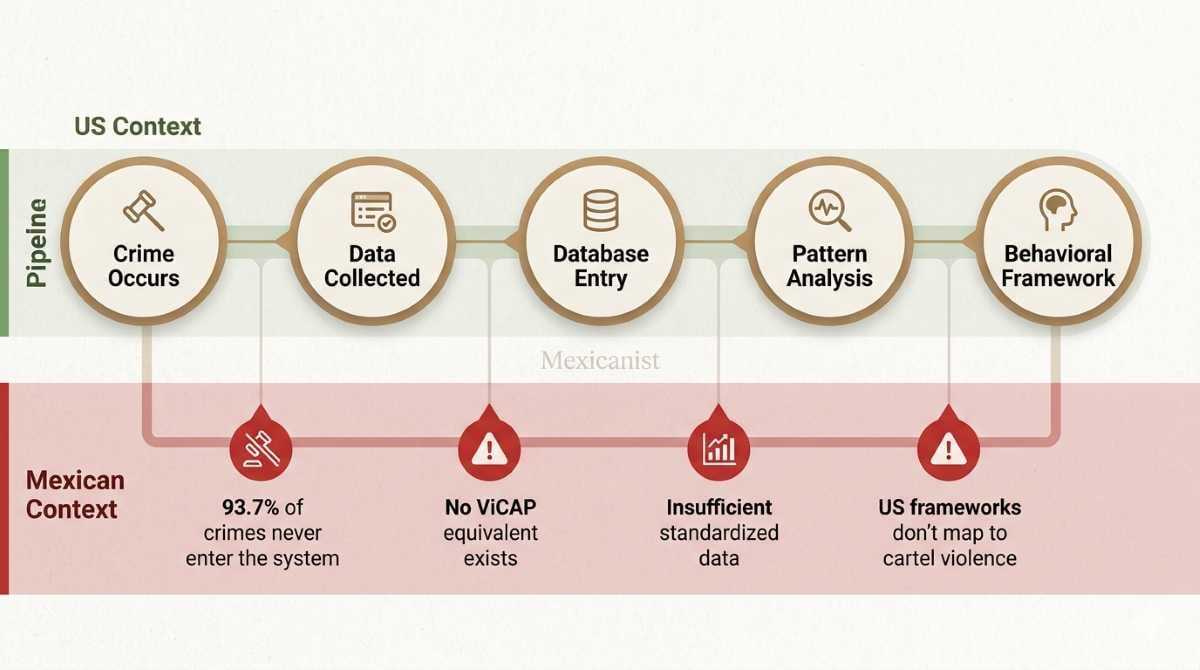
For Mexico, the question isn't which method is best—it's whether any of them can function without the data infrastructure they require. ViCAP works because US law enforcement agencies input case data consistently. In Mexico, where an estimated 93.7% of crimes go unreported or uninvestigated, according to the 2016 National Survey on Public Security and Victim Perception (ENSIPE), the raw material for behavioral analysis barely exists. You can't find patterns in data that was never collected.
The Limits (With Receipts)
Here's what the BAU's most passionate defenders rarely say out loud: the scientific foundation of criminal profiling is incomplete. A 2021 systematic review published in the International Journal of Law and Psychiatry by Rita Alexandra Brilha Ribeiro and Cristina Branca Bento de Matos Soeiro examined eight studies on profiling validity and concluded with devastating clarity: "Findings reveal that this forensic technique is as yet to be statistically validated." The authors noted that pre-existing validation attempts suffered from major methodological problems—small samples, inconsistent definitions, and the reluctance of profilers themselves to submit their methods to experimental scrutiny.
Then there's the landmark 2007 meta-analysis by Brent Snook, Joseph Eastwood, and colleagues, published in Criminal Justice and Behavior. It found that self-labeled profilers were not significantly better at predicting offense behaviors than comparison groups—including college students and non-profiler police officers. Let that sink in: trained FBI profilers, in controlled studies, did not outperform undergraduates at predicting what an offender would do next. This doesn't mean profiling is worthless. It means it's a human tool with human limitations—not a superpower.
"Findings reveal that this forensic technique is as yet to be statistically validated."
— Ribeiro & Soeiro, International Journal of Law and Psychiatry (2021)
The DC Sniper Case
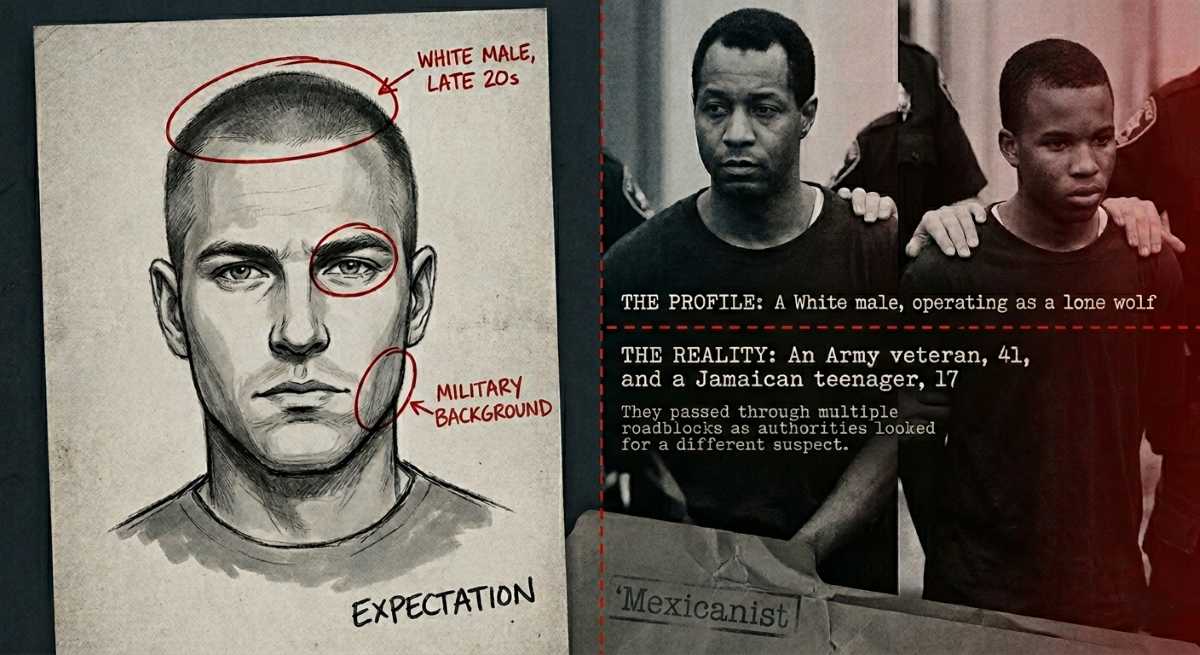
In October 2002, the Washington, D.C. area was paralyzed by a string of seemingly random sniper attacks that killed ten people over three weeks. Multiple profilers—both independent consultants and those advising law enforcement—converged on a consensus: the shooter was a white male, acting alone, probably in his twenties or thirties, likely a “loner” with military training. They were wrong on almost every count. The actual perpetrators were John Allen Muhammad, a 41-year-old Black Army veteran, and Lee Boyd Malvo, a 17-year-old Jamaican-born accomplice. They were not alone—they operated as a duo. They were not white. And the profiling errors had tangible consequences: because roadblocks were set up looking for a white male in a white van, Muhammad and Malvo passed through multiple checkpoints with the murder weapon still in their car, according to CNN's analysis of the investigation. The profilers weren't just wrong—their wrongness let the killers slip through the net.
This case matters for Mexican readers for a specific reason. Profiling errors don't just waste time—they redirect resources toward innocent people. In a country where wrongful arrests are already a systemic problem and where racial and class biases shape police behavior, flawed behavioral analysis imported from the US could amplify existing injustices rather than correct them.
The Mexican Data Desert
So—does Mexico use FBI-style behavioral profiling? The short answer is: not in any systematic, institutionalized way. The longer answer reveals why, and it has everything to do with infrastructure, not interest.
Mexican academia is producing criminal profiling specialists. UNAM's Faculty of Higher Studies Acatlán runs a criminal profiling program. Institutions like UDAVINCI and SECUIEP offer graduate degrees in forensic science and criminal profiling. The field is growing. But academic training does not equal operational capacity. The 2022 paper "Why Global North Criminology Fails to Explain Organized Crime in Mexico", published in the European Review of Organised Crime, argued that uncritically importing theories from the US or Western Europe to analyze Mexican crime "is detrimental to scientific knowledge's advancement" and reinforces misconceptions about the phenomenon. The paper's author noted that aspects of Mexican organized crime that dominant theories either disregard or misinterpret are actually more visible in Mexico than elsewhere—meaning the theoretical frameworks themselves are inadequate, not just the data.
The Small Wars Journal's 2025 analysis of Mexico's intelligence reform was more blunt. The state, the analysis argued, requires a constant flow of data—fingerprints, ballistics, DNA, financial records, geographic crime mapping, telecommunications intercepts—to build the kind of behavioral profiles that US agencies produce. Without this integrated base of information, it is impossible to identify patterns, anticipate dynamics, or design strategic responses. It condemns the state to a reactive rather than preventive role. The analysis concluded that the absence of intelligence “has had devastating consequences,” allowing criminal groups to maintain enduring advantages over institutions.
A 2016 survey by Mexico Evalua found that only 10.5% of crimes were reported, only 59.6% of those reports led to investigations, and only 54.1% of those investigations produced results. Do the math: roughly 3.4% of all crimes in Mexico result in any investigative action. You cannot build behavioral profiles on 3.4% of the evidence. The FBI's ViCAP database, by contrast, aggregates thousands of cases from federal, state, local, and tribal law enforcement agencies nationwide—and even then, participation is voluntary and uneven.
"Without this integrated base of information, it is impossible to identify patterns, anticipate dynamics, or design strategic responses. It condemns the state to a reactive rather than preventive role."
— Small Wars Journal, “Spy Law or Blind State?” (2025)
The Baker Institute's 2025 analysis of Mexico's security approach under the López Obrador administration detailed how the “hugs, not bullets” policy weakened police, judicial, and prosecutorial capacity, leaving critical gaps. The FBI currently maintains over 6,000 cases targeting transnational criminal organizations, with over 850 linked to cartel leadership—but these cases are built on US-side intelligence, not Mexican behavioral analysis. When the FBI does operate in Mexico, it brings its own data, its own analysts, and its own methodology. Mexican agencies are partners in name; in practice, they often lack the capacity to independently produce the kind of analysis that BAU-level work requires.
So what does this mean for readers following cartel news? When a headline announces that “FBI profiling led to a cartel arrest,” understand that the profiling was almost certainly done from Virginia or Quantico—using US-collected intelligence, not Mexican crime scene data. Mexican investigators were likely providing access and coordination, not behavioral analysis. This isn't a criticism of Mexican law enforcement; it's a description of a structural reality that no amount of Netflix-watching can fix.
The Science Pushes Back
Academic pushback against criminal profiling has intensified over the past two decades, focusing on three interconnected concerns: reliability, cultural bias, and ethical application across borders.
On reliability: the Ribeiro & Soeiro (2021) systematic review found that most profiling studies measure only “face validity”—whether experts believe the technique works—rather than predictive validity, which tests whether it actually does. Face validity is the weakest form of scientific evidence; it asks practitioners if they think their own tool is useful, which is like asking a psychic if they think they're psychic. The American Psychological Association's standards explicitly note that face validity is not considered a legitimate form of validity by most measurement theorists. Profilers, the literature suggests, have been remarkably resistant to allowing their abilities to be tested under controlled conditions—a red flag that shouldn't be ignored.
On cultural bias: a 2023 review published in Policing & Society examined racial and ethnic bias in investigative decision-making across seven case studies. It found that assessments were often based on “unstructured judgments and profiling grounded in cultural, religious and racial stereotypes.” The implications for cross-border application are stark: a profile developed from predominantly white, American serial killers may be worse than useless when applied to the vastly different demographics, motivations, and operational contexts of Latin American organized crime. Cartel violence is structural—driven by economics, territory, and political corruption—not by individual psychology. Trying to profile a cartel boss the way you'd profile a serial killer is like trying to read a spreadsheet using a microscope: wrong tool, wrong scale, wrong problem entirely.
On ethics: when the FBI operates in Mexico through verified teams and legal attaché offices, profiling is used alongside signals intelligence, financial tracking, and informant networks. But the export of behavioral analysis techniques raises difficult questions. Who is accountable when a flawed profile—produced by a US analyst unfamiliar with Mexican cultural context—leads Mexican authorities to focus on the wrong suspect? The answer, currently, is no one. Cross-border profiling operates in an accountability vacuum.
Voices From the Ground
Numbers tell you what's broken. People tell you how it feels. For this story, consider two perspectives—one from the world of Mexican criminology, and one from the messy reality of investigative work.
Luis Rodríguez Manzanera, professor emeritus of criminology at the National Autonomous University of Mexico (UNAM) and one of the most prolific criminologists in Latin America, has spent decades documenting both the promise and the pitfalls of criminal behavioral science in Mexico. His body of work—spanning victimology, clinical criminology, and criminal profiling—reflects a persistent tension: Mexican criminologists are trained in methods developed elsewhere, but must apply them in a context where institutional failure is the norm, not the exception.
In Mexican academic circles, this has led to what some scholars have called a crisis of relevance: criminal profiling theory, as taught in Mexican universities, often bears little resemblance to the realities of Mexican criminal investigation. Students learn about serial killer typologies designed for suburban American settings, then graduate into a country where the primary security threat is transnational organized crime with 160,000 to 185,000 active members, according to a 2025 study published in Science.
Then there's the investigative reality. In the fall of 2025, the FBI's Criminal Investigative Division announced the expansion of its Transnational Organized Crime–Western Hemisphere (TOC-West) program, training vetted partner units in intelligence-gathering techniques across Latin America. The framing is cooperation; the subtext is that Mexican agencies lack the capacity to do this independently. One Mexican security analyst, speaking on background to InSight Crime about the new intelligence law reforms, noted that the country's criminal intelligence infrastructure had been “systematically dismantled” over the previous administration, leaving a gap that no amount of training workshops could immediately fill. The human cost is measured not in missed cases but in the 93.7% of crimes that never enter the system at all.
Consider a family in a Mexican state where a loved one has been forcibly disappeared—a category of crime that, according to Mexico Evalua's 2025 data, has increased by 15% even as homicide numbers modestly decline. Behavioral profiling is irrelevant to their case. What they need is a functioning database, a responsive prosecutor, and a police force that isn't corrupt or compromised. The gap between the glossy world of TV profilers and the ground-level reality of Mexican criminal justice isn't just wide—it's a chasm measured in human lives.
How TV Rewired Your Brain
Before we get to “so what,” you need to understand why you think you already know what profiling is. Because you don't—not really. You think you know because you've watched it.
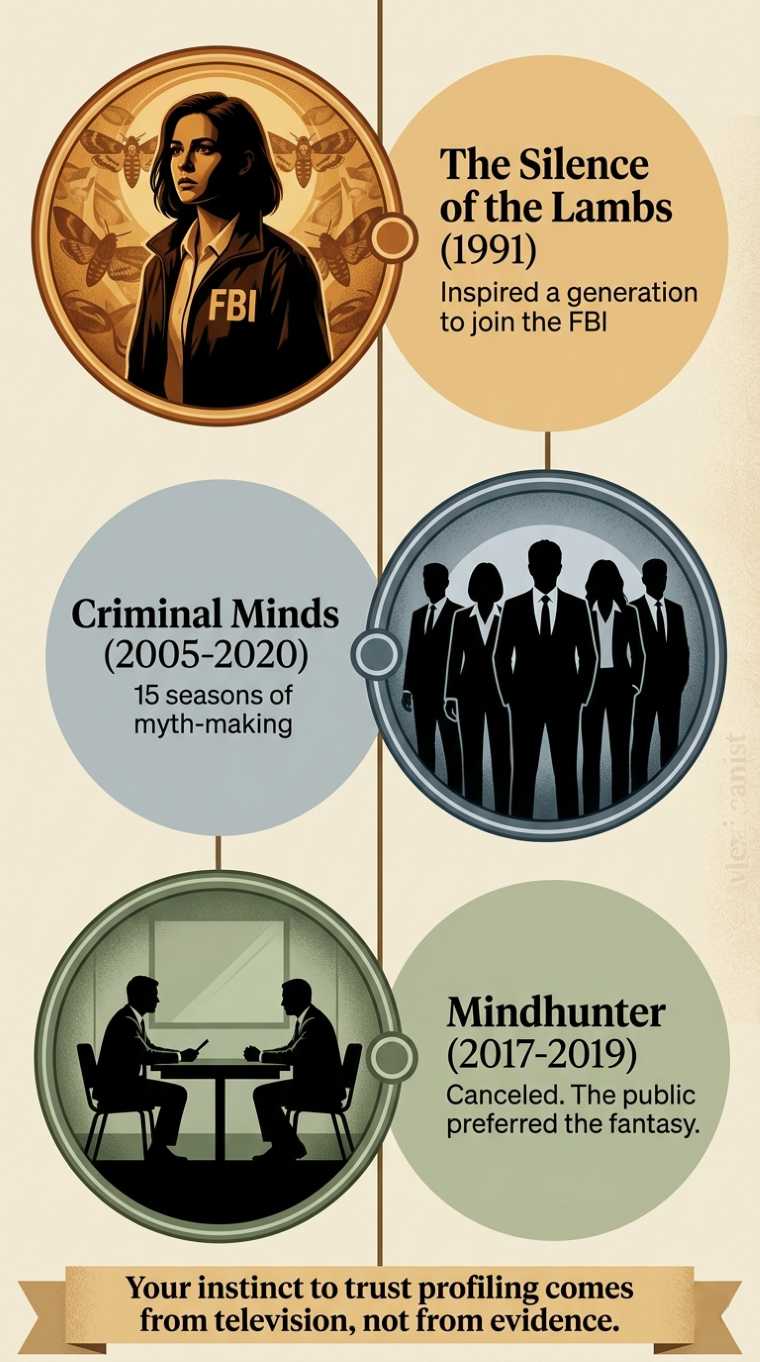
The cultural artifact that most shaped public perception of profiling is not a single film or show—it's a lineage. It starts with Thomas Harris's 1988 novel The Silence of the Lambs and Jonathan Demme's 1991 film adaptation, which gave the world Clarice Starling and the indelible image of the profiler as a brilliant, empathetic mind-reader. The FBI itself acknowledges the film's cultural impact, noting on its official history page that The Silence of the Lambs "inspired a generation of women to join the FBI." Then came CBS's Criminal Minds (2005–2020), which ran for 15 seasons and cemented the profiler-as-hero archetype in the popular imagination. Its characters—a team of impossibly attractive, supernaturally perceptive analysts who jet across the country to catch serial killers—created a template that every subsequent crime drama has either copied or deliberately subverted.
Netflix's Mindhunter (2017–2019), based on John Douglas's real memoir, was the most honest of these depictions. It showed profiling's origins in the 1970s FBI, its reliance on prison interviews with convicted killers, and—crucially—its limitations. The series displayed how racism, classism, and homophobia contaminated investigations. It showed profilers arguing with each other. It showed them being wrong. Netflix canceled it after two seasons, reportedly because its production costs couldn't justify viewership numbers—a decision that, ironically, confirmed one of the show's implicit themes: the public prefers the fantasy of profiling to its reality.
The consequence is what researchers call the “CSI Effect” on steroids. Studies show that regular viewers of crime dramas are more likely to overestimate the reliability of forensic evidence and to believe that profiling is more scientific than it actually is. For Mexican readers consuming a diet of US-produced true crime content, this creates a specific distortion: they learn to expect investigative tools and institutional capacities that their own justice system simply does not possess. The gap between expectation and reality doesn't just cause disappointment—it breeds cynicism about Mexican institutions, without accurately diagnosing why those institutions fall short.
So What?
Here's why all of this matters the next time you see a headline about an FBI profiler, a cartel takedown, or a binational security cooperation agreement.
First: Profiling is one tool in a large toolbox. It is not a silver bullet. When a headline credits profiling for a major arrest, ask yourself what other evidence—wiretaps, informants, financial records, forensic data—was also in play. The answer is usually: a lot.
Second: The data infrastructure gap between the US and Mexico makes most US-style profiling inapplicable in Mexican contexts. Behavioral analysis requires behavioral data. When 93.7% of crimes never enter the investigative system, the data required to build meaningful behavioral profiles simply doesn't exist. Any headline suggesting that Mexican authorities are using BAU-style methods should be read with this structural reality in mind.
Third: The export of profiling techniques from the US to Mexico carries risks that are rarely discussed. Cultural bias, accountability gaps, and the fundamental mismatch between serial-killer methodology and cartel-crime reality mean that US profiling frameworks can misdirect investigations, waste resources, and—in the worst case—contribute to wrongful targeting of suspects.
Fourth: Your instinct to trust profiling comes from television, not from evidence. The shows you've watched have trained you to see profilers as infallible. The scientific literature tells a different story. The gap between these two narratives is the gap between entertainment and understanding.
The deeper context here is not that profiling is useless. It's that profiling is limited—limited by data quality, by cultural context, by human bias, and by the fundamental difficulty of predicting human behavior. Those limitations don't disappear when a case crosses the border. In fact, they multiply. For readers who care about security, justice, and the US-Mexico relationship, understanding those limitations isn't optional. It's the difference between reading headlines critically and being misled by them.
References
[1] FBI, “Behavioral Analysis,” fbi.gov. Accessed April 2026.
[2] Scherer, J.A. & Jarvis, J.P. (2014). “Criminal Investigative Analysis: Practitioner Perspectives.” FBI Law Enforcement Bulletin.
[3] Ribeiro, R.A.B. & Soeiro, C.B.B.M. (2021). “Analysing criminal profiling validity: Underlying problems and future directions.” International Journal of Law and Psychiatry, 74.
[4] Snook, B., Eastwood, J., Gendreau, P., Goggin, C., & Cullen, R.M. (2007). “Taking Stock of Criminal Profiling: A Narrative Review and Meta-Analysis.” Criminal Justice and Behavior.
[5] CNN. “Why profiling doesn't work.” cnn.com.
[6] Baltimore Sun. “Facing the Beltway snipers, profilers were dead wrong.” (2002).
[7] NPR. “FBI Profiler Says Linguistic Work Was Pivotal in Capture of Unabomber.” (2017).
[8] FBI History. “The Silence of the Lambs Business Cards.” fbi.gov.
[9] Small Wars Journal. “Spy Law or Blind State? Criminal Intelligence and Mexico's New Security Framework.” (2025).
[10] European Review of Organised Crime. “Why Global North criminology fails to explain organized crime in Mexico.” (2022).
[11] Baker Institute. “Mexico's New Approach to Organized Crime Reveals Growing Contradictions.” (2025).
[12] FBI. “The FBI's Efforts to Combat Mexican Cartels.” Speeches and Testimony (2025).
[13] ENSIPE 2016, cited in “Mexico Victims and Public Security Perception Survey Report.”
[14] Science. “Reducing cartel recruitment is the only way to lower violence.” (2025).
[15] Policing & Society. “A Review of Cultural and Ethnic Bias in Investigative Decision-making.” (2023).
[16] FBI. “Violent Criminal Apprehension Program (ViCAP).” fbi.gov.
[17] Vulture/Netflix. “Why Mindhunter Season 3 Was Canceled.” CBR (2024).