The Maya Underworld: A Brief Guide to Xibalba
Xibalba wasn't abstract damnation — it was a nine-layered underworld ruled by twelve sadistic death gods who delighted in human suffering. The Maya believed you could physically enter through cenotes still open today.

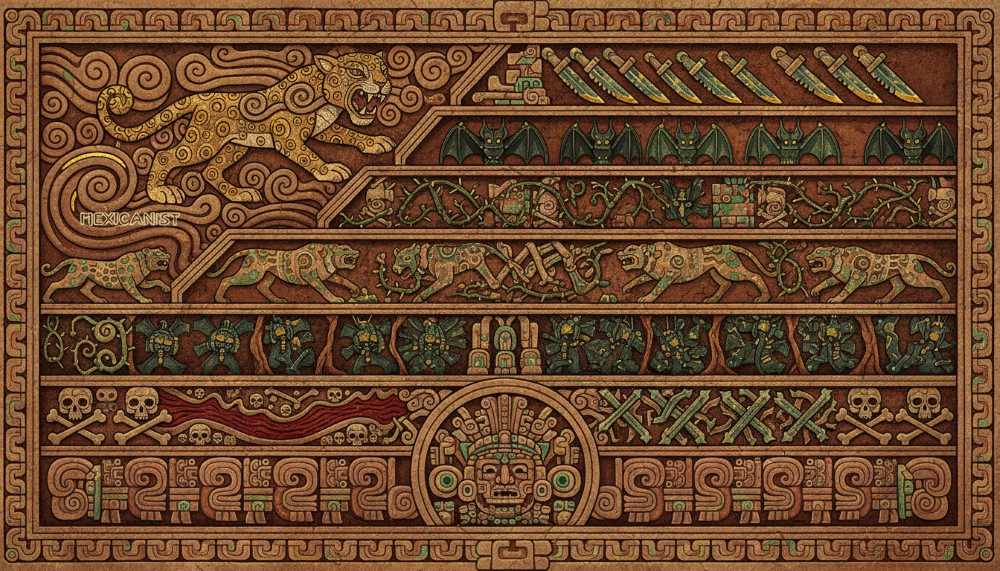
Forget everything you think you know about hell. The ancient Maya had something far more terrifying in mind — a nine-layered underworld ruled by twelve sadistic death gods who literally delighted in human suffering. They called it Xibalba, roughly translated as "Place of Fright," and if the name doesn't send a shiver down your spine, the details certainly will. This wasn't some abstract concept of eternal damnation; the Maya believed this was a real place you could physically enter, and thousands of souls supposedly made the journey through portals that still exist today — the mysterious cenotes scattered across Mexico's Yucatan Peninsula.
The Maya civilization, which flourished across southern Mexico, Guatemala, Belize, and Honduras from roughly 2000 BCE until the Spanish conquest, developed one of the most sophisticated and frankly terrifying underworld mythologies in human history. Their sacred text, the Popol Vuh — often called the "Maya Bible" — lays out this cosmic horror show in vivid detail. But here's what makes it fascinating: Xibalba wasn't just about punishment. It was about transformation, testing, and ultimately, rebirth. The underworld was a crucible where souls were forged or destroyed, depending on their cunning and courage.
The Nine Levels
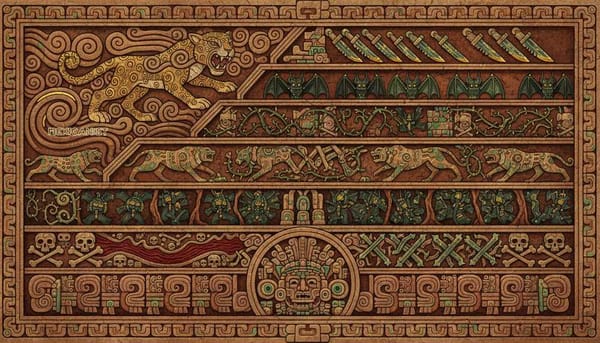
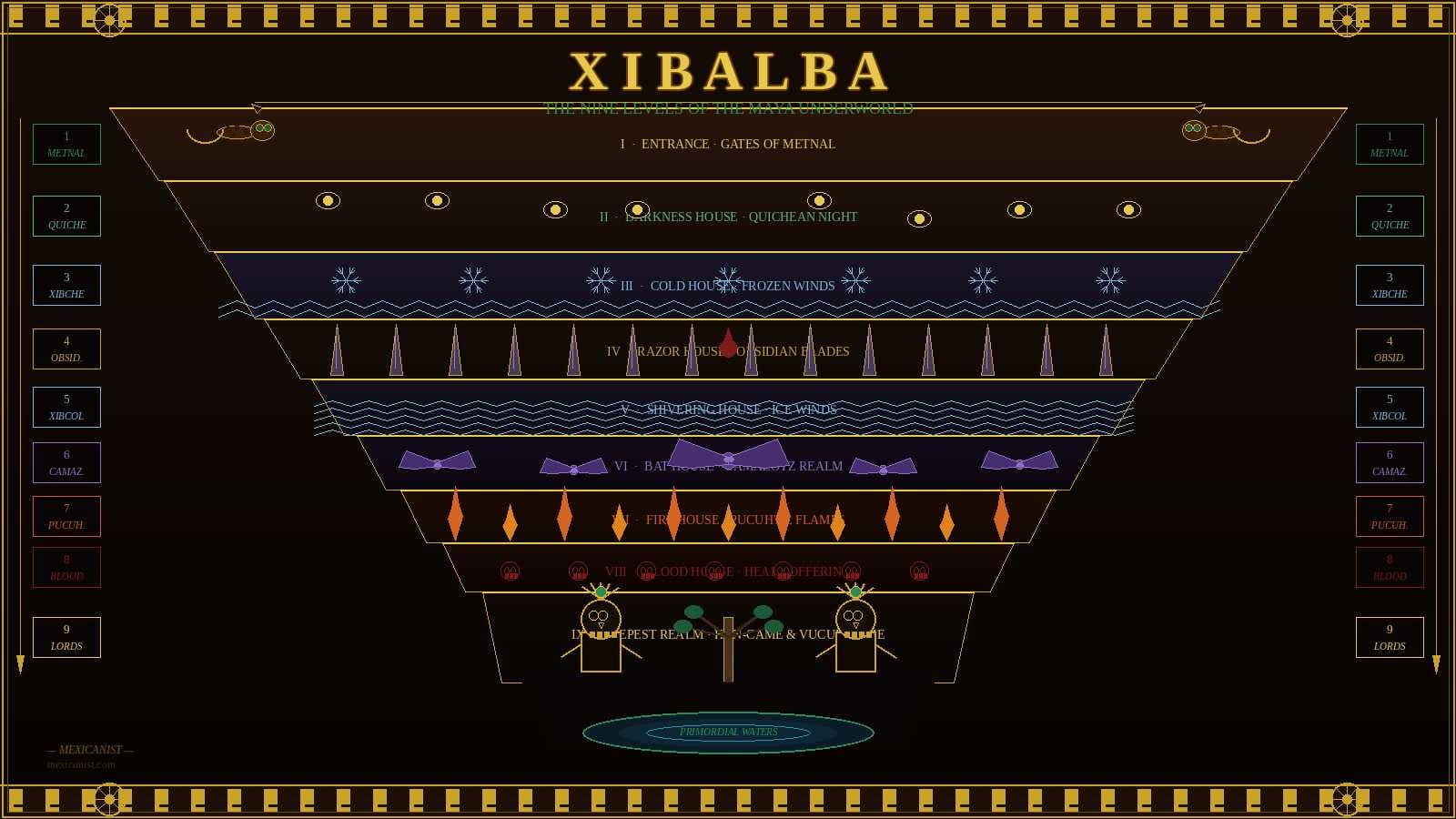
Picture an inverted pyramid stretching down into the earth, each level more treacherous than the last. That's Xibalba — nine distinct layers, each ruled by different deities, each presenting unique challenges to the souls who descended there. According to research published by National Geographic, this numeric structure is actually visible in the architecture of great Maya pyramids across Mexico, with many temples featuring nine terraces or steps representing these underworld levels [1]. The Maya weren't just telling stories; they were building their cosmology into stone.
The journey to Xibalba began at the moment of death, when souls would descend along the roots of the sacred World Tree — the ceiba — which connected the three realms of Maya cosmology: the heavens above, the earthly middle world, and the watery underworld below. As anthropologists at Mexicolore explain, this axis mundi concept appears throughout Maya art, with the tree's branches reaching into the sky, its trunk passing through the earth, and its roots extending deep into Xibalba [2]. The living could visit too — but it required navigating a series of obstacles that would break most people.
The entrance to Xibalba wasn't hidden. In 16th-century Verapaz, the Maya pointed Spanish chroniclers to a cave near Coban, Guatemala, as the traditional gateway to the underworld. Cave systems throughout Belize and Mexico's Yucatan Peninsula were similarly identified as entrances. In some Maya traditions, the Milky Way itself was considered the road to Xibalba — a celestial highway connecting the living world to the realm of the dead [3]. The Maya saw portals everywhere: in caves, in sinkholes, in the stars themselves.
The Lords of Xibalba
If you were expecting Satan with a pitchfork, think again. Xibalba was ruled by twelve death gods, and the Popol Vuh gives us their names and specialties in stomach-churning detail. At the top sat two supreme lords: Hun-Came ("One Death") and Vucub-Came ("Seven Death"), the senior executives of the underworld [4]. Beneath them operated ten more lords, each working in pairs and each responsible for a specific form of human misery.
The Disease Dealers
Xiquiripat ("Flying Scab") and Cuchumaquic ("Gathered Blood") were the hematologists from hell — they sickened people's blood, causing mysterious wasting diseases. Ahalpuh ("Pus Demon") and Ahalgana ("Jaundice Demon") specialized in causing bodies to swell grotesquely, turning victims into living embodiments of infection [5]. These weren't metaphorical afflictions; the Maya were describing real diseases that plagued their communities, personified as malevolent beings who actively sought to inflict suffering.
The Death Dealers
Chamiabac ("Bone Staff") and Chamiaholom ("Skull Staff") had perhaps the most intiutive job description: they turned dead bodies into skeletons. Ahalmez ("Sweepings Demon") and Ahaltocob ("Stabbing Demon") lurked in the unswept corners of people's houses, waiting to stab them to death — a reminder that domestic negligence could be fatal [6]. Finally, Xic ("Wing") and Patan ("Packstrap") caused people to die coughing up blood while walking on roads. If you've ever wondered why the Maya were obsessive about cleanliness and ritual, these death-lords provide a terrifying answer.
These weren't distant, disinterested gods. The Popol Vuh describes them as actively malevolent, taking genuine pleasure in human suffering. They didn't just punish the wicked; they hunted everyone. The Lords of Xibalba were the reason people got sick, the reason bodies decayed, the reason death itself existed. And they expected to be worshipped — with human sacrifice.
Before you could even face the Lords, you had to survive the journey to their court. The roads to Xibalba were guarded by three rivers: one filled with scorpions, one filled with blood, and one filled with pus [7]. Cross these, and you'd reach a crossroads where four speaking roads attempted to confuse and misdirect travelers. Pass this test, and you'd arrive at the council place — where realistic mannequins were seated near the Lords to humiliate visitors who greeted the wrong "person." Sit on the wrong bench, and you'd discover it was actually a hot cooking surface. The Lords found this hilarious.
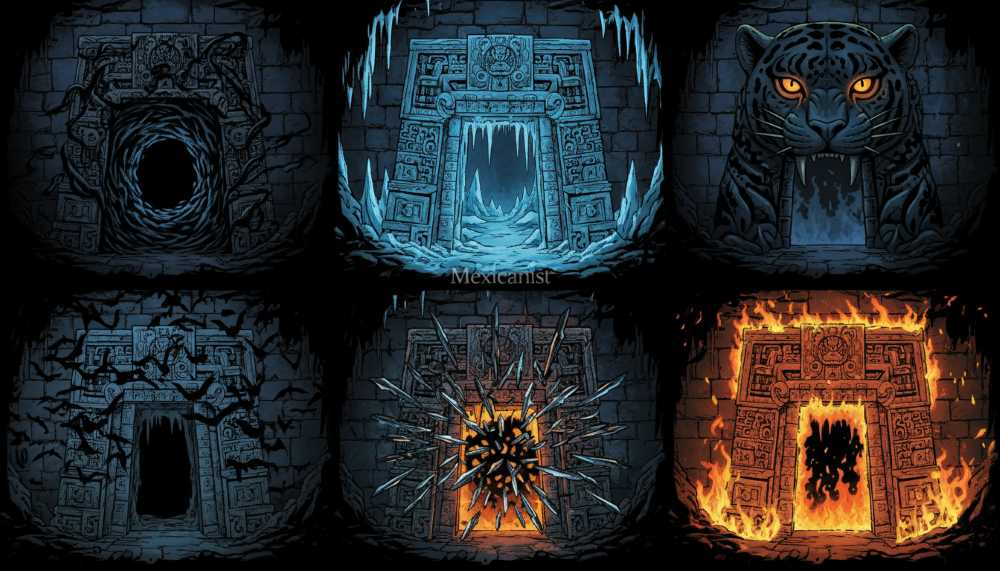
But the real tests were the houses — six deadly chambers designed to kill or break anyone placed inside them. The Popol Vuh names them with chilling simplicity:
Dark House
A house completely without light. Total, absolute darkness where nothing could be seen and obstacles lurked unseen. Visitors had to navigate by touch alone, and one wrong step could mean death.
Cold House (or Rattling House)
Filled with bone-chilling cold and rattling hail, this chamber tested endurance against hypothermia. The Maya didn't need to imagine this torture; highland Guatemala nights can be brutally cold, and this house made those temperatures seem mild.
Jaguar House
Exactly what it sounds like — hungry jaguars paced inside, waiting for fresh meat. Jaguars were the apex predators of Mesoamerica, and facing one in an enclosed space was a death sentence for all but the most skilled (or lucky) warriors.
Bat House
Filled with dangerous, shrieking bats. In Maya belief, bats were associated with death and sacrifice; the bat god Camazotz appears in their art as a fearsome figure. Being trapped in a room with hundreds of them was the stuff of nightmares.
Razor House
Blades and razors that moved of their own accord, slicing through anything — or anyone — in their path. This wasn't a test of endurance; it was a test of agility and cunning. Stand still, and you'd be cut to pieces.
Hot House
Filled with fire and intense heat — the opposite extreme of Cold House. Whether mentioned as a sixth house or an alternative trial, Hot House tested whether souls could withstand being roasted alive [8].
The Hero Twins
Here's where the story shifts from horror to triumph. The Popol Vuh tells of two brothers — Hunahpu and Xbalanque — who did what no one else had done: they entered Xibalba, outwitted the death gods, and survived to tell the tale. Their story is the oldest complete Maya myth preserved, recorded in the 16th-century K'iche' document that translates as "Book of the Community" [9].
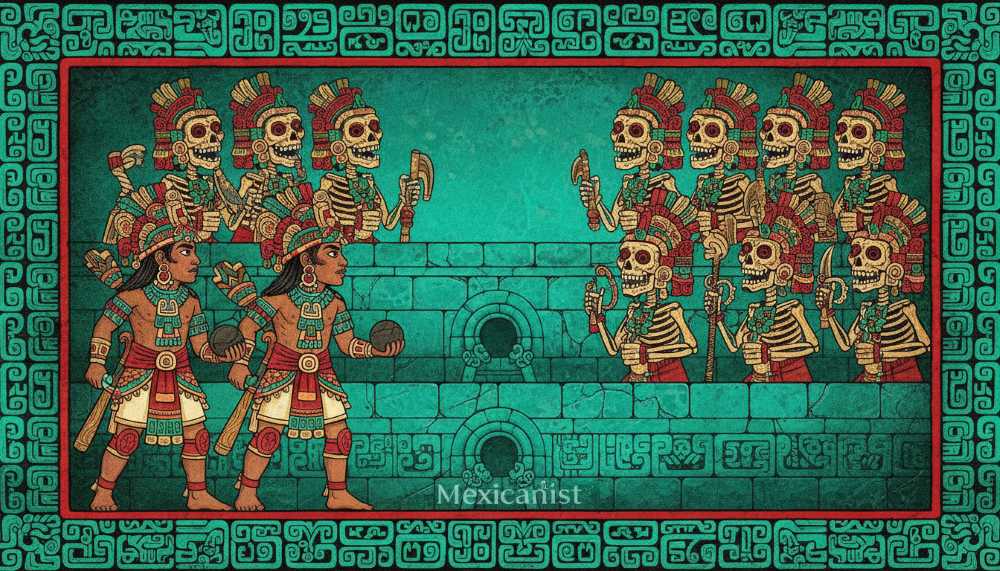
The twins' father, Hun Hunahpu, and his brother had been summoned to Xibalba for a ballgame — the sacred Maya sport called pok-ta-pok. The Lords of Xibalba challenged them, then cheated, using a ball fitted with hidden blades. Both brothers were killed; Hun Hunahpu's severed head was hung in a tree as a warning. But from that tree, his head spat into the hand of a passing maiden named Blood Moon, impregnating her with the twins who would one day avenge him [10].
Raised by their grandmother in the world above, Hunahpu and Xbalanque grew into skilled ballplayers. When their noisy games attracted the attention of the Lords of Xibalba, they too were summoned to the underworld — exactly as their father had been. But unlike their father, they came prepared. They survived Dark House by using their blowguns as shields against the unseen obstacles. They endured Cold House by lighting fires — a simple solution, but one that showed their ingenuity. They made it through Jaguar House by feeding the cats bones instead of themselves. In Bat House, Hunahpu lost his head to a diving bat, but Xbalanque replaced it with a squash and kept playing [11].
The climax came on the ballcourt, where the twins finally outplayed the Lords at their own game — literally. But their masterstroke was theatrical: they allowed themselves to be killed, had their bones ground into powder and thrown into a river, then emerged from the water transformed. They appeared in Xibalba as traveling performers, entertaining the Lords with miracles. When Hun-Came and Vucub-Came asked to be sacrificed and resurrected as part of the show, the twins happily obliged — then didn't bring them back [12]. The Lords of Xibalba were defeated, humiliated, and reduced to accepting lesser offerings. The twins ascended to become the sun and moon, marking the beginning of a new age.
The Portals Still Open Today
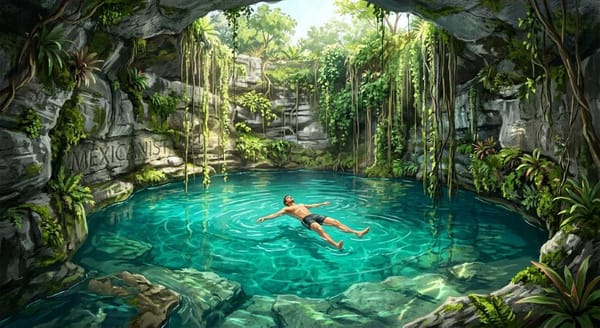
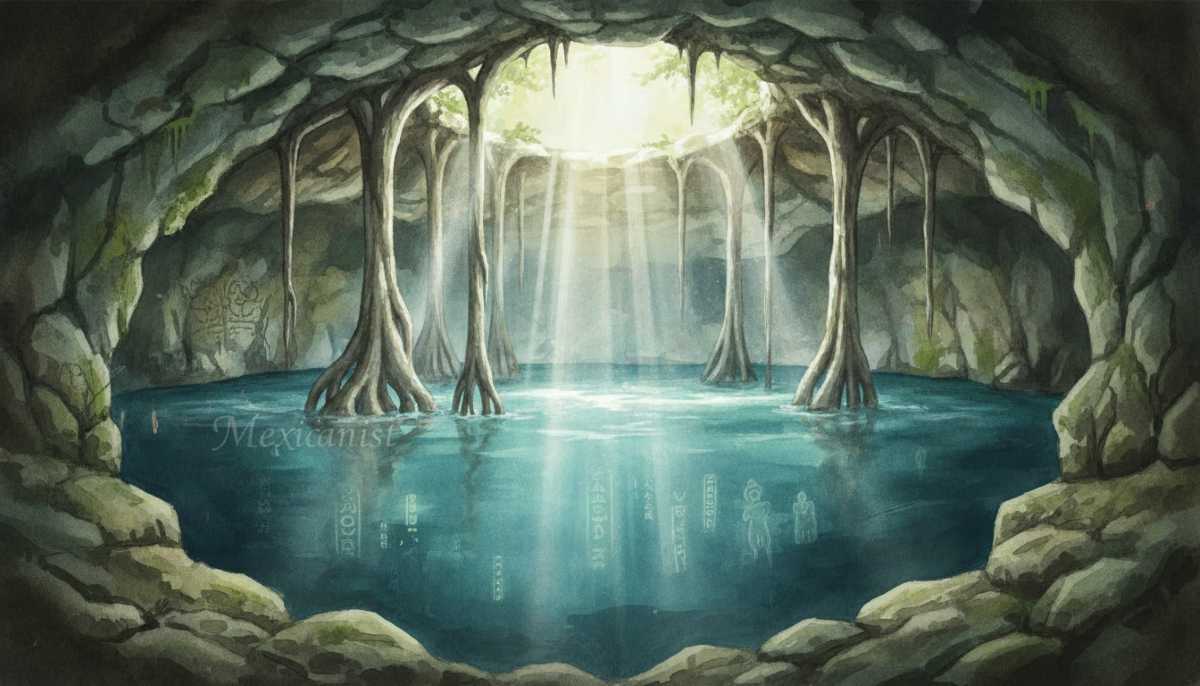
Here's where myth meets archaeology in spectacular fashion. The Yucatan Peninsula is pockmarked with an estimated 6,000 to 10,000 natural sinkholes called cenotes — collapse points where the limestone crust has given way to reveal the water table beneath [13]. To modern tourists, they're stunning swimming holes. To the ancient Maya, they were something far more significant: the physical entrances to Xibalba.
The Maya believed that Chaac, the rain god, resided in caves and cenotes. During droughts, the desperate appeal went straight down into these watery portals. But communicating with the gods required offerings — and the more valuable, the better. Archaeological investigations at the Sacred Cenote of Chichen Itza have recovered thousands of objects from its depths: gold, jade, pottery, obsidian, shell, wood, rubber, cloth, and human skeletons [14]. Jade was the most precious material to the ancient Maya, and hundreds of jade objects were thrown into that single cenote alone.
The Sacred Cenote at Chichen Itza measures about 60 meters (200 feet) in diameter, with sheer cliffs dropping 27 meters (89 feet) to the water table [15]. A 300-meter raised pathway (sacbe) connects it to the main ceremonial center, underscoring its religious importance. Friar Diego de Landa, the Spanish chronicler who witnessed Maya ceremonies in 1566, wrote: "Into this well they have had, and then had, the custom of throwing men alive as a sacrifice to the gods, in times of drought, and they believed that they did not die though they never saw them again" [16].
Between 1904 and 1910, American consul Edward Herbert Thompson dredged the Sacred Cenote, recovering a trove of artifacts now housed at Harvard's Peabody Museum. Subsequent Mexican-led expeditions in the 1950s and 1960s added to the collection, finding gold-sheathed bones, ceremonial knives with gold handles, and wooden ear flares decorated with jade and turquoise mosaics [17]. But it's the human remains that tell the most haunting story.
A groundbreaking 2024 study published in Nature analyzed ancient DNA from 64 individuals sacrificed at Chichen Itza over 500 years. The findings upended long-held assumptions: most victims were children, and many were boys — challenging the popular image of young women being thrown alive into the waters [18]. Research by Guillermo de Anda suggests that victims were often killed before being deposited in the cenotes, and their remains were sometimes transported dozens of miles from where they died. Only certain cenotes were considered true portals to Xibalba; others were reserved for domestic water use, indicating that Maya religious officiants believed specific sinkholes actually connected to the underworld [19].
The logic is elegant: the Yucatan Peninsula has almost no surface rivers or lakes. All fresh water comes from the underground aquifer, accessible only through cenotes. Water = life, and the source of life lay beneath the earth. If the underworld was a place of death and transformation, then these natural wells — descending into darkness, revealing hidden waters — were literal gateways to the realm below. The Maya didn't have to imagine the connection; they could see it, touch it, enter it themselves.
Even today, diving archaeologists find offerings in cenotes across the peninsula: incense burners, jade beads, ceramic vessels. Some items show evidence of intentional damage before being thrown in — "killed" objects meant to join their owners in the afterlife [20]. The portals are still receiving visitors, though now they're mostly tourists with waterproof cameras rather than sacrificial victims.
Myth, Metaphor, or Misunderstanding?
Not all scholars take the Popol Vuh at face value. Anthropologist Dennis Tedlock has speculated that the text's portrayal of Xibalba and its lords may represent K'iche' political propaganda — a slander against earlier Maya religious practices [21]. The story frames the Hero Twins' victory as the triumph of a newer, more sophisticated worldview over an older, bloodier one. It's possible that the "defeat" of Xibalba's gods reflects historical religious reform rather than cosmic drama.
Others point out that our understanding of Maya underworld cosmology is filtered through Spanish colonial sources. The Popol Vuh itself was transcribed in the Latin alphabet after the conquest, by Maya scribes working under Spanish oversight. How much of the original meaning survived the translation? How much was modified to make the religion more comprehensible — or more acceptable — to Christian missionaries? These questions don't have definitive answers, and responsible scholarship acknowledges the gaps in our knowledge.
What's undeniable is that the concept of Xibalba resonated across the Maya world for millennia. From the Preclassic period (2000 BCE - 250 CE) through the Postclassic (900 - 1500 CE), the underworld appears in Maya art, architecture, and religious practice. Whether as literal belief or rich metaphor, Xibalba shaped how the Maya understood death, transformation, and the precarious journey between worlds.
Why Xibalba Still Matters
Strip away the supernatural elements, and Xibalba offers profound insights into the human condition. The Maya understood that death wasn't an ending but a passage — dangerous, terrifying, but navigable. They believed that cunning and courage could overcome even the most sadistic opponents. Their heroes weren't warriors who conquered through violence, but tricksters who won through wit. And their portals to the underworld weren't abstract concepts but real places you could visit — if you dared.
Today, you can swim in the same cenotes the Maya considered sacred portals. You can climb temples built to mirror the nine levels of Xibalba. You can read the Popol Vuh and follow Hunahpu and Xbalanque through their otherworldly trials. The underworld hasn't gone anywhere — it's still there, waiting beneath the surface of the Yucatan, preserved in limestone and myth. Whether you see it as ancient religion, psychological archetype, or ripping good story, Xibalba remains one of humanity's most sophisticated attempts to answer the question that haunts us all: what happens when we die?
The Maya had an answer. They built it into their cities, carved it into their monuments, and threw their most precious offerings into watery portals to communicate with it. Xibalba — the Place of Fright — was their truth about death: a nine-level gauntlet ruled by twelve tormentors, where only the clever and courageous could hope to survive. It's terrifying. It's beautiful. And it's waiting for you to explore.
References
[1] National Geographic. "Underworld." National Geographic Travel. The Maya realm of the dead was made up of nine specific layers, a numeric structure evident on many great pyramids in Mexico.
[2] Mexicolore. "Exploring the Maya Underworld." Connecting the three levels is the axis mundi, World Tree, usually represented by a ceiba tree whose roots extend down into the Underworld.
[3] Wikipedia. "Xibalba." In some Maya areas, the Milky Way is viewed as the road to Xibalba. Entrance traditionally held to be a cave near Coban, Guatemala.
[4] Christenson, Allen J. (2007). Popol Vuh: Sacred Book of the Quiche Maya People. University of Oklahoma Press. The first among the Maya death gods ruling Xibalba were Hun-Came ("One Death") and Vucub-Came ("Seven Death").
[5] Wikipedia. "Xibalba." Xiquiripat ("Flying Scab") and Cuchumaquic ("Gathered Blood") sicken people's blood; Ahalpuh ("Pus Demon") and Ahalgana ("Jaundice Demon") cause bodies to swell.
[6] Ibid. Chamiabac and Chamiaholom turn dead bodies into skeletons; Ahalmez and Ahaltocob hide in unswept areas and stab people to death; Xic and Patan cause people to die coughing blood.
[7] Ibid. Roads to Xibalba were filled with obstacles: a river of scorpions, a river of blood, and a river of pus.
[8] Ibid. Six deadly houses: Dark House, Cold House (Rattling House), Jaguar House, Bat House, Razor House, and Hot House.
[9] Wikipedia. "Maya Hero Twins." The central figures of a narrative within the colonial K'iche' document Popol Vuh, constituting the oldest Maya myth preserved in entirety.
[10] Ibid. After Hun Hunahpu's execution, his head was placed in a tree. When Blood Moon passed by, the head spoke and impregnated her with spittle.
[11] Ibid. The twins survived the houses through ingenuity: using blowguns in Dark House, lighting fires in Cold House, feeding bones to jaguars, and Xbalanque replacing Hunahpu's severed head with a squash.
[12] Wikipedia. "Xibalba." The twins allowed themselves to be killed, their bones ground and thrown into a river, then emerged transformed. They tricked the Lords into requesting sacrifice without resurrection.
[13] Much Better Adventures. "The Secret Underwater World of Mexico's Cenotes." Estimates of cenotes in the Yucatan Peninsula range between 6,000 to 10,000.
[14] Wikipedia. "Sacred Cenote." Archaeological investigations removed thousands of objects: gold, jadeite, copal, pottery, flint, obsidian, shell, wood, rubber, cloth, and human skeletons.
[15] Ibid. The Sacred Cenote is 60 meters in diameter with cliffs dropping 27 meters to the water table.
[16] de Landa, Diego. Relacion de las Cosas de Yucatan (1566). Quoted in Wikipedia, "Sacred Cenote."
[17] Wikipedia. "Sacred Cenote." Edward Herbert Thompson dredged 1904-1910. Later expeditions found gold-sheathed bones and ceremonial knives.
[18] Nature (2024). "Ancient genomes reveal insights into ritual life at Chichen Itza." Analysis of 64 sacrificed individuals revealed most were children, many boys.
[19] de Anda Alanis, Guillermo (2007). "Sacrifice and Ritual Body Mutilation in Postclassical Maya Society." Only certain cenotes were used for sacrifice; others were domestic water sources.
[20] Wikipedia. "Sacred Cenote." Many objects show evidence of intentional damage before being thrown in — "killing" the object as sacrifice.
[21] Tedlock, Dennis. Popol Vuh: The Definitive Edition of the Mayan Book of the Dawn of Life. Speculated that Xibalba narrative may be K'iche' slander on earlier Maya worship.