Amazon vs. AliExpress: The Battle for Mexican Sellers Amid New Tariffs
Mexico just dropped a 35% tariff hammer on Asian imports. For the army of small Mexican sellers who've been getting crushed by ultra-cheap AliExpress and Temu goods, this isn't just news, it's a lifeline.

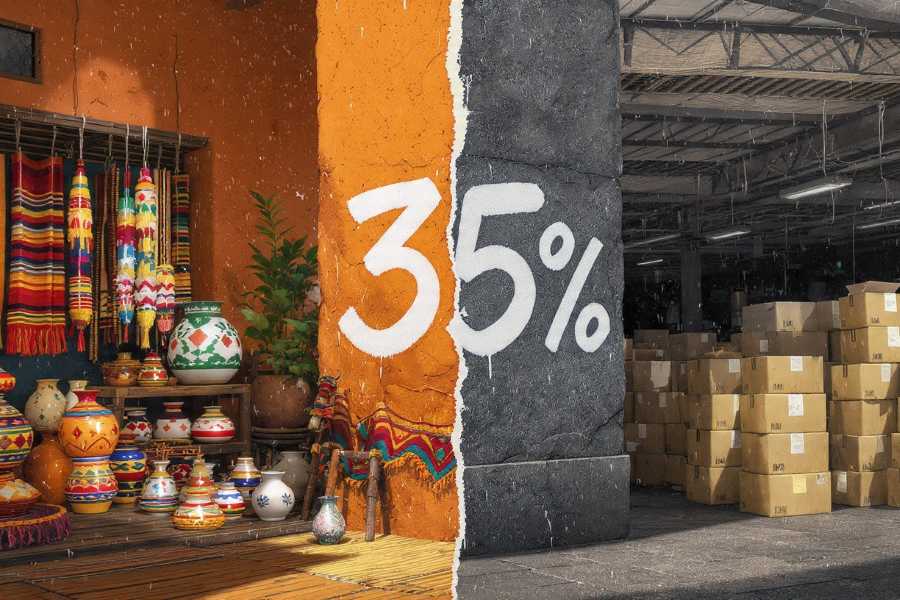
Maria Elena runs a small leather-goods shop out of her garage in Guadalajara. For three years, she watched helplessly as generic knockoffs of her handcrafted bags flooded Amazon Mexico at a third of her price. Every morning, she'd check her seller dashboard like a gambler checking the sports pages—always bracing for bad news. December 2025 changed everything.
When Mexico's Senate voted to slap tariffs of up to 35% on imports from China, India, South Korea, Thailand, and Indonesia, it wasn't just some trade policy tweak. It was a tectonic shift in the e-commerce world—one that suddenly made Maria Elena's hand-stitched huaraches competitive again against their $8 plastic cousins from Shenzhen.
She's not alone. Across Mexico, an army of small and medium-sized enterprises—the PyMEs that form the backbone of the economy—are waking up to a radically different competitive landscape. The ultra-cheap Asian imports that had been eating their lunch for a decade suddenly carry a heavy surcharge. And the e-commerce giants? They're scrambling to pivot faster than you can say "free two-day shipping."
This report is the story of that pivot. It's about how a $100 billion e-commerce market is being remade in real time—and why the next 18 months could determine whether Mexico's millions of small sellers finally get their shot at the big leagues, or whether the whole experiment ends up as just another chapter in the long book of well-intentioned trade policy gone sideways.
Mexico's E-Commerce Explosion
Let's start with the numbers, because they're genuinely staggering.
Mexico's e-commerce market hit approximately $100 billion in 2024. That's not a typo. One hundred billion American dollars changing hands through screens, smartphones, and delivery trucks in a country where a decade ago, online shopping was basically a niche hobby for the upper-middle class in Mexico City and Monterrey.
By 2026, the Center for Strategic and International Studies (CSIS) projects that figure will swell to $176.8 billion. In other words, Mexico's digital retail sector is growing so fast it makes Bitcoin look conservative.
The shopper count tells an equally dramatic story. In 2025, Mexico boasted roughly 80 million online shoppers, according to Statista. That's more than 60% of the population clicking "add to cart." E-commerce went from representing roughly 1% of total retail a decade ago to about 15% today—a fifteen-fold increase that has fundamentally altered consumer behavior across every demographic.
In terms of who's winning the platform wars, Mercado Libre still wears the crown with a commanding 15.4% market share. Amazon Mexico, which launched in 2015 with all the subtlety of a wrecking ball, has clawed its way to second place at 11.2%. Not bad for a platform that initially struggled to convince Mexicans that buying stuff on the internet wasn't some elaborate scam.
Today, Amazon delivers to all 32 Mexican states—from the bustling streets of Polanco to remote villages in Oaxaca where the nearest Walmart is a three-hour bus ride. The company's logistics network has become a case study in how to build trust in an emerging market: fast delivery, easy returns, and customer service that actually, you know, serves the customer.
The competitive dynamics are worth watching. While Mercado Libre still dominates in categories like electronics and general merchandise, Amazon has been making aggressive inroads in fashion, home goods, and especially among the growing segment of higher-income consumers who are already Amazon Prime subscribers in the U.S. and expect the same experience south of the border.
Then there's Walmart de México, which has been quietly building a formidable online operation. Their omnichannel strategy—buy online, pick up in-store—resonates in a culture that still values the tactile shopping experience. Walmart's online revenue grew 21.7% year-over-year, proving that brick-and-mortar isn't dead; it's just learning to play nice with the internet.
The Asian Invasion
To understand why the tariffs matter, you need to understand what they're pushing back against. And what they're pushing back against is, frankly, a tsunami.
China exported more than $90 billion in goods to Mexico in 2024. For context, that's up from $34 billion in 2015—a near-tripling in less than a decade. Mexico's trade deficit with China has hit record levels, and anyone with a passing understanding of economics knows that when one country floods another with cheap goods, the domestic manufacturing base tends to shrivel like a balloon in a cactus patch.
The e-commerce dimension of this flood has been particularly devastating for small sellers. AliExpress was the third-most-visited e-commerce site in Mexico, pulling in a jaw-dropping 63.7 million monthly visits. That's more visitors than the entire population of many countries. Temu, the newer entrant, grabbed 37.4 million users in Mexico's shopping app ecosystem, while Shein—the fast-fashion juggernaut—clocked 27.4 million users.
Together, these Chinese platforms have dominated the shopping app space in Mexico, creating a parallel retail universe where prices for electronics, clothing, home goods, and just about everything else exist in a bizarro dimension that has nothing to do with the actual cost of producing things locally.
How did they do it? The answer is a three-word playbook: volume, subsidies, and regulatory arbitrage.
Chinese sellers leveraged their country's massive manufacturing base to produce goods at prices that Mexican factories literally cannot match. They subsidized shipping through China's state-backed postal system, which kept delivery costs artificially low. And they exploited Mexico's de minimis exemptions—rules that allowed small-value packages to enter the country tariff-free—by breaking shipments into tiny parcels that individually fell below the threshold but collectively represented a flood of underpriced merchandise.
By August 2024, Mexico's tax authority (SAT) had had enough. They confiscated 1.4 million illegally imported products in a single month—a number that sounds like something from a police procedural but was very much real life. The message was clear: the free ride was over.
The de minimis loophole, which had been exploited with surgical precision by Shein, Temu, and AliExpress, became a political flashpoint. Domestic manufacturers argued—with considerable justification—that they were being asked to compete against goods that effectively bypassed the entire tariff system. It was, to use a Mexican expression, like bringing a knife to a gunfight—except the other guy also had a tank, an air force, and apparently a nuclear option.
The Tariff Hammer
In December 2025, Mexico's Senate did something that sent shockwaves through global supply chains: it approved tariffs of up to 50% on imports from China, India, South Korea, Thailand, and Indonesia. The majority of products now face tariffs up to 35%.
The scope is breathtaking. More than 1,460 product lines are affected, spanning autos, textiles, clothing, plastics, steel, furniture, leather goods, glass products, and motorcycles. This isn't a surgical strike—it's a carpet bombing of Asian imports.
The government framed the move as essential to safeguarding an estimated 350,000 domestic jobs. According to Navigator Global's December 2025 analysis, the tariffs are expected to generate approximately $3.76 billion in government revenue—not exactly chump change for a country that could always use a few extra billion pesos in the coffers.
The tariff regime actually builds on earlier measures. In prior months, Mexico had already imposed 17-19% tariffs on small-value express delivery goods, targeting the de minimis loophole directly. The December legislation was the hammer—the earlier measures were just the nails being positioned.
The new tariffs took effect on January 1, 2026. Beijing condemned the move as "misguided"—which, in diplomatic speak, is roughly equivalent to screaming "this is totally unfair and we're really mad about it." China's Ministry of Commerce warned of "negative impacts" on bilateral trade, though stopped short of specifying retaliatory measures. Yet.
Many trade analysts see the tariff move as part of a broader strategic alignment with the United States, which has been pressuring its trading partners to reduce dependence on Chinese goods. With the USMCA review scheduled for July 2026, Mexico's tariff posture sends a clear signal: we're serious about reducing our exposure to Chinese imports, and we're willing to eat some short-term economic pain to prove it.
White & Case's analysis noted that Mexico has "formalized and expanded import tariffs to more than 1,400 products," marking what the Hinrich Foundation described as a decisive "shift toward protectionism." The Baker Institute, for its part, framed the tariffs within the broader context of "Mexico's Economy Under US Tariffs and Trade Uncertainty"—a reminder that this chess game has more than two players.
For Mexican consumers, the immediate impact is straightforward: things made in China, India, and Southeast Asia just got more expensive. A $20 Bluetooth speaker from AliExpress now effectively costs $27. A $15 Shein dress? Call it $20. These aren't catastrophic price increases, but they're enough to make consumers think twice—and that's precisely the point.

Amazon's Mexico Play
While AliExpress and Temu are scrambling to figure out their next move, Amazon Mexico is sitting pretty—and they know it.
The numbers tell the story. Amazon has invested more than $3 billion in Mexico since entering the market in 2015. That investment has created over 8,000 direct jobs and an estimated 32,000 indirect positions. The company now operates more than 40 facilities across the country, from massive fulfillment centers in the Estado de México to last-mile delivery stations in mid-sized cities that most Americans have never heard of.
But the really interesting number is this: 27,000. That's how many Mexican small and medium-sized enterprises (PyMEs) now sell on Amazon Mexico. And here's the kicker: 99% of them are small or medium businesses. These aren't multinational corporations gaming the system—they're Maria Elena from Guadalajara, and Carlos the artisanal hot sauce maker from Puebla, and the family that's been making leather belts in León for three generations.
Together, these Mexican sellers have listed over 3 million products on Amazon. They've created an estimated 57,000 direct and indirect jobs through their selling activities. And their collective economic footprint continues to grow as Amazon expands its seller support programs, logistics infrastructure, and marketing tools for local businesses.
Amazon Business launched in Mexico in March 2024, opening up a whole new B2B channel for Mexican suppliers. The platform lets local manufacturers sell directly to other businesses, cutting out the middlemen who have traditionally taken a fat slice of the profit pie. For Mexican PyMEs that have the quality but lack the distribution network to reach corporate buyers, this is potentially transformative.
According to Amazon's own economic impact data, their entry into Mexico lowered consumer prices by up to 28% across key product categories. That's the double-edged sword of e-commerce: cheaper for consumers, brutal for domestic producers who can't match the efficiency. But with the new tariffs tilting the scales, Amazon's network of local sellers suddenly looks less like a vanity project and more like a strategic masterstroke.
And then there's Mercado Libre, the homegrown champion. Mercado Libre isn't just competing with Amazon—in many ways, it's out-investing them. The company planned $2.45 billion in investment for 2024 alone, operates more than 90 facilities, and employs over 12,000 people directly in Mexico. An estimated 414,000 Mexican families rely on Mercado Libre as their primary source of income—a number so large it essentially constitutes a small city of entrepreneurs.
How Platforms Are Betting on Mexican-Made
Here's where it gets interesting. The tariffs didn't just punish Asian imports—they created a positive incentive for platforms to invest in local supply chains. And the platforms are responding with the enthusiasm of dogs who just heard the treat jar open.
Both Amazon and Mercado Libre have been aggressively expanding their local seller recruitment programs. Amazon's "Impulsa" program offers training, credits, and logistics support specifically designed for Mexican PyMEs. Mercado Libre has launched similar initiatives, including specialized programs for artisans, indigenous producers, and women-led businesses. The messaging is clear: we want local products, and we'll help you sell them.
The broader macroeconomic trends support this pivot. Foreign direct investment in Mexico rose more than 10% year-over-year to $34.3 billion in the first half of 2025 alone, driven largely by the nearshoring boom—companies relocating production closer to the U.S. market to avoid supply chain disruptions and tariff exposure. Manufacturing FDI has been growing at an annual clip of 20% since 2019, according to BCG's analysis of nearshoring dynamics.
Interestingly, even Chinese firms got in on the nearshoring trend before the tariffs hit. Chinese greenfield FDI in Mexico peaked at $5.6 billion in 2023, as companies like BYD and other manufacturers set up shop to serve the North American market. Whether those investments survive the new tariff environment is an open question—and a tense one, given the geopolitical stakes involved.
Local manufacturing is increasingly being framed not just as a necessity but as a competitive advantage. Mexican-made products can reach consumers faster than imports (no three-week shipping from Shenzhen), they can be customized more easily, and they come with a built-in marketing narrative that resonates with consumers who are developing a taste for authenticity.
Social commerce—buying through platforms like Instagram, TikTok, and WhatsApp—is growing at more than 20% year-over-year and is projected to account for 40% of online sales in the near future. This is a channel that disproportionately favors small, local producers who can build personal brands and direct relationships with customers. You can't really do that when you're a faceless factory pumping out generic goods from 8,000 miles away.
The platform calculus is straightforward: local sellers mean lower shipping costs, faster delivery times, fewer regulatory headaches, and a product offering that stands out from the sea of generic Asian imports. In a post-tariff world, that's not just nice to have—it's the difference between thriving and scrambling.
The Small Business Gold Rush
Alright, let's talk about the opportunity, because it's real and it's massive.
Mexican SMEs represent more than 95% of all business units in the country. They contribute roughly 14.6% of GDP and employ about half the workforce. These are the businesses that have historically been squeezed between multinational corporations on one side and the gray market on the other. The tariffs just gave them a breather—and potentially, a ladder.
Consider the math. A Mexican artisan selling handcrafted ceramics for $25 was competing against Chinese mass-produced versions at $8. With a 35% tariff, that Chinese version now costs roughly $10.80. Still cheaper, yes, but the gap has narrowed significantly—and when you factor in shipping times, quality differences, and the growing consumer preference for unique, locally-made products, the value proposition starts to shift.
The numbers on consumer behavior are telling. According to CSIS's analysis, 94% of Mexican retail membership holders are "multi-home"—they use multiple platforms. That means consumers are already in the habit of shopping around, comparing prices and quality across Amazon, Mercado Libre, Walmart, and smaller niche platforms. When the price gap narrows, quality and uniqueness become the differentiators. And that's where Mexican producers have an edge.
The nearshoring boom is creating ancillary supply chain opportunities for local SMEs. As multinational companies set up manufacturing operations in Mexico, they need local suppliers for everything from packaging to components to catering services. This isn't theoretical—it's already happening, and the tariff environment is accelerating the trend.
Perhaps the most compelling opportunity lies in the USMCA framework. Products manufactured in Mexico get tariff-free access to the U.S. market—a consumer base ten times the size of Mexico's. For Mexican SMEs that can scale production to meet U.S. demand, the new tariffs could be the catalyst that transforms them from local players into regional competitors.
Consumers are also playing a role. Faster delivery from local sources is increasingly valued—we're living in an Amazon Prime world where waiting three weeks for a package from China feels like waiting for a letter by Pony Express. Mexican sellers offering 2-5 day delivery have a structural advantage that tariffs only amplify.
The window is open. The question is whether enough Mexican entrepreneurs will climb through it before it closes.
It Ain't All Tacos and Tequila
Now, before we get carried away with the small business victory lap, let's pump the brakes and look at the downside. Because there are downsides, and ignoring them would be intellectually dishonest.
First and most obviously: prices will go up for Mexican consumers. A 35% tariff doesn't evaporate—it gets passed along. Electronics will be more expensive. Textiles will be more expensive. Furniture, glass products, motorcycle parts—all more expensive. For a country where a significant portion of the population lives paycheck to paycheck, even modest price increases hurt.
Business groups have opposed the tariff hikes, and their objections aren't unreasonable. Many Mexican businesses rely on imported components and raw materials from Asia. A furniture maker in Jalisco might buy Chinese hardware, Thai fabrics, and Indonesian wood—all of which are now more expensive. The tariffs protect finished goods but can actually raise costs for manufacturers who depend on global supply chains.
Then there's the retaliation risk. China is Mexico's second-largest trading partner after the United States. Beijing has thus far limited its response to diplomatic grumbling, but trade wars have a habit of escalating. If China decides to restrict Mexican agricultural exports or limit access to its own massive consumer market, the economic fallout could dwarf any benefits from the tariffs.
There's also a legitimate question about whether Mexican manufacturers can scale fast enough to fill the gap left by reduced Asian imports. Building a factory takes time. Training workers takes time. Establishing quality control systems takes time. And the tariff regime doesn't come with a patience clause.
Infrastructure remains a persistent challenge. Mexico's logistics network, while improving, still
The regulatory environment is another headwind. According to the OECD and Deloitte, 34% of manufacturers cite regulatory obstacles as a reason to not invest in Mexico. Navigating Mexico's Byzantine bureaucracy—permits, inspections, labor requirements, tax compliance—can feel like running an obstacle course designed by someone who actively dislikes businesses.
And finally, the informal economy—which accounts for roughly 25% or more of Mexico's GDP—could absorb some of the demand displaced by the tariffs. If formal Mexican retailers raise prices, consumers may simply shift to informal markets, street vendors, and cross-border shopping in the U.S. The tariffs could end up penalizing formal businesses while leaving the informal sector untouched.
In short: the tariffs create an opportunity, but they don't guarantee success. The next 18 months will reveal whether Mexico's small business ecosystem is ready to seize the moment, or whether the structural challenges prove insurmountable.
The Great Mexican E-Commerce
Mexico's 35% tariffs on Asian imports are not just a trade policy—they're a bet. A bet that Mexican businesses can compete when the playing field is leveled. A bet that e-commerce platforms will invest in local suppliers when the economics make sense. A bet that consumers will choose quality and proximity over rock-bottom prices when the gap narrows.
The early signs are encouraging. Amazon's 27,000 Mexican SMEs are reporting increased sales and visibility. Mercado Libre's local-first programs are expanding. The nearshoring boom is bringing foreign investment and manufacturing expertise into the country. And consumers, while paying somewhat higher prices, are discovering that locally-made products aren't just more expensive—they're often better.
But this story is far from written. The July 2026 USMCA review could reshape the trade landscape once again, potentially imposing new rules of origin or digital trade provisions that either help or hurt Mexican e-commerce. China's response—whether diplomatic, economic, or both—remains an open variable. And the perennial challenges of infrastructure, regulation, and informal competition aren't going away.
What's clear is this: the next 18 months represent a once-in-a-generation opportunity for Mexican small businesses. The tariffs have opened a window. The platforms are ready to help. The consumers are willing to listen. Whether this becomes a story of Mexican entrepreneurial triumph or another cautionary tale about the unintended consequences of trade policy depends on what happens next.
For Maria Elena in Guadalajara, the answer is simple: "I'm going to sell more bags this year than I ever thought possible. And they're going to be my bags—made in Mexico, by me, for people who appreciate real craftsmanship."
Sometimes, the simplest stories are the best ones. Let's hope this one has a happy ending.
Sources
2. CSIS Analysis — Insights into the Mexican E-Commerce Competition Landscape https://www.csis.org/analysis/insights-mexican-e-commerce-competition-landscape
3. Navigator Global (December 2025) — Mexico enters 2026 with sweeping new tariffs on Chinese imports https://navigator.global/my/library/mexico-enters-2026-with-sweeping-new-tariffs-on-chinese-imports
4. Reuters (December 2025) — Mexico to hike tariffs on China starting Thursday https://www.reuters.com/business/autos-transportation/mexico-hike-tariffs-china-starting-thursday-2025-12-30
5. Amazon (2024) — How Amazon Mexico benefits consumers, businesses, and the Mexican economy https://www.aboutamazon.com/news/policy-news-views/how-amazon-mexico-benefits-consumers-businesses-and-the-mexican-economy
6. Statista — E-commerce in Mexico: statistics & facts (2025) https://www.statista.com/topics/4768/e-commerce-in-mexico/
7. Mordor Intelligence — Mexico E-commerce Market Size, Forecast Report https://www.mordorintelligence.com/industry-reports/mexico-ecommerce-market
8. White & Case — Mexico formalizes and expands import tariffs to more than 1,400 products https://www.whitecase.com/insight-alert/mexico-formalizes-and-expands-import-tariffs-more-1400-products-key-impacts
9. Hinrich Foundation — Mexico's shift toward protectionism: The impact of new tariffs https://www.hinrichfoundation.com/research/article/trade-governance/mexico-protectionism-new-tariffs-impact
10. Baker Institute — Mexico's Economy Under US Tariffs and Trade Uncertainty https://www.bakerinstitute.org/research/mexicos-economy-under-us-tariffs-and-trade-uncertainty
11. BCG — The Shifting Dynamics of Nearshoring in Mexico https://www.bcg.com/publications/2024/shifting-dynamics-of-nearshoring-in-mexico
12. PCMI / Payments CMI — Strategic Insights into Mexico's E-Commerce Market https://paymentscmi.com/insights/mexico-e-commerce-market
13. Sourcing Journal / WWD — Mexico Hits China With Up to 50% Tariffs on 1400 Products https://wwd.com/sourcing-journal/trade/mexico-china-tariffs-apparel-textiles-footwear-sheinbaum-trump-usmca-1238860428
14. Rest of World — U.S. shoppers stock up on AliExpress and Temu before tariffs hit https://restofworld.org/2025/temu-shein-stock-up-haul-tariffs
15. OECD / Deloitte — Mexican retail competition reports (as cited by CSIS) https://www.csis.org/analysis/insights-mexican-e-commerce-competition-landscape