From Mexican Farmworker to World's Top Brain Surgeon — and Now He's Bringing His Mission to Cancún
He crossed the border illegally at 19. Picked cauliflower in California. Now he holds Mayo Clinic's most prestigious neurosurgery chair — and he's bringing Mission: BRAIN to Cancún. A Mexicanist exclusive.

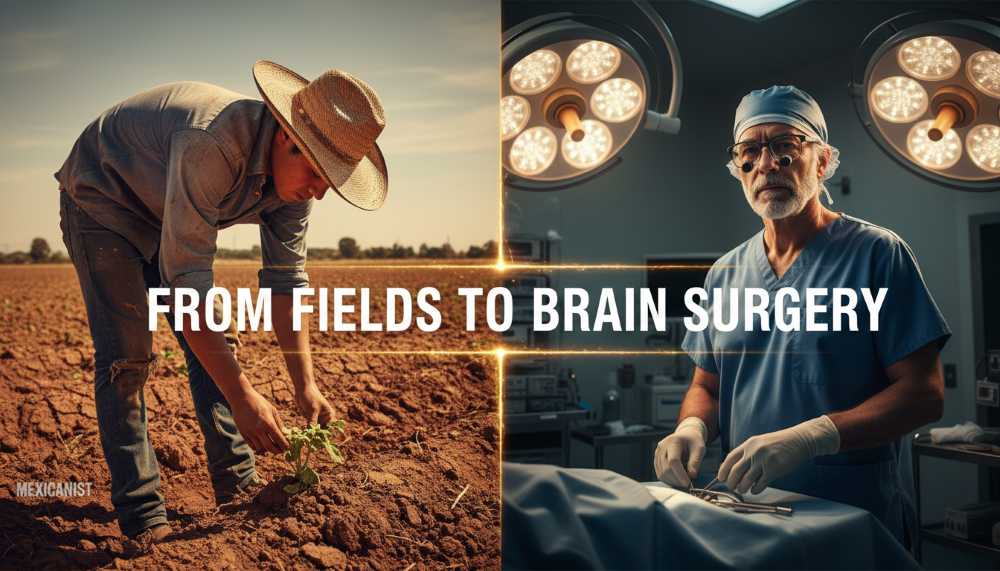
Alfredo Quiñones-Hinojosa crossed the US border illegally at 19, couldn't speak English, and picked tomatoes in the fields of Central Valley, California. Today he holds the William J. and Charles H. Mayo Professorship — the most prestigious chair in neurosurgery in America. His foundation has operated on 54,000 brains across 27 countries. And last week, he signed a deal with the governor of Quintana Roo to build a world-class neurosurgery center in Cancún. Nobody in the English-speaking world has this story. You do now.
Here's a sentence that doesn't belong in the same paragraph but is nonetheless true: the man who may revolutionize brain surgery access in Latin America once spent his days bent over in the California sun, picking cauliflower for $3.35 an hour.
Dr. Alfredo Quiñones-Hinojosa — everyone calls him Dr. Q — is the chair of neurologic surgery at Mayo Clinic Jacksonville. He runs a research lab studying brain tumor stem cells. He has published over 150 scientific articles. He edited the definitive textbook on operative neurosurgical techniques. Netflix featured him in The Surgeon's Cut. Disney and Brad Pitt's Plan B Entertainment are making a movie about his life.
And on April 17, 2026, he sat down with Quintana Roo Governor Mara Lezama in Cancún and signed a memorandum of understanding to evaluate building a Mission: BRAIN center in the city's Distrito Financiero y Tecnológico — the financial and tech district that the state government has been pushing as its answer to Dubai-by-the-Caribbean.
If it happens, it would be the first Mission: BRAIN surgical center in Mexico. And it would transform the medical landscape of a region that currently can't even keep its Red Cross ambulances running.
The Border Crossing That Changed Everything
To understand why this matters, you need to understand the man. Because Dr. Q isn't just a brilliant surgeon who happened to pick a nice location for his next project. He's a Mexican-born scientist who has spent his entire career trying to solve exactly the problem that Quintana Roo faces: people dying because they can't access the care they need.
Quiñones was born in Mexicali, Baja California, in 1968. He was interested in medicine from childhood — partly because his younger sister died of colitis, a preventable condition that devastated his family and planted a seed that would define his career. But in Mexicali in the 1980s, the path from a poor kid's imagination to a medical degree was not exactly well-lit.
In 1987, at 19, he crossed into the United States. No English. No money. No connections. He worked the fields outside Fresno — tomatoes, cauliflower, cotton. He loaded trucks. He sent money home. He saved enough to take English classes at San Joaquin Delta College in Stockton.
What happened next is the kind of trajectory that makes Hollywood call: community college to UC Berkeley (psychology, highest honors) to Harvard Medical School (cum laude) to a neurosurgery residency at UCSF to a faculty position at Johns Hopkins, where he became one of the youngest professors of neurosurgery in the institution's history. In 2016, Mayo Clinic recruited him to lead their neurosurgery department in Jacksonville, Florida — one of the most prestigious chairs in American medicine.
Along the way, he became a US citizen, published his autobiography Becoming Dr. Q (which won an International Latino Book Award), and founded Mission: BRAIN — Bridging Resources and Advancing International Neurosurgery.
Mission: BRAIN is a 501(c)(3) nonprofit with 112 chapters across 27 countries. It has provided surgical care to more than 54,000 patients. It mobilizes over 1,000 medical volunteers. Its model is simple but radical: bring world-class neurosurgical care to places that don't have it, train local doctors to continue the work, and leave behind infrastructure that outlasts any single mission trip.
The foundation operates across Latin America, Africa, the Middle East, and Asia. In countries like Sierra Leone, it works with the nation's only neurosurgeon. In Nepal, it runs chapters across multiple medical schools. In Gambia, it exposes medical students to neurosurgery for the first time.
And now, potentially, Cancún.
Why Cancún — and Why Now
Here's the part that should make you sit up: Quintana Roo has no dedicated neurosurgery center.
The state that receives more international tourists than any other in Mexico — the home of Cancún, Playa del Carmen, Tulum, Cozumel — has roughly 1.8 million permanent residents and tens of millions of visitors annually. For brain tumors, spinal cord injuries, aneurysms, or any condition requiring a neurosurgeon, patients currently have to be flown to Mexico City, Monterrey, or across the border to the United States. For families without resources — which is most families in the interior Maya communities — that's not an option. It's a death sentence.
The Red Cross emergency system in Playa del Carmen and Tulum has fewer than 40 active medical professionals covering half a million people. A 1.75-billion-peso private hospital complex is coming to Cancún, but it's aimed at medical tourism, not local emergency care. The gap between the glittering hotel zone and the medical reality of ordinary Quintana Roo residents is vast.
Dr. Q knows this gap intimately. He grew up on the wrong side of it. His entire career — from his research on brain tumor stem cells at Johns Hopkins to his volunteer surgical missions across Latin America — has been about closing that gap. The Cancún project isn't a vanity play or a real estate deal. It's the logical endpoint of a life's work.
The memorandum of understanding signed between Lezama and Quiñones-Hinojosa is a preliminary agreement. It commits both parties to evaluating the feasibility of installing a Mission: BRAIN surgical center in the Cancún financial district. The center would focus on:
- Complex neurosurgery — brain tumors, spinal conditions, pediatric neurological disorders
- Training local medical staff — the Mission: BRAIN model prioritizes knowledge transfer over parachute medicine
- Serving vulnerable populations — Lezama specifically emphasized patients "in conditions of economic vulnerability who currently cannot afford these interventions"
- Positioning Quintana Roo in medical tourism — the project has a dual purpose: serve locals and attract international patients
The location in the Distrito Financiero y Tecnológico is strategic. The district — a planned business hub near the Cancún hotel zone — is the Lezama administration's flagship development project. Adding a world-class neurosurgery center would give it instant credibility and differentiate it from every other "innovation district" pitch in Latin America.
Mexico's Brain Drain Reverses
Dr. Q's return to Mexico — even in this preliminary form — is part of a larger pattern that deserves attention.
For decades, Mexico's best medical minds have left. The country trains excellent doctors and then watches them take positions at Harvard, Stanford, Mayo Clinic, and the NIH. The pull factors are obvious: better funding, better facilities, better salaries, better security. The push factors are equally obvious: a public health system stretched past breaking, cartel violence that makes clinical research dangerous in some states, and a political class that has historically treated healthcare as a budget line to be cut rather than an infrastructure investment.
The result: Mexico has some of the best medical schools in Latin America and some of the worst health outcomes. Life expectancy has stagnated. Chronic underfunding of public hospitals is the norm. And for complex conditions like brain tumors, the gap between what's possible and what's available is measured in lives lost.
Dr. Q is the exception that could prove a new rule. If Mission: BRAIN Cancún succeeds, it creates a model: Mexican talent returning home, bringing American institutional backing and global expertise, partnering with state government to build something that serves both the local population and the international market. It's not charity — it's infrastructure.
Memoranda of understanding are easy. Hospitals are hard. Between the signing ceremony and the first surgery are years of feasibility studies, funding negotiations, regulatory approvals, construction, staffing, and accreditation. Mission: BRAIN's model relies heavily on volunteer surgeons and donated equipment — sustainable for surgical missions, but a permanent center requires a different financial architecture.
Then there's the political question. Governor Lezama is up for reelection in 2027. Her successor may or may not share her enthusiasm for a neurosurgery center in a financial district that may or may not exist by then. Mexican infrastructure projects have a well-earned reputation for consuming vast sums of money and producing very little.
But here's the counterargument: Dr. Q has done this before. In 27 countries. With 54,000 patients. He's not a politician making promises — he's a surgeon who shows up, operates, trains local staff, and builds institutions that outlast him. If anyone can pull this off, it's the farmworker from Mexicali who became the Mayo Professor.
And if he does, the message it sends — to every Mexican kid working a field, every doctor considering leaving, every family that can't afford a flight to Mexico City for their child's brain tumor — is worth more than any press release.
Sources: 24 Horas Quintana Roo — "Mission Brain Cancún: buscan centro mundial de neurocirugía" (April 18, 2026); La Jornada Maya — Quintana Roo coverage (April 18-19, 2026); Mission: BRAIN Foundation; Wikipedia — Alfredo Quiñones-Hinojosa