Seven Ways Teaching Goes Horribly Wrong
Sor Juana Ines de la Cruz was destroyed by the very mentors who should have nurtured her. They transmitted knowledge, then feared what that knowledge produced. So they silenced it. The cruelest pattern of all.

Every teacher imagines the same thing: that what they pass on will be used wisely. That the spark they light becomes a lantern, not a wildfire. That the student becomes a credit to the craft, not a cautionary tale. It is the oldest dream in the book, and also, as it turns out, the most frequently betrayed one. From the moment Prometheus handed fire to humanity and got his liver stapled to a rock for the trouble, the transmission of knowledge has carried within it the seeds of its own undoing. This is not a marginal phenomenon, some academic footnote about bad apples. This is structural. It is the dark matter of pedagogy, and it is everywhere.
Consider the numbers: more than 25% of psychology graduate students report negative mentoring experiences with their dissertation advisors, according to the National Academies of Sciences, Engineering, and Medicine (2019). Roughly 50% of employees across sectors report at least one negative mentoring experience in their careers, per research by Eby and colleagues. A foundational 2000 study by Eby, McManus, and Simon identified five distinct categories of negative mentoring: mismatch within the relationship, mentor distancing, manipulative behavior, lack of mentor expertise, and outright sabotage. That study has been cited 898 times. If mentorship were a pharmaceutical, the FDA would have pulled it from the shelves decades ago.
But statistics only tell you the clinical picture. The literary and historical record tells you what it feels like, and what it costs. The story of teacher and student, when it goes wrong, is not merely a workplace grievance or an academic malfunction. It is one of the fundamental tragic structures of Western civilization. It is Frankenstein and his Creature. It is Socrates and Alcibiades. It is Heidegger and every Jewish student he ever mentored before joining the Nazi Party. It is, in its most extreme American incarnation, the Harvard psychologist Henry A. Murray and a brilliant 17-year-old undergraduate named Ted Kaczynski. The Unabomber did not emerge from nowhere. He emerged, in part, from a laboratory.
The Original Sin
We might as well start at the beginning, or at least at the beginning of the modern version. Mary Shelley's Frankenstein; or, The Modern Prometheus was published anonymously on January 1, 1818, the product of the infamous ghost-story competition at the Villa Diodati on Lake Geneva during the summer of 1816, the so-called Year Without a Summer caused by the eruption of Mount Tambora. Byron challenged the group. Polidori produced The Vampyre. Mary Shelley, eighteen years old, produced the single most influential parable about creation and irresponsibility in the English language.
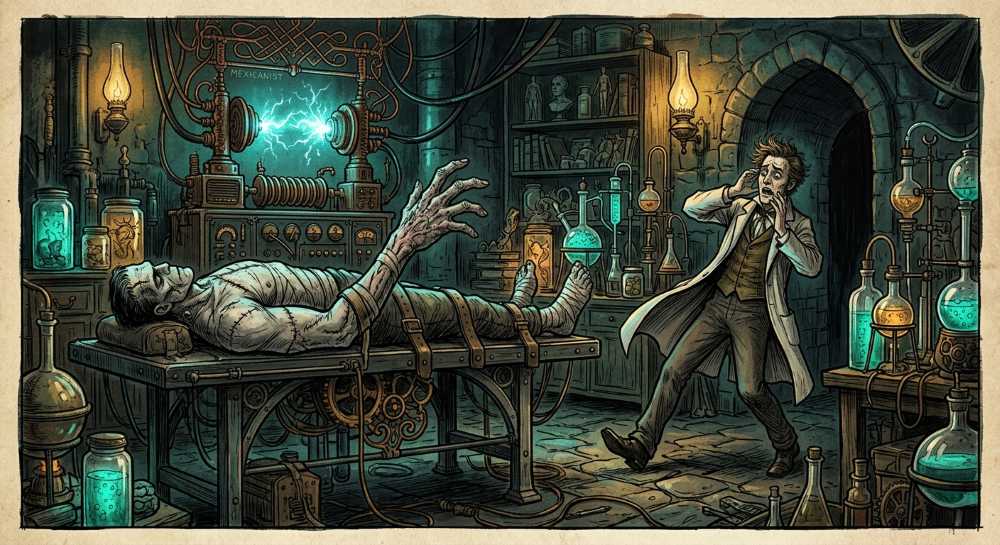
Victor Frankenstein is the ultimate failed mentor. He does not merely teach; he brings into existence. He transmits the ultimate knowledge, the spark of life itself, and then does what no mentor should ever do: he runs. The Creature opens his eyes, stretches out a hand, and Victor flees the room. The mentorship is doubly failed. First, Victor imparts life without accepting responsibility for the outcome. Second, the Creature, abandoned, educates himself through reading, discovering Paradise Lost, Plutarch's Lives, and Sorrows of Werter in a forest hovel, and the knowledge he acquires does not ennoble him but deepens his anguish and turns him toward vengeance. The education of the Creature is the most pitiable autodidact sequence in literature, and it produces exactly what Victor feared most: a being who understands his own suffering and blames his creator for it.
Learn from me, if not by my precepts, at least by my example, how dangerous is the acquirement of knowledge and how much happier that man is who believes his native town to be the world, than he who aspires to become greater than his nature will allow.
That is Victor, speaking to Walton in Chapter 4, in what amounts to the novel's thesis statement. And then there is the Creature's own devastating formulation, speaking to Victor in Chapter 10: "I ought to be thy Adam, but I am rather the fallen angel, whom thou drivest from joy for no misdeed." The Creature identifies the precise nature of the betrayal: he was supposed to be a creation worthy of love, an Adam to Victor's God. Instead, he was cast out. The knowledge itself, the Creature tells us in Chapter 13, does not corrupt: "Of what a strange nature is knowledge! It clings to the mind when it has once seized on it like a lichen on the rock." What corrupts is the abandonment after the knowledge. The Frankenstein pattern, the first of seven we will identify, is this: the mentor transmits knowledge but refuses responsibility for the outcome.
Victor himself eventually recognizes this, though far too late. In Chapter 20, he confesses: I, not in deed, but in effect, was the true murderer. It is the frankest admission of mentorship failure in all of literature, and it arrives only after the bodies have piled up. The lesson is ancient and it is simple: if you are going to create something, you had better be prepared to love it. Victor could not. The Creature, in his agony, made sure that everyone paid for that failure.
The Virtuous Teacher and the Brilliant Monster
If Frankenstein is the literary archetype, Socrates and Alcibiades are the historical original. Around 432 BCE, Socrates saved the life of the teenage Alcibiades at the Battle of Potidaea. What followed was one of the most consequential mentor-student relationships in Western history, and also one of the most catastrophically failed. Socrates, the greatest teacher Athens ever produced, dedicated years to the moral education of its most brilliant and most dangerous young aristocrat. The result was not a philosopher. The result was the man who single-handedly doomed the Athenian Empire.
Alcibiades was, by every account, dazzling. He was beautiful, charismatic, ferociously intelligent, and completely unprincipled. Socrates saw the potential and tried, genuinely tried, to redirect it toward virtue. In Plato's Symposium, Alcibiades himself describes the dynamic with unusual candor: Socrates was the only man who made him feel shame, the only one whose words could penetrate his armor of self-regard. And yet Alcibiades used his Socratic education, his rhetorical training, his intellectual confidence, not for virtue but for personal ambition. He became the most brilliant and unscrupulous politician of his generation, which, in Athens, was saying something.
The catastrophe came in 415 BCE. Alcibiades advocated for and was appointed commander of the Sicilian Expedition, a massive military adventure that ended in utter disaster for Athens. When recalled to face charges of sacrilege, he did what no student of Socrates should ever do: he defected to Sparta, revealing Athenian military strategies to the enemy. He later fled Sparta for Persia, then returned to the Athenian side, won naval victories, was exiled again, and was finally assassinated in Phrygia at Persian instigation in 404 BCE. It was a career of such vertiginous treachery that it would strain credulity in a novel.
But the deepest consequence of Alcibiades' betrayal fell not on Athens but on Socrates himself. In 399 BCE, Socrates was tried and executed on charges of corrupting the youth, a charge directly connected to his association with Alcibiades and other aristocratic traitors. The city blamed Socrates' teaching for producing men like Alcibiades and Critias, leader of the Thirty Tyrants. The transmission of critical thinking and dialectical skill had produced not a philosopher but a manipulator, a man who weaponized the very tools of self-examination that Socrates had developed. This is the Socrates-Alcibiades pattern: the knowledge itself is sound, but the student repurposes it for ends the teacher never intended. It is perhaps the most painful form of mentorship gone wrong, because the teacher did nothing wrong. The knowledge was good. The student was not.
The Laboratory and the Bomb
And now we arrive at the case that turns the abstract into the visceral. Ted Kaczynski, the Unabomber, was born on May 22, 1942, in Chicago. He entered Harvard at age 16 in the fall of 1958, graduated in 1962, earned a PhD in mathematics from the University of Michigan in 1967 with a dissertation on boundary functions that won the Sumner B. Myers Prize, became an acting assistant professor at UC Berkeley at 25, resigned in 1969, retreated to a cabin in Lincoln, Montana, in 1971, and between 1978 and 1995 conducted a bombing campaign that killed 3 people and injured 23 more. He was arrested on April 3, 1996, and died in prison on June 10, 2023.
That is the outline. The interior is worse. From late 1959 to early 1962, spanning Kaczynski's sophomore through senior years at Harvard, a psychologist named Henry A. Murray conducted a series of experiments on 22 Harvard undergraduates. Murray was no fringe figure. He was a former director of the Office of Strategic Services personality assessment program, the precursor to CIA recruitment techniques, and the creator of the Thematic Apperception Test. His Harvard experiment was designed to study stress responses. The method: subjects were told they would debate personal philosophy with another student. Instead, they were subjected to what Murray himself called vehement, sweeping, and personally abusive interrogation by an attorney who attacked their deepest values and beliefs while electrodes monitored their physiological responses. The sessions were filmed.
Kaczynski was one of those subjects. He was, by his own account to attorney Anthony Mello, pressured into participating. He was 17 years old, a prodigy, socially isolated, and uniquely vulnerable. A former research associate of Murray's, Wessman, later said he was long bothered by the unethical dimension of this study. Alston Chase, in his 2003 book Harvard and the Unabomber, argued that the Murray experiment drove Kaczynski beyond the pale, aiming at psychic deconstruction by humiliating undergraduates and thereby causing them to experience severe stress. The study is now widely regarded as ethically unconscionable.
At the University of Michigan, Kaczynski's doctoral advisor was George Piranian, who described his student in terms that should chill any educator: It is not enough to say he was smart. He did not make mistakes. Piranian had been working on the boundary functions problem himself without success; Kaczynski took it over and solved it. But when reporters called after the Unabomber arrest, Piranian said there are some topics that are not suitable for discussion. The mentorship at Michigan was purely technical: the intellect was sharpened while the person was neglected. And at Berkeley, the young professor was described as almost pathologically shy, received poor teaching evaluations, was not reappointed, and resigned into total isolation.
The result was what we might call a pincer effect of failed mentorship. At Harvard: abusive mentorship under the guise of scientific study, an adult authority figure weaponizing trust and access against a vulnerable prodigy. At Michigan: purely technical mentorship that developed mathematical brilliance without any human connection. At Berkeley: no meaningful mentorship at all. The knowledge transmitted was purely technical, mathematical boundary functions and psychological stress responses, but never included the ethical dimension of what knowledge is for. Kaczynski later weaponized his own intellect against the system that had trained and, in Murray's case, traumatized him. This is the Murray-Kaczynski pattern: mentorship itself is weaponized. Knowledge is transmitted through trauma rather than care, and the student, quite reasonably, comes to see knowledge itself as a weapon.
The Corrupted Teacher
Not all mentorship failures begin with the student. Some begin with the teacher. On May 1, 1933, Martin Heidegger, arguably the most important philosopher of the twentieth century, joined the Nazi Party, ten days after being elected Rector of Freiburg University. On November 3, 1933, he issued a decree applying Nazi racial policies to Freiburg students. He resigned as Rector in 1934 but remained a Nazi Party member through 1945. This was not a momentary lapse. It was a sustained moral catastrophe by the man who had written Being and Time, the philosopher of authenticity, of care (Sorge), of being-toward-others.
Among those others were some of the century's most important thinkers, and several of them were Jewish. Hannah Arendt arrived at Marburg University in 1924 at age 18 and began a clandestine affair with Heidegger, then 35, married, and her professor. The affair lasted until 1928. When Heidegger joined the Nazi Party and began implementing Nazi educational policies as Rector, Arendt, who was Jewish, fled Germany. She experienced what she called betrayal and the ruining of her life. She would not see Heidegger again until 1950. Her entire later philosophy of totalitarianism and the banality of evil can be read as an engagement with, and refutation of, the existential framework she learned from her teacher.
Emmanuel Levinas, a Lithuanian-born French philosopher of Jewish heritage, studied under Heidegger at Freiburg in 1928-1929 and initially regarded Being and Time as a philosophical revelation. Then almost all of his family was murdered in the Holocaust. Levinas later wrote, in a commentary on forgiveness that has become one of the most quoted lines in twentieth-century philosophy: One can forgive many Germans, but there are some Germans it is difficult to forgive. It is difficult to forgive Heidegger. Levinas's entire ethical philosophy, which places infinite responsibility for the Other above ontology, can be read as a systematic response to Heidegger's failure. Where Heidegger prioritized Being, Levinas insisted on ethics as first philosophy.
The Heidegger pattern is uniquely devastating: the teacher's own moral failure poisons the knowledge transmitted, forcing students to rebuild from the wreckage. Arendt, Levinas, Hans Jonas, Karl Lowith, Herbert Marcuse, each had to reckon with this betrayal in their own work. Heidegger taught them to think in revolutionary ways, and then demonstrated that revolutionary thinking could accommodate itself to fascism. The knowledge was not misused by the student. The knowledge was corrupted at the source.
The Misread Legacy
And then there is the case where the knowledge is accurate, the teacher is virtuous, but the students transform a descriptive framework into a prescriptive ideology. Leo Strauss, the German-American political philosopher who taught at the University of Chicago from 1949 to 1968, was a quiet, scholarly figure devoted to close reading of ancient texts. His central insights were the distinction between esoteric and exoteric writing, the observation that philosophers fearing persecution write at two levels; the crisis of modernity, the idea that liberal democracy's relativism leads to nihilism; and the importance of the noble lie, the Platonic concept that society needs foundational myths. These were analytical observations, careful readings of what Plato and others actually meant. Strauss himself was deeply skeptical of direct political engagement.
His students, and their students, had other ideas. Irving Kristol, the godfather of neoconservatism, acknowledged in 1979 that Strauss was too wary of modernity for the neoconservatives. Allan Bloom, Strauss's direct student at Chicago, wrote The Closing of the American Mind (1987), a polemic that became a neoconservative manifesto, more combative than anything Strauss himself ever wrote. Paul Wolfowitz, who studied with both Strauss and Bloom, became U.S. Deputy Secretary of Defense and a primary architect of the 2003 Iraq War. Other influential students, including Walter Berns, Harry Jaffa, and William Kristol, transformed Strauss's philosophical skepticism into political activism.
The core divergence is this: Strauss's analysis of the noble lie was descriptive, an observation about what philosophers have done, not a recommendation. His students interpreted it as prescriptive, a justification for leaders to actively deceive the public for their own good. Strauss's skepticism about liberal universalism was transformed, through a chain of interpretation, into a justification for spreading democracy by force. The 2003 invasion of Iraq was supported by many Strauss-influenced intellectuals, but Strauss himself was opposed to all grandiose schemes of political idealism, as Irving Kristol himself acknowledged. Whether this is a distortion or a logical extension of Strauss's thought remains one of the most heated debates in contemporary intellectual history. But the pattern is clear: the teacher's ideas were accurate, but students transformed an analytical framework into a political weapon.
Echoes in Other Chambers
J. Robert Oppenheimer assembled the greatest collection of scientific minds in history at Los Alamos during the Manhattan Project (1943-1945). He was their director and their intellectual leader. The knowledge transmitted, how to split the atom, how to build a bomb, was used exactly as intended. But the moral consequences were not. After the Trinity test on July 16, 1945, Oppenheimer famously recalled the Bhagavad Gita: Now I am become Death, the destroyer of worlds. The more direct mentorship failure, however, came from within the team. Edward Teller, a Hungarian physicist who worked under Oppenheimer at Los Alamos, had long advocated for the hydrogen bomb, a weapon far more destructive than the atomic bomb. Oppenheimer opposed it.
In April 1954, during Oppenheimer's security clearance hearing, Teller provided devastating testimony against his former mentor: I feel I would like to see the vital interests of this country in hands which I understand better, and therefore trust more. The scientific community regarded this as a profound betrayal. Isidor Rabi famously said it should have been Teller who was ostracized. Many Los Alamos colleagues shunned Teller for the rest of his life. The pattern: Oppenheimer transmitted the knowledge of nuclear physics; Teller used that knowledge to push for weapons of unlimited destructiveness that Oppenheimer himself opposed. The student exceeded the teacher in exactly the direction the teacher feared.
Friedrich Nietzsche, age 24, met Richard Wagner, age 55, in 1868. Wagner became a father figure and intellectual mentor. Nietzsche's first book, The Birth of Tragedy (1872), was deeply influenced by Wagner's aesthetic vision. But by the 1876 Bayreuth Festival, Nietzsche became disillusioned with Wagner's nationalism, anti-Semitism, and Christian themes in Parsifal. In 1888, Nietzsche published Nietzsche contra Wagner and The Case of Wagner, explicitly repudiating his former mentor. The pattern is the inverse of most mentorship-gone-wrong stories: the student recognized the corruption in the teacher's project and broke away. But the knowledge Wagner transmitted, about art, culture, and the will to power, stayed with Nietzsche and was transmuted into his own philosophy. Sometimes the knowledge survives the betrayal. Sometimes, even, it is sharpened by it.
And yes, we are going there, because popular culture has its own taxonomy of failed mentorship and it is worth taking seriously. Chancellor Palpatine, also known as Darth Sidious, represents the most iconic modern depiction of corrupt mentorship. His seduction of Anakin Skywalker follows a precise playbook: trust-building from childhood, intellectual seduction through forbidden knowledge the Jedi withheld, systematic isolation from other mentors, and finally the offer of power over death itself. Anakin is seduced not by evil per se but by knowledge, specifically knowledge that the Jedi Order deliberately withheld. The transmission of forbidden knowledge produces the transformation the dark teacher intended, but the use of that knowledge produces something the original teachers, the Jedi, never intended: the destruction of the Order itself. It is the same pattern, dressed in black robes and scored by John Williams.
The Tenth Muse Silenced
No survey of mentorship gone wrong would be complete without the most important Latin American case, and the one that most directly speaks to the readers of this publication. Sor Juana Ines de la Cruz, the Tenth Muse of Mexico, the Phoenix of America, was a self-taught nun, poet, philosopher, playwright, and one of the greatest intellectuals of the Spanish colonial world. She was born around 1648-1651 and died on April 17, 1695, while nursing her fellow nuns during a plague. Between those dates, she produced a body of work that still staggers, and she was destroyed by the very mentors who should have nurtured her.
The first betrayer was Antonio Nunez de Miranda, a Jesuit priest who became Sor Juana's confessor around 1669 when she entered the convent. Nunez de Miranda initially supported her intellectual vocation but became increasingly hostile to her writing and learning. Britannica records that Sor Juana broke with her Jesuit confessor in the early 1680s because he had publicly maligned her. The UC Press notes that Nunez de Miranda, having recognized her intellectual gifts, sought to suppress them, aware of how potentially disruptive a self-defined and articulate woman could be. This is mentorship gone wrong in its most classical pattern: a mentor who recognizes talent but fears its consequences, attempting to contain rather than develop it.
The second betrayal was more cunning. In 1690, Sor Juana wrote a private critical letter analyzing a sermon by the Portuguese Jesuit Antonio Vieyra. The Bishop of Puebla, Manuel Fernandez de Santa Cruz, obtained the letter and published it without her permission under the title Carta Atenagorica, or Letter Worthy of Athena. He prefaced it with his own letter, written under the female pseudonym Sor Filotea de la Cruz, in which he praised her intellect while admonishing her to devote herself to religious rather than secular study. It was a velvet-gloved silencing: publish the work to demonstrate the brilliance, then use that very publication as a platform to demand the brilliance stop.
Sor Juana responded with her masterwork: Respuesta a Sor Filotea (1691), one of the earliest and most powerful feminist intellectual documents in the Western tradition. In it, she defended the right of women to education and intellectual pursuit, citing dozens of learned women throughout history. But the Church hierarchy was relentless. Under pressure from her new confessor and the broader ecclesiastical establishment, Sor Juana was forced to cease writing. She sold her library of over 4,000 books and her scientific and musical instruments. She signed a renewed profession of faith in her own blood. She died four years later. This is the Sor Juana pattern, perhaps the cruelest of all: mentors who transmit knowledge and then, threatened by what that knowledge has produced, attempt to destroy it. The knowledge Sor Juana acquired produced a critical, independent mind that her mentors found intolerable. So they silenced it.
Seven Patterns of Pedagogical Catastrophe
Across all of these cases, from the literary to the historical to the pop-cultural, seven recurring patterns emerge. Each represents a distinct mechanism by which the transmission of knowledge produces something the teacher did not intend.
1. Abandonment after creation (Frankenstein). The mentor transmits knowledge or life but refuses responsibility for the outcome. The student is left to self-educate, and the knowledge acquired in isolation produces suffering rather than wisdom. This is the most common pattern in literary fiction and the most emotionally devastating, because the failure is one of care, not of intellect. Victor Frankenstein did not teach his Creature wrong. He simply refused to teach him at all.
2. Abusive transmission (Murray and Kaczynski). The mentorship relationship itself is weaponized. Knowledge is transmitted through trauma rather than care, and the student comes to see knowledge itself as a weapon. This is the pattern most likely to produce literal violence, because the student has been taught, through the mentor's own example, that power over others is the point of knowledge.
3. The virtuous teacher, the corrupted student (Socrates and Alcibiades). The knowledge itself is sound, but the student repurposes it for ends the teacher never intended. This is the most painful pattern for the teacher, because the failure cannot be attributed to bad pedagogy. Socrates taught Alcibiades well. Alcibiades simply chose to use the teaching for his own purposes. The knowledge, once transmitted, no longer belongs to the teacher.
4. The corrupted teacher (Heidegger). The teacher's own moral failure poisons the knowledge transmitted, forcing students to rebuild from the wreckage. This pattern produces not violence but a particular kind of philosophical anguish: the student must simultaneously acknowledge the power of the knowledge and repudiate the person who transmitted it. Levinas's entire career can be read as this act of simultaneous acknowledgment and repudiation.
5. Divergent interpretation (Strauss). The teacher's ideas are accurate, but students transform a descriptive or analytical framework into a prescriptive and political one. The knowledge is not corrupted at the source; it is corrupted in transit. This is perhaps the most common pattern in contemporary academic life, and the most difficult to detect, because the students genuinely believe they are faithful to the teacher's intent.
6. Deliberate seduction (Palpatine, Saruman). The mentor intends to corrupt. But even here, the knowledge offered produces consequences that exceed the mentor's control. Palpatine seduced Anakin with the promise of power over death, but the resulting Darth Vader eventually turned on his master. The knowledge, even when weaponized by a malign teacher, retains its own agency. It cannot be fully controlled by the one who transmits it.
7. Containment and silencing (Sor Juana). The mentor recognizes the student's brilliance and, threatened by it, attempts to destroy what the knowledge has produced. This is the pattern most specific to women and marginalized groups in the history of mentorship, and it is the cruelest, because the mentor's initial act of recognition makes the subsequent act of silencing possible. Nunez de Miranda could not have silenced Sor Juana if he had not first recognized her genius. The recognition and the silencing are the same gesture.
Knowledge, Once Given, Is No Longer Yours
In every case we have examined, the transmission of knowledge succeeds. That is, the student acquires the knowledge. The failure lies in what happens after the transmission: the mentor's inability or unwillingness to accept the consequences of what has been taught, or the student's repurposing of knowledge for ends the teacher never imagined. The deepest version of this paradox is this: true knowledge, once transmitted, belongs to the recipient, not the transmitter. Every act of genuine teaching is an act of letting go, and every teacher who cannot let go creates the conditions for their own Frankenstein moment.
This is not an argument against teaching. It is an argument for teaching with awareness of what teaching actually is: a transfer of power. When Victor Frankenstein brought the Creature to life, he was not merely conducting an experiment. He was handing over the most dangerous thing in the world, the capacity for self-awareness, to a being he had not prepared to receive it. When Socrates taught Alcibiades to question everything, he was not merely training a philosopher. He was arming a future traitor with the rhetorical tools to justify any position. When Henry Murray subjected a 17-year-old prodigy to abusive interrogation, he was not merely studying stress. He was demonstrating, with the authority of Harvard and the OSS, that power over others is what knowledge is for.
The data bears this out. Negative mentoring experiences have a disproportionately powerful impact compared to positive ones, consistent with broader psychological research on negativity bias. A 2021 study by Tuma and colleagues, interviewing 40 life science doctoral students, found that negative mentoring experiences are systemic and arise from structural features of academia, not just individual dysfunction. The problem is not a few bad mentors. The problem is a system that treats mentorship as a transmission of information rather than a relationship of care, and then acts surprised when the relationship fails and the information is weaponized.
The answer, if there is one, is not to stop teaching. It is to teach with the awareness that knowledge is not a gift you can take back. It is a seed that will grow in soil you cannot control. Frankenstein should have loved his Creature. Socrates should have accepted that even the best teaching can be misused. Murray should never have run his experiment. Heidegger should have remembered his own philosophy. Sor Juana's confessors should have celebrated what they had helped create. And every teacher, everywhere, should remember that the moment you hand over knowledge, it is no longer yours. The student will do with it what they will. The only question is whether you have given them, along with the knowledge, a reason to use it wisely. That part, the ethical part, the part about what knowledge is for, is the part that most often gets left out of the syllabus. And that, more than anything else, is how mentorship goes wrong.
Sources
Shelley, M. Frankenstein; or, The Modern Prometheus. Lackington, Hughes, Harding, Mavor & Jones, 1818.
National Academies of Sciences, Engineering, and Medicine. The Science of Effective Mentorship in STEMM. National Academies Press, 2019. https://www.ncbi.nlm.nih.gov/books/NBK552762
Eby, L.T., McManus, S.E., & Simon, S.A. "The Protege's Perspective Regarding Negative Mentoring Experiences." Journal of Vocational Behavior, 57(1), 2000. Cited by 898. https://www.sciencedirect.com/science/article/pii/S0149206399800683
Tuma, T.K., et al. "A Systems Characterization of the Negative Mentoring Experiences." CBE-Life Sciences Education, 20(4), 2021. Cited by 158. https://pmc.ncbi.nlm.nih.gov/articles/PMC8734396
Chase, A. Harvard and the Unabomber: The Education of an American Terrorist. W.W. Norton, 2003.
The Guardian. "Harvard and the Unabomber." June 22, 2000. https://www.theguardian.com/theguardian/2000/jun/22/features11.g2
Psychology Today. "Harvard's Experiment on the Unabomber, Class of '62." 2012. https://www.psychologytoday.com/us/blog/impromptu-man/201205/harvards-experiment-on-the-unabomber-class-of-62
History.com. "What Happened to the Unabomber at Harvard." https://www.history.com/articles/what-happened-to-the-unabomber-at-harvard
Plato. Symposium. Trans. Alexander Nehamas and Paul Woodruff. Hackett, 1989.
Britannica. "Alcibiades." https://www.britannica.com/biography/Alcibiades-Athenian-politician-and-general
Wikipedia. "Trial of Socrates." https://en.wikipedia.org/wiki/Trial_of_Socrates
Wikipedia. "Martin Heidegger and Nazism." https://en.wikipedia.org/wiki/Martin_Heidegger_and_Nazism
Goethe-Institut. "Heidegger and Nazism." https://www.goethe.de/prj/zei/en/art/27022324.html
Levinas, E. Totalite et Infini. Martinus Nijhoff, 1961.
Fricker, M. Epistemic Injustice: Power and the Ethics of Knowing. Oxford University Press, 2007.
Prospect Magazine. "No More Heroes." https://www.prospectmagazine.co.uk/essays/57188/no-more-heroes
Norton, A. Leo Strauss and the Politics of American Empire. Yale University Press, 2004.
Wikipedia. "J. Robert Oppenheimer." https://en.wikipedia.org/wiki/J._Robert_Oppenheimer
Famous Trials. "Testimony of Dr. Edward Teller in the Oppenheimer Hearing." https://famous-trials.com/oppenheimer/2706-testimony-of-dr-edward-teller-in-the-oppenheimer-hearing
Nietzsche, F. The Case of Wagner / Nietzsche contra Wagner. 1888.
Britannica. "Sor Juana Ines de la Cruz." https://www.britannica.com/biography/Sor-Juana-Ines-de-la-Cruz
Project Vox. "Sor Juana Ines de la Cruz (1648-1695)." https://projectvox.org/sor-juana-1648-1695
UC Press. "Sor Juana's World." https://publishing.cdlib.org/ucpressebooks/view?docId=ft7c600832
Wiley (2021). "Trust between teacher and student in academic mentoring." Journal of Philosophy of Education. https://onlinelibrary.wiley.com/doi/full/10.1111/1467-9752.12560
Frontiers in Education (2023). "Mentor-mentee relationships in academia: insights toward understanding." https://www.frontiersin.org/journals/education/articles/10.3389/feduc.2023.1198094/full