The Crocodile’s Eye — Part 8: The Man Who Taught the Killer
Don Eligio Canul has been waiting for them in a house full of obsidian and copal smoke. He taught Hernán Ku the language of the water twelve years ago. He's been documenting the killings alone ever since — pinning photographs to a wall while the police wrote "crocodile" and stopped listening.

Previously: Hudson's profile had been fundamentally wrong. He sat in a Tulum hotel room confronting the wreckage of his certainty. Miguel took him to a cenote the tourists had never found — walls covered in paintings older than the conquest, the water watching. They stopped looking for a killer and started looking for a believer.
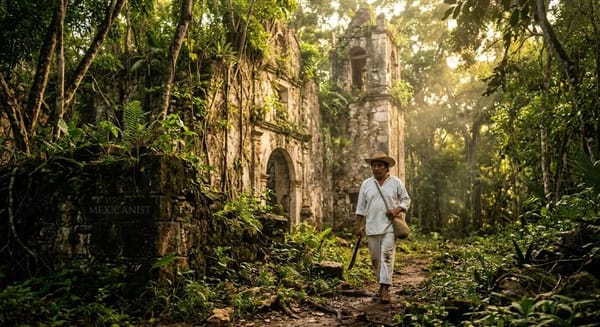
The road to San Francisco de Asís was barely a road at all - more of a scar cut through the jungle, the limestone beneath exposed and jagged, the ruts deep enough to swallow a tire. Miguel navigated the Jeep with the careful attention of a man who knew that a wrong turn here could mean hours of walking, or worse. Beside him, Hudson was reviewing the file Torres had assembled: one witness statement, one photograph, one name. Don Eligio Canul. Age sixty-seven.
A h’men - a traditional Maya spiritual guide - who had lived in this village his entire life, who was rumored to know the old ways, who had been seen at Cenote Calavera three days before Anna Svensson’s body was found. A photograph, grainy and taken from a distance, showed him standing at the cenote’s edge, his arms raised toward the moon, his mouth open in what could have been prayer or song. “Torres thinks he’s our killer,” Hudson said, tapping the photograph.
“The marks on Svensson’s chest match symbols associated with the h’men tradition.
Don Eligio has the knowledge, the access, the opportunity. He lives alone, no alibi, no witnesses. And according to the village gossip, he’s been increasingly unstable - talking about the water being angry, about sacrifices that need to be made.” “That describes half the old men in Quintana Roo,” Miguel said, though his voice carried doubt.
“The traditions didn’t disappear. They went underground.
Every village has someone who knows the old prayers.”
“But not everyone has been seen at the crime scenes.” Hudson’s voice was level, the voice of certainty. “Don Eligio was at Cenote Azul on October thirtieth. Two days before Keller’s body was found. He was at Cenote Calavera on November twenty-eighth. Three days before Svensson.
That’s not a coincidence. He’s our primary suspect, Miguel. The profile fits. Isolated male, custodial relationship with the sites, messianic worldview — this is textbook.” Miguel said nothing. He drove. The village appeared through the trees like a memory of a different time. Concrete block houses with thatched roofs, a church whose facade had been decorated with motifs that predated Christianity by centuries, a central square where old men sat on benches and watched the world with eyes that had seen too much to be surprised by anything.
The Jeep pulled to a stop in front of the largest structure - a house set apart from the others, surrounded by flowering plants that Miguel recognized as species used in traditional medicine, in traditional ritual, in ways that the Spanish had tried to eradicate and failed. Don Eligio Canul was waiting for them. He stood in the doorway of his house, a man whose body seemed to exist in a different relationship with time. His face was lined, but his eyes were clear, alert, watchful.
He wore the traditional white guayabera, the embroidery at the collar showing symbols that Miguel recognized from the museum in Mérida - glyphs that had been carved into limestone before the concept of Mexico existed.
In one hand, he held a staff carved from zapote wood, the grain flowing into the shape of a crocodile’s head at its peak. “Detective Manito,” Don Eligio said, his voice carrying the accent of someone who had learned Spanish as a second language, who thought in a tongue that had no words for the things he saw.
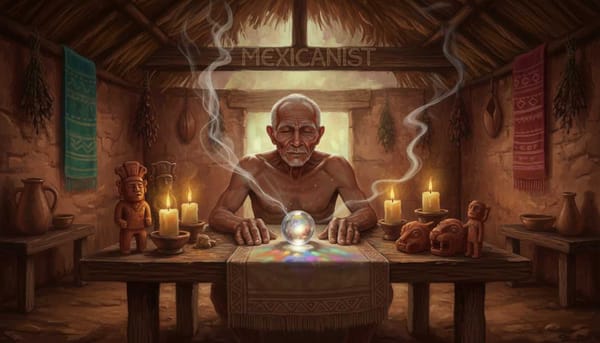
“I have been expecting you.” The interior of the house was cool, dark, filled with the scent of copal incense and dried herbs.
Every wall was covered with objects that told a story the Spanish had tried to erase: stone tools, ceramic vessels, carved jade, obsidian blades. In the corner, an altar held offerings - corn, candles, photographs of people who had been dead for generations. And above it all, mounted on the wall like a guardian, was a crocodile skull. Its eye sockets had been filled with obsidian discs that seemed to watch, to wait, to remember.
Don Eligio gestured for them to sit, and they did - the detective and the profiler, men of evidence and reason, sitting on woven mats in a house that existed outside their frameworks. “You are here about the bodies,” Don Eligio said. It wasn’t a question. “The water has been speaking. The crocodiles have been carrying messages.
You think I am the one who sends them.” “We know you were at Cenote Azul before Daniel Keller died,” Miguel said, choosing directness over the dance of interrogation.
“We know you were at Cenote Calavera before Anna Svensson. We know you have the knowledge, the tools, the symbols. We found obsidian fragments in the wounds. We found marks that match the traditions you practice.” Don Eligio listened without moving, his eyes fixed on something that seemed to exist beyond the walls of the room.
When Miguel finished, the old man was silent for a long moment. Then he laughed - with something that sounded almost like grief. “The water speaks, Detective. But not everyone who listens understands what it says.” Don Eligio moved to the altar — not to retrieve anything, Miguel realized, but to block it. He positioned himself between the detectives and the wall behind. But he was too slow. Miguel had already seen them.
The photographs were pinned to the wall in a pattern that someone had assembled over years, not hours. Cenotes he recognized and cenotes he didn’t. Dates in a hand that wrote the way people write when they’re keeping accounts, not records. At the edges, where the pins had run out, the photographs were overlapped — new evidence layered onto old, the way coral grows over limestone, each year of watching pressing the previous year deeper into the wall. “How long?” Miguel asked. Don Eligio turned.
His expression was that of a man who’d expected a different question. “Three years since the first body. But I heard the water before that. Six years, perhaps. The frequency changes when something is wrong.”
“The police —”
“Did not come.” Not bitterly. The way you state a fact about weather. Something that was neither surprising nor forgivable. “I described what I heard. They wrote ‘crocodile’ and stopped listening.” Hudson had moved to the wall, his camera documenting the arrangement of photographs.
He stopped at one: a figure at a cenote’s edge, wearing something over his face that the light made ambiguous. The mask. “He came back to the same sites,” Hudson said.
“These dates. The intervals.” Don Eligio was quiet. “He came to you,” Miguel said. Don Eligio sat. “Many come to learn,” he said at last.
Hudson lowered his camera. He looked at the wall — not at the photographs now, but at the years of them. Three years of pinning evidence to a wall in a village no one came to. He looked at Miguel, and what passed between them was not spoken, but Miguel saw it: the profiler realizing that his textbook primary suspect was a seventy-year-old man who had been running his own investigation, alone, while Hudson was still working the Nile case in an air-conditioned office. Hudson put the camera in his lap and sat down on the mat.
“I teach what I can.
The water teaches the rest.” He looked at his hands. “I did not teach him fast enough.”
“Who is he?”
“He learned the words. But not the silence between them.” Don Eligio’s voice carried grief. “The rituals are not gestures, Detective. They are conversations with forces that do not forgive impatience. You do not command the water. You ask it. You do not send souls to Xibalba.
You help them find their own way there.” He looked at the skull. “He learned the shape. He never learned to ask.”
“His name.” Don Eligio said nothing. The copal burned. Somewhere outside, a bird called once and went quiet. “You’ve been alone with this for three years,” Hudson said, from his corner of the room. His voice held no profiler strategy — just a man asking. “You could have kept being alone with it. Why us?” Don Eligio crossed to the table and sat.
He studied Miguel the way people study maps they’ve made themselves, looking for the place where the paper ends and the territory begins. “Give me your hand.” Hudson, across the room, made a small movement with one shoulder — not a shrug, just the slight adjustment of someone who’s decided not to object. Miguel held out his left hand — the scarred one, the one with the healed fracture that had never quite straightened. Don Eligio held his own palm beneath it, not touching. Close enough that Miguel felt the heat of it. “When you touched the mask,” the old man said.
“The one in the museum.
You felt it.” Not a question. “What did it sound like?” The laundry machines below his apartment. The frequency he’d felt in his wrist since the fall into the dry cenote at age eight, the fall his grandfather had found funny and his grandmother had not. The thing he’d stopped mentioning. Miguel said: “Old.” Don Eligio lowered his hand. He looked at the photographs on the wall — at the four circled in red, at the seven that remained blank — and Miguel understood that he’d been looking at those seven circles since before the detectives arrived.
Carrying them. “His name,” Don Eligio said, “was Hernán Ku. He came to me twelve years ago saying the water had spoken to him.” He reached past Miguel and pressed the stone disc — the glyph, the signature — into his hand.
“He was wrong about what it meant.” Miguel closed his fingers around the disc. In the healed fracture in his wrist, in the bone where the frequency always arrived first, he felt it again.
The thing that had lived in standing water since before he could explain it. “You can stop him,” Don Eligio said.
“But only if you learn to listen before you run out of time.” The drive back was long and quiet. Miguel counted the blank circles on the map photograph as Hudson drove. Seven cenotes. Seven signatures not yet carved. He counted them twice to be sure, and the second time felt no better than the first. “The shaman’s not our guy,” Hudson said finally.
“But he knows who is. And now, so do we.”
Hudson photographed the arrangement of objects while Don Eligio prepared coffee in the back room. The obsidian blades showed wear from actual use. The jade carvings had been handled in ceremonies predating the conquest. But it was the crocodile skull above the altar that held him—its obsidian-filled eye sockets watching with a patience that made the back of his neck prickle. He photographed it twice, the second time because his hands had been unsteady on the first.
“The skull belonged to my grandfather’s grandfather,” Don Eligio said, appearing at Hudson’s shoulder. The old man moved without sound, his bare feet finding the smooth places in the stone floor. “He was the last of the water keepers who worked with the living crocodiles. After him, we kept only the memory.”
“Water keepers,” Hudson repeated.
“You mean—”
“I mean that the covenant between humans and crocodiles was not symbolic, Professor Hudson. It was practical. My ancestors did not worship the crocodiles. They worked with them. They developed a… relationship. A partnership that served both species.”
Don Eligio moved to the altar, his hand touching each object in a sequence that had clearly been practiced thousands of times. A ceramic bowl. A bundle of dried herbs. A conch shell worn smooth by generations of hands. A jaguar tooth on a leather cord. Each touch seemed to anchor him further in the space, his presence becoming more solid, more present, as if the objects were lending him their accumulated weight.
“You are a profiler,” Don Eligio said, turning to face Hudson.
“You study patterns in human behavior. You look for signatures, for repetitions, for the grammar that violence speaks when it thinks no one is listening.”
“That’s correct.”
“Then you understand that the grammar is not the meaning. A signature is not a motive. A pattern is not a purpose.” The old man’s eyes were clear, sharp, holding an intelligence that belied his age. “What Hernán is doing—the bodies, the marks, the teeth—these are words in a sentence he learned from me. But the meaning he has given them is his own. And I am responsible for teaching him the vocabulary without teaching him the silence that should contain it.”
Don Eligio had been twelve years old when his father first brought him to the cenote at the new moon. The memory was as clear as if it had been yesterday—clearer, in some ways, because the decades since had worn away the irrelevant details and left only the essence.
His father had been a h’men for forty years, inheriting the role from his own father, who had inherited it from his father before him, a chain of transmission that stretched back before the Spanish conquest and would have stretched further if the friars hadn’t burned the records. Don Eligio—Eli, then, just a boy with too many questions and not enough answers—had grown up watching his father conduct ceremonies, whisper prayers, prepare offerings for the water that ran beneath their village like blood beneath skin.
But watching was not knowing. And on the night of his twelfth birthday, his father had finally decided it was time for him to understand.
“The h’men tradition is not a religion,” his father had told him, standing at the cenote’s edge with the water black and still below.
“It is a technology. The prayers are not pleas to gods who might or might not exist. They are instructions. The water has a language, and we have learned to speak it. That is all.”
Young Eli had not understood. The cenote was just water, he thought. Water in a hole in the ground. How could water have a language?
His father had smiled, the expression catching the torchlight in a way that made him look both ancient and ageless. “You hear it already,” he said.
“I have watched you. When you stand at the water’s edge, you go still. Your breathing changes. You are listening to something that most people cannot hear.”
“It’s just a buzzing,” Eli had said, embarrassed.
“Like a bee, but lower. It doesn’t mean anything.”
“It means everything.” His father knelt beside him, his hand finding the water’s surface and disturbing it with a single touch. “Feel that. Not with your skin. With your bones.”
Eli had reached toward the water, his fingers breaking the surface tension. The cold was immediate, shocking in the tropical heat, but beneath the cold was something else—a vibration, a resonance that seemed to travel up his arm and settle in his jaw, in his sternum, in the spaces between his ribs. It was the same buzzing he’d always heard, but stronger now, more intentional, as if the water were speaking directly into his body.
“The limestone beneath us is not solid,” his father said.
“It is a cathedral.”
“What is it saying?”
His father had been quiet for a long moment. Then: “It is saying that we are not alone.”
“Waiting for what?”
“Waiting for us to remember what we owe.”
That had been the beginning of Don Eligio’s training—the decade-long process of learning to hear what the water carried, to interpret its frequencies, to conduct the ceremonies that kept something in balance. His father had taught him the prayers, the offerings, the precise timing of rituals that corresponded to the sacred calendar. But more importantly, he had taught him the silence that surrounded the words—the understanding that the rituals were not about control, but about relationship.
“You cannot command the water,” his father had told him, again and again, in the years that followed.
“You can only request. You can only offer. And the water will respond according to what you have given it. If you give it fear, it will give you fear back. If you give it gratitude, it will receive you with gratitude. But if you give it nothing—if you take and take without returning—then it will take back what it is owed. And it does not bargain.”
Don Eligio had been forty-seven when Hernán Ku came to him. He had been practicing as a h’men for thirty-five years, conducting ceremonies, training the next generation, maintaining the covenant in a world that had largely forgotten it existed. He had taught dozens of students, some who stayed and some who left, some who understood and some who merely went through the motions.
Hernán had been different.
“He heard the water before I taught him anything,” Don Eligio told Hudson and Miguel, his voice carrying the weight of old grief.
“The frequency was already in his bones. His grandfather had been a water keeper. The gift had skipped two generations and landed in Hernán with a force I had never seen.”
“But he didn’t understand,” Miguel said. It was not a question.
“He understood the vocabulary. Learned the ceremonies faster than any student I’d ever taught.” Don Eligio shook his head. “But the silence between the words—that he could not learn. He heard the water speaking and thought it was speaking to him. Personally.”
“Weren’t you chosen?” Hudson asked.
“I was given a responsibility. Hernán believed he had been given a destiny.” Don Eligio looked at the crocodile skull on his wall. “You call it ‘the covenant’ because that is the word your reports can hold. The old word is Wayob — the bond between the human and the animal, between what walks above and what waits below. The Wayob does not have chosen ones. It has servants. Hernán thought it was about power—that if he performed the rituals correctly, he could make the water answer to him.”
“Can you?” Miguel asked. “Control it?”
Don Eligio was quiet. He crossed to the altar, adjusted a candle that didn’t need adjusting. When he turned back, the answer seemed to cost him something. “The water receives. That is its nature. It carries what is poured into it. What it carries, it remembers.” He paused. “And what has been poured in must eventually be accounted for.” He looked at Hudson, then at Miguel, as if deciding how much of the rest to say. “Hernán has been pouring something into the water for twelve years. Not just bodies. Intention. Purpose. He has been trying to make the water speak his language.” The old man turned back to the altar. A long silence. “I fear it may have learned.”
Don Eligio moved to a wooden cabinet in the corner of the room, hand-carved with the same crocodile motifs that appeared throughout the house. He opened it with a key that hung on a leather cord around his neck, revealing shelves of notebooks—bound volumes filled with handwriting that covered decades.
“This is what your police reports cannot show you,” Don Eligio said, pulling down a volume and opening it to a page covered in glyphs and Spanish text.
“My notes from the years I watched Hernán. The ceremonies he conducted, the offerings he made, the places he went. I could not stop him—I did not have the power to stop him. But I could document. I could bear witness.”
He handed the notebook to Hudson, who opened it carefully, his profiler’s mind already cataloguing the structure of the entries.
“Twelve years ago, he conducted his first independent ceremony at Cenote Ch’aak,” Don Eligio said.
“He told me it was to ask for guidance. But I felt what he was actually asking. He was asking the water to accept him. To recognize him as something more than a servant—a partner. An equal.”
“And the water…”
“The water did not answer. It never answers in words. But the crocodiles—they began to gather. At the cenotes where Hernán conducted his ceremonies, the crocodile population increased. They would appear from the underground passages, drawn by something I could not hear. As if they were responding to a call that only they could perceive.”
Hudson looked up from the notebook. “The ultrasonic device. The frequency B’alam described.”
Don Eligio nodded slowly. “Hernán found a way to amplify what he already carried. The frequency in his bones, the resonance he had learned to produce through the ceremonies—he built a machine that could speak louder than any prayer. A technology that could reach the crocodiles where they lived, in the passages beneath the earth, and tell them what to do.” Hudson had been writing in his notebook throughout. He looked up. “What frequency?” Don Eligio considered the question as a musician considers a question about tempo: as if the asker had understood something real but named it wrong. “Between seventeen and nineteen cycles per second. Below what humans hear. Where a reptile’s inner ear stops registering sound and begins registering instruction.” Hudson wrote it down. The vestibular system, not the auditory cortex. A voice the crocodiles felt in their bones.
“That’s not religion,” Miguel said.
“That’s engineering.”
“It is both. Hernán has done what my ancestors could never do—he has mechanized the covenant. He has turned prayer into programming, and the crocodiles are his hardware.” Don Eligio closed his eyes. “I taught him the language of the water. I did not teach him that language could be used for commands. That was his own invention.”
“And the sacrifices—the bodies, the markings—are they part of the programming?”
“Each body is a message. And each message tells the water the same thing: I am the one who feeds you. I am the one you must answer to.”
Don Eligio looked at the photographs on his wall—the seven blank circles that represented the rituals not yet completed.
“He needs seven more. Seven offerings, at seven cenotes. When the last body is placed, the covenant will be complete—not restored, but completed. In a form it has never taken before.”
“How do we stop him?” Miguel asked.
Don Eligio reached into his cabinet once more, retrieving a small object wrapped in cloth. When he unwrapped it, the detectives saw a ceramic whistle, carved with glyphs that matched those on the walls of the underwater chamber.
“This is the voice that speaks in the old language,” Don Eligio said.
“The frequency that Hernán’s machine cannot override. It was given to me by my father, who received it from his father. It is not a weapon. It is a reminder. When Hernán’s crocodiles hear it, they will remember what they were before he taught them to obey. They will remember the covenant that he has tried to pervert. And they will choose.”
“Choose what?”
“Choose whether to follow the frequency they have been conditioned to, or the frequency they have carried in their blood for millions of years. The water receives, Detective. But it also judges. And when it judges, there is no appeal.”
Next Wednesday: Part 9 — Plastic Teeth A body in a cenote with the ritual marks. Three rows of nine. But the teeth in the wounds aren't bone — they're resin. The prophet is cutting corners. Which means the sacred materials are being saved for something else.
Subscribe to get each chapter by email →
The Crocodile's Eye is a work of fiction. The cenotes, the covenant, and the crocodiles are real. The rest is what the water remembers.
© 2026 Mexicanist.com. All rights reserved. This work may not be reproduced, distributed, or transmitted in any form without prior written permission.