San Francisco de Asís and the Villages Time Forgot
The Mexican Caribbean rakes in over $20 billion a year from tourism. But drive two hours inland, past the last resort billboard, and the 21st century starts to look awfully negotiable. The Maya communities of the Quintana Roo interior are living a different calendar entirely.

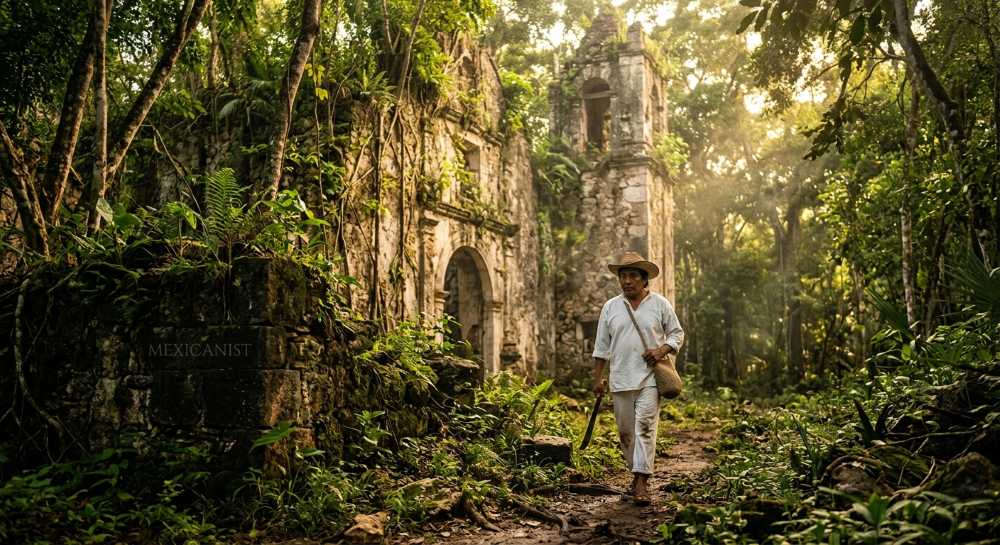
You are sipping a margarita on a white-sand beach in Cancún, scrolling through Instagram, when someone mentions there are Maya villages two hours inland where people still draw water from cenotes and cook over open flame. Villages where the nearest ATM is a forty-minute drive through jungle so thick your phone signal dies before you hit the second speed bump. You almost spit out your margarita. Two hours? That is roughly the distance from Manhattan to the Hamptons, except instead of tasting menus and infinity pools, you will find subsistence milpa farming, crumbling colonial churches, and a living culture that predates the Spanish by millennia. Welcome to the other Quintana Roo.
The Mexican Caribbean rakes in over $20 billion a year from tourism alone. In 2024, Cancún and the Riviera Maya welcomed more than 17 million visitors, a figure that would make most European capitals weep with envy. Quintana Roo added 12,000 new hotel rooms in a single year. The state’s hotel zone is a glittering ribbon of 110,000-plus rooms stretching along the coast like a conga line of concrete and glass. But drive inland, past the last resort billboard, past the last paved shoulder, and the twenty-first century starts to look awfully negotiable. The Maya communities of the Quintana Roo interior—Felipe Carrillo Puerto, JoséMaría Morelos, the scattered hamlets of Tuzik, Señor, Yaxley, Chanchen—are living a different calendar entirely.
Forget ruins. This is about the people who stayed put. It is the ugly truth behind the pretty village—the massive gap between the fancy hotels and the jungle, and the revolution happening right under tourists' noses in places they only ever encounter as a theme-park diorama. Spoiler: the real thing is nothing like the replica.
The Chapel on the Hill
Let us start with the name. San Francisco de Asís—St. Francis of Assisi, the patron saint of animals and ecology, the guy who preached to birds and gave away his inheritance. It is a fitting namesake for a chapel perched 37 meters above sea level at the highest point of Xcaret Park, looking out over the Mexican Caribbean like a benediction. The Chapel of San Francisco de Asís at Xcaret is a gorgeous piece of architecture: Colonial-style bell tower, Maya stone elements, a living tree growing through its structure like nature’s own amen. Couples pay serious money to get married there. You can book it for a wedding package that runs well into five figures. It is, by any measure, stunning.
But here is the thing about Xcaret’s San Francisco de Asís: it is a replica. Or, more precisely, it is a composite—a romanticized amalgam of colonial church architecture and Maya aesthetics designed to give tourists the feeling of having visited something authentically old without requiring them to actually visit the places that are authentically old. The park’s Maya Village, complete with working artisans and thatched-roof palapas, is similarly curated. It is lovely, it is educational, and it is about as representative of daily life in a real Maya community as Epcot’s Mexico pavilion is representative of Oaxaca.
The real San Francisco de Asís, the historical one, belongs to a network of colonial-era missions and churches scattered across the Yucatán Peninsula—churches built by Spanish friars from the stones of demolished Maya temples, churches that witnessed the Caste War, churches whose crumbling facades still bear bullet holes and burn marks. The original 16th-century chapel at the Xcaret site (then called Pole) was constructed with pre-Hispanic stones and featured a Maya-style thatched roof, a physical testament to the forced syncretism of the colonial project. That chapel is long gone. What stands now is a lovingly designed homage, and there is nothing wrong with homage—unless you mistake it for the real thing.
The distinction matters because the real Maya communities of Quintana Roo are not theme-park attractions. They are not living museums. They are working, struggling, adapting communities whose relationship with the coast—and with the $20-billion tourism machine that dominates it—is complicated, often extractive, and frankly not nearly as photogenic as Xcaret would have you believe.
The Real Geography Behind the Village
Quintana Roo occupies the eastern edge of the Yucatán Peninsula, a flat limestone shelf that was once the floor of a shallow sea. The entire peninsula is riddled with cenotes—natural sinkholes formed when the limestone ceiling of underground rivers collapses—and the Maya have been using these as freshwater sources for at least 3,000 years. The geology dictates everything: where people settle, what they grow, how they move. The interior is not mountainous or dramatic; it is a low, humid expanse of tropical forest, savannah, and wetland, blisteringly hot in the dry season and ankle-deep in water during the rains.
The highway from Cancún to Felipe Carrillo Puerto—Federal Highway 180D—is a smooth, tolled road that will get you there in about two and a half hours. But turn off the highway onto the secondary roads that lead to villages like Tuzik, Señor, Yaxley, and Chanchen, and the asphalt gives way to packed dirt and limestone gravel. These are Cruzo’ob towns—descendants of the Maya rebels who fought the Caste War and maintained an independent territory for more than fifty years. Their names appear in 19th-century military dispatches as outposts guarding Tixcacal Guardia, the ceremonial center of the Cruzob Maya. In the 21st century, they appear on few maps that tourists ever see.
The municipality of Felipe Carrillo Puerto covers an enormous swath of central Quintana Roo—roughly 13,000 square kilometers, larger than some countries. According to the FAO, 92% of its population is indigenous. In some communities, 99.8% of residents speak an indigenous language, primarily Yucatec Maya. The illiteracy rate in certain villages reaches 20.6%, and the main social deficiencies identified by government data include deprivation of social security, lack of basic housing services, and inadequate food access. This is not a hidden tragedy; it is a documented, measurable reality that coexists—barely—with the coastal strip’s staggering prosperity.
JoséMaría Morelos, the other major interior municipality, fares even worse on some indices. Its Human Development Index clocks in at 0.679, compared to 0.687 for Felipe Carrillo Puerto and figures well above 0.800 for the coastal municipalities of Benito Juárez (Cancún) and Solidaridad (Playa del Carmen). A study of Mayan children in JoséMaría Morelos found that while poverty signs were present, they were not as intense as expected—a finding the researchers attributed to the resilience of traditional subsistence systems and community networks. In other words: people are getting by, but getting by is not the same as getting ahead.
The Caste War
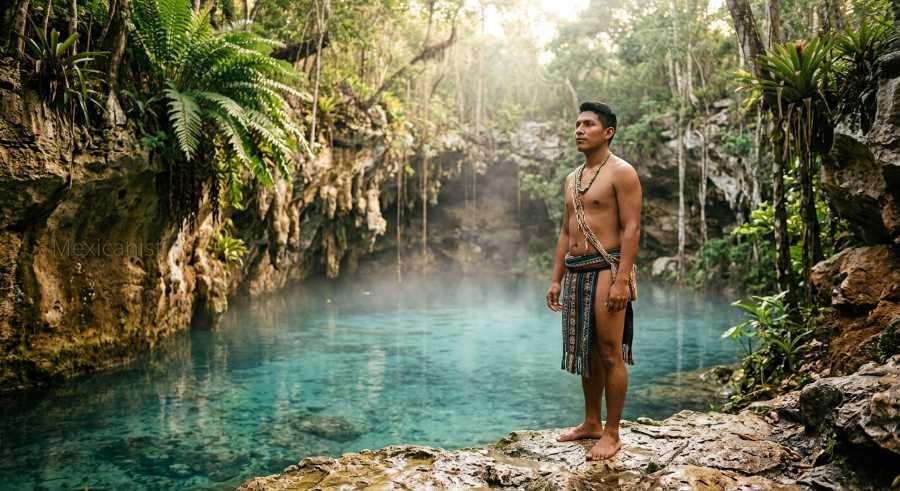
You cannot understand the interior without understanding the Caste War of Yucatán. It is the single most important event in the region’s modern history, and almost nobody outside Mexico has heard of it. On July 30, 1847, Maya forces led by Cecilio Chi of Tepich and Jacinto Pat of Tihosuco rose up against the Hispanic (Yucateco) elite who had systematically exploited Maya labor and seized Maya lands for decades. The resulting conflict raged for more than fifty years, reducing the population of the Yucatán Peninsula by an estimated 30 to 50 percent and creating a humanitarian catastrophe that reshaped the demographics of the entire region.
The Maya rebels, known as Cruzob (followers of the Speaking Cross), established an independent state centered on Chan Santa Cruz—present-day Felipe Carrillo Puerto. From 1847 until 1901, this territory was effectively a sovereign Maya nation, complete with its own religious cult, military organization, and diplomatic relations (the British in Belize traded arms for mahogany with the Cruzob). It was a remarkable achievement: an indigenous state that held out against the Mexican republic for half a century in the dense jungle of eastern Yucatán. The Caste War, as the cultural anthropologist Matthew Restall has argued, was not a mere peasant revolt but a genuine war of independence—one that came agonizingly close to succeeding.
Walk into Tihosuco today and you will see the shell of the Templo del Santo Niño Jesús, a massive church begun in the 1830s and almost completed when Maya warriors stormed it in 1848 and burned it to the ground. The gaunt ruins still stand—a roofless nave open to the sky, its stone walls charred and pockmarked, the back half partially restored and still in use for Mass. The Caste War Museum occupies a building nearby, its displays a jumble of captured rifles, tattered flags, and photographs of rebel leaders who look, depending on your perspective, like freedom fighters or bandits or both. It is one of the most evocative historical sites on the peninsula, and it receives a fraction of the visitors who troop through Chichén Itzáevery day.
The Caste War left more than just bullet-pocked buildings. It shaped who these people are, how they vote, what they believe. The folks deep in Quintana Roo? They are the tough descendants of rebels who fought, won, lost, bargained, and outlasted one of the longest indigenous uprisings in the Americas. Their relationship with the Mexican state—and with the tourism machine the state keeps pushing—is colored by that history in ways most visitors never bother to notice.
Life in the Interior
In a village like Chanchen or Señor, daily life revolves around the milpa—the traditional Maya agricultural system of intercropping corn, beans, and squash. The milpa is not just a farming technique; it is a cosmological framework, a social institution, and an ecological adaptation refined over three millennia. A farmer plants his milpa in the clearing made by slashing and burning a patch of jungle, works it for two or three years, then lets it lie fallow for a decade or more to regenerate. It is sustainable, biodiverse, and increasingly endangered by the same market forces that are reshaping every other aspect of life in the peninsula.
A 2024 study found that at least 75% of Yucatec Maya farmers have already adopted conventional agricultural practices—chemical fertilizers, monoculture, mechanized tillage—abandoning the traditional methods that sustained their communities for generations. The reasons are familiar: population pressure, market incentives, government subsidies that favor industrial agriculture, and the simple fact that a young man can earn more in a week at a Cancún resort than in a month of milpa farming. The exodus of young people from interior communities to the coast is a slow, quiet hemorrhage that threatens the long-term viability of these villages in ways that no government program has yet managed to arrest.
Housing in many interior villages still includes a significant proportion of traditional thatch-roofed structures, though concrete block construction is increasingly common. Basic services remain limited. The JICA technical report on Felipe Carrillo Puerto documented solid waste generation at 40 tons per day across the municipality—a figure that suggests both population density and service capacity far below coastal levels. Healthcare is provided by rural medical units, often a single doctor serving a dispersed population of thousands. In some communities studied by researchers, 20.63% of the adult population is illiterate, and the nearest secondary school requires a daily commute of an hour or more.
And still, these communities hold on. They keep their language—Yucatec Maya is spoken in nearly every home, and in some villages, nearly 100% of the population speaks it. They keep their food, their rituals, their forest smarts. Bottom line: they have got a way of life that Mexico's government has tried to wipe out, steal, romanticize, and forget. This ain't some museum exhibit. It is alive, breathing, fighting, and changing every single day.
The Two Quintana Roos
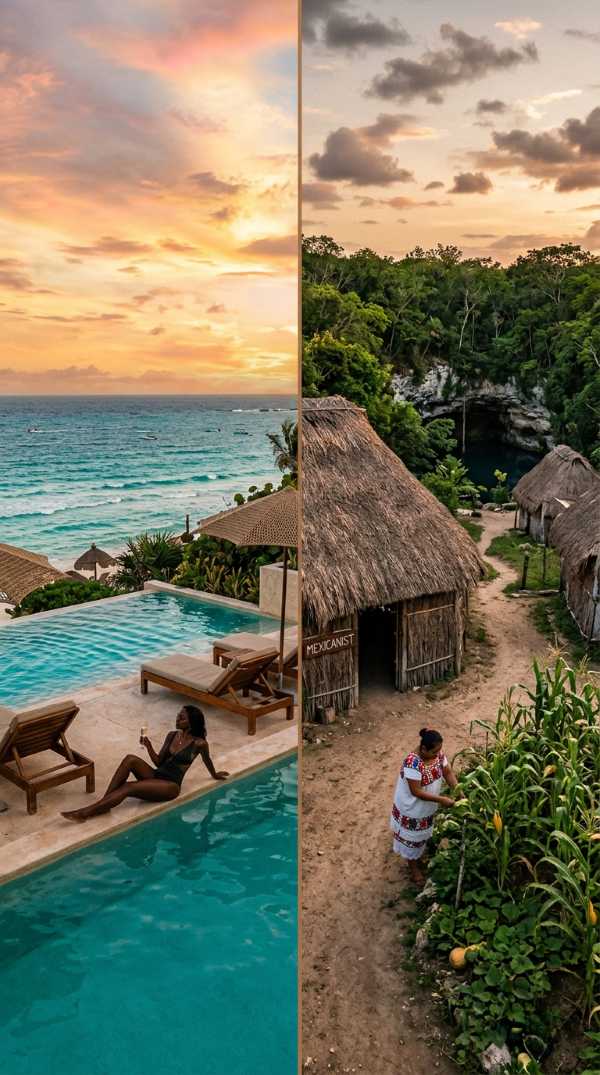
Let us talk numbers. In 2024, the municipality of Benito Juárez—home to Cancún—recorded $78.1 million in international sales alone. Quintana Roo as a whole generated over $20 billion from tourism. The state’s economically active population reached 995,000 in early 2025, with employment heavily concentrated in the coastal corridor. Benito Juárez and Solidaridad (Playa del Carmen) account for the vast majority of the state’s GDP, hotel rooms, and foreign exchange earnings. The hotel zone in Cancún, a narrow 22-kilometer strip of sand, contains more hotel rooms than the entire rest of the state combined.
Now consider the interior. Felipe Carrillo Puerto and JoséMaría Morelos have HDI scores of 0.687 and 0.679 respectively—levels comparable to some of Mexico’s poorest municipalities. CONEVAL data from 2020 documented high rates of multidimensional poverty in both municipalities, with social deprivation concentrated in access to social security, basic housing services, and food. Governor Mara Lezama’s administration has claimed a 9.3% reduction in poverty state-wide, with 177,000 people lifted out of poverty—the lowest rate in fifteen years. But the gains are overwhelmingly coastal. The interior has seen little of this prosperity, and the gap is not closing fast enough to prevent a growing sense of abandonment.
The irony is that the interior is not poor because it lacks resources. It is poor because those resources—forest, water, biodiversity, cultural heritage—have been systematically undervalued by an economic model that prizes beachfront real estate above all else. The coastal tourism industry depends on the interior’s freshwater (the same underground rivers that form the cenotes tourists love to swim in), its forests (which stabilize the climate and prevent the sargassum blooms choking the beaches), and its cultural heritage (which provides the authentic backdrop that resorts market to their guests). But the flow of value is almost entirely one-directional: from the interior to the coast, from Maya communities to multinational hotel chains, from the people who steward the land to the corporations that profit from it.
There is, however, a counter-narrative, and it is unfolding in the interior itself. Maya Ka’an is a community-based tourism initiative that spans the central municipality of Felipe Carrillo Puerto and the Sian Ka’an Biosphere Reserve, a UNESCO World Heritage Site. The name means“Maya House”in Yucatec, and the initiative is exactly that: a house built by Maya people, for Maya people, using the tools of the tourism industry without being consumed by them. It is, by any measure, one of the most promising models for sustainable, equitable tourism development in Mexico.
Maya Ka’an was designed from the ground up by the communities it serves. Local cooperatives run cenote tours, guided jungle walks, traditional cooking workshops, and homestay experiences. The revenue stays in the community. The cultural narratives are controlled by the people who actually live them. According to the Sustainable Travel initiative and the One Planet Network, the Maya Ka’an model aims to minimize tourism’s impact on environmental resources while diversifying Quintana Roo’s tourism offering beyond the beach-resort monoculture. The model is now being considered for expansion across Mexico—a recognition that community-based tourism can work at scale, not just as a boutique curiosity.
The key difference between Maya Ka’an and the dominant coastal model is who holds the power. In Cancún, the tourism industry is controlled by national and international capital. Hotels are owned by Spanish chains, managed by multinational corporations, and staffed by workers who commute from marginalized neighborhoods. In Maya Ka’an, the tourism product is owned and operated by the community itself. Visitors stay in family homes, eat food prepared by local cooks, and learn about the forest from people whose families have managed it for generations. It is not luxury tourism, and it is not trying to be. It is something more interesting: an attempt to build a tourism economy that does not require the surrender of cultural sovereignty.
National Geographic has featured the region, documenting how approximately 2,000 people live within the Sian Ka’an reserve itself, maintaining traditional houses, nurturing community bonds, and espousing self-sufficiency. The region’s cenotes—many operated by Maya cooperatives or women’s collectives—offer some of the most extraordinary swimming experiences on the planet, far from the crowds of the Riviera Maya. But the infrastructure to reach them remains minimal, and the marketing budget is a rounding error compared to what any single Cancún resort spends on Instagram ads.
The Real Cost of Paradise
So what does paradise really cost? Not just the environmental wreckage researchers keep documenting—the mangrove destruction, the coral bleaching, the sargassum deluge that ran up a $12 million cleanup bill in a single season. Not just the social carnage: housing shortages in Cancún and Playa del Carmen, resort wages so low that some workers take home less than $20 a day. The real cost is what economists politely call opportunity cost: billions poured into a skinny coastal strip while the interior—the ecological engine that makes the whole coast possible—gets left to fend for itself.
The interior communities of Quintana Roo are not asking for charity. They are asking for a fair share of the wealth that their land, their water, their forest, and their culture help generate. They are asking for infrastructure—roads, schools, healthcare, internet—that would allow them to participate in the 21st century without abandoning the traditions that define them. They are asking, in the most practical terms, for the tourism industry to stop treating them as a backdrop and start treating them as partners.
The good news is that the tools for change already exist. Maya Ka’an has proven that community-based tourism can work. The state government’s poverty reduction figures, while heavily coastal, suggest that political will exists to address inequality. The growing global interest in regenerative travel, indigenous-led tourism, and off-the-beaten-path experiences provides a market tailwind. It is not about whether these communities can handle tourism. It is whether tourism can handle them—and whether the bigwigs running the show have enough humility to figure that out before it is too late.
The real San Francisco de Asís is not some chapel with an ocean view. It is a bunch of communities that have been living, working, praying, fighting, and just surviving in Quintana Roo's backcountry for longer than those fancy hotels even existed. They were there before the Spanish showed up. They were there when Cancún was a fishing village of 400 people. They will be there long after the last all-inclusive resort gets reclaimed by the jungle. The villages that time forgot have not forgotten themselves. Maybe it is time the rest of us remembered them.
Sources
Cultural Survival, “Tourism Development in Quintana Roo, Mexico,” culturalsurvival.org.
DataMexico, “Quintana Roo: Economy, Employment, Equity, Quality of Life,” economia.gob.mx.
DataMexico, “Felipe Carrillo Puerto: Economy, Employment, Equity, Quality of Life,” economia.gob.mx.
FAO, “Strengthening Sustainable Fisheries to Safeguard Marine Biodiversity,” openknowledge.fao.org (data on 92% indigenous population in Felipe Carrillo Puerto).
Sustainable Travel International, “Mayaka’an: A New Ecotourism Destination That Empowers Mayan Communities,” sustainabletravel.org.
One Planet Network, “Destination Maya Ka’an Initiative,” oneplanetnetwork.org.
National Geographic, “Ancient Ruins and Indigenous Culture in Mexico’s Maya Ka’an Region,” nationalgeographic.com.
Travel Trade Caribbean, “Quintana Roo Rakes in Over $20 Billion From Tourism in 2024,” traveltradecaribbean.es.
Travel and Tour World, “Cancún and Riviera Maya Consolidating Dominance With Over 17 Million Combined Visitors,” travelandtourworld.com (Feb 2026).
Gitnux, “Mexico Tourism Statistics 2026,” gitnux.org (data on 12,000 new hotel rooms in QR in 2023).
Wiley Online Library, “Health Needs of Indigenous Mayan Older Adults in Mexico,” onlinelibrary.wiley.com (data on 99.8% indigenous language speakers, 20.63% illiteracy).
Redalyc, “Poverty in Mayan Children in Quintana Roo, Mexico,” redalyc.org (2023 study on José María Morelos).
ResearchGate, “Poverty Reduction in Mexico? Case Study for Quintana Roo 2010–2016,” researchgate.net.
JSTOR, “Ecological Degradation, Global Tourism, and Inequality: Maya Interpretations of the Changing Environment in Quintana Roo, Mexico,” jstor.org.
Agroecology Coalition, “The Case of Yucatec Maya,” agroecology-coalition.org (data on 75% of Maya farmers using conventional practices).
Davidson, William V., “Ceiba, Plaza, and Cruzo’ob Towns, Quintana Roo, Mexico: A Settlement Geography,” williamvdavidson.com.
ProQuest, “Race, Class, and the Production of Post Caste War Maya Identity in East Central Quintana Roo,” proquest.com.
Indigenous Mexico, “Indigenous Quintana Roo: The Last Two Centuries (Part 2),” indigenousmexico.org.
INAH, “Tihosuco,” lugares.inah.gob.mx.
Xcaret Park, “St. Francis of Assisi Chapel,” xcaret.com.
Barceló Experiences, “Xcaret, a Dreamlike Eden in the Riviera Maya,” barcelo.com.
Quintana Roo State Planning (SEFIPLAN), Municipal Human Development Index data, sefiplan.qroo.gob.mx.
Conservation Atlas, “In Cancún’s Backyard: Discovering Maya Ka’an,” conservationatlas.org.
White, Christine, et al., “Tourism from Below: An Approach for the Realisation of Community-Based Tourism,” University of Leeds (etheses.whiterose.ac.uk), 2021.
Mexico Soul, “Caste War of Yucatán, the Cruzob Maya and Church,” mexicosoul.substack.com.
Riviera Maya News (Facebook), “Quintana Roo Has Reduced Poverty by 9.3%,” 2025.
Community Conservation Research Network, “Maya Zone, Mexico,” communityconservation.net.
JICA, “The Study of Management on Sanitation Environment,” openjicareport.jica.go.jp (data on 40 tons/day solid waste in FCP).