Shell Companies and Sacred Water: How Land Deals Work in the Riviera Maya
The Riviera Maya is in the middle of one of the most consequential land grabs. Foreign capital, corporate shells, and a byzantine legal architecture originally designed to protect indigenous land rights are being weaponized to transfer communal territory into private and often anonymous hands.

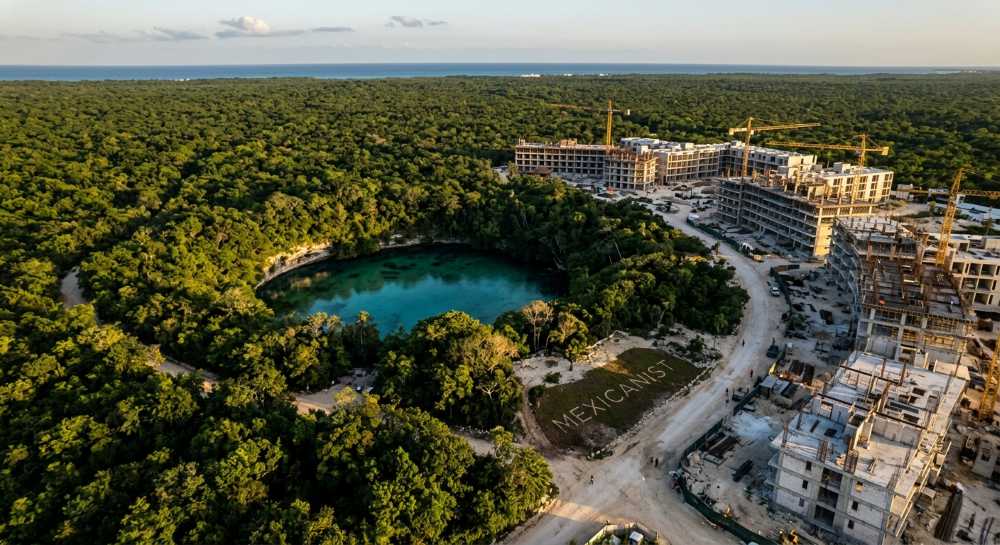
Somewhere between the boutique hotel with the reclaimed-wood lobby and the cenote where Maya priests once communed with Chaac, the god of rain, a notary public is stamping documents that will change the meaning of “land ownership” forever. The buyer is a sociedad anónima—a Mexican corporation whose beneficial owners are, shall we say, creatively obscured behind three layers of holding companies registered in Delaware, Panama City, and a mail-drop office in Cancún. The seller is an ejidatario, a communal landholder whose family has worked this soil since the Mexican Revolution promised it to people like him in 1917. The price would make a Manhattan developer blush at the bargain. The paperwork says everything is legal. And technically, it is. That’s the whole problem.
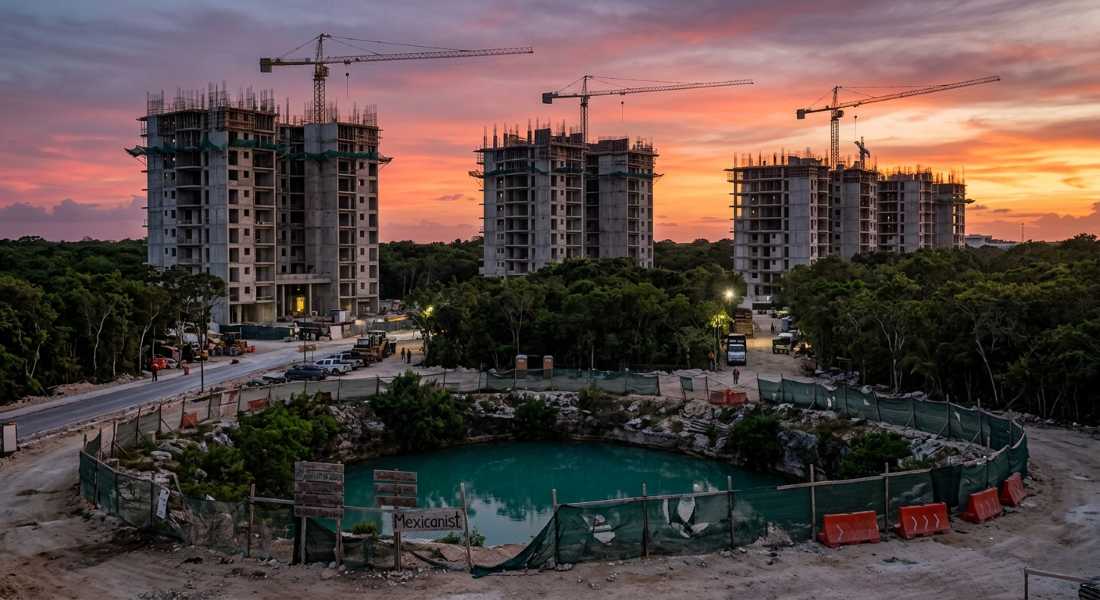
The Riviera Maya—that 130-kilometer stretch of Caribbean coastline from Cancún to Tulum and beyond—is in the middle of one of the most consequential land grabs in the Western Hemisphere, and almost nobody outside Mexico is paying attention. Foreign capital, corporate shell structures, and a byzantine legal architecture originally designed to protect indigenous land rights are being weaponized to transfer communal territory into private, profitable, and often anonymous hands. The sacred cenotes—those iridescent limestone sinkholes that have sustained Maya communities for millennia—are being contaminated by construction runoff, pig farms, and hotel septic systems. And the paperwork, as they say, is pristine.
This is a story about how legal mechanisms meant to balance sovereignty, indigenous rights, and foreign investment have been systematically subverted in one of the world’s most desirable real estate markets. It’s about ejido land that was never supposed to be sold, fideicomiso trusts that were never supposed to be this opaque, and shell companies that were never supposed to own sacred water. Welcome to the Riviera Maya, where the deal is always on, and the jungle always has a receipt.
Land, Revolution, and the Ejido System
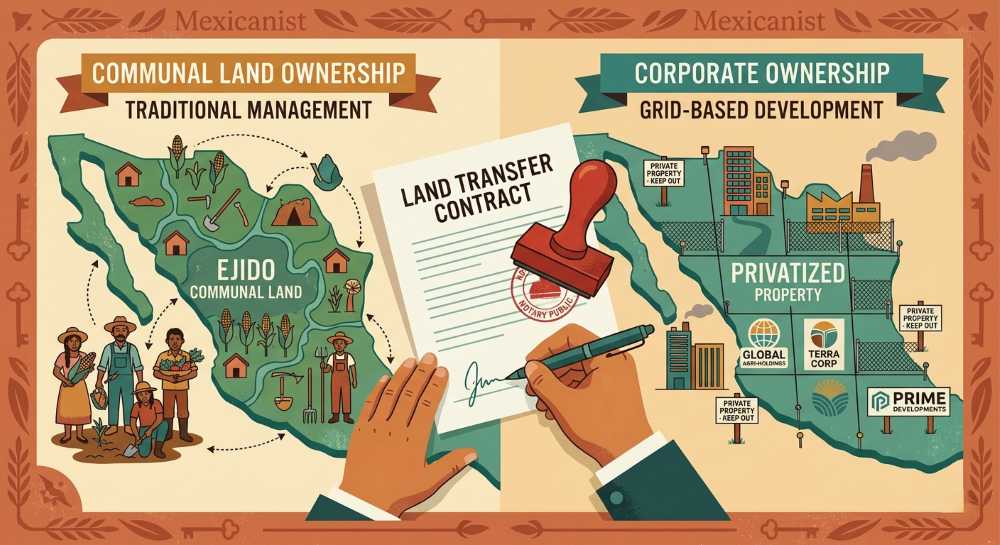
To understand the land deals consuming the Riviera Maya, you first have to understand the ejido—a concept so fundamentally Mexican that trying to translate it into English is like trying to explain jazz to a metronome. An ejido is communal land held in trust by the Mexican state for the benefit of a recognized community of ejidatarios. It is not private property. It cannot be freely sold, mortgaged, or seized by creditors. It was, by revolutionary design, inalienable—a shield against the very concentration of land that had fueled the Mexican Revolution in the first place.
Article 27 of the 1917 Constitution, born from Emiliano Zapata’s cry for “tierra y libertad” (land and liberty), established the ejido as the cornerstone of Mexican agrarian reform. The state would expropriate large estates and redistribute the land to peasant communities, who would hold it collectively. By the late 20th century, the ejido system covered roughly 52% of Mexico’s territory—an area equivalent to the size of Egypt—encompassing more than 30,000 communities and over 100 million hectares, according to the Global Land Tool Network’s synthesis report on Mexican ejido tenure. In Quintana Roo, the state that contains the Riviera Maya, much of the land outside the tourist zones was—and in many cases remains—ejido land, held by Maya communities whose connection to the territory predates the Spanish conquest by centuries.
The ejido was never a perfect system. Many ejidatarios lacked formal title documents, leading to boundary disputes and administrative chaos. Agricultural productivity on ejido land was often low, and credit was scarce because banks couldn’t foreclose on land that couldn’t be sold. But the system served its primary purpose: it kept land in the hands of the people who worked it, and it prevented the re-emergence of the hacienda system that had enslaved generations of rural Mexicans. For Maya communities in Quintana Roo, the ejido was more than an economic arrangement—it was the legal recognition of their ancestral relationship with the land and the water beneath it.
Mexico’s Constitution also established a “restricted zone”—a strip of land within 50 kilometers of the coastline and 100 kilometers of international borders—where foreigners are absolutely prohibited from acquiring direct ownership of land. This provision, rooted in historical trauma over territorial loss (Texas, anyone?), was designed to prevent foreign powers from establishing coastal footholds. The entire Riviera Maya falls within this restricted zone, which means that, constitutionally speaking, no foreigner can directly own beachfront property from Cancún to Tulum.
In 1973, Mexico introduced the fideicomiso—a bank trust mechanism—to allow foreign investment in the restricted zone while maintaining constitutional protections. Under a fideicomiso, a Mexican bank holds legal title to the property on behalf of a foreign beneficiary, who retains all usage rights: the right to live in, lease, sell, mortgage, or bequeath the property. The trust initially had a 30-year term, later extended to 50 years and renewable. It was, in the words of one Cancún real estate attorney, “the elegant compromise that let Mexico have its sovereignty cake and eat foreign investment too.”
The 1992 Reforms Opening the Door
Then came NAFTA. Or more precisely, then came the political and economic logic that made NAFTA possible. In January 1992, President Carlos Salinas de Gortari pushed through sweeping amendments to Article 27, ending the revolutionary commitment to land redistribution and allowing ejido land to be privatized for the first time. The reforms were framed as modernization—a necessary step to integrate Mexico’s rural economy into global markets ahead of the North American Free Trade Agreement. The ejido, Salinas argued, was an anachronism holding back agricultural productivity and rural development.
The key mechanism was PROCEDE—the Program for the Certification of Ejido Rights and Titling of Urban Plots—a voluntary land certification program that allowed ejidatarios to obtain individual title to their parcels. Once certified, parcels could be sold, rented, used as collateral, or even fully privatized if two-thirds of the ejido assembly voted in favor. The program was technically voluntary, but the pressure to participate was immense: without certification, ejidatarios couldn’t access credit, and their land tenure remained insecure in the eyes of lenders and investors. Research by de Janvry, Emerick, Gonzalez-Navarro, and Sadoulet (2014) at UC Berkeley found that households obtaining PROCEDE certificates were subsequently 28% more likely to have a migrant member, suggesting that certification often led to land sales and out-migration rather than the promised agricultural investment.
The results were dramatic and, for many communities, devastating. According to Ana de Ita’s landmark study “Promised Land” published by CECCAM, more than half of ejidatarios, 78% of communal landholders, and 62% of private proprietors became minifundistas—small landholders with plots smaller than five hectares—after PROCEDE. The certification program effectively atomized communal landholdings, making individual parcels easier to acquire by outside buyers while leaving communities without the collective bargaining power they once had. The “market-based agrarian reform” promoted by the World Bank had, in practice, become a mechanism for land concentration in the hands of those with capital, not those who worked the soil.
“The reforms unleashed potentially sweeping changes... The inalienability of ejidal lands was the central tenet promulgated by Article 27. Mexico’s revolutionary government of 1992 reversed these provisions.” — Christopher Thoms, University of Michigan
How Ejido Land Becomes Private Property
So how does communal land that was never supposed to be sold end up as a private deed in the hands of a foreign-backed corporation? The answer is a masterclass in legal choreography—a multi-step process that transforms ejido rights into fee simple title through a series of transactions that are each technically legal while the cumulative effect is exactly what the Constitution was designed to prevent.
Step One: Certification and Parceling
The process begins with PROCEDE certification. The ejido assembly votes to enter the program, and a government surveyor maps individual parcels. Each ejidatario receives a certificate of parcel rights, which is not the same as a fee simple title—but it’s a crucial step in that direction. Critically, the certification process often occurs without adequate legal counsel for the ejidatarios, many of whom speak Maya as their first language and may not fully understand the implications of the Spanish-language documents they are signing. The Legal Cultures Subsoil project at the Institute of Latin American Studies at the University of London documents that the 1992 reform “ended the revolutionary commitment to land redistribution and set the principles for a new legal framework to regulate rural development, land, resource-use and ownership.” The reform “ceased to recognize socially or collectively titled land as inalienable and imprescriptible.”
Step Two: The Assembly Vote for Privatization
Once parcels are certified, the ejido assembly can vote to adopt “dominio pleno”—full private ownership—for some or all of the certified land. This requires a two-thirds majority, but the process is vulnerable to manipulation. Developers and their intermediaries have been known to offer individual ejidatarios cash payments for their votes, creating the appearance of a democratic decision while effectively purchasing consent. In some documented cases, only a handful of the original ejidatarios remain in the assembly by the time the vote is taken, as others have already sold their rights and departed. The GLTN case study notes that the reforms “allowed privatization of the ejido if a two-thirds majority of the ejidatarios voted in favor,” but the reality on the ground often involves significant coercion and information asymmetry.
Step Three: The Cession of Rights
Even without full privatization, ejidatarios can transfer their parcel rights to other Mexicans through a “cesión de derechos” (cession of rights). This is where much of the fraud originates. As the Latin Investor’s Riviera Maya risk guide explains: “The most common scam, ejido fraud, typically unfolds like this: a seller offers you an attractive ‘below market’ price on land near Tulum or Bacalar, pressures you to pay quickly, provides a ‘cession of rights’ or ‘possession’ document instead of a registered deed, and promises the title will be ‘regularized later,’ which never happens because the land was never legally sellable.” These cessions are often notarized by local notaries who may not fully verify the underlying land tenure, creating a paper trail that looks legitimate but is built on sand.
Step Four: Regularization and Registration
The final step is “regularization”—the process by which previously irregular land titles are brought into the formal registry. In Quintana Roo, this process has been accelerated by state government programs intended to provide legal certainty to property owners. But regularization can also legitimize transactions that were originally irregular or fraudulent, effectively washing dirty titles clean. Once a property is registered in the Public Registry of Property and Commerce (RPPyC), it appears as legitimate fee simple title, and the ejido’s communal claim is extinguished. The paperwork, again, is pristine.
The Corporate Fideicomiso End-Run
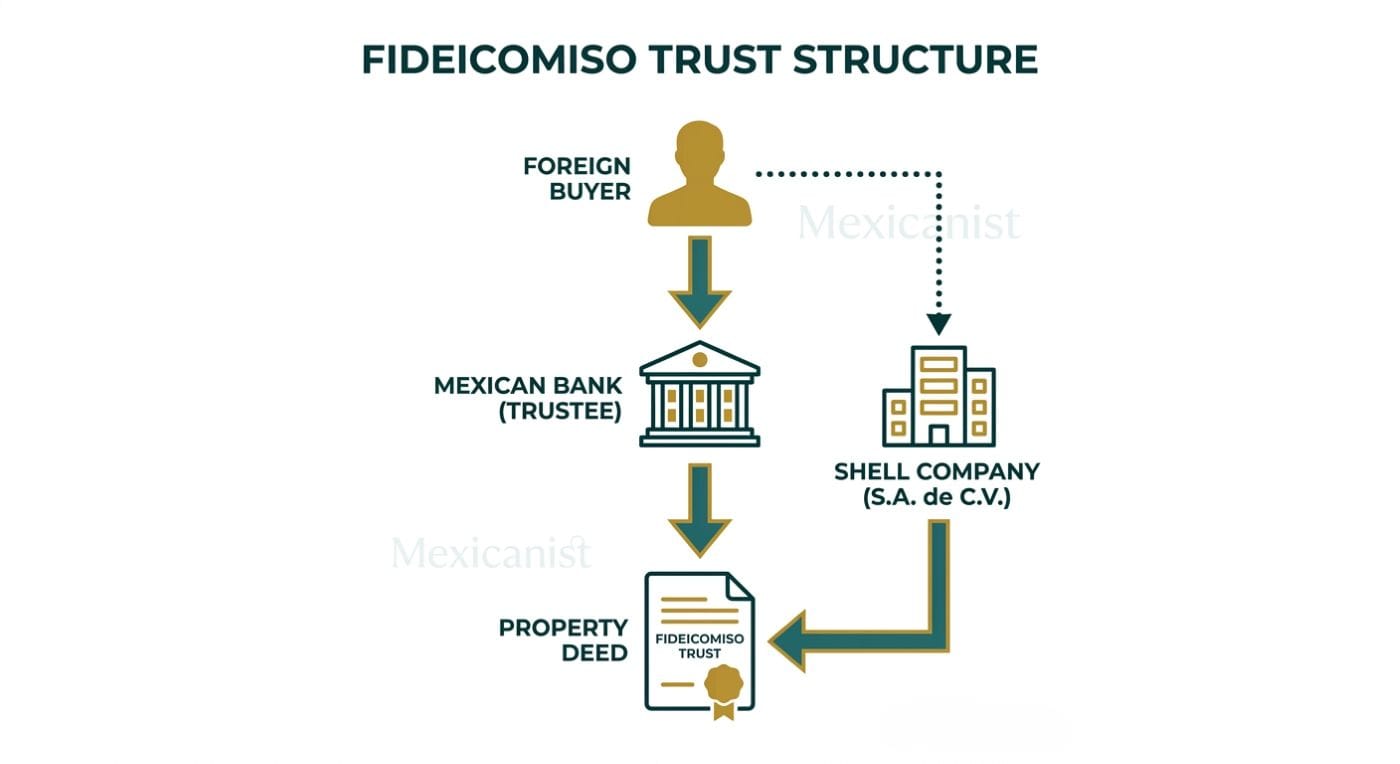
If the ejido-to-private pipeline is the back door through which communal land exits indigenous hands, the fideicomiso is the front door through which foreign capital enters. The mechanism itself is straightforward: a Mexican bank holds legal title to a property in the restricted zone on behalf of a foreign beneficiary. The beneficiary enjoys all the economic benefits of ownership—use, rental income, resale profits, inheritance—while the bank holds the deed. Trust terms are 50 years and renewable. Annual bank fees run from $500 to $1,500 USD. Setup costs range from $2,000 to $5,000.
What makes the fideicomiso system particularly interesting—and particularly vulnerable to abuse—is the question of who the beneficiary actually is. While the trust deed identifies the beneficiary by name, that beneficiary can be a corporation. And in Mexico, corporations (sociedades anónimas) have historically been able to operate with a degree of anonymity that would make a Swiss banker blush. A single fideicomiso can therefore serve as a conduit for anonymous foreign capital to acquire restricted zone property, with the bank serving as a legitimate—and largely unquestioning—intermediary.
The scale is enormous. Peninsula Lawyers, a Riviera Maya-based firm specializing in foreign real estate transactions, notes that “for years, foreign buyers have used structures like LLCs or bank trusts (fideicomisos) to purchase property. These tools offered privacy and helped with estate planning.” The Riviera Maya Cozy guide to fideicomisos confirms that the entire Riviera Maya falls within the restricted zone, meaning virtually all foreign-owned property in the region passes through this trust mechanism. Mexico Life Realty, which has operated in the market since 2004, describes the fideicomiso as “a formally registered property right” and emphasizes that it is “not a lease” and “not a loophole.” But when the beneficiary is an anonymous shell company, the distinction between a legitimate investment vehicle and a money-laundering instrument becomes, shall we say, academic.
There’s an additional wrinkle that makes the fideicomiso system even more permeable. While the Constitution restricts foreign ownership in the restricted zone, foreigners can own Mexican corporations outright—and Mexican corporations can own property in the restricted zone without a fideicomiso, provided the corporation agrees to be treated as a Mexican person for purposes of the restricted zone provisions. This means that a foreign investor can create a Mexican sociedad anónima, fund it with offshore capital, purchase restricted zone property directly, and avoid the fideicomiso entirely.
The corporate veil substitutes for the trust structure, and the beneficial owner remains hidden behind the corporate entity. Easy Legal Mexico’s guide to restricted zone property confirms that “foreign buyers can legally control homes, condos, and land in the restricted zone” through these structures, while MexLaw notes that “the restricted zones are defined as the strip of land located 100 kilometers along the borders and 50 kilometers from the coast.”
Shell Companies and the Anonymous Architecture
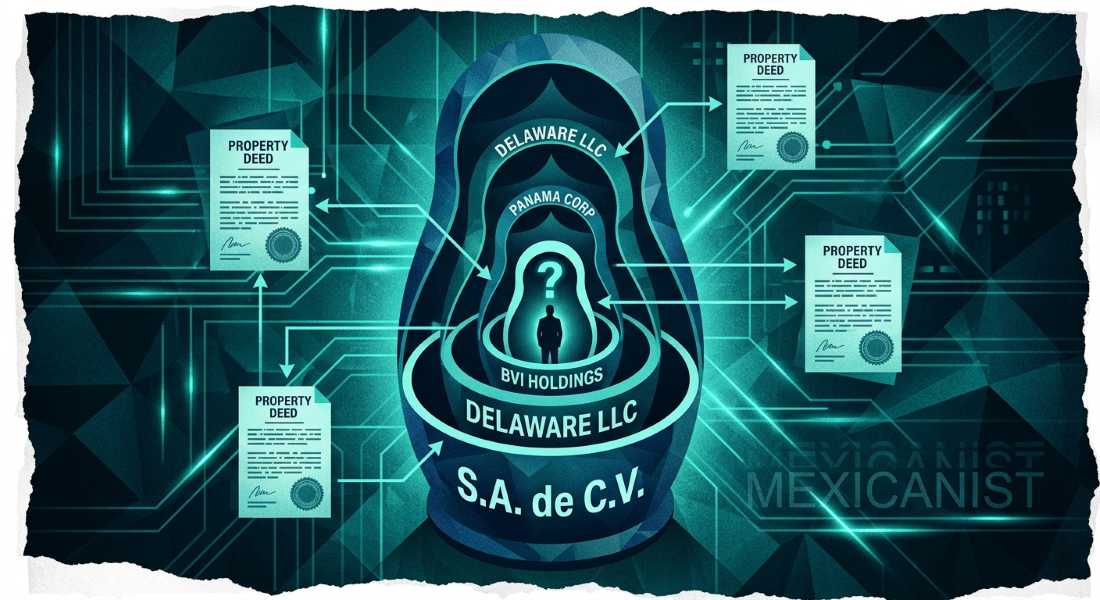
And now we arrive at the real artistry: the shell company. In Mexico, the sociedad anónima (S.A.) or sociedad anónima de capital variable (S.A. de C.V.) is the corporate form of choice for real estate acquisition. These entities can be formed in days, require minimal disclosure of beneficial ownership, and can hold unlimited real property. A single S.A. de C.V. can own dozens of properties across the Riviera Maya, and unless someone conducts a thorough forensic investigation, the true beneficial owner—the person who actually profits from the rents, the resale, the appreciation—remains invisible.
Global Witness, the anti-corruption advocacy organization, has documented how anonymous companies are used to launder money through U.S. real estate, and the same logic applies in Mexico. Their research found that “in most countries, including the US, real estate ownership is anonymous, meaning ownership is usually tracked at the legal and not the beneficial ownership level,” making it “extremely difficult for law enforcement” to identify money laundering. Insight Crime reports that a new U.S. anti-money laundering rule targeting shell companies “could have a big impact on Latin American crime groups,” precisely because the current system allows “a company in the country while keeping its real owners anonymous.”
In the Riviera Maya context, the shell company architecture typically involves three or four layers: a Mexican S.A. de C.V. that holds the actual property deed; a parent holding company, often registered in a U.S. state like Delaware or Wyoming that doesn’t require beneficial ownership disclosure; an intermediary entity in a low-tax jurisdiction like Panama or the British Virgin Islands; and finally, the ultimate beneficial owner—who may be a foreign individual, a foreign corporation, or another anonymous entity. Each layer adds legal distance between the land and the person who profits from it, and each layer makes legal recourse for displaced communities more expensive, more complex, and less likely to succeed.
Mexican researcher Melissa Schumacher Gonzalez, a doctor of urban land management, described the developers’ playbook in an interview with Truthout: “They buy land, and if someone doesn’t want to sell, they isolate them, cut off their access to the street, to force them to sell.” This divide-and-conquer strategy is particularly effective against ejido communities, where individual parcel holders may face vastly different economic pressures. A developer who can purchase just enough parcels to surround a holdout can make the holdout’s land effectively unusable—and then acquire it at a fraction of its true value. Truthout’s investigation found that real estate companies in Mexico use “a combination of corruption, ties with organized crime, intimidation tactics, forced evictions and some allege arson, to clear the way for them to build their empires.”
Cenotes Under Siege
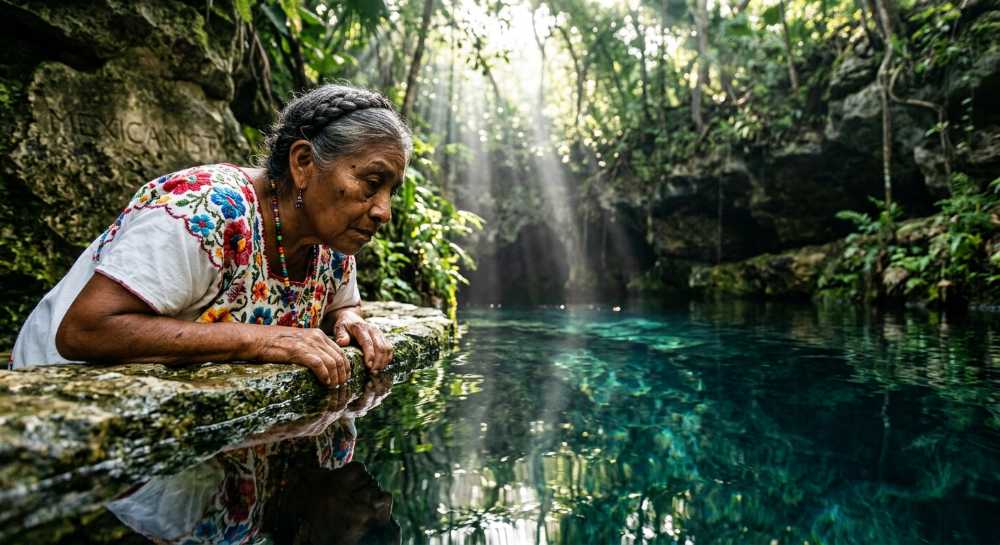
The cenotes of the Yucatán Peninsula are not just geological formations—they are living sacred beings in the Maya cosmovision. These limestone sinkholes, formed by the collapse of cave ceilings to reveal crystal-clear groundwater below, have been the primary source of freshwater in the region for millennia. The ancient Maya considered cenotes portals to Xibalba, the underworld, home to deities like Chaac, the god of rain, and supernatural guardians called aluxo’ob. Community members are taught to enter cenotes only with permission and care. They are not resources to be exploited; they are relatives to be respected.
Today, the cenotes are under existential threat. Construction runoff from hotel and condominium developments, contamination from industrial pig farms, and septic leakage from inadequately regulated tourism infrastructure are poisoning the same aquifer that sustains both the cenotes and the communities that depend on them. The Ring of Cenotes Geohydrological Reserve in Yucatán—designated a RAMSAR Wetland of International Importance in 2009 and a State Protected Natural Area covering 219,207 hectares in 2013—faces mounting pressure from large-scale infrastructure, agricultural, and real estate projects that proceed without Free, Prior, and Informed Consent from Maya communities, despite Mexico’s commitments under the UN Declaration on the Rights of Indigenous Peoples and ILO Convention 169.
A Watershed Case
In March 2023, the Indigenous Maya organization Kanan Ts’ono’ot (Guardians of the Cenotes) from Homún, Yucatán, filed a federal amparo—a constitutional injunction—seeking legal recognition of the Ring of Cenotes as a subject of rights, with community members designated as its legal guardians. The case arose when new access roads were built near Homún without community notification, intended to facilitate construction of a large-scale pig farm designed to raise 49,000 animals. Residents objected due to risks of groundwater contamination and broader ecological harms to the cenotes. In response, the company accelerated construction. The community gathered evidence of organochlorine pesticides—substances banned in many countries—in the region’s water.
On May 29, 2023, the federal judge ruled that Yucatán authorities had committed omissions and violated rights by authorizing the Environmental Impact Statement for the megafarm. The court issued a definitive suspension halting megaprojects that threaten the Ring of Cenotes. This does not mean the petition has been fully won—the court has not yet issued a final ruling on whether the cenotes themselves have legal personhood—but the suspension remains in force. The Associated Press reported in 2024 that Indigenous Mayans are seeking personhood status for their sacred cenotes, which would make the Ring of Cenotes the first ecosystem in Mexico with its own legal rights if the petition succeeds. It is, in every sense, a watershed case.
Research published on ResearchGate on “Cenotes and Placemaking in the Maya World” confirms that “today, cenotes are threatened by pollution and contamination due to trash-dumping, intensive farming, and the effects of tourism.” The cenotes are not just cultural artifacts; they are the only source of freshwater for much of the peninsula, and their contamination threatens the survival of both indigenous communities and the tourism industry that ostensibly drives the region’s economy. Destroy the water, and you destroy everything—including the asset that makes the land valuable in the first place. It is, to put it mildly, a paradox that the developers have yet to solve.
Case Studies and the Fraud Economy
Tulum
Bloomberg’s 2025 investigation, titled “Deception in Paradise,” laid bare the human cost of Tulum’s real estate frenzy. Erin Norris, a data development center employee from Austin, Texas, spent nearly her entire life savings—$107,000—on a one-bedroom condo from Akela Development Group. Four years later, she has no condo and no money. One Akela partner was found dead on the beach; a second was found hanging from a rope amid mounting debt; the third fled the country. Akela was marketing six projects encompassing 245 units when it disappeared. It only ever delivered one building with 30 units.
Norris’s story is not exceptional. Local attorney Estrella Rios told Bloomberg she receives at least two calls a day from new clients who bought pre-construction apartments during the pandemic and now realize their homes will never be delivered. Most victims are middle-class foreigners who hoped to use their nest eggs for second homes or short-term rental investments. In time, many discovered that construction had never started because the developer had allegedly stolen the land it claimed to own. Tulum’s government is so antiquated that foreigners who don’t speak Spanish are left relying on local attorneys who charge them at every step. As of early 2026, Tulum authorities have closed 18 real estate developments for regulatory violations in the last six months alone, according to Riviera Maya News.
Bacalar
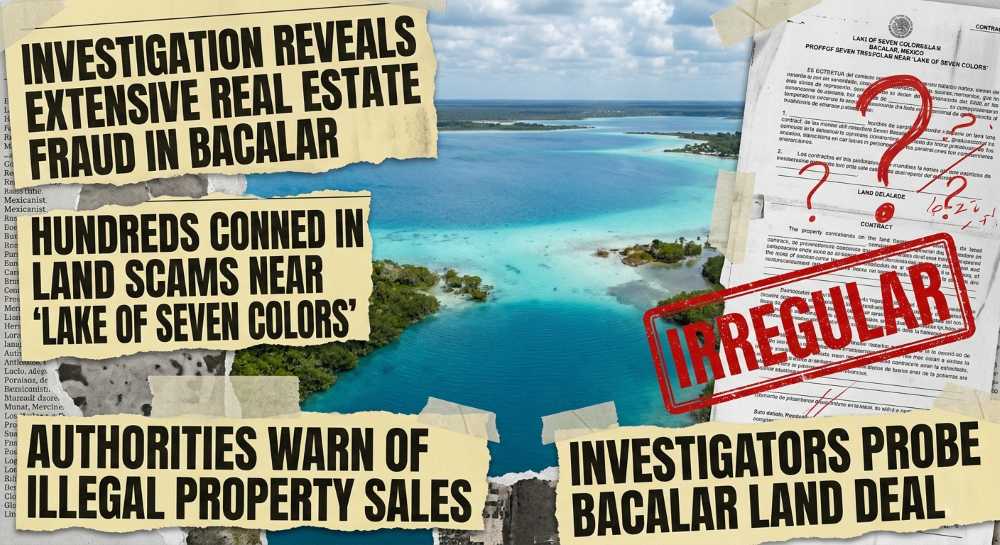
In Bacalar—the “Lake of Seven Colors” that has become the Riviera Maya’s next frontier for tourism development—the Secretariat of Sustainable Urban Territorial Development (Sedetus) issued an alert in 2025 naming specific real estate companies selling land illegally. The named companies include DEPI del Caribe, Ariveé Lagoon Bacalar, Zazil Bacalar, Villa Tikal, Sanctum Vila, Viveret Tierra, Viverent–Vive de las Rentas, and Imkani Tu Hogar. All were involved in various aspects of real estate development without municipal permits. The alert was part of a broader state strategy that uncovered 116 irregular real estate developments across Quintana Roo in a single year, with 126 flagged as high-risk for buyers lacking legal security. By early 2026, that number had climbed to over 400 irregular developments identified by state authorities.
The Irregular Development By the Numbers
The statistics emerging from Quintana Roo paint a grim picture of a real estate market that has outpaced its own regulatory infrastructure. Consider the following data points, compiled from official state sources and reported by Riviera Maya News:
Metric | Data Point | Source Year |
Irregular developments identified in Q. Roo | 116+ | 2025 |
High-risk developments for buyers | 126 | 2025 |
Total irregular developments flagged | 400+ | Early 2026 |
Tulum projects closed for violations | 18 (in 6 months) | Early 2026 |
Attempted registry frauds blocked by Alert system | 6 | 2025 |
Fraudulent companies named in Bacalar alert | 8+ | 2025 |
Playa del Carmen
Quintana Roo’s government has taken some steps to address the fraud epidemic. In 2025, the state launched a “Real Estate Alert” system that flagged six attempted registry fraud moves, emailing owners early enough to stop title changes, according to Vallarta Daily. The state has also created a public registry to help citizens verify projects and avoid potential fraud before purchasing property. But these measures are reactive, not proactive—they catch fraud after it’s attempted, rather than preventing the conditions that make fraud possible in the first place. The fundamental problem remains: a legal architecture that allows opaque corporate structures to acquire property in a zone where the Constitution explicitly restricts foreign ownership, with inadequate mechanisms to verify who is really behind the transaction.
Mexico’s 2025 AML Reform
In June 2025, Mexico approved a comprehensive reform to its Anti-Money Laundering (AML) law that could—could—change everything. The reform was driven by Mexico’s need to align with global standards set by the Financial Action Task Force (FATF), and it introduces a much higher standard of transparency for real estate transactions. The core change: the definition of “beneficial owner” has been dramatically tightened.
Previously, authorities might only consider someone a beneficial owner if they controlled 50% of a company. The new law lowers this threshold to just 25% of capital or voting rights. More importantly, it introduces the concept of “effective control”—any person who exercises control through indirect means, including power over administration, strategy, or main policies, is now considered a beneficial owner, even without a direct equity stake. The law specifically targets front men and shell companies, requiring a deep investigation to identify the actual person who benefits from every transaction.
Peninsula Lawyers, the Riviera Maya firm, describes the reform as having “forever changed how you use corporations and trusts” in Mexico. “The old ways of ensuring privacy are no longer an option,” they write. For the Riviera Maya, where anonymous corporate structures have been the norm for decades, this is a seismic shift—at least on paper. The critical question is enforcement. Mexico’s AML regime has historically been strong on legislation and weak on implementation.
The IMF’s 2009 Detailed Assessment Report on Mexico’s AML framework noted significant gaps in enforcement, and while the 2025 reform addresses many of those gaps, the resources required to investigate beneficial ownership behind thousands of corporate real estate holdings in Quintana Roo are enormous. Whether the reform will be a game-changer or a paper tiger depends entirely on the political will to enforce it.
Counterarguments and Limitations
It would be intellectually dishonest to present the land deal ecosystem in the Riviera Maya as a simple morality play of evil developers versus innocent communities. The reality is messier, and several counterarguments deserve serious consideration.
Ejido Modernization Has Benefited Some Communities
Not all PROCEDE certification has led to dispossession. The Landesa (Rural Development Institute) study of ejidos and comunidades in Oaxaca found that “tenure security and conflict management in the ejido improved due to the reforms,” even if credit access did not. Some ejidatarios have used their certified parcels as collateral to access credit and invest in their land, and some communities have entered into joint ventures with developers that provide genuine economic benefits. The DTIC metastudy of ejido reforms similarly found that the changes had “a more limited effect than intended, neither as beneficial as hoped nor as damaging as feared.” Blanket condemnation of the reform ignores these nuances.
Foreign Investment Is Not Inherently Exploitative
The Riviera Maya’s economy is fundamentally dependent on foreign investment and tourism. Cancún was literally created as a government-planned tourism development in the 1970s, and the region’s GDP, employment, and infrastructure are overwhelmingly driven by the industry that foreign capital built. The fideicomiso system, for all its vulnerabilities, has allowed thousands of ordinary foreigners to invest in Mexican property legally and transparently, contributing to local economies and tax bases. Many foreign buyers are themselves victims of the same fraudulent schemes that displace indigenous communities—the Bloomberg investigation made clear that developers prey on middle-class foreigners as readily as on ejidatarios.
The Cenote Movement Faces Legal Hurdles
While the Kanan Ts’ono’ot amparo is groundbreaking, granting legal personhood to natural ecosystems is a relatively new concept in jurisprudence, and its practical implementation faces significant challenges. Who speaks for the cenotes in legal proceedings? What happens when the community’s guardian designation conflicts with state environmental regulations? How are damages calculated when a “person” is a subterranean body of water? These questions are not trivial, and even well-intentioned legal innovation can produce unintended consequences. The court’s reluctance to issue a final ruling on personhood may reflect these practical concerns as much as political pressure.
The land deals of the Riviera Maya are not happening in the shadows—they are happening in plain sight, facilitated by legal mechanisms that were designed to protect sovereignty and indigenous rights but have been repurposed to serve the interests of capital. The ejido system, the fideicomiso trust, the corporate veil—each was created with legitimate intentions, and each has been systematically exploited to transfer communal territory into anonymous private hands. The cenotes—sacred, irreplaceable, and increasingly contaminated—are the most visible casualties of this system, but they are not the only ones.
The 2025 AML reform offers a genuine, if uncertain, pathway toward greater transparency. By lowering the beneficial ownership threshold to 25% and introducing the concept of effective control, the reform takes direct aim at the shell company architecture that has shielded anonymous land acquisitions for decades. But laws are only as strong as their enforcement, and in a region where 400+ irregular developments have been identified, where fraudulent companies operate openly, and where indigenous communities still lack adequate legal representation, enforcement will be the ultimate test.
The Maya communities of Quintana Roo are not passive victims in this story. The Kanan Ts’ono’ot collective’s fight for cenote personhood, the Maya community leaders pushing for reform of Quintana Roo’s outdated Indigenous Law, and the indigenous leaders questioning the whereabouts of 15 million pesos intended for Maya communities—these are acts of resistance against a system that was not designed to serve them. The cenotes have survived the Spanish conquest, the Caste War, and a century of revolutionary promises. Whether they survive the current real estate boom may depend on whether the paperwork finally catches up with the truth.
For investors, homebuyers, and anyone who cares about the future of one of the world’s most extraordinary landscapes, the implications are clear: due diligence is not optional, transparency is not negotiable, and the legal architecture of land ownership in the Riviera Maya demands scrutiny—not just of the deeds and trusts and corporate structures, but of the system that produces them. The jungle always has a receipt. It’s time we learned to read it.
Sources
[1] Global Land Tool Network (GLTN), “Ejido Land Tenure and Registration System: Mexico Case Study – Synthesis Report,” GLTN/UN-Habitat, 2024. https://gltn.net/publications/ejido-land-tenure-and-registration-system-mexico-case-study-synthesis-report
[2] de Ita, A., “Promised Land,” CECCAM. https://www.ceccam.org/sites/default/files/deItaPromised_Land.pdf
[3] de Janvry, A., Emerick, K., Gonzalez-Navarro, M., & Sadoulet, E., “Delinking Land Rights from Land Use: Certification and Migration in Mexico,” UC Berkeley, 2014. https://www.ocf.berkeley.edu/~kemerick/certification_and_migration.pdf
[4] Legal Cultures Subsoil, “1992 Reform of Article 27 of Mexican Constitution,” ILCS/SAS. https://legalculturessubsoil.ilcs.sas.ac.uk/legal-actions/1992-reform-of-article-27-of-mexican-constitution
[5] Kelly, J.J. Jr., “Article 27 and Mexican Land Reform: The Legacy of Zapata’s Dream,” 25 Colum. Hum. Rts. L. Rev. 541 (1994). https://scholarship.law.nd.edu/cgi/viewcontent.cgi?article=1693&context=law_faculty_scholarship
[6] Jones, G.A. & Ward, P.M., “Privatizing the Commons: Reforming the Ejido and Urban Development in Mexico,” ResearchGate, 1998. https://www.researchgate.net/publication/227637309
[7] Varley, A. & Salazar, “The Impact of Mexico’s Land Reform on Periurban Housing Production,” UCL Discovery, 2012. https://discovery.ucl.ac.uk/id/eprint/10111688/
[8] Thoms, C., “The Inadequacy of Article 27 Reforms in Shaping Sustainable Ejidos,” University of Michigan. https://dlc.dlib.indiana.edu/dlc/bitstreams/4106b2cf-2c0a-4c25-a257-f2d58d56140c/download
[9] Brown, L., “Ejidos and Comunidades in Oaxaca, Mexico since 1992 Reforms,” Landesa/RDI, 2004. https://www.landesa.org/wp-content/uploads/Brown_Ejidos-and-Comunidades-since-1992-Reforms_2004.pdf
[10] Eco Jurisprudence Monitor, “Yucatán (Mexico) Court Case: Rights of the Ring of Cenotes,” 2025. https://ecojurisprudence.org/initiatives/yucatan-mexico-case-lawsuit-seeking-recognition-of-the-ring-of-cenotes-as-subjects-of-law-with-rights
[11] Associated Press, “Indigenous Mayans Want Their Sacred Cenotes to Have Personhood,” 2024. https://apnews.com/article/water-indigenous-cenotes-mexico-sacred-1afd40cf5106f3194882b70c3f3f6010
[12] The Yucatan Times, “Maya Indigenous People in Yucatan Want Their Sacred Cenotes to Have Personhood Status,” 2025. https://theyucatantimes.com/2025/06/maya-indigenous-people-in-yucatan-want-their-sacred-cenotes-to-have-personhood-status
[13] ResearchGate, “Cenotes and Placemaking in the Maya World: Biocultural Landscapes as Archival Spaces,” 2023. https://www.researchgate.net/publication/376352275
[14] Navarro, A. & Meghjani, T., “Deception in Paradise,” Bloomberg, March 27, 2025. https://www.bloomberg.com/features/2025-tulum-real-estate-fraud
[15] Riviera Maya News, “Urban Development Names Fraudulent Real Estate Companies Selling Land in Bacalar,” 2025. https://riviera-maya-news.com/urban-development-names-fraudulent-real-estate-companies-selling-land-in-bacalar/2025.html
[16] Riviera Maya News, “Over 100 Illegal Real Estate Developments Uncovered This Year Across Quintana Roo,” 2025. https://riviera-maya-news.com/over-100-illegal-real-estate-developments-uncovered-this-year-across-quintana-roo/2025.html
[17] Riviera Maya News, “Real Estate Company Selling Puerto Morelos Commercial Lots Without Permits Closed Down,” 2026. https://riviera-maya-news.com/real-estate-company-selling-puerto-morelos-commercial-lots-without-permits-closed-down/2026.html
[18] Vallarta Daily, “Real Estate Alert Blocks Title Fraud in Quintana Roo,” January 2, 2026. https://www.vallartadaily.com/mexico-real-estate/real-estate-alert-blocks-title-fraud-in-quintana-roo
[19] Pearson, T., “Corrupt Real Estate Firms Are Displacing Indigenous Mexicans in New Colonialism,” Truthout, May 13, 2024. https://truthout.org/articles/corrupt-real-estate-firms-are-displacing-indigenous-mexicans-in-new-colonialism
[20] Bolio, J., “Using an LLC or Trust in Mexico: The New Beneficial Owner Rules for Real Estate,” Peninsula Lawyers, August 20, 2025. https://peninsulawyers.com/new-beneficial-owner-rules-real-estate-mexico
[21] Bolio, J., “Fideicomiso Explained – Mexican Bank Trust for Foreign Buyers,” Peninsula Lawyers, 2026. https://peninsulawyers.com/fideicomiso-explained-mexican-bank-trust-foreign-buyers
[22] Elevee Realty, “Riviera Maya Fideicomiso Guide for Foreign Property Buyers,” 2025. https://eleveerealty.com/blog/fideicomiso-explained-for-riviera-maya-buyers
[23] Riviera Maya Cozy, “Fideicomiso in Mexico. How Does It Work?” 2025. https://rivieramayacozy.com/fideicomiso-mexico
[24] Mexico Life Realty, “Buying Property in Mexico’s Restricted Zone: 2026 Fideicomiso FAQ,” 2025. https://www.mexicolife.com/blog/buying-property-in-mexicos-restricted-zone-complete-faq-for-foreign-buyers.html
[25] MexLaw, “The Ejido, a Mexican Concept Misunderstood by Foreigners,” 2024. https://mexlaw.com/ejido-mexican-concept-misunderstood-foreigners
[26] MexLaw, “The Most Desired Property in Mexico Can Be Found in the Restricted Zone,” 2024. https://mexlaw.com/desired-property-mexico-can-found-restricted-zone
[27] Easy Legal Mexico, “Restricted Zone Property in Mexico Explained for Foreign Buyers,” 2025. https://www.easylegalmexico.com/restricted-zone-property-in-mexico-explained-for-foreign-buyers
[28] HMH Legal, “Real Estate Due Diligence Mexico,” 2025. https://hmhlegal.com/real-estate-due-diligence-mexico
[29] The Latin Investor, “Buying Property in Riviera Maya: Risks, Scams and Pitfalls,” 2025. https://thelatinvestor.com/blogs/news/riviera-maya-risks-pitfalls
[30] Global Witness, “How Anonymous Companies Help Launder Money in US Real Estate,” 2023. https://www.globalwitness.org/en/campaigns/corruption-and-money-laundering/anonymous-companies-used-to-launder-money-in-us-real-estate
[31] Insight Crime, “US Shell Company Crackdown Could Stymie LatAm Money Launderers,” 2024. https://insightcrime.org/news/us-shell-company-crackdown-could-stymie-latam-money-launderers
[32] IMF, “Mexico: Detailed Assessment Report on Anti-Money Laundering,” Country Report No. 09/7, January 2009. https://www.imf.org/external/pubs/ft/scr/2009/cr0907.pdf
[33] FATF/Egmont, “Concealment of Beneficial Ownership,” 2024. https://www.fatf-gafi.org/content/dam/fatf/documents/reports/FATF-Egmont-Concealment-beneficial-ownership.pdf
[34] Cultural Survival, “Tourism Development in Quintana Roo, Mexico,” Cultural Survival Quarterly, 2010. https://www.culturalsurvival.org/publications/cultural-survival-quarterly/tourism-development-quintana-roo-mexico
[35] Stanford University Press, “Indigenous Dispossession: Housing and Maya Indebtedness in Mexico,” excerpt. https://www.sup.org/books/anthropology/indigenous-dispossession/excerpt/excerpt-introduction
[36] Mexico News Daily, “Communities Fight Displacement, Land Dispossession on Yucatán Peninsula,” 2024. https://mexiconewsdaily.com/news/communities-fight-displacement-land-dispossession-on-yucatan-peninsula