How US Straw Buyers Arm Mexico's Cartels
An investigation into how straw buyers purchased firearms through Amazon and US dealers, trafficking them into Mexico via the Laredo-Nuevo Laredo corridor. Mexican arrests mark the first major enforcement action linking the platform to cross-border arms trafficking.

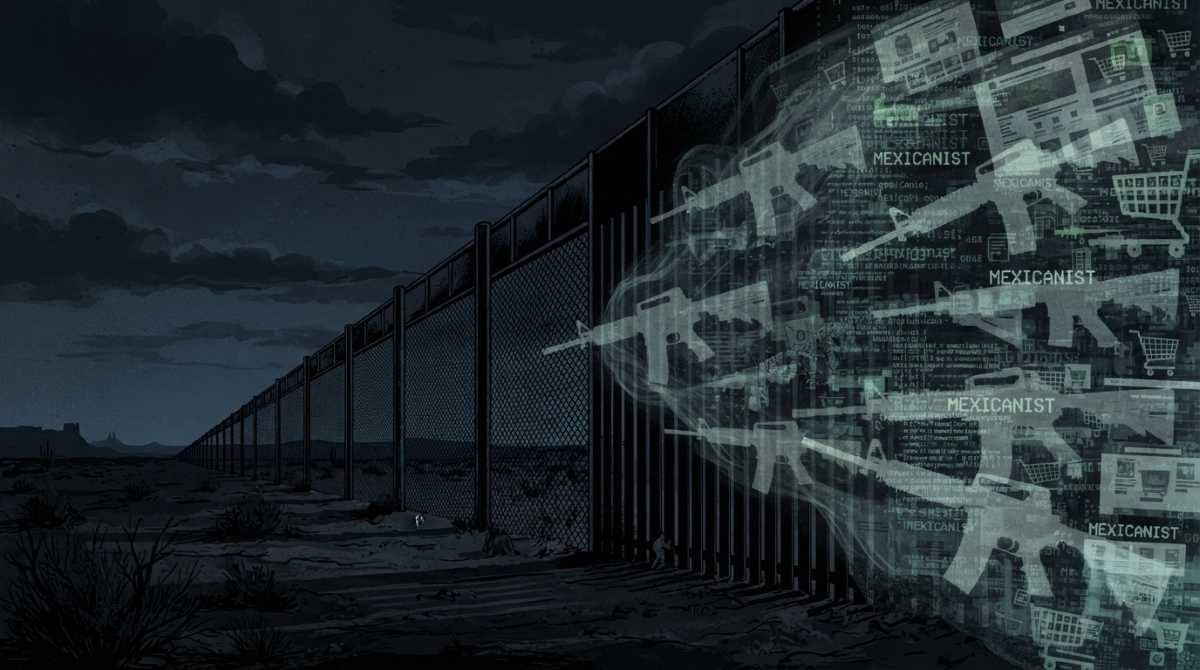
The buyers never met the men who paid them. They communicated through encrypted messaging apps, received instructions from profiles with no photographs, and picked up prepaid debit cards left in locker bays at Houston strip malls. Each transaction followed the same pattern: walk into a licensed firearms dealer or log into an online marketplace, purchase the weapon on the list, then mail it to a freight forwarder in Laredo who never asked questions.
Mexican authorities arrested eleven people this week connected to a straw purchasing network that moved more than 400 firearms across the border over eighteen months, according to a statement from the Fiscalia General de la Republica (FGR). The investigation, conducted jointly with US Homeland Security Investigations, represents the first major enforcement action linking Amazon's online gun marketplace to large-scale cross-border weapons trafficking.
The FGR said the network operated from Texas, Arizona, and California, recruiting US citizens through social media advertisements offering quick cash for "legal purchases." Recruits submitted their driver's licenses to anonymous recruiters, received prepaid Visa cards loaded with between $3,000 and $8,000, and were told which gun to buy. Many of the weapons were purchased through Amazon's licensed dealer network, where buyers complete National Instant Criminal Background Checks through partner firearms retailers before shipment.
"The platform gave them scale," said a source familiar with the investigation who spoke on condition of anonymity because they were not authorized to discuss ongoing operations. "Instead of driving from shop to shop in Texas, a single buyer could place five orders from different dealers in a morning, all with background checks that came back clean because the buyer had no criminal record. The system worked exactly as designed."
The investigation began in February 2025 when US Customs and Border Protection officers at the World Trade Bridge in Laredo seized a shipment of twelve AR-15 style rifles declared as "auto parts." The rifles were packed in a container with used alternators and starter motors, wrapped in oilcloth and suspended within the engine components to evade X-ray detection. A subsequent two-week inspection operation at the same crossing identified three more shipments using identical concealment methods, all destined for addresses in Nuevo Laredo, Matamoros, and Reynosa.
Court documents unsealed in the Southern District of Texas describe how the network adapted to border enforcement patterns. When officers increased inspection rates at Laredo, traffickers shifted to pedestrian crossings at El Paso and Calexico, disassembling rifles into components small enough to cross in backpacks. When enforcement tightened at those crossings, they used commercial cargo routes again, paying truck drivers $500 per weapon to hide firearms among legitimate freight.
The Laredo-Nuevo Laredo corridor has long been the primary artery for illegal weapons flowing from the United States into Mexico. The US Government Accountability Office estimates that 70 percent of firearms traced to Mexican crime scenes originate in the United States. What has changed, according to agents involved in the investigation, is not the route but the method of acquisition.
"Traditional straw purchasing involved a buyer visiting multiple gun stores across state lines, filling out forms, and paying cash," said a retired ATF agent who worked firearms trafficking cases along the southwest border for 22 years. "That pattern still exists, but it is slow, it generates paper trails, and it requires the buyer to have physical presence. The online model solves all of those problems. A buyer in Houston can purchase from a dealer in Pennsylvania through Amazon, pay with a prepaid card that cannot be traced to the actual operator, and have the weapon shipped to a freight forwarder who does not require ID at pickup."
Amazon entered the firearms market in 2023 when it began listing guns and ammunition from licensed dealers on its platform, a move that drew immediate criticism from gun safety advocacy groups and Democratic lawmakers. The company does not sell firearms directly but operates as a marketplace connecting buyers with licensed Federal Firearms License (FFL) holders. Every sale still requires a background check through the National Instant Criminal Background Check System (NICS) conducted by the selling dealer before shipment.
The company has maintained that its platform is safer than unregulated private sales because all transactions go through licensed dealers. In a statement to Mexicanist, an Amazon spokesperson said: "Amazon requires all sellers of firearms and ammunition to be federally licensed and to comply with all applicable laws and regulations. We prohibit any seller from facilitating straw purchases and work proactively to identify and remove listings that violate our policies."
Critics argue that the platform's infrastructure, designed for speed and convenience, creates new vulnerabilities that traditional brick-and-mortar regulations did not anticipate. The speed of transactions, the geographic separation between buyer and seller, and the use of prepaid financial instruments all complicate enforcement.
"They built a marketplace optimized for frictionless transactions," said a senior researcher at a Mexico City security think tank who studies arms trafficking patterns. "Every feature that makes Amazon convenient for legitimate buyers makes it attractive for traffickers. The same algorithm that recommends a book to a reader can suggest a specific Glock model to someone who just bought a cleaning kit. The same logistics network that delivers shoes in two days can deliver a shipment of rifles to a Laredo warehouse in the same timeframe."
The individuals arrested this week include three US citizens, six Mexican nationals, and two Venezuelan nationals, according to the FGR. They face charges of illicit weapons trafficking, organized crime, and money laundering. Mexican authorities also seized 87 firearms, more than 10,000 rounds of ammunition, 47 high-capacity magazines, and approximately $240,000 in cash from properties in Nuevo Laredo and Monterrey.
The arrests expose what investigators describe as a distributed model that made the network difficult to disrupt. The straw buyers, the recruiters, the freight forwarders, and the end recipients operated in separate cells with limited knowledge of each other. Buyers never met recruiters in person. Recruiters communicated with coordinators through encrypted platforms that deleted messages after 24 hours. Payments moved through prepaid cards and cryptocurrency exchanges registered in jurisdictions outside the United States.
For the communities on both sides of the border that bear the cost of this trade, the scale of the operation is measured in the weapons that made it through. The network successfully trafficked an estimated 350 firearms before it was detected, according to investigators. Of those, approximately 200 have been recovered in crime scenes across Tamaulipas, Nuevo Leon, and Coahuila. The remaining 150 have not been found.
The investigation continues across multiple jurisdictions. US federal prosecutors in the Southern District of Texas have convened a grand jury to examine whether additional indictments will be filed against freight forwarding companies and online payment facilitators. Mexican authorities have issued arrest warrants for twelve additional suspects believed to be operating recruitment cells in Houston, Phoenix, and Los Angeles.
For Amazon, the case presents a regulatory and reputational challenge that the company has worked to avoid since entering the firearms market. The company's terms of service explicitly prohibit straw purchases, and its compliance team reviews dealer listings for suspicious patterns. But the network's operators appear to have identified gaps in those systems, distributing purchases across multiple buyers, dealers, and payment methods to avoid triggering automated flags.
A former Amazon compliance employee who worked on firearms policy and spoke on condition of anonymity said the company's screening tools are designed to detect obvious abuse, not organized trafficking.
"The system flags a buyer who purchases fifteen identical rifles from one dealer in a week," they said. "It does not flag five buyers who each purchase three rifles from different dealers, paid with different cards, shipped to different addresses that all belong to the same freight consolidation company. The data exists to connect those dots, but the company has not built the systems to do it."
The US Bureau of Alcohol, Tobacco, Firearms and Explosives has been conducting trace analyses on the recovered weapons to determine whether specific dealers, or the Amazon marketplace itself, show statistical patterns consistent with trafficking. Preliminary findings, according to law enforcement sources, indicate that at least four licensed dealers in Texas and Arizona sold multiple firearms to individuals later identified as network straw buyers, but none exceeded the reporting thresholds that would have triggered an automatic notification to ATF.
Under current law, dealers must report the sale of two or more handguns to the same buyer within five business days. There is no equivalent reporting requirement for long guns, including the AR-15 style rifles that dominated the network's purchase orders. The network appears to have exploited this gap deliberately, ordering long guns exclusively and keeping handgun purchases to one per buyer per week.
The absence of a multiple long gun reporting requirement has been a focus of advocacy groups for years. The case is providing new ammunition for lawmakers who argue that the requirement should be extended. Senator Richard Durbin, Democrat of Illinois, said in a statement Thursday that the arrests showed "how porous our gun laws have become in the age of e-commerce" and called for legislation requiring dealers to report multiple long gun sales to the same buyer.
Mexican authorities estimate they intercepted approximately 15 percent of the network's total traffic, a recovery rate that agents describe as consistent with typical firearms trafficking investigations. The remaining weapons, now distributed across multiple criminal organizations in northern Mexico, will continue to appear in crime scene reports for years, each serial number a data point in a trail that investigators are still following.
The FGR said it is coordinating with the Mexican Secretariat of Security and Civilian Protection to trace the recovered weapons to specific criminal groups. Preliminary analysis links at least 40 of the firearms to the Cartel del Noreste, a splinter faction of the Zetas that controls smuggling routes through Nuevo Laredo. The remaining weapons show distribution patterns consistent with the Gulf Cartel and the Sinaloa Cartel, suggesting the network sold to multiple buyers rather than a single organization.
In Nuevo Laredo, where the weapons first crossed into Mexico, the municipal police department has recorded 17 homicides since the beginning of July, five of them committed with weapons that shell casing analysis indicates were manufactured in the United States within the past three years. The connection to this specific network has has not been confirmed the numbers match the timeline.
The investigation does not end with these arrests. Federal prosecutors in both countries are building cases against the financial facilitators who structured the prepaid card system and the online recruiters who operated the social media campaigns. Those cases, investigators say, will take months to develop. The encrypted messaging records that could identify the network's leaders are stored on servers in jurisdictions that may not cooperate with US or Mexican law enforcement requests.
On the freight side of the operation, the companies that received and forwarded the weapons without scrutiny are facing civil liability questions. Three Laredo-based freight forwarding firms have received subpoenas from the US Attorney's Office for the Southern District of Texas, according to people familiar with the matter. The companies are not accused of criminal involvement — prosecutors are examining whether their failure to inspect incoming packages constituted negligence.
The broader question, and the one that keeps enforcement officials up at night, is how many similar networks are operating undetected. The digitalization of straw purchasing has lowered barriers to entry. A trafficking operation that once required physical presence, local knowledge of gun stores, and cash distribution networks can now be run from a laptop with prepaid cards and social media accounts. The infrastructure that Amazon and other platforms provide is not illegal. The way this network used it was.
An FGR official briefed on the investigation put it differently. "We arrested eleven people," they said. "But we know this model. We know there are others. The question is where they are buying and how long before we find them."