Mahahual's Bet on the Big Ships: Why a Tiny Cruise Port Holds the Key to Southern QRoo's Future
As Belize builds a $450M mega-port 115 kilometers away, Mahahual's 25-year-old multi-brand cruise model faces its biggest test. And property values from here to Chetumal are watching.

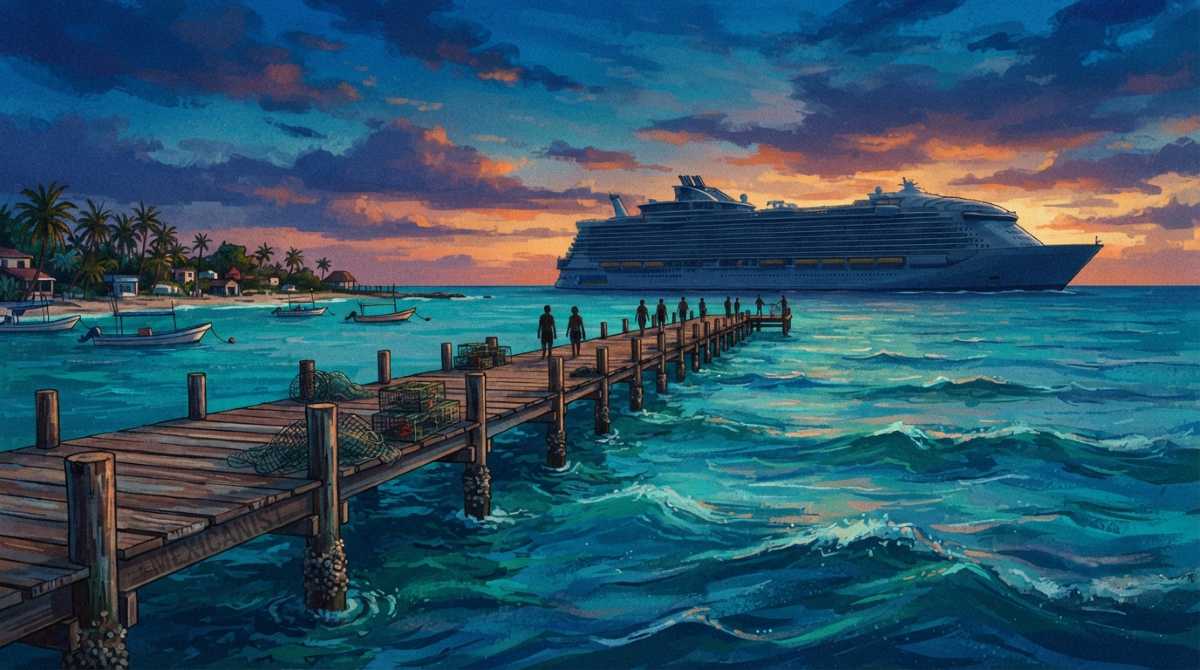
The cruise pier stretching into the turquoise water off Costa Maya was never supposed to carry this much weight. Twenty-five years ago, the single dock was a compromise between development and conservation: build one open-access port that all cruise lines could use, leave the rest of the coastline untouched, and let Mahahual grow at its own pace. This weekend, President Claudia Sheinbaum visits that same pier, and the question is no longer about pace. It is whether a quarter-century-old model can hold against a fully funded competitor 115 kilometers away.
The numbers explain why the story is no longer abstract. Mahahual's net ship count dipped in the first half of 2026 compared to the record-setting start of 2025, but the vessels now pulling into port are measurably larger. Fewer ships, bigger ships, more passengers per docking. In 2024, the port welcomed 2.2 million cruise visitors, a 22 percent jump from 1.8 million in 2023. Through the first four months of 2025 alone, Mahahual handled 932,834 passengers. That was a 10.5 percent increase over the same period in 2024, according to port data. The math is the port's central argument: if you cannot increase dockings, increase the size of what docks.
That argument now faces its most concrete threat. On June 22, 2026, Belize's Department of the Environment quietly approved a $450 million expansion of the Belize City port into a commercial cargo and cruise hub capable of docking four Oasis-class ships simultaneously. Those vessels measure 365 meters long, each carrying nearly 10,000 passengers and crew. The project, developed by Port of Belize Limited, involves dredging 8.6 million cubic meters of marine material and constructing a 448-acre artificial mangrove island using the spoil. Belize currently lacks deep-water berths. Every cruise passenger arriving today comes via tender boats from anchored ships, limiting the country to roughly 1.5 to 2 million passengers annually. The expansion targets 4 to 5 million.
That flow would come largely from the same Western Caribbean itineraries that currently stop at Mahahual and Cozumel. When the Belize port comes online (the timeline is still unclear, but environmental approval is the hardest hurdle and it has already cleared), cruise lines will have a brand-new deep-water alternative 71 miles from Mexico's second-busiest cruise port.
And unlike Mahahual, the Belize project faces no local opposition over environmental restrictions or community consultation. The silence of the approval process has drawn criticism inside Belize over transparency, but the project itself is moving.
The $1 Billion Rejection That Changed Everything
Mahahual did not arrive at this moment passively. The turning point came May 19, 2026, when Mexico's Environment Ministry formally rejected Royal Caribbean's plans for Perfect Day Mexico, a $1 billion, 107-hectare waterpark and private resort adjacent to the Costa Maya cruise port. Royal Caribbean had purchased the port itself in July 2025, betting that owning the destination would lock in exclusive access for its fleet. SEMARNAT ruled the project would cause significant environmental damage to mangroves and the adjacent reef system. The rejection was definitive.
The cancellation created two immediate problems. First, it removed the single largest private investment ever proposed for southern Quintana Roo. Think 20,000 daily visitors, thousands of construction jobs, and a tax base that would have transformed Mahahual's municipal finances. Second, it pushed Royal Caribbean, the world's largest cruise company, to look elsewhere for its next private destination at precisely the moment Belize announced it could host four megaships.
The business community in Mahahual is not crying over the lost project. They are pragmatic about what comes next.
"We have to maintain the multi-brand model," a Costa Maya hotel association representative told local press ahead of Sheinbaum's visit. The statement was a tactical choice of words. Multi-brand means the port stays open to all cruise lines (Carnival, MSC, Norwegian, Disney, and anyone else) rather than becoming the exclusive property of one company. It was the founding principle of the port 25 years ago, and local business owners believe it is the only strategy that works against Belize's challenge.
"The new infrastructure in our neighboring country will not represent a commercial risk if we remain open," the group said, "but rather it will function as an engine of shared prosperity for the entire border region."
That is either clear-eyed regionalism or wishful thinking, and the answer depends on what Sheinbaum brings with her this weekend.
Sheinbaum arrives in Mahahual with a defined position but not a full plan. On June 5, from a morning press conference in Coatzacoalcos, she announced a new development framework for Mahahual built around ecotourism, not mass tourism. SEMARNAT Secretary Alicia Bárcena and Fonatur director Sebastián Ramírez joined Quintana Roo Governor Mara Lezama to present the outlines: a special protection decree that would limit future development to low-impact, community-led projects, plus 197.5 million pesos in state funding (roughly $10.5 million at current exchange) for street rehabilitation and malecón improvements.
"Give it a category of protection so that only ecotourism can be developed," Sheinbaum said during that June 5 briefing. "This can only be done in coordination with the community."
The language was designed to position the federal government on the side of conservation after rejecting Royal Caribbean. But the 197.5-million-peso figure is small for a port that moved 2.2 million passengers last year. Street paving and a boardwalk renovation improve the visitor experience, but they do not extend the pier for larger ships, deepen the channel, or expand cargo capacity. The Zaragoza Canal project (a long-promised connection between the Caribbean Sea and Chetumal Bay designed to unlock the entire southern economy) remains suspended amid budget cuts and environmental reviews.
On July 17, during a morning press conference in Tulum, Sheinbaum acknowledged that some Mahahual residents had actually supported the Royal Caribbean project and that the government remains open to working with the company on an ecotourism alternative.
"Because some of them were in favor of the park that was proposed," Sheinbaum said. "So we are working with the community to see what tourism scheme can be developed, even with the same company; to see if there is an ecotourism project that can be proposed for the area, one that does not have the environmental impacts the other park would have and that can be beneficial for the region."
The message was conciliatory, but the timeline was not specified. Construction seasons in the Caribbean operate on a narrow window. Every month of uncertainty is a month Belize spends advancing its own project.
What This Means for Property in Southern QRoo
For investors watching the Yucatán Peninsula from Cancún southward, the Mahahual question is not about cruise ship capacity. It is about whether federal infrastructure spending can sustain a secondary market that has never quite matched the Riviera Maya's gravitational pull.
Chetumal, the state capital 140 kilometers south of Mahahual, has been the perennial underperformer in Quintana Roo's real estate story. Prices per square meter in Chetumal run roughly one-third of Cancún's residential averages and one-fifth of Tulum's speculative peak. The gap has persisted for decades because the capital lacks the tourism engine that drives the rest of the state. Mahahual was supposed to be that engine. A cruise port close enough to Chetumal to pull visitors south, distant enough to leave the capital's residential market undisturbed.
The Belize port complicates that calculation. If Belize captures the Western Caribbean itineraries that would otherwise call at Mahahual, the economic multiplier for the entire corridor weakens. Fewer ships mean fewer hotel nights in Mahahual's beachfront guesthouses, fewer tours to the Bacalar lagoon and the Chacchoben ruins, fewer restaurant covers, fewer reasons for a foreign buyer to consider a second home in the Costa Maya zone.
If Mahahual stabilizes or grows through federal investment, deeper dredging, and longer piers, the bet pays off differently. Mahahual's beachfront properties, priced at roughly $1,200 to $1,800 per square meter for lots within walking distance of the malecón, would look cheap relative to the $3,500-plus per square meter commanding Tulum's beach road. Chetumal residential lots, still trading below $400 per square meter in the city center, would finally have a growth narrative attached to them.
The key variable is not land (there is plenty of it). The key variable is infrastructure, and specifically whether the federal government treats the Costa Maya port as a strategic asset worth upgrading or a legacy facility worth maintaining at current capacity.
Mahahual has certain advantages that do not appear on a balance sheet. The port sits closer to several of the Western Caribbean's most popular inland excursions (the Bacalar lagoon, the Kohunlich archaeological site, the Calakmul Biosphere Reserve) than any Belize counterpart could. Belize's new port will require tendering passengers to a mainland facility followed by hours of road time to reach comparable attractions. Mahahual's passengers step off the gangway into a village built around the cruise experience, with the inland attractions a 30- to 90-minute drive away.
But those advantages erode if the port infrastructure cannot handle the largest ships. The Oasis-class vessels that Belize is preparing to receive are coming to the Western Caribbean regardless. If Mahahual cannot berth them, the cruise lines will substitute Mahahual calls with Belize calls on their biggest ships, while continuing to send smaller vessels to Mahahual. The result is a slow bleed: same number of dockings, fewer passengers, less economic activity, and a decline in the per-passenger revenue that sustains the local business community.
The business community understands this calculus. That is why their message to Sheinbaum was not a request for handouts but a call for strategic parity.
"To safeguard the competitiveness of this strategic enclave, we close ranks with the President and the Governor," they said in their joint statement. The phrase "close ranks" is revealing. It signals that the private sector views this as a fight. A fight against Belize's infrastructure advantage, against environmental restrictions that slow Mexican permitting, against the risk that federal attention will drift north to Cancún and Tulum once the weekend visit ends.
Sheinbaum's protection decree, if it becomes law, will lock Mahahual into an ecotourism model that the federal government defines. That model could work. Community-led ecotourism at a cruise port is unusual but not impossible. The question is whether it generates enough economic activity to sustain the 2,600 residents of Mahahual and the broader corridor's property market. Ecotourism yields higher per-visitor revenue but lower volume. In a port designed for volume, the math requires careful calibration.
The answer will arrive in measurable form. The Zaragoza Canal either breaks ground in 2027 or stays suspended. Pier extension studies either appear in federal infrastructure budgets or they do not. Cruise line calls for the 2027-28 season either hold steady at Mahahual or shift toward Belize City. The hotel association either reports stable occupancy or starts discounting.
For now, the single pier at Costa Maya points toward open water and a competitor that already has its environmental permit. Sheinbaum's visit this weekend will tell property buyers in southern Quintana Roo whether the federal government is willing to place a bet of its own. And whether the 25-year-old experiment in open-access, multi-brand cruising has a future beyond its current design.
In Mahahual, the malecón lights come on at dusk, and local business owners watch the horizon. They are not watching for ships anymore. They are watching for a budget line item.