Rhinos at the School Gate: The Militarization of Puerto Vallarta's Suburbs
Armored vehicles roll into a quiet subdivision. Soldiers take over an elementary school. Zero arrests. This is the new normal.

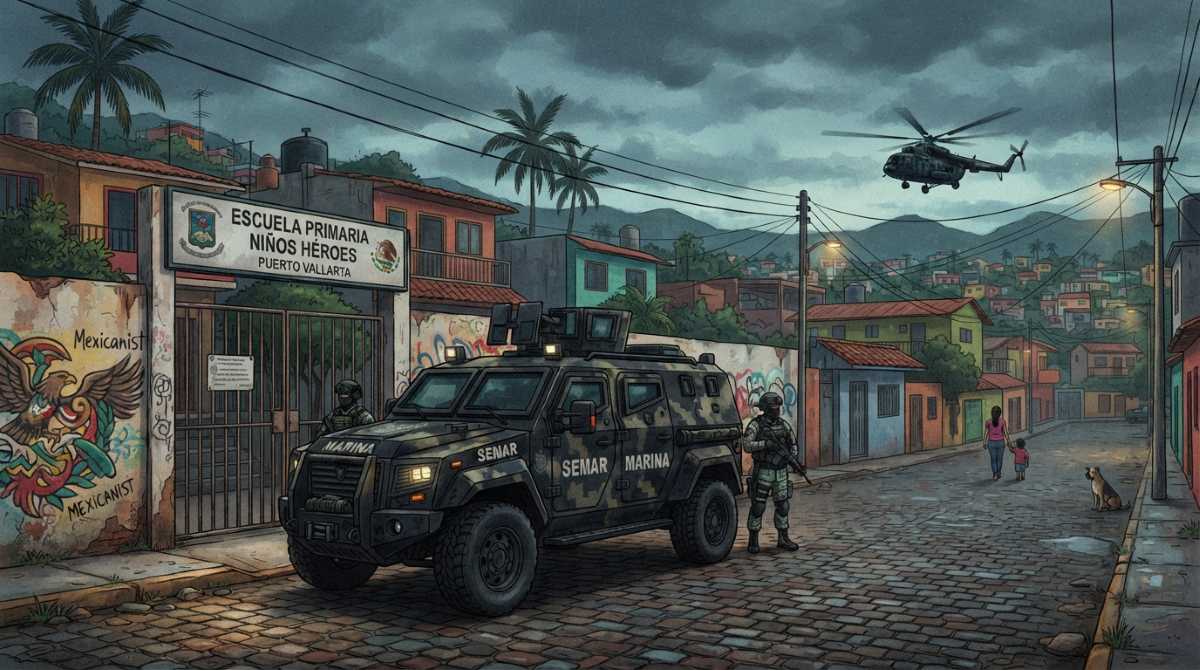
Armored military vehicles rolled into the Ecoterra subdivision on Friday evening as a helicopter gunship descended over the empty lots and dirt roads of this rural Puerto Vallarta development. At the main entrance, an elementary school lit up not for classes but as a staging ground for soldiers with radios and rifles, while residents watched from their doorways.
By the time the operation ended, hours later, there were no arrests. No weapons were seized. No shots were fired.
The deployment was one of the largest seen in this part of Jalisco in recent memory. Elements of the Mexican Army and the National Guard arrived in Rhino tactical vehicles, their armor plating and mounted weaponry designed for combat zones, not suburban streets. A federal helicopter conducted reconnaissance flights over the development for hours, inspecting undeveloped plots, vacant land, and rural access roads. The military set up a temporary coordination center in the elementary school at the main entrance to the subdivision, using its classrooms and facilities as a command post.
What triggered the mobilization was not a firefight or a cartel assault. It was a phone call from a neighbor.
Residents of the area had reported in recent days seeing pickup trucks carrying people they believed to be armed. The reports generated unease among neighbors in the housing development and surrounding communities. The state responded with everything at its disposal.
Ecoterra is a fraccionamiento, a planned housing development, on the rural edge of Puerto Vallarta, a city better known internationally for its beaches, resorts, and cruise ship pier than for armed deployments. The developments between El Colorado and El Ranchito are the kind of places families move to for more space and quieter streets. On Friday evening, those streets were filled with armored vehicles weighing several tons, their gun mounts traversing the corners where children walk to school. A military helicopter circled low enough for residents to make out its markings.
The Rhino is a heavy armored personnel carrier, built to withstand ambushes and improvised explosive devices in active combat zones. It is not designed for residential streets. When it rumbles past a house where a family is eating dinner, the ground shakes. The message it sends is unambiguous: someone in authority decided that this neighborhood required military-grade force. The question that went unanswered on Friday night is whether that decision was proportionate to the threat.
The use of the elementary school as a command post reveals how routine the military occupation of civilian infrastructure has become. Military personnel set up temporarily in the campus at the main entrance to the subdivision, using its facilities as a coordination point for the security operation. The school is where children will return on Monday morning. The building will be cleaned and restored to its ordinary purpose, but the precedent has been set. The next time federal forces operate in this area, the elementary school is already on their map as a viable staging ground.
The helicopter reconnaissance added a third dimension to the operation, and for many residents it was the most unsettling. The sound of rotors overhead has become a feature of suburban life in parts of Mexico that are not frontline cartel territory, a soundtrack that announces the state is watching. The aircraft spent hours inspecting empty lots and dirt roads, looking for threats that did not materialize. But the signal was clear: the government is willing to deploy aerial surveillance over a housing development because someone reported suspicious vehicles.
The lack of results is not incidental to this story. It is the story.
A major operation involving multiple federal forces, armored vehicles, air support, and the temporary military occupation of a public school produced zero arrests, zero weapons confiscated, and zero confrontations. Authorities presented this as a success. The presence of the Mexican Army and the National Guard remains active with preventive patrols, the government stated, whose objective is to strengthen security conditions and maintain permanent surveillance for the benefit of families living in Ecoterra and surrounding communities.
The logic is circular. The presence of the military is justified by the threat of armed groups. The absence of any armed groups is presented as proof that the military presence is working. The operation was necessary because of reports of suspicious vehicles. The operation found nothing, which means it worked. For citizens, there is no way to challenge this reasoning because it contains no factual claim that can be tested. Preventive security is a closed loop.
For the families of Ecoterra, the calculus is more straightforward. They now live in a place where a report of suspicious trucks brings armored vehicles to their streets and a helicopter to their skies. This may feel like protection. It may also feel like occupation. The difference, for a family watching a Rhino armored vehicle park near their child's school, is not always clear. Some residents may find comfort in the visible presence of armed soldiers. Others may find themselves locking their doors a little tighter, suddenly aware that the line between their quiet suburb and the conflict zone they read about in the news is thinner than they thought. Either way, the neighborhood they moved to has changed.
Jalisco has become a laboratory for Mexican security policy in recent years. The state is home to the Jalisco New Generation Cartel, known as CJNG, one of the most powerful and aggressive criminal organizations in the Western Hemisphere. The federal government has responded with increasing military deployments across the state. But those deployments do not always target cartel strongholds or known conflict zones. Increasingly, they target the spaces where ordinary Mexicans live, work, and send their children to school. The Ecoterra operation fits a pattern visible across Jalisco and beyond: military force deployed to residential areas based on general suspicion rather than specific intelligence, producing little in the way of tangible results while normalizing the presence of armed soldiers in everyday life.
This pattern is not unique to Puerto Vallarta. Similar operations have been documented in the suburbs of Guadalajara, in the housing developments of Zapopan, and in residential neighborhoods of Tijuana and Monterrey. In each case, the formula is the same: reports of suspicious activity, a disproportionate military response, and a permanent shift in what residents accept as normal.
Preventive security is the official term for this approach, and it has become the most powerful phrase in Mexico's security vocabulary. It covers a growing range of military activities in civilian areas, from highway checkpoints to neighborhood patrols to school-based operations. The term is elastic enough to justify almost any deployment the government considers necessary. It is also elastic enough to avoid scrutiny, because an operation that prevents something from happening produces no evidence of its own necessity. There is no paper trail for a raid that was never needed.
The residents of Ecoterra did not ask for a military base in their elementary school. They asked for someone to investigate the pickup trucks. They received armored vehicles, a helicopter, and a permanent military presence described as ongoing preventive patrols. Whether this makes them safer is a question the operation does not answer, because the operation was not designed to answer it. It was designed to demonstrate that the government is capable of responding. In that sense, it succeeded.
The deeper problem is that the demonstration itself changes the neighborhood. Every deployment of military force into a civilian area shifts the baseline of what residents consider normal. Children who grow up seeing soldiers at their school gate will not find it unusual. Parents who accept a military command post in their child's elementary school have already crossed a threshold that, once crossed, is difficult to uncross. The normalization of armed force is not a side effect of preventive security. It is the mechanism by which preventive security operates.
When the military leaves Ecoterra, and it will leave eventually, the residents will face the same problem they had before the operation: suspicious vehicles on rural roads, a local police force that lacks the capacity or the will to respond effectively, and the knowledge that the only solution their government can offer is to militarize their neighborhood again. The operation changes nothing about the conditions that produced the original concern. It only changes what residents are willing to accept. The suspicious trucks on the road to El Colorado may still be there. The same informants will make the same calls. And the response, if the pattern holds, will look exactly like Friday night.
On Monday morning, children will walk past the elementary school where soldiers set up their command post on Friday night. The building will be clean, the classrooms restored to their purpose. But the precedent has been set. The next time someone sees a suspicious truck on the road to El Colorado, the response path is already determined. The Rhinos will roll in again. The helicopter will return. And another Mexican neighborhood will learn to live with the quiet normalization of armed force at the school gate, because the alternative feels worse.