What INEGI's Well-Being Data Actually Says About Northern Mexico
Coahuila tops the satisfaction rankings. But the real story in INEGI's bienestar survey is the chasm between north and south.

The man in the questionnaire, had INEGI's enumerators found him at home on the right day, might have said his life was going well. He lives in Saltillo, works in an automotive plant on the outskirts of town, and his monthly salary, while not enough for a house in the private residential developments climbing the hills west of the city, is enough that his children do not go to bed hungry. Multiply that man by a hundred thousand, and you have the headline that greeted the press in June: Coahuila, according to INEGI's Encuesta Nacional de Bienestar Autorreportado, or ENBIARE, ranks among the states with the highest self-reported quality of life in Mexico.
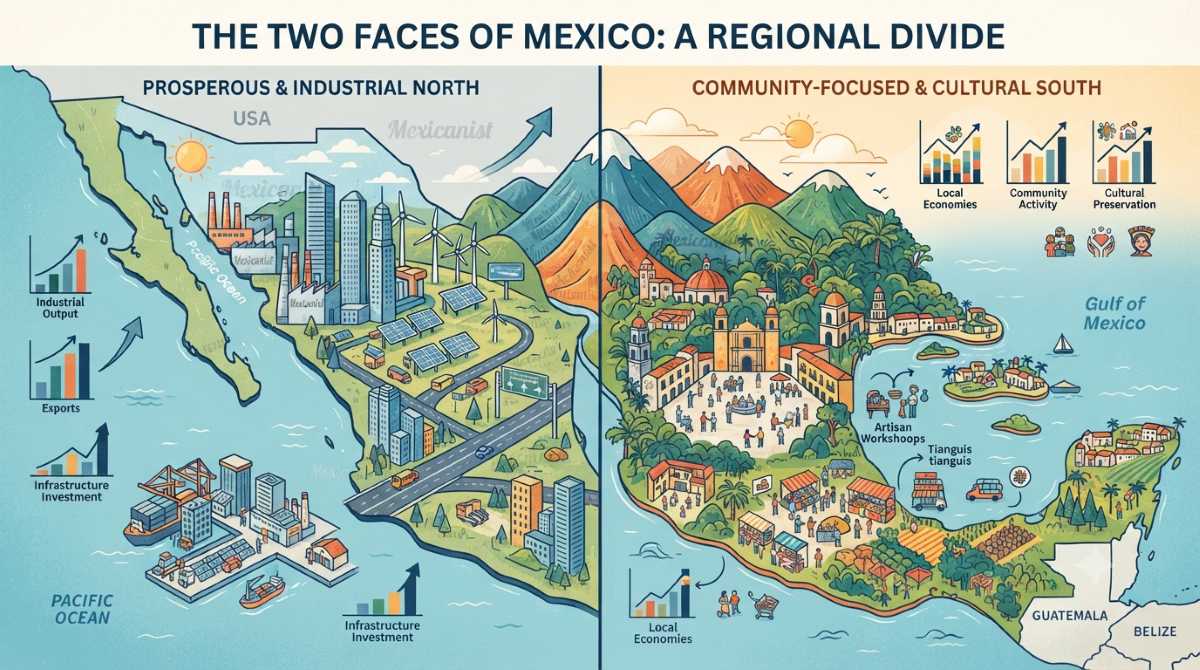
The number that matters is this: 8.4 out of 10. That is the average life satisfaction score reported by Coahuila's survey respondents, placing the state near the top of a national ranking that includes all 32 Mexican states. The national average sits at 7.3. But the gap between those two figures is not the real story. What INEGI's bienestar survey actually reveals is a Mexico split along geographic and economic lines, where the factors that drive a high satisfaction score in the north are almost inverted in the south, and where the national average, the typical metric cited in government press releases, conceals as much as it clarifies.
INEGI's ENBIARE, first conducted in 2021 and repeated at intervals since, is unusual among Mexican government surveys. It does not measure GDP growth, employment rates, or household income, at least not directly. Instead, it asks people how they feel about their own lives. Respondents rate their overall life satisfaction on a scale of zero to ten, answer questions about their sense of purpose, their perceived economic security, and the strength of their social connections. The methodology, adapted from the OECD's Better Life Index framework, attempts to capture something that traditional economic indicators routinely miss: the gap between objective conditions and subjective experience.
That gap, in the case of Mexico's northern states, is remarkably narrow. Coahuila, Nuevo Leon, Baja California Sur, and Chihuahua consistently form a cluster at the top of the bienestar ranking, with average satisfaction scores between 8.2 and 8.6. These are states with diversified manufacturing economies, relatively low unemployment, and average household incomes well above the national median. The correlation between economic security and life satisfaction in these states is linear and strong. People who report feeling financially secure tend to report higher life satisfaction. The data suggests that in the industrial north, money buys contentment at a fairly reliable rate.
The picture in southern and southeastern Mexico is different. Chiapas, Oaxaca, Guerrero, and Veracruz rank at the bottom of the bienestar scale, with average life satisfaction scores between 6.5 and 6.9. These states face objective disadvantages: higher poverty rates, lower educational attainment, weaker infrastructure, and more limited access to formal employment. But the ENBIARE data, when disaggregated by dimension, reveals a more interesting pattern. On questions related to community satisfaction and social belonging, respondents in several southern states score as high as their northern counterparts, and in some cases higher. The sense of having people to count on in a crisis, of being part of a community that cares, cuts across the income gradient in ways that defy simple economic explanation.
This is where the bienestar data becomes genuinely useful for policymakers, and where the headline-friendly ranking obscures the more complex reality. If you look only at the aggregate satisfaction scores, you might conclude that the policy prescription is straightforward: replicate the northern economic model in the south, and satisfaction will follow. The disaggregated data suggests otherwise. Economic security clearly matters, but so do social networks, trust in institutions, and perceived safety. A development strategy that focuses exclusively on industrial recruitment and wage growth, without addressing the social and institutional dimensions of well-being, is unlikely to close the satisfaction gap in the states that need it most.
Three dimensions of the ENBIARE data are particularly worth examining. The first is economic security, measured by respondents' ability to cover unexpected expenses and their confidence in their future financial situation. Coahuila and Nuevo Leon score significantly above the national average here, with more than 60 percent of respondents reporting confidence in their economic future. In Chiapas and Guerrero, that figure drops below 40 percent. The gap is not surprising its magnitude is striking: it suggests that in the southern states, a majority of the population is living with a baseline level of economic anxiety that the northern states have escaped.
The second dimension is social support. Respondents are asked whether they have someone they can rely on in a personal crisis. Here, the geographic pattern shifts. While northern states still score well, the differences narrow considerably. Communities in Oaxaca and Yucatan report levels of social support that approach or match those in Coahuila and Nuevo Leon, despite significantly lower economic indicators. The data suggests that something about the social fabric in these states a denser network of family ties, perhaps, or stronger community institutions provides a buffer against the economic hardships that the region faces.
The third dimension is trust in institutions, which is low across the board but varies significantly by state. Northern states tend to report slightly higher trust in local government and police, while southern states report lower trust in nearly all institutions except, in some cases, community-level authorities. The pattern is consistent with the broader political geography of Mexico, where the north has seen more consistent investment in state capacity over the past two decades, and where citizens have greater exposure to formal institutions.
What the ENBIARE data does not say is perhaps as important as what it does. It does not say that Coahuila is the best place to live in Mexico, a framing that several Mexican media outlets adopted in their coverage. What it says is that Coahuila's residents, on average, report higher life satisfaction than residents of other states. That is a meaningful distinction. The data is subjective by design. It measures perception, not objective reality. A person in Chiapas might have a lower satisfaction score not because her life is objectively worse in every dimension, but because the gap between her expectations and her reality is wider.
This distinction matters for investors as well as policymakers. For companies considering location decisions, the ENBIARE data offers a proxy for workforce stability and retention. Northern states with high satisfaction scores are likely to have lower turnover rates, all else being equal. Workers who report higher life satisfaction are less likely to leave their jobs or their communities. The data suggests that employers in Coahuila and Nuevo Leon enjoy a labor market advantage that goes beyond wage levels: a workforce that is, by its own account, content. In the south, the challenge is different. Lower satisfaction scores may signal higher latent mobility, particularly among younger workers who are more likely to migrate north or to the United States in search of better economic conditions.
For Mexican policymakers, the ENBIARE data presents an uncomfortable challenge. The north-south divide in well-being is not a new phenomenon the survey provides a new lens through which to see it. The economic gap between the regions has been documented for decades. The subjective well-being gap, measured consistently and across all states, is a more recent and in some ways more troubling finding. It suggests that the economic disparities are not just a matter of statistics. They are experienced, daily, by the people who live in them.
There is a temptation, when looking at the ENBIARE rankings, to treat the outcome as fixed: the north is satisfied, the south is not, and nothing short of a massive redistribution of resources will change it. The data does not support that conclusion. The southern states that score relatively well on community satisfaction show that there are assets to build on, even in places where economic indicators are weak. The challenge for policy is to strengthen economic security without eroding the social bonds that sustain communities through hardship. That is a more delicate task than simply building a factory and hoping satisfaction follows.
The next ENBIARE release, expected in 2026, will be closely watched for signs of convergence or divergence. If the gap between north and south narrows, it will suggest that the economic policies of the past five years have had an effect on subjective well-being. If it widens, it will confirm what many already suspect: that Mexico's development model is producing growth in some regions and stagnation in others, and that the benefits of economic change are distributed unevenly across the map.
INEGI's bienestar survey does not offer easy answers. It offers a better set of questions. Why do people in the north feel more secure? What sustains community trust in the south? How do you build economic resilience without dismantling social cohesion? The answers to those questions will determine not just Mexico's rankings on the next bienestar survey, but the shape of its development for the next generation.
In Saltillo, the auto worker whose satisfaction score helped lift Coahuila into the top tier of the national ranking does not think about the ENBIARE when he goes to work. He thinks about his shift, his supervisor, and whether his youngest daughter's fever has broken. The survey's value is not in the number it assigns to his life. It is in what that number, layered across a country of 130 million people, reveals about the places where opportunity is concentrated and the places where it is not. That is a story no ranking can tell on its own.