The Realtor Who Walked Into Puerto Vallarta and Never Walked Out
A well-known real estate agent vanished after showing a luxury home in Jardines de Conchas Chinas. His car turned up in a neighborhood with no cameras.

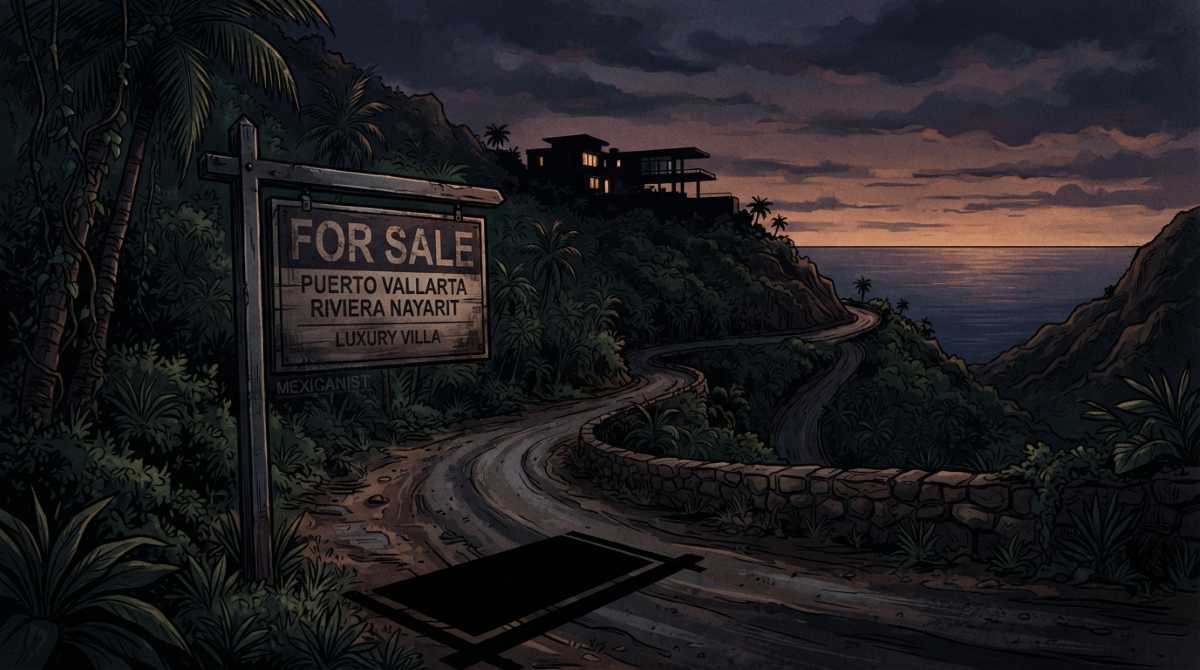
The appointment was a standard property showing in Jardines de Conchas Chinas, the kind of transaction that real estate agents in Puerto Vallarta complete dozens of times a year. César Ríos, 44, a well known agent in the city's luxury market, arrived at the property on the afternoon of Thursday, July 16, to meet a prospective buyer. He has not been seen since.
His family reported him missing when he failed to return home that evening. Around 10 p.m., police located his white Chevrolet Trax abandoned in El Pitillal, a working class neighborhood 15 minutes north of the property. The vehicle was unlocked. His phone and wallet were gone. There are no security cameras in the area. No witnesses have come forward.
Jalisco recorded 1,246 disappearances in 2025. That is an average of more than three per day, and it represents the fourth consecutive year the tally has exceeded 1,000. Most of these cases never become headlines, never receive dedicated investigation teams, never get mentioned in the English language press. This one did because of who César Ríos was and where he was working. He was not a tourist who wandered into the wrong part of town. He was a local professional operating in the upper end of Puerto Vallarta's real estate market, a sector that has spent the past two years trying to reassure international buyers that the city remains safe. That reassurance just became much harder to sell.
Ríos worked with several of the major brokerages in Banderas Bay and had built a reputation among expat buyers looking for second homes in the hills above the coast. Friends described him as cautious, a man who double checked the details of every showing and kept his family informed of his schedule. On the afternoon he disappeared, he told his wife he was meeting a client at a property in Jardines de Conchas Chinas and expected to be home by 5 p.m. He sent a message at 3 p.m. confirming the meeting was underway. That was the last communication anyone received from his phone.
Jardines de Conchas Chinas sits on the slopes above the southern hotel zone, a neighborhood of gated villas, ocean views, and private security booths. Properties there typically start at $600,000 and climb past $3 million for homes with full bay views. The streets are narrow, winding, and largely invisible from the main road. It is one of the most exclusive residential areas in Puerto Vallarta, the kind of place where agents do not typically expect trouble. The contradiction is what makes the case so unsettling to the local real estate community. A professional disappearance in a luxury neighborhood suggests a level of planning that does not fit the usual narrative of opportunistic street crime. Someone knew where the agent would be, or the buyer was not a buyer at all.
The discovery of Ríos's vehicle in El Pitillal only deepened the questions. The neighborhood, located inland on the northern edge of the city, has long been considered one of the more problematic areas of Puerto Vallarta. Residents there have complained for years about the absence of municipal surveillance and the frequency of armed robberies. Police say the area has no functioning security cameras. The vehicle was found on a residential street where neighbors reported hearing nothing unusual. It is possible the car was driven there after the encounter and abandoned. It is possible Ríos was transported elsewhere. No forensic evidence has been released.
For the real estate industry in Puerto Vallarta, the case represents a nightmare scenario. Agents regularly show properties to strangers. They enter homes alone with people whose identification they have no means of verifying. The industry has no formal protocol for vetting prospective buyers, no shared database of suspicious inquiries, no standard security practice beyond what individual agents and their brokerages decide to implement. In the wake of Ríos's disappearance, several agencies in the city have begun reviewing their internal procedures. A few have told agents to insist on meeting new clients at the office rather than at a property. Others have suggested dual agent showings for high value listings. None of these measures are mandatory.
The broader context is one that Puerto Vallarta's tourism and real estate sectors have been trying to manage for some time. In early 2025, the federal government launched Operation Ecoterra, a military deployment aimed at reducing cartel related violence in the region. The operation brought visible security patrols to the hotel zone and the airport corridor. It produced a series of high profile arrests. But the underlying dynamics that fuel disappearances in Jalisco have not changed. The state remains one of the most dangerous in Mexico for forced disappearances, a grim statistic that predates Ecoterra and will outlast it. A military patrol on the Malecón does nothing to prevent a carefully staged meeting in a hillside villa.
The Ríos family has retained a private attorney and is pushing state prosecutors to treat the case as a priority. The Jalisco Attorney General's Office has opened an investigation but has not classified the case as a kidnapping. Officially, César Ríos is a missing person. His family knows what that distinction means in Jalisco. The difference between a missing person and an abduction victim often depends not on the facts of the case but on the political will to pursue it. In a state where more than a thousand people vanish every year, resources are thin and attention spans are shorter.
What makes this case different from the thousands of other disappearances that Jalisco's overwhelmed prosecutor's office processes annually is the economic weight behind it. Puerto Vallarta's real estate market generated an estimated $2.8 billion in foreign investment in 2025, much of it from American and Canadian buyers purchasing second homes and retirement properties. The city's tourism economy, which accounts for roughly 60 percent of local GDP, depends on the perception that Puerto Vallarta is safer than other parts of Mexico. Every headline about a missing professional in a luxury neighborhood chips away at that perception.
The local real estate community is acutely aware of this. Several agents Mexicanist spoke with asked for anonymity, but were direct about the implications. One described a client from San Francisco who cancelled a scheduled site visit the day after the news broke. Another said a Canadian couple who had been in negotiations for a $950,000 property in Conchas Chinas had paused their search pending more information. These are not panicked reactions. They are rational responses to a situation in which the basic assumption of safety that underpins a luxury real estate transaction has been called into question.
Ríos is not the first real estate professional to disappear while showing a property in Mexico, and he will not be the last. In 2023, an agent in Cancun went missing after a showing in Puerto Morelos; her body was found three weeks later in a cenote. In 2024, two agents in Los Cabos were kidnapped after an open house and released after a ransom payment. The industry has been aware of these risks for years. The response has been incremental rather than structural. A safety app here, a buddy system there. The underlying vulnerability of the transaction, one agent alone with one unknown stranger in an empty building, has not been addressed.
Puerto Vallarta's municipal government has offered no public statement on the case. The state prosecutor's office, when reached by Mexicanist, provided only a confirmation that the investigation is ongoing and declined to comment on leads or suspects. The silence from official channels has not gone unnoticed by the community. Several local real estate associations are discussing the possibility of drafting a formal security protocol for property showings, though no timeline has been set and no binding commitments have been made.
On the afternoon of July 17, the day after Ríos disappeared, a group of roughly 30 real estate agents gathered outside the brokerage where Ríos had worked. They stood in a loose circle near the entrance, holding phones and talking in low voices. Some of them held signs with Ríos's photograph and a phone number for tips. One of the organizers, a woman who had worked with Ríos for six years, told a local reporter that the group planned to keep the pressure on authorities. "We are not going to let this go cold," she said. "We know what happens to these cases when nobody is watching."
The group dispersed after an hour. The signs remained taped to the windows of the brokerage. Inside, the phones were ringing. Clients wanted to know if it was safe to come to Puerto Vallarta. The agents did not have an answer they felt confident giving.
The following morning, Ríos's wife filed a formal request with the state prosecutor's office for access to cell tower data from the area around both the Jardines de Conchas Chinas property and El Pitillal. The request is pending. The family has also distributed flyers with Ríos's photograph across the Vallarta bus terminal and taxi stands, a common tactic among families of the disappeared in Jalisco, who know that authorities rarely act without public pressure.
There is a particular detail that sticks with the people who knew César Ríos. He had a habit of photographing his showings. Before every appointment, he would take a picture of the property listing or the street sign and send it to his wife. It was a small thing, a routine born of habit rather than fear. He did it on July 16. The photograph shows the entrance gate to a property in Jardines de Conchas Chinas. The timestamp reads 2:47 p.m. It is the last known image of his day before he disappeared. The gate is still closed.