Pachuca Debuts Double-Decker Team Bus with Gaming Zone — the New Standard for Liga MX Travel
Pachuca's new double-decker team bus features a gaming lounge, reclining seats, and full entertainment system. The club says it will transform travel for the Apertura 2026 season.

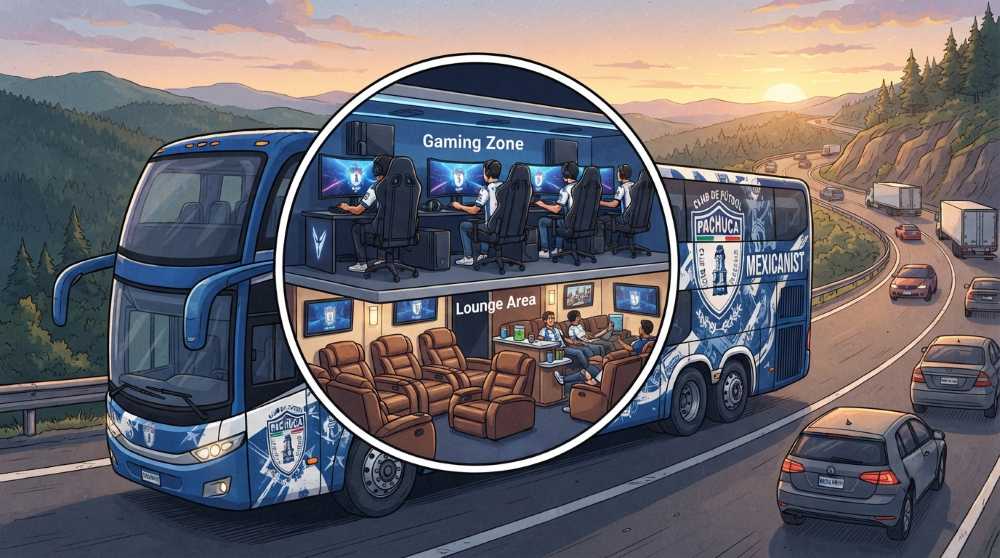
Pachuca's players will not be spending their road trips staring at the ceiling of a standard bus anymore. The Tuzos unveiled a custom double-decker team bus ahead of the Apertura 2026 season, and it looks less like a team coach and more like a lounge on wheels.
The new bus features two levels of passenger seating. The lower level is designed for rest and relaxation, with reclining seats that can be converted into sleeping positions. The upper level is where the action happens: a dedicated gaming zone equipped with multiple screens, gaming consoles, and high-speed internet connectivity. Between the two levels, the bus can accommodate the entire squad and coaching staff in comfort.
"We wanted to create an environment where the players arrive at the stadium fresh, focused and in the right mindset," said a club spokesperson. "The bus is part of that."
The gaming zone is the bus's most distinctive feature. Stairs lead to the upper deck, where a row of gaming stations faces large screens mounted on the walls. The setup allows players to play FIFA, Call of Duty or whatever else they prefer during the two-to-six-hour bus rides that Liga MX teams regularly make between cities.
The gaming zone serves a practical purpose beyond entertainment. Long bus rides are a fact of life in Liga MX, where teams regularly travel distances of 500 to 1,000 kilometers for away matches. Keeping players mentally engaged during those trips — rather than letting them zone out or sleep too close to game time — can affect performance. A competitive gaming session keeps the mind active and the mood light.
The psychological aspect is also relevant. Team bonding on the bus has been part of football culture since the sport went professional. Adding a gaming zone gives players a shared activity that builds camaraderie in a way that individual screen time on phones or tablets does not.
The lower level focuses on the opposite: real rest. The reclining seats are wider and more comfortable than standard bus seating, with adjustable lumbar support and footrests. The seats can be reclined almost flat, allowing players to sleep during overnight trips or rest before an evening match.
The bus also includes a kitchenette with a refrigerator and microwave, a bathroom, and storage space for equipment. The interior is designed in Pachuca's blue and white colors, with the club crest prominently displayed.
The total investment in the bus has not been disclosed, but customized double-decker coaches of this type typically cost between $500,000 and $1 million USD. For a club of Pachuca's size — a mid-market Liga MX team with a strong youth academy and a history of developing talent — the investment is significant but not extraordinary.
The Liga MX Travel Reality
Pachuca's new bus draws attention to an aspect of Liga MX that fans rarely see: the travel grind. Unlike European leagues where teams often fly to away matches, Liga MX teams regularly travel by bus for distances that would be unthinkable in Europe. Pachuca is roughly 90 kilometers from Mexico City, six hours from Guadalajara, and twelve hours from Monterrey. Road trips to northern teams like Tigres or Rayados involve overnight travel.
Most teams make these trips on standard charter buses that are no different from what a tour group or corporate retreat would use. A few teams have invested in customized coaches. Pachuca's double-decker sets a new standard for luxury and functionality.
Pachuca is not the first Liga MX team to invest in a custom bus. Tigres and Monterrey have both upgraded their team transport in recent years. But Pachuca's double-decker with a gaming zone is the most elaborate yet.
The trend reflects the growing professionalization of Mexican football. As the league attracts more investment, younger players and greater media attention, clubs are looking for competitive advantages in areas beyond the training ground. Travel comfort is one of those areas. A player who arrives at an away stadium well-rested and in a positive frame of mind is more likely to perform than one who made the same trip in a cramped, uncomfortable bus.
Whether the gaming zone translates into wins is a question that cannot be answered until Pachuca starts playing road games in the Apertura 2026 season. ### The Academy Connection
Pachuca's investment in the bus also reflects the club's broader strategy. The Tuzos are known for one thing above all: their youth academy. Pachuca has produced some of Mexico's best talents over the past two decades, including Hirving Lozano, Érick Gutiérrez, and the Dos Santos brothers. The academy is the club's competitive advantage, and attracting the best young players requires showing them that Pachuca treats its players well.
A state-of-the-art team bus is part of that pitch. When a 17-year-old prospect considers whether to join Pachuca or another club, the bus sends a message: this club invests in its players. It may seem trivial, but in the competitive world of Mexican youth football, every advantage matters.
The bus also benefits the academy players who travel with the first team. The Tuzos regularly call up youth players for away matches, and the bus experience — gaming zone included — can help integrate them into the senior squad culture.
Pachuca's bus announcement was timed for maximum social media impact. The club released a promotional video showing players reacting to the bus for the first time, with the gaming zone revealed as a surprise. The video accumulated hundreds of thousands of views within hours.
In modern football, content is as important as results when it comes to building a brand. Pachuca competes with bigger clubs — América, Chivas, Tigres, Monterrey — for attention in a crowded market. A viral bus video does more for the club's profile than a mid-table finish. The bus may not win trophies, but it wins something almost as valuable in 2026: relevance.
Whether the gaming zone translates into wins remains to be seen. Pachuca opens its Apertura 2026 campaign with two away matches in the first month, giving the bus an early test. If the Tuzos start the season strong on the road, the bus will get the credit. If they struggle, the bus will become a symbol of misplaced priorities.
The Travel Reality in Numbers
Pachuca's schedule for the Apertura 2026 season illustrates why the bus matters. The Tuzos face away matches against Juárez (1,600 km round trip), Mazatlán (1,400 km), Tijuana (3,200 km) and Querétaro (400 km). The total road travel for the season exceeds 12,000 kilometers — roughly the distance from Mexico City to Tokyo and back.
At highway speeds, that represents approximately 150 hours on the road. Spread across a six-month season, that is roughly six full days of travel time. For a player who spends those hours in a standard bus with limited legroom and no entertainment, the cumulative toll on physical recovery and mental freshness is significant.
Pachuca's double-decker changes the equation. Players can sleep in reclining seats during overnight trips. They can play FIFA or watch movies during daytime journeys. The bus becomes a mobile recovery and entertainment center rather than a simple transport vehicle.
A $500,000 to $1 million bus is not cheap. But compared to other investments in professional football — a mediocre foreign signing who will earn $2 million per year for three years, or a coaching staff turnover that costs millions in severance — the bus is a bargain. It lasts for years, serves the entire squad, and generates positive PR that money cannot buy.
Pachuca's ownership group has shown a willingness to invest in infrastructure. The club has one of the best youth academies in Mexico, a modern stadium, and training facilities that compare favorably with European clubs. The bus fits that pattern: invest in the environment around the players, and the results will follow.
Whether the gaming zone translates into wins remains to be seen. Pachuca opens its Apertura 2026 campaign with two away matches in the first month, giving the bus an early test. If the Tuzos start the season strong on the road, the bus will get the credit. If they struggle, the bus will become a symbol of misplaced priorities.
But the bus is already a win in one sense: it has generated more positive press coverage for Pachuca than any signing in the current transfer window. For a club that lives in the shadow of Mexico City's glamour teams, that kind of attention is worth its weight in blue and white paint.
The Tuzos open their Apertura 2026 campaign on the road — first at Juárez, then at Mazatlán. Two long trips in the first month. Two chances to prove that a gaming lounge on wheels is more than a marketing gimmick. The players have already tested the bus on a short run to a pre-season friendly. Their verdict: the reclining seats work, the FIFA tournament got competitive, and the WiFi held up. Whether any of that translates into points on the scoreboard is a question for September. For now, Pachuca has the best bus in Mexican football. That, at least, is not a debate.