Resort Developers vs. Sacred Cenotes: Quintana Roo's Water War
If cenotes could file police reports, the docket would wrap around the Yucatán twice. A $30 billion railway, concrete-hungry developers, and 10,000 sacred sinkholes — and the underworld is losing.

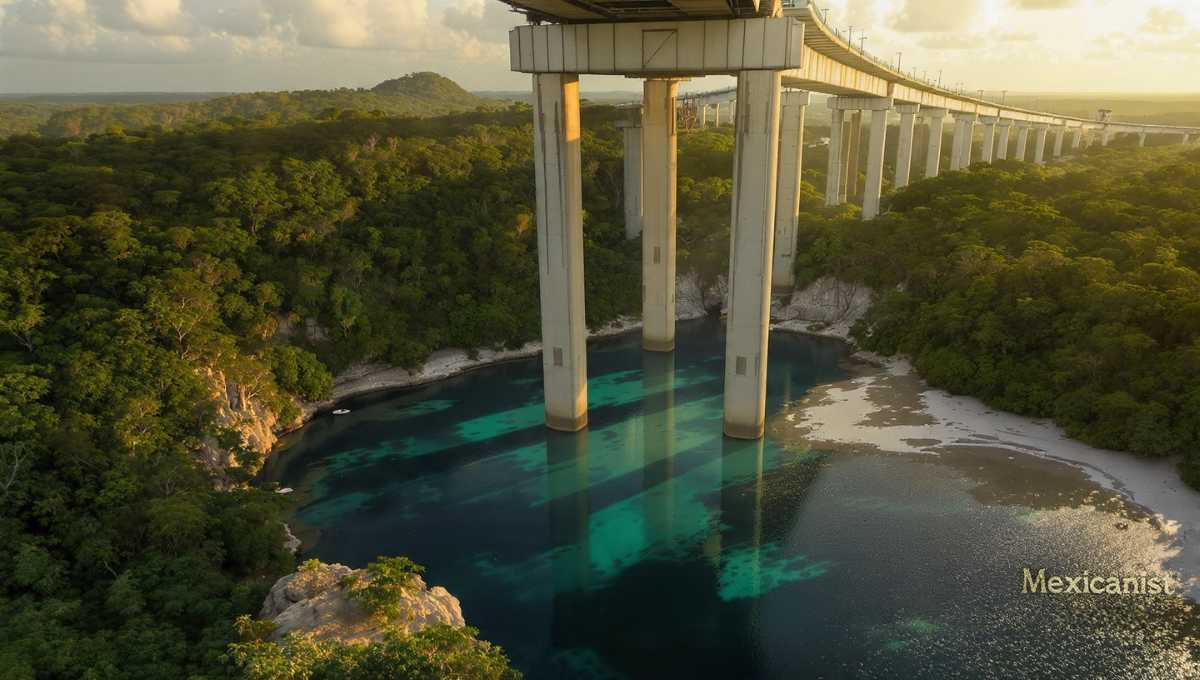
Beneath the postcard-perfect coastline of Quintana Roo — the stretch of Caribbean paradise that gave the world Cancún, Playa del Carmen, and Tulum — there's a war being fought underground. Not with guns. With concrete, steel pillars, and billion-dollar permits.
The combatants? On one side: resort developers, real estate speculators, and a federal government hell-bent on turning Mexico into the world's fifth-most-visited country by 2030. On the other: a ragtag coalition of cave divers, Maya communities, biologists, and environmental activists who've watched the Yucatán Peninsula's ancient freshwater system get carved up like a developer's pie chart.
The battlefield is the cenote — those hauntingly beautiful limestone sinkholes the ancient Maya called gateways to the underworld. And right now, the underworld is losing.
The Numbers That Should Terrify You
Let's start with the body count — cenote edition:
● 10,000+ cenotes dot the Yucatán Peninsula, forming the region's only freshwater source across a 165,000-square-kilometer aquifer
● 80% of explored cenotes in Quintana Roo show alarming contamination levels, according to recent studies
● 120+ cenotes are at risk of contamination from Tren Maya construction alone, per activist Gemma Santana
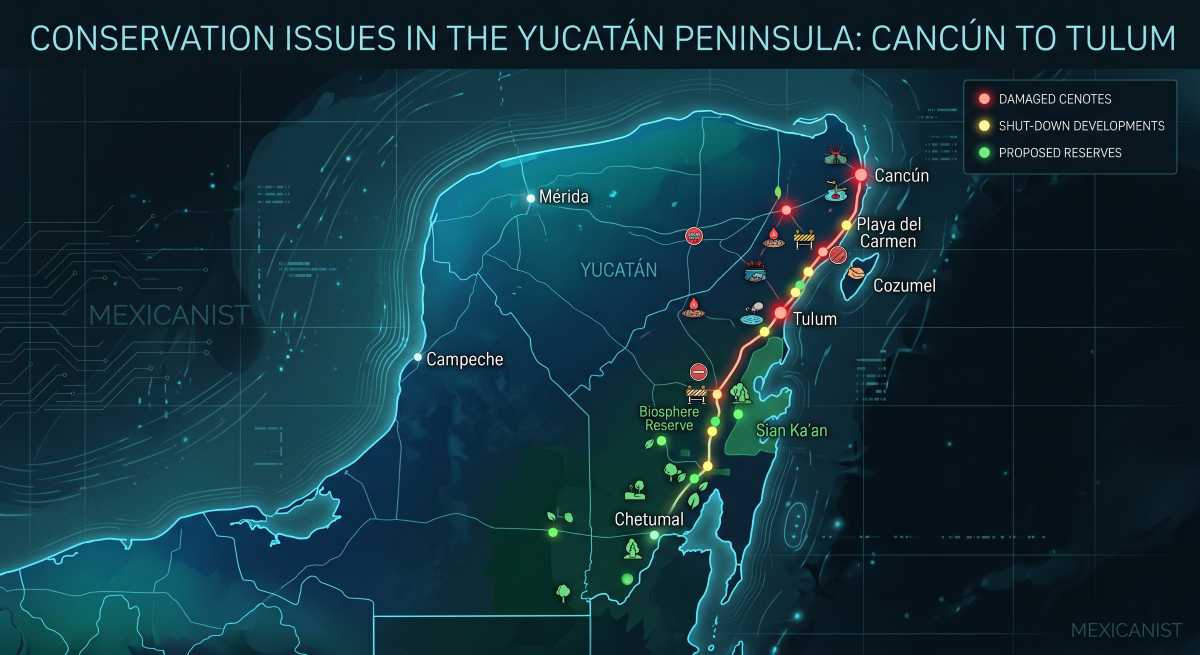
● 30+ cenotes confirmed contaminated in just Tramo 5 of the Tren Maya — the 65-kilometer stretch between Cancún and Tulum
● 8 caves and cenotes officially acknowledged as damaged by Environment Minister Alicia Bárcena, with concrete poured directly into chambers named Garra del Jaguar, Oppenheimer, Manitas, and Dos Balas
● 3 cenotes destroyed by Vulcan Materials' subsidiary Sac-Tun (formerly Calica) at a limestone quarry in Solidaridad — what the government itself called an "ecological disaster"
● 45 real estate and hotel developments shut down by Profepa between 2019 and April 2025 for environmental violations — 21 in Benito Juárez (Cancún), 24 in Playa del Carmen
● ~100 irregular developments detected on the Ruta de los Cenotes alone, according to municipal authorities
● 11,000+ hectares of forest cleared for Tren Maya, per Semarnat's own admission
● 21 million tourists visited Quintana Roo in 2023 — a quarter of all of Mexico's tourism revenue
If cenotes could file police reports, the docket would wrap around the Yucatán twice.
The $30 Billion Concrete Snake
Meet the Tren Maya — the 1,554-kilometer railway that was supposed to lift 1.1 million people out of poverty and create 900,000 jobs by 2030, according to United Nations projections. Former President Andrés Manuel López Obrador's pet megaproject was declared a matter of "national security," handed to the military for construction, and shielded from court injunctions like a president's favorite child.
It cost nearly four times its original $8 billion budget, coming in at roughly $27-30 billion. In its first year of operation, it carried about 1,200 daily passengers — a fraction of the projected 22,000 to 37,000. That's like buying a Ferrari to drive to the corner store.
But the real cost isn't measured in pesos. It's measured in stalactites.
Biologist and speleologist Roberto Rojo was exploring a cave in Quintana Roo when he heard the unmistakable sound of an industrial drill punching through the ceiling above him. Stalactites rained down. He ducked for cover, then captured video as a steel pillar — 24 meters tall, 1.2 meters in diameter — was driven straight into the cenote chamber. Cement oozed into crystal-clear water, creating dark stains that looked like bruises on the earth's skin.
By Rojo's count, more than 15,000 steel pillars have been driven into the thin Yucatán soil to support the elevated railway. At the site he documented, 40 pillars march through a single cenote in rows of four.
"If you destroy part of the cenote system, you risk it all, because they're interconnected and drain to the sea," Rojo warned in a National Geographic investigation published in September 2025.
The Yucatán Peninsula's porous limestone bedrock means there are virtually no surface rivers or lakes. The cenote network is the water system. It sustains millions of people, hundreds of species — from jaguars to tapirs — and the entire tourism economy that depends on pristine beaches (which themselves depend on the aquifer's health).
You can't pave paradise and expect the beach to stay clean. The geology doesn't negotiate.
The Concrete Cowboys of Playa del Carmen
If the Tren Maya is the sledgehammer, private developers are the scalpels — and they've been at it far longer.
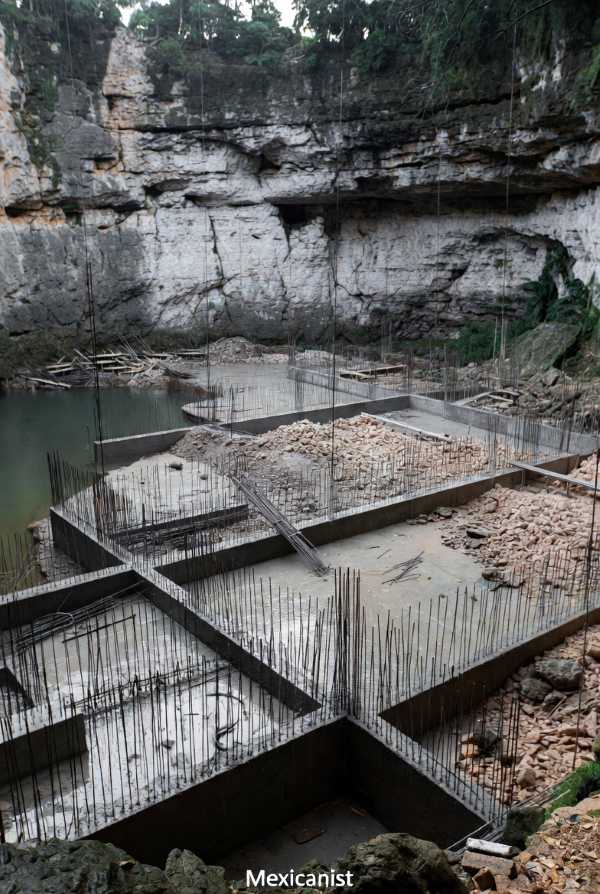
In early 2025, a Playa del Carmen real estate developer did something so brazen it managed to shock a country that thought it had seen everything: they poured concrete directly into a cenote to build an apartment building. Not near it. Not around it. Into it. Filled the sacred sinkhole with cement like it was a pothole on the highway.
The case went viral on social media. The municipality shut down the site. The state environmental prosecutor (PPA) opened an investigation. But the damage was done — literally. Once you concrete over a cenote, you block the natural water flow through the underground river system, increasing flood risk for the entire surrounding area.
This wasn't an isolated incident. It was just the one that got caught on camera.
On the Ruta de los Cenotes — a stretch outside Puerto Morelos where adventure tourism meets raw jungle — authorities have detected approximately 100 irregular developments. Many went up without environmental impact assessments, on forest land that was illegally cleared, on top of cenote systems that nobody bothered to map before breaking ground.
Profepa, the federal environmental protection agency, shut down 45 developments in Quintana Roo's tourist zones between 2019 and April 2025. Of those, 39 were cited for lacking environmental impact authorizations altogether. The remaining six violated existing permits. One project near the Royalton Riviera Cancún was shuttered for having zero environmental clearance. Another in Playa Paraíso filled nearly 1,000 square meters of coastal scrub with construction material — no permit, no shame.
The pattern is as consistent as it is cynical: build first, ask forgiveness later. By the time inspectors arrive, the cenote is already a foundation.
The American Quarry That Ate Three Cenotes
Enter Vulcan Materials Company — the Alabama-based construction materials giant that operates through its Mexican subsidiary Sac-Tun (formerly Calica). Their limestone quarry in Solidaridad, Quintana Roo, was so aggressive that Environment Minister Alicia Bárcena declared it an "ecological disaster" and announced that the company must restore the site.
Three cenotes destroyed. Gone. obliterated by industrial quarrying inside a karst landscape so fragile that even a well-placed hammer can crack an underground river.
Semarnat responded by declaring the area a Protected Natural Area — effectively locking Vulcan out of further extraction. López Obrador, in his final days in office, banned material extraction at the seized site altogether. The company's dispute with the Mexican government became an international incident, pitting a Fortune 500 company against a sovereign nation's environmental agencies.
The irony? The very limestone Vulcan was extracting is the rock that forms the cenotes. They were literally mining the cenotes' bones.
Sélvame del Tren and the Resistance
If you want to understand the activist side of this war, talk to José Urbina. A Tulum-based environmentalist fighting Tren Maya, Urbina has walked government officials through the jungle to show them the contamination firsthand.
"They listened, they came, they saw with their own eyes," Urbina told Mongabay. "We walked with them in the jungle, we took them to see the contamination, to see the damage — and they understood."
Urbina is part of Sélvame del Tren ("Save Me from the Train"), a grassroots movement that has become the most vocal opposition to the railway's environmental destruction. The group works alongside Cenotes Urbanos, a citizen science initiative, to map and monitor cave health across Quintana Roo.
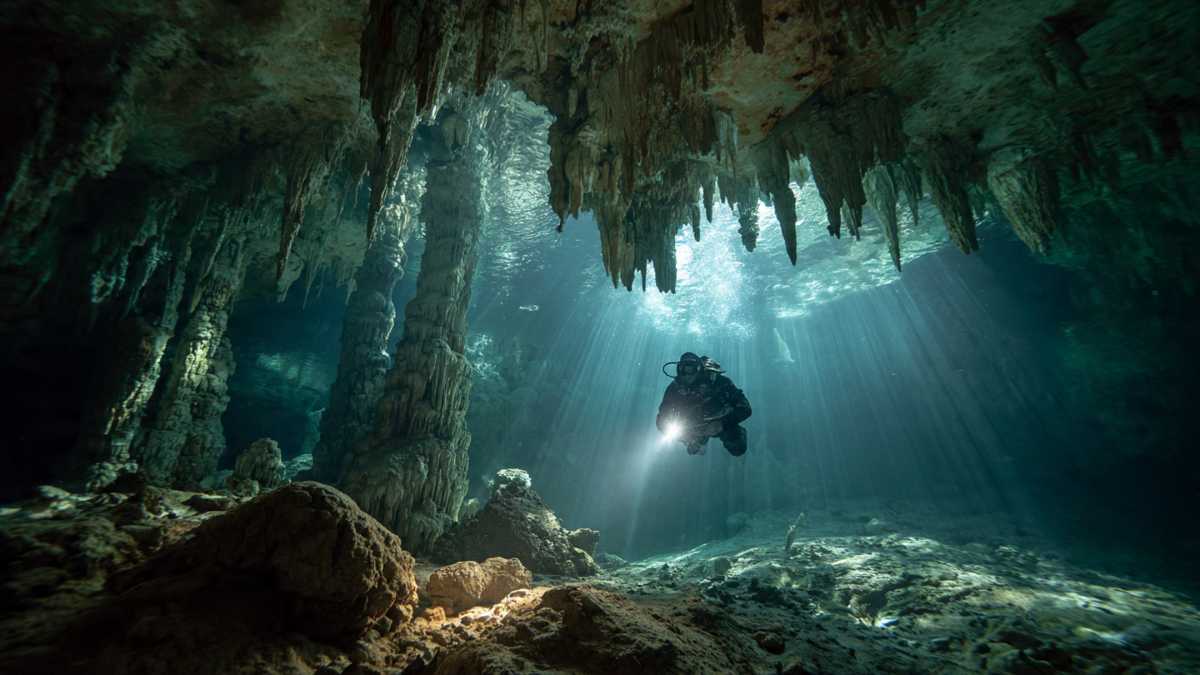
Together, they've partnered with cave divers and researchers from CINDAQ (Centro Investigador del Sistema Acuífero de Quintana Roo) to measure water quality in caves that are home to increasingly threatened species — blind cave fish, specialized crustaceans, and organisms that exist nowhere else on Earth.
Their approach is methodical: map the damage, document the science, publish the results, shame the perpetrators. They've been remarkably effective at getting international attention — National Geographic sent a team, and the resulting September 2025 feature put the cenote crisis on the global map.
In April 2025, Sélvame del Tren proposed creating two new ecological reserves along Tramo 5 South to compensate for Tren Maya's damage. Semarnat officials visited the sites. The proposal is under review.
But the activists aren't anti-development across the board. Urbina himself put it plainly: "If they respect the law, they respect the environment, please be my guest. But if they need to break the law, insult and endanger people who are raising their voices — then it doesn't matter if it's a train or a highway. It's wrong."
Hard to argue with that.
The Government's Belated Mea Culpa
Here's where things get genuinely interesting. The Sheinbaum administration — which inherited the Tren Maya mess from AMLO — has done something unusual for a Mexican federal government: it admitted fault.
Environment Minister Alicia Bárcena stood before Congress and acknowledged that eight caves and cenotes were damaged by Tramo 5 construction. She told a radio audience that "a restoration process is necessary" and that environmental groups should help evaluate what went wrong.
Semarnat revealed that the train deforested more than 11,000 hectares and contaminated more than 30 cenotes in a single section. Undersecretary of Biodiversity Marina Robles García is exploring biosphere reserve status for caves and cenotes in Quintana Roo.
The agency even proposed removing fencing along the tracks that blocks wildlife crossings and banning new access roads that would connect the train to deeper jungle tourism activities — recognizing that the secondary development triggered by improved access might be more destructive than the train itself.
This is, to put it mildly, unprecedented. Mexican governments don't typically admit that their flagship infrastructure projects caused ecological harm. The question is whether the mea culpa translates into actual policy or remains political theater.
President Claudia Sheinbaum has announced plans to expand Tren Maya with 10 cargo hubs and a 44-mile extension to the port of Progreso. She's also pushing the railway toward Guatemala — despite concerns about the Maya Biosphere Reserve. And she wants Mexico to jump from the world's sixth to fifth most-visited country, a 40% tourism increase that would mean three million more tourists per year.
So the same government acknowledging environmental damage is simultaneously planning more development that could cause... more environmental damage. Bold strategy.
The Acapulco Warning
Adrián Méndez Barrera, coordinator of the UNDP-backed Kuxatur project (the name means "living tourism" in Maya), has issued a stark warning: if Quintana Roo doesn't change course, it could become the next Acapulco.
That's not a throwaway comparison. Acapulco was Mexico's premier beach destination for decades before uncontrolled development, environmental degradation, and criminal violence turned it into a cautionary tale. Hurricane Otis in 2023 delivered the final blow to a city already hollowed out by poor planning.
"Tourism requires biodiversity to exist — the landscapes, the water, the reefs; without them, there is simply no tourism," Méndez Barrera said. He pointed to visible damage already done: reef deterioration, water pollution, and mangrove loss that increases hurricane vulnerability.
A study of urban cenotes and monitoring wells in Playa del Carmen found elevated nutrient concentrations linked to untreated wastewater discharge. Parts of the city lack proper drainage, meaning sewage seeps directly into the aquifer — the same aquifer that feeds the beaches tourists fly 5,000 miles to visit.
Cancún's cenotes are already "dying," according to a March 2026 report, trapped within the urban sprawl, choked by garbage, and ignored by authorities. The report described cenotes along Avenida Chichén Itzá in Supermanzana 60 — once-vital wetlands now surrounded by the city, surviving between trash and official neglect.
When the cenotes die, the freshwater dies. When the freshwater dies, the beaches erode. When the beaches erode, the tourists stop coming. It's not environmental alarmism — it's basic geology.
The Great Divide: Jobs vs. Jewels
Not everyone agrees the cenotes should be saved at all costs. The Tren Maya debate has split former allies down the middle.
Ecologist Germán Yáñez, once Roberto Rojo's diving partner, joined the National Institute of Anthropology and History team that deployed 2,000 specialists to evaluate cultural heritage along the railway route. His verdict? "The train is an incredible achievement." He argues it will save the peninsula by creating jobs and fighting the marginalization that has kept Maya communities impoverished for centuries.
The UN projections are staggering: 900,000 new jobs, 1.1 million people lifted from poverty. The train has already uncovered significant archaeological finds, including a complete Maya canoe dating to 900 CE.
But critics counter that over 25,000 archaeological pieces were destroyed during construction. Environmental activist Otto von Bertrab called the project a "cultural and environmental catastrophe," noting that López Obrador explicitly promised no trees would be cut — and millions were felled.
The truth, as usual, isn't on either extreme. The Yucatán Peninsula genuinely needs economic development. Its indigenous communities have been marginalized for 500 years. A railway connecting them to the broader economy isn't inherently evil. The problem isn't the train. The problem is the way it was built — without adequate environmental studies, with retroactive permits, with court injunctions ignored, with cenotes treated as speed bumps rather than irreplaceable ecosystems.
As National Geographic writer Michael Finkel framed it: "Supporters see it as a potential global model for balancing conservation with growth. The detractors argue the opposite: that the only thing the Maya Train will accomplish is to show the world what not to do."
What Actually Needs to Happen
If Quintana Roo is going to have both tourism and cenotes — and it can, because they're the same thing — here's the playbook:
1. Map everything. You can't protect what you haven't surveyed. Only a fraction of Quintana Roo's underground water system has been properly mapped. CINDAQ and similar organizations need funding, not obstruction.
2. Enforce the permits that exist. Profepa's 45 closures prove the laws are there. They're just not enforced proactively. Developers know they can build first and pay fines later — fines that are rounding errors compared to profits.
3. Make the penalties hurt. Shutting down a construction site after a cenote is already filled with concrete isn't deterrence — it's theater. Fines should exceed profits. Criminal charges should follow deliberate destruction.
4. Protect before, not after. Semarnat's proposal to grant biosphere reserve status to cave systems is smart. It should have happened before 15,000 steel pillars went in, not after.
5. Invest in wastewater infrastructure. Playa del Carmen's contaminated cenotes aren't just a developer problem. The city needs drainage. Without it, every flush is a slow-motion ecological disaster.
6. Listen to the locals. Maya communities have been reading this landscape for millennia. The Kuxatur model — "living tourism" — offers a framework where development serves communities rather than extracting from them.
7. Connect the dots for tourists. The 21 million visitors who flock to Quintana Roo each year need to understand that the pristine beach they're lying on exists because of the cenote system beneath it. Kill the cenotes, kill the beach, kill the tourism. It's that simple.
Quintana Roo is standing at the edge of a sinkhole — figuratively and literally. The cenote system that makes the region's beaches, tourism, and freshwater possible is being destroyed by the very industry that depends on it. The Tren Maya poured gasoline on the fire. Private developers have been lighting matches for decades.
The Sheinbaum government's acknowledgment of damage is a start. Sélvame del Tren's activism is essential. CINDAQ's science is invaluable. But none of it matters if three million more tourists arrive on the same crumbling infrastructure, if developers keep filling sinkholes with concrete, and if the only freshwater system on the peninsula gets treated as a construction inconvenience.
The Maya believed cenotes were portals to Xibalba — the underworld. Right now, Xibalba is receiving visitors it never asked for. The concrete kind. The steel kind. The kind that comes with building permits signed in back rooms.
The cenotes survived the Spanish conquest. They survived 500 years of colonialism. Whether they survive the 2020s tourism boom is an open question — and the answer will determine if Quintana Roo remains paradise or becomes a very pretty cautionary tale.
Sources
1. National Geographic — "The Fight to Preserve Mexico's Enchanting Cenotes," Michael Finkel, September 2025. [Link](https://www.nationalgeographic.com/environment/article/saving-mexico-cenotes-tren-maya)
2. Yucatán Magazine — "Nat Geo Documents How the Maya Train Damage Cenotes," August 22, 2025. [Link](https://yucatanmagazine.com/national-geographic-maya-train-impact/)
3. Mongabay — "Mexican government looks to correct Tren Maya environmental damages," April 2025. [Link](https://news.mongabay.com/2025/04/mexican-government-looks-to-correct-tren-maya-environmental-damages/)
4. La Silla Rota — "Tren Maya: ecocidio, despojo y división de comunidades, acusan ambientalistas," November 25, 2025. [Link](https://lasillarota.com/nacion/2025/11/25/tren-maya-ecocidio-despojo-division-de-comunidades-acusan-ambientalistas-570713.html)
5. Riviera Maya News — "Profepa shuts 45 Quintana Roo resorts for eco violations." [Link](https://www.rivieramayanews.mx/profepa-shuts-down-45-developments-in-quintana-roo-tourist-zones-for-environmental-violations/)
6. Riviera Maya News — "Damage to Eight Caves and Cenotes from Maya Train in Quintana Roo Acknowledged." [Link](https://www.rivieramayanews.mx/damage-to-eight-caves-and-cenotes-from-maya-train-in-quintana-roo-acknowledged/)
7. El Financiero — "Gobierno acepta daños en Tren Maya: retirará malla de vías y cenotes," April 15, 2025. [Link](https://www.elfinanciero.com.mx/empresas-ESG/2025/04/15/gobierno-acepta-danos-en-tren-maya-retirara-malla-de-vias-y-cenotes/)
8. MVS Noticias — "¿Se contaminan más de 120 Cenotes en Quintana Roo por el Tren Maya? Gemma Santana lo explica," October 8, 2025. [Link](https://mvsnoticias.com/entrevistas/2025/10/8/se-contaminan-mas-de-120-cenotes-en-quintana-roo-por-el-tren-maya-gemma-santana-lo-explica-714645.html)
9. Grupo Pirámide — "En Quintana Roo, 80% de los cenotes están contaminados, amenaza para economía regional," July 2025. [Link](https://grupopiramide.com.mx/nota/en-quintana-roo-80-de-los-cenotes-estan-contaminados-amenaza-para-economia-regional/)
10. Por Esto — "Detectan alrededor de 100 desarrollos irregulares en la Ruta de los Cenotes," September 14, 2025. [Link](https://www.poresto.com/quintana-roo/riviera-maya/2025/9/14/detectan-alrededor-de-100-desarrollos-irregulares-en-la-ruta-de-los-cenotes.html)
11. Por Esto — "'Se están muriendo': Cenotes de Cancún sobreviven entre basura y omisiones," March 31, 2026. [Link](https://www.poresto.com/quintana-roo/cancun/2026/3/31/se-estan-muriendo-cenotes-de-cancun-sobreviven-entre-basura-y-omisiones.html)
12. Macronews Mexico — "Escándalo ambiental por una inmobiliaria en Playa del Carmen; rellenan cenote con concreto," March 2025. [Link](https://macronews.mx/quintana-roo/solidaridad/escandalo-ambiental-por-una-inmobiliaria-en-playa-del-carmen-rellenan-cenote-con-concreto-para-construir-departamentos/)
13. CreditRiskMonitor / Semarnat — "Calica destroyed three cenotes, must restore ecological disaster." [Link](https://info.creditriskmonitor.com/NewsStory.aspx?NewsId=48501697)
14. The Yucatan Times — "Tourism in Crisis: Environmental Collapse in Quintana Roo Due to Uncontrolled Development," May 2025. [Link](https://theyucatantimes.com/2025/05/tourism-in-crisis-environmental-collapse-in-quintana-roo-due-to-uncontrolled-development/)
15. Revista Flow — "Playa del Carmen enfrenta crisis ambiental: estudio revela cenotes y pozos contaminados." [Link](https://revistaflow.com/playa-del-carmen-enfrenta-crisis-ambiental-estudio-revela-cenotes-y-pozos-contaminados/)
16. Mexico Daily Post — "The Maya Train: A costly ride through Mexico's Southeast losing 7.1 million pesos every 24 hours," August 22, 2025. [Link](https://mexicodailypost.com/2025/08/22/the-maya-train-a-costly-ride-through-mexicos-southeast-losing-7-1-million-pesos-every-24-hours/)
17. El Universal — "Buscan compensar daños ambientales del Tramo 5 sur del Tren Maya; ONG propone dos nuevas reservas ecológicas," April 4, 2025. [Link](https://www.eluniversal.com.mx/estados/buscan-compensar-danos-ambientales-del-tramo-5-sur-del-tren-maya-ong-propone-dos-nuevas-reservas-ecologicas/)
18. Infobae — "¿Qué está pasando en Tulum? Sélvame Mx denuncia apertura ilegal de carretera sobre cenotes históricos," April 4, 2026. [Link](https://www.infobae.com/mexico/2026/04/04/que-esta-pasando-en-tulum-selvame-mx-denuncia-apertura-ilegal-de-carretera-sobre-cenotes-historicos/)
19. CINDAQ — Centro Investigador del Sistema Acuífero de Quintana Roo A.C. [Link](https://www.cindaq.org/)
20. Thriving Earth Exchange / AGU — "Community Outreach and Participation in Tourist Cenotes, Quintana Roo, Mexico." [Link](https://thrivingearthexchange.org/project/quintana-roo-mexico/)
21. Quinta Fuerza — "Semarnat retirará malla de vías y cenotes del tramo 5 del Tren Maya en Playa del Carmen." [Link](https://quintafuerza.mx/quintana-roo/playa-del-carmen/semarnat-retirara-malla-de-vias-y-cenotes-del-tramo-5-del-tren-maya-en-playa-del-carmen/)
22. Sol Quintana Roo — "Semarnat admite daño a cenotes y cavernas por construcción del Tren Maya." [Link](https://solquintanaroo.mx/semarnat-admite-dano-a-cenotes-y-cavernas-por-construccion-del-tren-maya/)
23. Riviera Maya News — "Maya Train Passengers Jump 74% in 2025." [Link](https://www.rivieramayanews.mx/passenger-numbers-on-maya-train-surge-74-from-may-2024-to-2025/)