Tacoma's Quiet Move: Why Toyota Shifting Production to Texas Matters for Mexico
Toyota's $3.6 billion decision to move Tacoma assembly from Tijuana to San Antonio signals the deeper forces reshaping North American automotive supply chains.

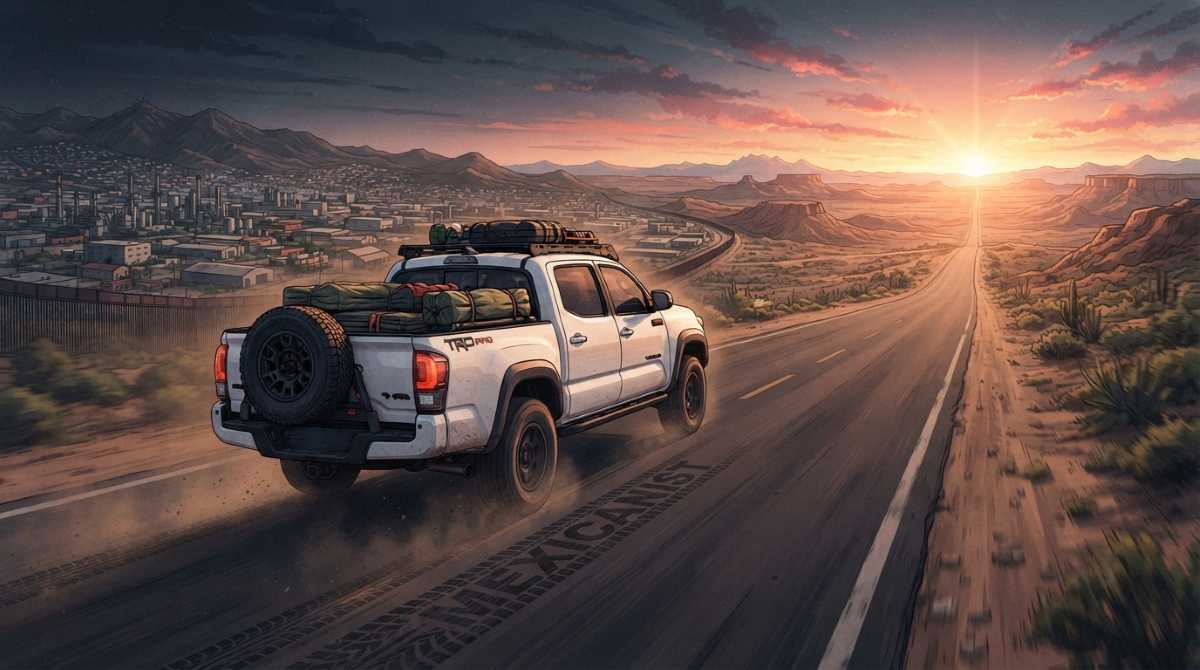
The trucks still roll out of the Tijuana plant every morning, Tacoma pickups stacked on flatbeds heading north toward the Otay Mesa crossing. The convoy has been a fixed routine on the Tijuana-Tecate highway for more than two decades. By 2030, that parade will have stopped entirely.
Toyota announced on July 6 that it will invest $3.6 billion to build a second assembly line at its San Antonio, Texas campus, gradually relocating Tacoma production from its Baja California facility to the United States over the next four years. With 166,653 Tacomas assembled at the Tijuana plant last year, and 93 percent of those destined for US and Canadian customers, the scale of what is being moved is hard to overstate. The Tacoma is the best-selling midsize pickup in America, with 274,638 units sold across the US in 2025 alone. More than half of Toyota's overall US sales growth last year came from the Tacoma line.
The Japanese automaker framed the decision as supply chain rationalization. Ted Ogawa, president and CEO of Toyota Motor North America, said in a company statement that the San Antonio expansion "reinforces our commitment to American manufacturing" and "will help strengthen our supply chain, meet customer demand, and create economic opportunities in Texas." The second line will add 150,000 units of annual capacity to the Texas plant and create 2,000 jobs for the state.
But in Tijuana, the announcement landed as something else entirely. Alfonso Millan, who leads the Baja California chapter of the National Chamber of Freight Transportation (CANACAR) and whose members transport hundreds of Tacomas across the border every day, put it plainly. "We took the news with caution, but very seriously," he told reporters. "I'd be a little more cautious about what to expect going forward. As of now, the plant has been a model of efficiency, hard work and prompt deliveries."
CANACAR's alert to its members, which circulated within hours of Toyota's press release, warned that the implications extend far beyond a single assembly line. The chamber represents the freight and logistics backbone of the cross-border automotive trade, and its assessment was direct: when a flagship vehicle like the Tacoma leaves Mexican soil, the entire supplier ecosystem feels it. For CANACAR's members, the daily convoy of finished Tacomas heading to US dealerships represents thousands of trucking loads per year. That volume moves through Otay Mesa, the busiest commercial port of entry in California, supporting not just drivers but customs brokers, warehouse operators, and freight forwarders on both sides of the border.
The math is blunt. Toyota's Tijuana plant, its first full-scale operation in Mexico when it opened in 2004, employs more than 3,000 workers. Some 1,500 suppliers feed into the facility's operations, from stamped metal parts to electrical wire assemblies to seat components. Ismael Plascencia, coordinator of the business administration program at CETYS University in Tijuana, estimates that the indirect job losses among suppliers could reach an additional 2,000 positions. "The implications are significant because the jobs are well-paid," Plascencia said. "People earn more in the automotive sector than in other industrial sectors."
The Baja California plant is singularly dependent on the Tacoma. It produces no other vehicle model. If no replacement is assigned to the facility before the Tacoma line finishes its migration to Texas, the plant faces an existential question about its continued operation. Toyota has said it has no future product announcements for the Tijuana facility at this time. A company spokesperson added that "Toyota is maintaining its operations in Mexico," but offered no clarity on what the Baja California plant will build after the last Tacoma rolls off the line.
This is where the story connects to forces larger than one automaker's production planning. The transfer is happening against the backdrop of a trade environment that has shifted dramatically in the past year. The United States has imposed tariffs of up to 25 percent on vehicles imported from Mexico, directly raising the cost of every Tacoma that crosses the border. More fundamentally, the review of the United States-Mexico-Canada Agreement, known in Mexico as the TMEC, was allowed to lapse on July 1 without an extension. The Trump administration has instead opted for annual reviews, creating a rolling uncertainty that makes long-term manufacturing commitments across the border a harder calculation for every automaker.
President Donald Trump praised Toyota's decision on Truth Social, writing that "Toyota is moving from Mexico to the United States (to Texas!). This is something of great importance. Tariffs are working!"
The cause-and-effect claim is disputed by trade analysts, who point out that Toyota's $10 billion US manufacturing investment plan predated the tariff escalation and that the company was already retooling its North American footprint long before the latest trade disputes. But the political narrative is potent. Toyota's move is the kind of concrete, visible example the administration can hold up as proof that protectionism delivers jobs to American workers. The plant in San Antonio, which currently builds full-size Tundra pickups and Sequoia SUVs near its annual capacity of 200,000 vehicles, will expand to approximately 5 million square feet, bringing Toyota's cumulative investment at the site to $8.3 billion.
For Mexico, the timing could not be worse. The country's automotive sector is the crown jewel of its manufacturing economy, accounting for roughly 3.5 percent of GDP and nearly 20 percent of manufacturing output. Baja California alone generates an estimated 400,000 direct manufacturing jobs, according to Index Tijuana, the organization representing export-oriented industries. And while Toyota's Guanajuato plant, which employs 2,800 workers and produces Tacomas alongside the Tijuana facility, has said operations will continue unaffected, the dual-plant strategy now looks fragile. Guanajuato will focus on the next-generation hybrid Tacoma, leaving Tijuana as the exposed branch.
Mexico's Secretariat of Economy issued a statement acknowledging the decision as "part of a process to restructure its global operations" and stressed that the transition would be gradual. "The relocation of production will not happen immediately but rather as a gradual process completed by 2030," officials said. The statement added that the company is "continuing to assess the plant's future" beyond that date.
The Baja California plant opened in 2004 as Toyota's first wholly owned manufacturing operation in Mexico. At the time, it represented a bet on the region's cross-border advantages: a skilled workforce, proximity to the largest US market for trucks, and the institutional stability of NAFTA, the precursor to the USMCA. Two decades later, that bet is being unwound.
One worker outside the Tijuana facility told the San Diego Union-Tribune that the plant had been a good place to work. She said she felt somewhat safe for now but was not sure about the future. That uncertainty has spread fast through Tijuana's industrial corridor, where the plant sits along the highway to Tecate surrounded by auto parts warehouses, logistics yards, and supplier workshops.
The business community in Baja California has not waited for clarity from Tokyo or Mexico City. Octavio Sandoval, president of the Baja California Business Coordinating Council, said his organization is already working on a mitigation strategy. "We're going to develop a strategy to mitigate the impact," Sandoval said. "These are decisions we cannot change."
Elisa Ibanez, president of the Tijuana chapter of Coparmex, Mexico's Employers Confederation, described the Toyota announcement as a "wake-up call" for the country. "Companies tend to locate where other companies are, bringing their suppliers with them," she said. "We need to be mindful of that impact, and we can't downplay it. We need to pay attention to that warning."
The TMEC review that collapsed on July 1 adds another layer. Under the original agreement, the three countries were to conduct a joint review every six years. The Trump administration's decision to let the deadline pass without renewal and instead move to annual reviews means that every year, automakers face the prospect of a rules reset. Toyota's press release on the San Antonio expansion explicitly called for a quick resolution, stating that the company "encourages a quick resolution of the USMCA review to make the North American region globally competitive." That statement, buried in a press release about moving jobs to Texas, was the closest a major automaker has come to publicly acknowledging the cost of the uncertainty.
The deeper question is what this means for the nearshoring narrative that has dominated Mexico's economic story for the past three years. The argument has been that proximity to the US market, competitive labor costs, and the institutional framework of the USMCA made Mexico the natural winner as companies sought to move production out of Asia and closer to American consumers. The logic was simple: if global supply chains were going to shorten, Mexico was in the right place at the right time. Toyota's Tacoma decision does could not refute that thesis — it complicates it significantly. If the trade rules that make cross-border manufacturing viable are in constant flux, and if tariffs create a cost disadvantage that outweighs labor savings, companies will recalculate. The question is which direction.
Plascencia at CETYS University argued that the moment demands a strategic response, not a defensive one. "Mexico needs to seek diversification," he said. "That doesn't mean antagonizing the United States. However, if we see that they aren't treating us fairly as a trading partner, the smartest thing we could do is develop our own industrial policy and diversify our markets." He pointed to Baja California's existing strengths in medical devices, aerospace, and healthcare services as sectors that could absorb some of the shock.
The Guanajuato plant continues at full capacity, with 155,000 units annually focused on the hybrid Tacoma for the US market. Other automakers including BMW, Kia, and Volkswagen maintain major Mexican operations. The US remains dependent on Mexican-built vehicles for a significant share of its market. Toyota itself has said it remains committed to Mexico and that the Guanajuato operation will continue. But the Tacoma decision has introduced a new calculus.
Plascencia summed up the challenge for Baja California. "Instead of seeing things in black and white because Toyota is leaving, which is a strong blow," he said, "we should continue to strengthen the other areas where we can develop value chains together with California, San Diego and Tijuana because, in the end, we are a metropolis that competes globally."
The warning from CANACAR is specific and concrete. One pickup truck, gradually moving north over four years, is a signal. The question is how many more signals arrive before 2030.