The Letter They Did Not Want: How 1,800 Mexican Municipalities Rejected Trump's "Remain in Mexico" Revival
In an extraordinary show of subnational defiance, Mexico's municipal presidents became the frontline resistance to Trump's revived migration enforcement, rejecting ICE demand letters en masse.

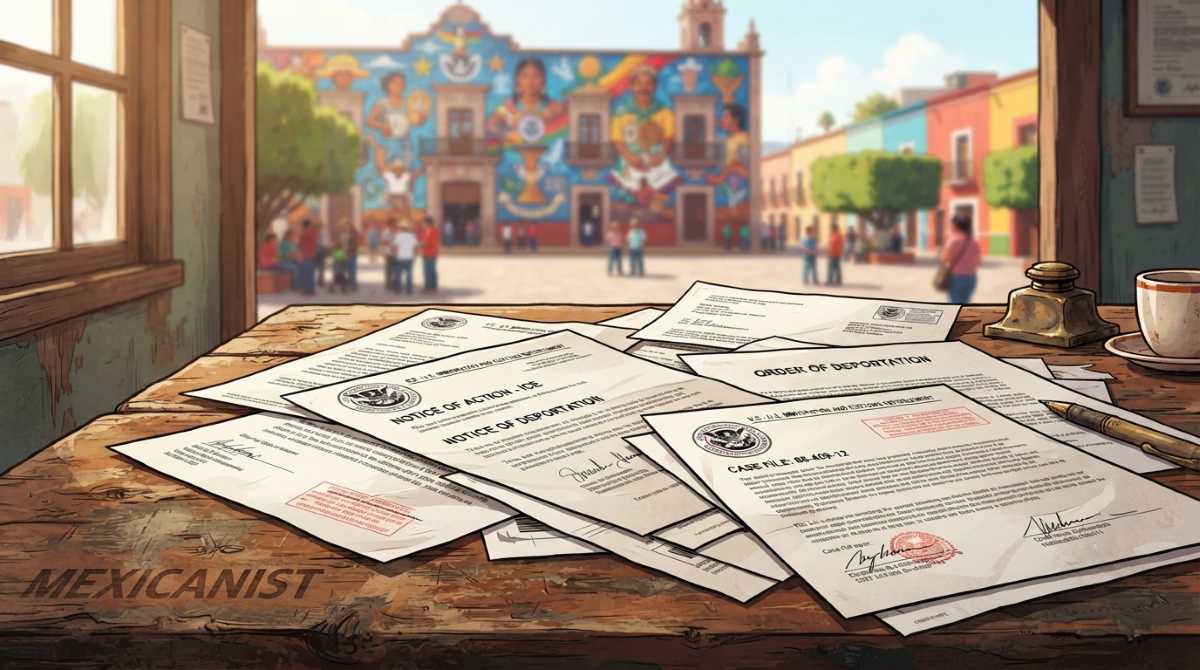
The letters arrived on municipal letterhead, stamped with the ICE seal, and addressed to Mexico's smallest unit of government: the local mayor. They asked for resources. They asked for cooperation. They asked municipal presidents to help make Trump's revived migration enforcement work on Mexican soil. And then, in an extraordinary cascade of refusal that caught Washington off guard, the mayors said no.
More than 1,800 municipalities across at least a dozen states have now formally rejected the demand letters sent by US Immigration and Customs Enforcement in early July, according to reports from state-level associations of municipal governments. The coordinated pushback, unprecedented in scale, is the first major test of Trump's post-election migration strategy at the level where federal policy meets local reality. And it represents a problem the Trump administration did not plan for: a country where the center cannot compel the periphery.
The letters, sent by ICE field offices to municipal governments in border and interior states, requested that local authorities "present resources" for detention and deportation operations under the revived Migrant Protection Protocols, known colloquially as "Remain in Mexico." The program, which requires asylum seekers to wait in Mexico while their US claims are processed, was a pillar of Trump's first-term immigration enforcement. It is being resurrected alongside a broader deportation push that includes military aircraft, detention expansion in US border cities, and bilateral pressure on Mexico's federal government.
But ICE sent the letters to municipal presidents, not to federal officials in Mexico City. And that is where the plan unravelled.
Municipal presidents in states including Nuevo Leon, Tamaulipas, Chihuahua, Baja California, Sonora, Coahuila, Zacatecas, San Luis Potosi, Jalisco, Michoacan, Guanajuato, and Estado de Mexico have issued public statements or formal resolutions rejecting the demands. The arguments are consistent across party lines. Municipalities say they lack the financial resources, the legal authority, and the political mandate to participate in US deportation operations.
"We are not border patrol agents. We are not migration officers. We run the water, the trash collection, the public lighting," said a municipal president from a town in Nuevo Leon, speaking on condition of anonymity because of the sensitivity of the matter. "ICE sent us a letter asking us to coordinate detention logistics. We do not have a detention centre. We do not have a deportation budget. We have a pothole problem and a broken water pump."
The rejection has been notable for its cross-party uniformity. Mayors from the ruling Morena party, the opposition PAN, and the centrist PRI have all issued similar statements. This is not a partisan fight in Mexico; it is a structural one. The municipalities are not saying they disagree with the policy. They are saying they cannot implement it.
"What ICE appears to have miscalculated," said a Mexico City-based migration analyst who has advised the Secretaria de Gobernacion, "is the difference between a federal government that can negotiate and a municipal government that has no choice but to say no. The federal government can be diplomatic. The municipality has to tell its residents what happened. And the residents are not going to accept their town being turned into a staging ground for US deportations."
The letter itself has been described by several municipal officials as vague regarding specific demands but clear in its intent. It asked municipalities to confirm their capacity to receive deportation flights, provide temporary shelter for detainees, and coordinate logistics with ICE field offices. It offered no funding. It offered no timeline. It offered no guarantee of federal Mexican support.
"They basically asked us to sign a blank cheque for operations we do not control, with money we do not have, for a policy we did not design," said a municipal secretary in Tamaulipas.
The federal response has been careful. President Claudia Sheinbaum's administration initially said it had not vetted the letters and could not confirm their origin or legal basis. That cautious stance frustrated many municipal leaders, who felt the federal government was leaving them exposed.
"They told us, 'We cannot tell you what to do. You are autonomous,'" said one municipal president from Chihuahua. "Autonomous. We are autonomous to be defrauded by an international agency."
Within days, the federal government issued guidance stating that municipalities were not obligated to comply with the letters. But by then, the pushback had already taken on a life of its own. State-level associations of municipalities, particularly the Conferencia Nacional de Municipios de Mexico (CONAMM), began circulating template rejection resolutions. Mayors passed them in open session, often with press coverage, turning a bureaucratic exchange into a public stand.
The number grew quickly. What started as a handful of rejections in Tamaulipas spread to hundreds within a week, then thousands. The count of 1,800 is a minimum; some municipal associations estimate the true number is higher, as smaller communities may not have issued formal resolutions but have privately confirmed their refusal.
The episode reveals a feature of Mexico's political structure that US policymakers regularly underestimate. Mexican municipalities are constitutionally autonomous. They are not administrative extensions of the state or federal governments. They have their own elected mayors, their own budgets (however small), and their own legal responsibilities. The US government, accustomed to dealing with federal authorities in migration matters, sent letters to a level of government that has no legal mechanism to enforce federal migration policy.
"The US treats Mexico as a unitary state in migration negotiations," said a former Mexican diplomat who served in Washington. "It is not. The federal government can agree to a lot of things in a meeting in the capital. It cannot deliver on those agreements if the municipalities say no. And now they have said no, loudly and publicly, with documents."
For the Trump administration, the rejection presents a practical problem. The revived Remain in Mexico program requires partner cities and towns in Mexican border states to receive migrants while their claims are processed. Without municipal cooperation, the program has no ground-level infrastructure. The US cannot build detention facilities on Mexican soil without Mexican permission. It cannot land deportation flights at airports without local acceptance. And it cannot rely solely on the federal government to compel municipalities that are constitutionally protected from federal direction on matters of local governance.
The Sheinbaum administration now faces a delicate balancing act. It must maintain a cooperative working relationship with Washington on migration, trade, and security, while preserving the domestic credibility that comes from protecting local governments from what many Mexicans perceive as an overreach of US authority. The rejection letters, from the federal perspective, are both a shield and a headache. They demonstrate that Mexico's democracy is robust enough to produce local resistance to foreign demands. They also create a patchwork of municipal non-cooperation that makes federal-level agreements harder to implement.
"Washington wants to do business with Mexico City," said a political analyst in Monterrey. "But the business is being done in places like Reynosa, Nuevo Laredo, Ciudad Juarez, and Tijuana. And those cities have just told Washington that they are not open for this kind of business."
The broader implications extend beyond the mechanics of deportation. The municipal rejection is one of the most significant acts of subnational diplomacy in recent Mexican history. In a country where foreign policy has traditionally been the exclusive domain of the federal executive, more than 1,800 local governments have effectively conducted their own foreign relations by publicly refusing a formal request from a US federal agency.
This is not unprecedented in Latin America. In the United States, sanctuary city movements have seen local governments refuse cooperation with federal immigration authorities. But the scale and uniformity of the Mexican municipal rejection, across multiple states and party affiliations, has no clear parallel. It represents a de facto veto of federal-level migration commitments by the level of government that would be asked to implement them.
What happens next depends on whether Washington tries to negotiate directly with individual municipalities or recalibrates its diplomatic approach. Some analysts expect ICE to attempt bilateral agreements with willing municipalities, bypassing state and federal governments. Others predict the Trump administration will increase pressure on Mexico City to bring its municipalities in line, perhaps through trade conditions or security cooperation terms.
Neither approach is straightforward. Direct negotiations would require ICE to engage with more than a thousand independent elected officials across a country where many municipalities lack the staff to respond to US government correspondence, let alone negotiate complex migration logistics. Federal pressure, meanwhile, would test the limits of Mexico's constitutional federalism and risk a domestic political backlash that the Sheinbaum government can ill afford as it navigates its relationship with a US administration that has repeatedly signalled its willingness to use economic threats rather than diplomacy.
For now, the municipal presidents have done what the federal government could not: they have said no. They have not sent diplomatic notes or issued carefully worded statements of concern. They have posted resolutions on municipal social media accounts, held press conferences in town squares, and voted in open session. A mayor in Coahuila read the ICE letter aloud at a town council meeting, then asked for a vote. Every councillor voted no.
"We are not heroes," the Tamaulipas municipal secretary said. "We are just people who received a letter and told the truth: we cannot do what you ask. That should not be remarkable. That it is remarkable tells you everything about how this relationship has worked."
The council in that Tamaulipas town has scheduled its next regular meeting for August. On the agenda: the water treatment plant, the paving of a secondary road, and a new public health clinic. There is no item about US deportation operations. There will not be one.