The Mangroves of Nichupté: Cancún's Forgotten Ecosystem
Behind Cancún’s glittering hotel zone lies a 3,000-hectare mangrove lagoon most tourists never see. It is a Natural Protected Area, home to 208 bird species and four endangered mangrove species — and it is being quietly poisoned by the tourism industry it supports.

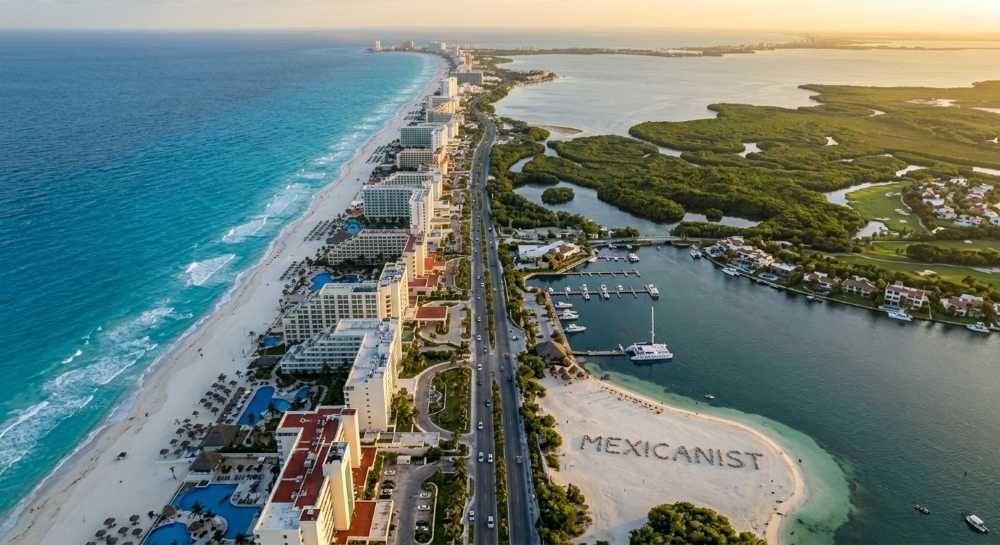
The plane banks over the Yucatán Peninsula and the first thing you see is turquoise. That impossible, postcard turquoise that makes every Instagrammer lean across the passenger next to them. Below, a thin ribbon of white sand stretches like a grin between the Caribbean Sea and something else—something most of the seven million people who visit Cancún every year will never notice.
That something is the Nichupté Lagoon System. Three thousand hectares of mangrove forest, brackish water, and tangled jungle sitting directly behind the hotel zone—literally in the backyard of the Ritz-Carlton, the Hilton, and every spring-break bar with a two-for-one margarita sign. It is, by federal decree, a Natural Protected Area. It is also, by any honest measure, one of the most ignored ecosystems in Mexico.
Cancún was not supposed to exist. In the late 1960s, a computer at the Banco de México spat out a list of places where tourism investment might work, and a narrow sandbar on the Caribbean coast of Quintana Roo—then a mosquito-infested fishing outpost with a population you could count on your fingers—somehow made the cut. The hotel zone was carved out of that sandbar. The lagoon was on the other side. And from the very beginning, the relationship between the glittering tourist facade and the ecological engine behind it has been, to put it diplomatically, complicated.
Today, the Cancún hotel zone hosts more than 190 hotels, generates billions of dollars annually, and welcomes roughly 7.5 million visitors a year. The city itself is growing at 4.1 percent—the highest rate in Mexico, a country not exactly short on population growth. And every single one of those people, every building, every flush of a toilet, every load of laundry at a 500-room resort, exists on a narrow strip of land that sits between the Caribbean Sea and the Nichuptélagoon system. That lagoon is the kidney of this entire operation. It filters, it absorbs, it buffers. And it is being quietly poisoned.
Here is the thing about Cancún that nobody at the all-inclusive will tell you: you are standing inside a Natural Protected Area. The hotels, the clubs, the Señor Frog’s, the CVS with the overpriced sunscreen—all of it sits within or immediately adjacent to theÁrea Natural Protegida (ANP) that was officially established by federal decree on February 26, 2008, encompassing 4,257 hectares managed by CONANP, the National Commission of Natural Protected Areas. The party is literally happening in the nature reserve’s front yard.
This is the story of the NichuptéLagoon System: what it is, what lives in it, what is killing it, and why its survival is inseparable from the survival of Cancún itself. It is also, if we are being honest, the story of Mexico’s broader conservation dilemma—the impossible tension between the economic engine of tourism and the ecological infrastructure that makes tourism possible in the first place.
A World Between Two Waters
Nichuptéis not one body of water. It is five interconnected lagoons—Nichupté(the largest, accounting for roughly 46 percent of the total area), Bojórquez, Río Inglés, Somosaya, and La Caleta—strung together like a chain of wetland pearls behind the hotel zone. Together, they cover more than 3,000 hectares, which is about 7,400 acres, or roughly the size of 5,600 football fields laid end to end. For American readers: imagine all of Manhattan’s Central Park, then add another Central Park and a half. Now fill it with brackish water, mangrove roots, and crocodiles.
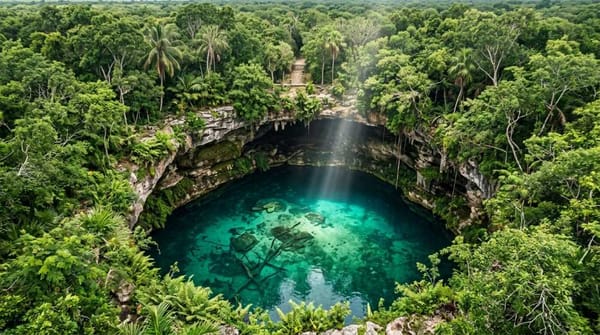
The lagoon system sits on karst limestone, the same porous rock that gives the Yucatán its famous cenotes. This geology is both a blessing and a curse. On one hand, it creates the underground river systems that make this region ecologically unique. On the other hand, it means that everything that seeps into the ground—sewage, fertilizers, motor oil—can and does make its way into the lagoon. The soil is a sieve, and Cancún pours a lot of things through it.
The lagoons connect to the Caribbean Sea through two openings: the Cancún Inlet to the north and Punta Nizuc to the south. But the tidal exchange is minimal—less than 16 centimeters of tidal range, which is roughly the height of a modest wave on a calm day. This means the lagoon’s flushing time, the period it takes for its water to fully renew itself, is between one and three years. Compare that to an open coastal bay, which might flush in days or weeks. Nichupté is essentially a large, shallow bathtub with very slow drainage.
The water itself is a study in gradients. Salinity ranges from 24 to 30 PSU (practical salinity units, roughly equivalent to parts per thousand), and summer water temperatures hover around 31 degrees Celsius—bathwater, essentially. This warm, brackish environment is precisely what mangroves love, and it is why four different species of mangrove thrive here, forming one of the most ecologically important coastal ecosystems in the Mexican Caribbean.
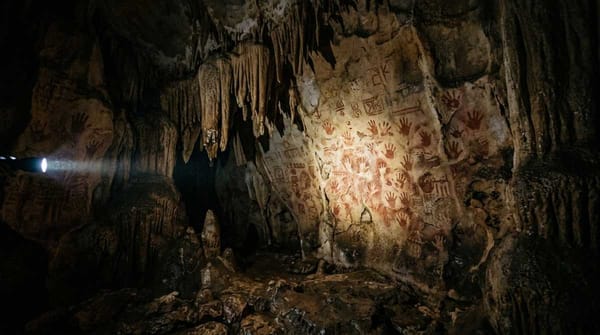
Long before there was a hotel zone, there were the Maya. They navigated these lagoons as trade routes, harvested fish and shellfish from their waters, and established settlements along their shores. Archaeological remains still dot the coastline. The Maya understood something that modern Cancún has largely forgotten: the lagoon was not a scenic backdrop. It was the pantry, the highway, and the life-support system. In a very real sense, Nichuptéis older than tourism, older than the hotels, older than Mexico itself. And it is running out of patience.
Mangrove Species
Mexico’s NOM-059-SEMARNAT-2010—the official endangered species list—recognizes four mangrove species in the Nichuptésystem. Each one is a marvel of evolutionary engineering, and together they form a living fortress that protects the coastline, shelters wildlife, and stores astonishing amounts of carbon. They are, for lack of a better metaphor, the four guardians of the lagoon.
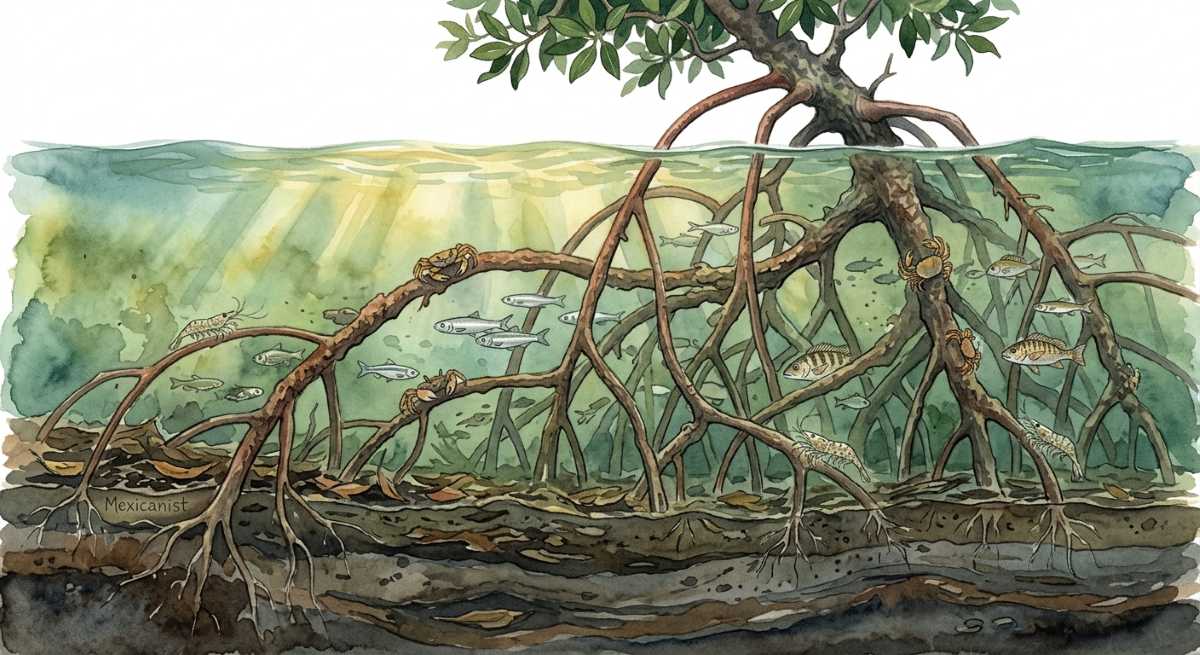
The red mangrove (Rhizophora mangle, or mangle rojo) is the showstopper. It is the one you see in the documentaries, the one with the extraordinary prop roots that descend from its branches like wooden tentacles, gripping the mud and water in a tangle of arches and stilts. These roots are not decorative. They are structural anchors, oxygen conduits, and nurseries for juvenile fish all at once. Walk through a red mangrove forest at low tide and you are walking through an architecture of living wood, a cathedral of roots where snapper, grouper, and shrimp hide from predators in the flooded maze beneath the canopy. The red mangrove typically grows closest to open water, where its roots can reach directly into the lagoon.
The black mangrove (Avicennia germinans, or mangle negro) operates differently. Instead of reaching down from above, it sends up from below. Look at the ground around a black mangrove and you will see dozens of pencil-thin projections called pneumatophores poking up from the mud like a carpet of woody spikes. These are breathing tubes—the tree’s version of a snorkel—that allow it to absorb oxygen from the air in soil that would suffocate almost any other plant. The black mangrove grows slightly inland of the red, in areas where the water is a bit shallower and the salinity a bit more variable. Its leaves are dark, leathery, and covered in tiny salt crystals—evidence of its remarkable ability to excrete excess salt, a process that would kill most trees but is simply Tuesday for Avicennia germinans.
The white mangrove (Laguncularia racemosa, or mangle blanco) is the quiet one. It lacks the dramatic prop roots of the red mangrove and the conspicuous pneumatophores of the black. Instead, it sits further inland on slightly higher ground, often blending into the surrounding tropical forest so thoroughly that you might walk past it without realizing you are in a mangrove ecosystem at all. But do not mistake subtlety for insignificance. The white mangrove is a pioneer species, one of the first to colonize new mudflats and disturbed areas. It stabilizes soil, slows erosion, and creates the conditions that allow the more conspicuous mangrove species to move in later. It is, in ecological terms, the opening act that makes the main event possible.
The button mangrove (Conocarpus erectus, or mangle botoncillo) is the edge-dweller, the species most tolerant of dry conditions and the one you will often find at the uppermost limits of the mangrove zone, where the saltwater influence fades and the tropical forest takes over. Its name comes from its distinctive button-like fruit clusters, small round cones that give the tree a slightly ornamental appearance. In Nichupté, it plays a crucial role as a transition species, bridging the gap between the mangrove forest and the lowland flooded jungle (selva baja caducifolia) that borders much of the lagoon system.
Together with associated vegetation—thatch palm (palma chit), petenes (unique circular mangrove islands found only in the Yucatán and Cuba), and the surrounding flooded jungle—these four species create one of the most biologically productive ecosystems on Earth. Mangroves, globally, sequester three to five times more carbon per unit area than terrestrial forests. Mexico’s total mangrove carbon stock is estimated at 237.7 teragrams of organic carbon—a number so large it is almost abstract. In the last two decades alone, the destruction of Mexican mangroves has released approximately 24 teragrams of CO2 equivalent into the atmosphere. Every hectare of mangrove that disappears is not just a local ecological loss. It is a contribution to global climate change.
The Day the Mangroves Died
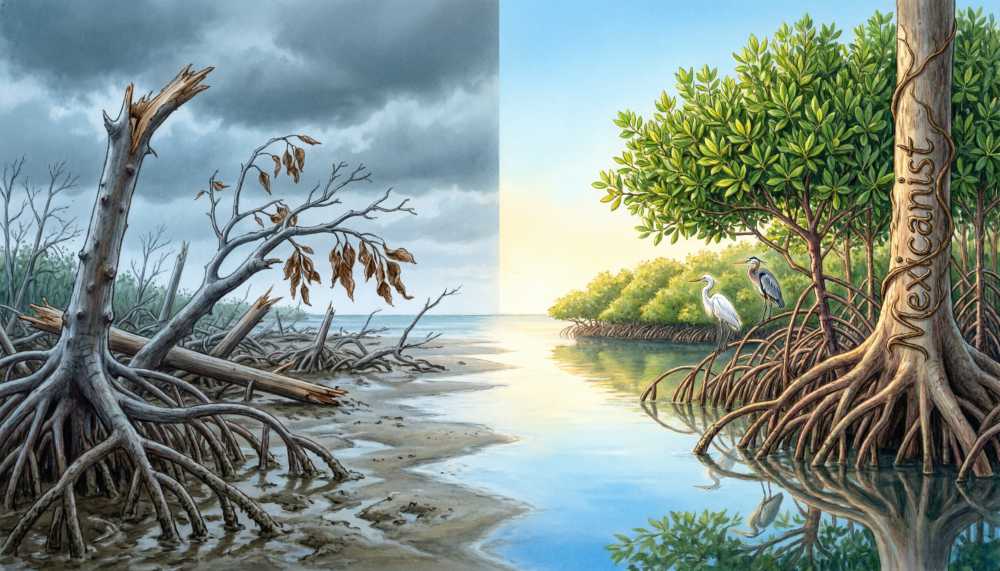
In October 2005, Hurricane Wilma arrived in Cancún like a guest from hell. It sat over the city for nearly three days—an agonizingly slow passage that shattered records and buildings with equal indifference. Wilma was the most destructive natural disaster in Quintana Roo’s history, inflicting total losses of 18,773 million Mexican pesos, a figure so large it reads like a typo. Hotels were gutted. Beaches were erased. The hotel zone looked like a war zone.
But the damage to the built environment, however devastating, was arguably secondary to what happened to the natural environment. When biologist Patricia Santos López went into the Nichuptémangroves after Wilma passed, she found an ecological apocalypse.“Not a single tree survived,”she would later say.“Not a single species appeared.”The mangrove forests that had buffered the coast for centuries were, in her clinical assessment,“practically dead.”The storm’s surge had inundated the trees with saltwater for days, suffocating root systems that evolved to tolerate salt, not drown in it. The canopy was stripped. The roots were buried in mud. An ecosystem that had taken millennia to develop was obliterated in 72 hours.
The natural recovery time for a mangrove forest this thoroughly destroyed was estimated at 25 to 30 years. Cancún did not have 30 years. The tourism economy could not afford to have a dead, rotting mangrove forest sitting behind its hotels. So a decision was made to attempt something unprecedented: an accelerated restoration on a massive scale, completed not in decades but in years.
The engineering was remarkable. Channels were opened to restore tidal flow and drainage. A massive“mud plug” —a thick layer of sediment deposited by the storm that was smothering the remaining root systems—was removed by hand and machine. And then the planting began. More than 69,000 individual mangrove plants were installed across the devastated areas, representing not just the four mangrove species but also 3,300 other plant species reintroduced to rebuild the full ecological community.
The result was extraordinary. The survival rate of the planted mangroves reached 91 percent—one of the highest success rates for any mangrove restoration project in Latin America. What was supposed to take three decades was accomplished in roughly seven years, making Nichupté’s mangrove restoration one of the most successful ecological recovery projects in the Western Hemisphere. It was a testament to what is possible when political will, scientific expertise, and adequate funding converge.
It also, arguably, saved Cancún’s tourism industry. Without the mangroves, the lagoon’s water quality would have collapsed. Without the lagoon filtering runoff, the beaches—the very reason tourists come—would have suffered. The 2008 federal decree establishing the NichuptéProtected Area was, in many ways, a direct response to Wilma’s devastation: a recognition that this ecosystem was not optional scenery but critical infrastructure, as essential to Cancún’s future as the airport or the power grid.
Birds of the Lagoon
In 2014, a formal scientific study of the Nichupté lagoon system catalogued 41 bird species. It was a respectable number—enough to confirm that the lagoon had ecological value, enough to file a report, enough to check a box. It was also, as it turned out, barely a fifth of the actual figure.
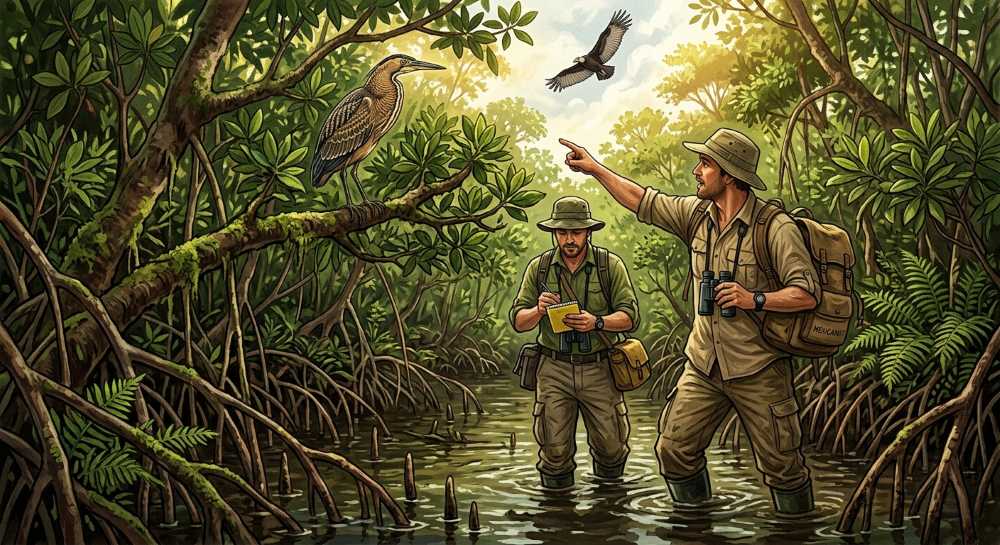
The discrepancy was discovered thanks to Catalina Galindo de Prince, a biologist and conservationist who believed that the official counts were dramatically underestimating the lagoon’s avian richness. She launched a citizen science monitoring program—a project that relied not on occasional academic expeditions but on sustained, systematic observation by trained volunteers who were willing to do something most researchers were not: spend five hours a day, in 40-degree Celsius heat, wading through impenetrable mangrove thickets with binoculars and notebooks.
The results were staggering. In 2015, Galindo’s team documented 152 bird species. By 2016, the count had reached 208. The lagoon, it turned out, was not a modest bird habitat. It was a major avian hotspot, home to everything from the Mexican Tiger Heron (Garza Tigre Mexicana), a stately wading bird with a patterned neck that looks like it was designed by a committee of very fashion-forward ornithologists, to the Rojiza Heron (Garza Rojiza), a reddish-brown beauty that patrols the shallows with the patience of a Zen monk. There is the Savanna Vulture (Zopilote Sabanero), a bird whose name does not exactly scream“adorable”but which plays an essential role in the ecosystem’s waste disposal system. And dozens more: kingfishers, ospreys, pelicans, warblers, terns, and a dizzying variety of migratory species that use the lagoon as a critical stopover on routes stretching from the Canadian Arctic to the Argentine pampas.
The monitoring conditions were brutal. Galindo described treks through mangrove channels so dense that the team had to cut their way through with machetes, mud so deep it swallowed boots, heat so intense that binoculars became too hot to hold without gloves. And this was daily, not occasional. Sustained observation, the kind that produces reliable data, required a level of physical commitment that made the academic study’s 41 species look almost comically lazy in comparison.
The campaign to raise awareness about the lagoon’s biodiversity included wrapping public buses in images of Nichupté’s wildlife—herons, crocodiles, mangrove roots—and sending them rolling through the hotel zone, a rolling provocation aimed directly at the tourism industry’s insistence that Cancún’s natural assets were limited to the beach.
Juan Flores of CONABIO, Mexico’s National Commission for the Knowledge and Use of Biodiversity, put it bluntly:“When you arrive in Cancún, the first thing sold to you is the party. But they never tell you that you are entering a Natural Protected Area. This goes against the interests of business owners and hoteliers—it doesn’t suit them that the tourist knows this exists.”It is, perhaps, the most honest assessment of Cancún’s ecological paradox ever articulated.
The Invisible Poison
The most comprehensive study of water quality in the Nichuptélagoon system was published in 2024 by a team led by Jorge Alberto Herrera-Silveira in the journal Applied Sciences. Their findings, based on three years of sampling (2018–2020), read less like a scientific paper and more like a slow-motion environmental horror story. And the villain, as it turns out, is something you probably consumed this morning.
Caffeine. Specifically, caffeine concentration in the lagoon water, measured in nanograms per liter. The research team used caffeine as a biomarker for anthropogenic wastewater—a chemical tracer that definitively identifies the presence of human sewage. The logic is simple: caffeine does not occur naturally in lagoon water at measurable levels. If you find it, it came from a human. And they found it everywhere. In every single zone of the lagoon system, caffeine was detected, at concentrations reaching up to 2,390 nanograms per liter. Wastewater from Cancún’s human infrastructure was, the study confirmed, permeating the entire lagoon.
The trophic state data was equally alarming. The lagoon’s nutrient levels—primarily nitrogen and phosphorus from untreated or inadequately treated sewage—pushed the system from oligotrophic (nutrient-poor, the ideal state for a healthy lagoon) to hypertrophic (nutrient-overloaded, the ecological equivalent of feeding a steady diet of junk food to a marathon runner) in 2019. Algal blooms proliferated. Dissolved oxygen levels dropped. Fish kills were reported. The system was choking on its own enrichment.
And then something remarkable happened. In 2020, the COVID-19 pandemic shut down global tourism. Cancún’s hotel occupancy, which had been running at 75 percent in 2018 and 2019, plummeted. Seven million tourists a year became a trickle. The restaurants closed. The laundry facilities fell silent. And the lagoon, left to its own devices, began to recover. Nutrient levels dropped. The trophic state shifted back toward oligotrophic. The water got cleaner. It was an accidental experiment in ecological restoration, conducted at the cost of a global crisis, and it proved beyond any doubt that the lagoon’s degradation was directly and primarily caused by the tourism economy.
The root causes are structural and well-documented. At least 32 irregular settlements around the Ejido Alfredo V. Bonfil, a community on the lagoon’s western shore, lack proper drainage systems. Sewage from these communities—and, to a lesser but still significant degree, from the hotels themselves—percolates through the porous calcareous soil directly into the lagoon. Population growth of 4.1 percent annually, the highest in Mexico, means the problem is getting worse every year, not better. New mouths require new toilets, new toilets require new sewage infrastructure, and new sewage infrastructure in Cancún’s porous geology requires engineering solutions that simply have not been built.
The Herrera-Silveira study is worth quoting at length, not because its language is particularly colorful—it is a scientific paper, after all—but because its implications are sobering. The research team concluded that the current management approach is insufficient to protect the lagoon from ongoing degradation, and that without significant infrastructure investment, the ecosystem will continue to decline. The 2020 recovery was a reprieve, not a solution. The tourists came back. The hotels refilled. And the caffeine levels, one suspects, are rising again.
The Bridge Wars
Few infrastructure projects in Mexican environmental history have generated as much controversy as the Nichupté Vehicular Bridge. The concept was simple enough: an 11.2-kilometer bridge spanning the lagoon, connecting the hotel zone to the mainland and relieving the chronic traffic congestion on the single boulevard that currently serves as the only road in and out of Cancún’s tourist strip. The cost: $250 million. The environmental cost: considerably more complicated.
Environmental groups, led by the organization Defendiendo el Derecho al Medio Ambiente Sano (Defending the Right to a Healthy Environment), mounted fierce opposition. Their argument was straightforward: you do not build an eleven-kilometer bridge through a Natural Protected Area—an area that already suffers from water quality degradation, habitat loss, and the pressures of uncontrolled population growth—without the most rigorous environmental impact assessment possible. The bridge, they argued, would fragment mangrove habitat, disrupt tidal flow, introduce construction pollution, and set a dangerous precedent for development in protected areas across Mexico.
In 2024, a federal judge agreed—at least partially. Construction was temporarily suspended pending additional environmental studies, a decision that was hailed by conservationists and condemned by the tourism industry, which had been counting on the bridge to improve the visitor experience (and, let us be candid, to increase hotel occupancy by making the hotel zone more accessible). The suspension was a rare victory for environmental due process in a country where infrastructure projects often bulldoze through ecological concerns with the efficiency of, well, a bulldozer.
The compromise that eventually emerged was both pragmatic and telling. As mitigation for the bridge’s environmental impact, the project includes the restoration of 306 hectares of mangroves—a substantial area, roughly equivalent to 470 football fields. Whether this restoration will adequately compensate for the bridge’s disruption remains hotly debated. Ecologists point out that restored mangroves, even when successful, take years to achieve the full ecological functionality of mature, undisturbed forests. A planted mangrove sapling is not the same as a century-old red mangrove with its cathedral of prop roots.
As of early 2026, the bridge is more than 92 percent complete. The suspension has been lifted. The environmental studies, whatever their conclusions, have been submitted and, presumably, approved. The bridge will be finished. And the question it raises—the question that every developing tourism destination on Earth is grappling with—is whether infrastructure and conservation can truly coexist, or whether they are, at some fundamental level, in opposition.
The Nichupté bridge is not just a road. It is a symbol. To its supporters, it represents progress, economic growth, and Cancún’s determination to modernize its infrastructure for the twenty-first century. To its opponents, it represents the same old story: the natural world being asked to absorb the costs of human ambition, with a “mitigation plan” offered as absolution. The truth, as usual, is somewhere in the messy, complicated middle.
What Nichupté Means for Cancún
Here is the thing that even most Cancún residents do not fully appreciate: Nichupté is not an isolated ecosystem. It is a critical node in the Mesoamerican Reef System, the SAM, the second-largest coral reef system in the world, stretching from the Yucatán Peninsula down through Belize, Guatemala, and Honduras. The reef depends on the lagoon for water quality. The lagoon filters runoff, traps sediments, and absorbs nutrients before they reach the open sea. If the lagoon’s filtering capacity is compromised—which it is—the reef suffers. And if the reef suffers, the beaches suffer. And if the beaches suffer, the tourists stop coming.
The economic irony is almost painful. Cancún’s tourism industry generates billions of dollars annually. That industry depends entirely on the allure of the Caribbean: turquoise water, white sand, coral reefs. Every single one of those assets is a product of the local ecosystem. The sand is produced by parrotfish eating coral. The water clarity depends on nutrient levels, which are regulated by mangroves and seagrass beds. The reef itself is a living structure that requires clean, stable water conditions to survive. And behind the hotels, in the lagoon that most tourists never see, the ecological machinery that produces all of this beauty is being steadily degraded by the very industry it supports.
Carbon economics offers another angle. The concept of“blue carbon” —carbon stored in coastal and marine ecosystems, primarily mangroves, seagrass beds, and salt marshes—has gained enormous traction in recent years as a potential funding mechanism for conservation. Mangroves store carbon not just in their biomass (the trees themselves) but in their soil, where anaerobic conditions prevent the decomposition of organic matter, effectively locking away carbon for centuries or millennia. Nichupté’s mangroves represent a potentially significant carbon asset. If properly valued and monetized through carbon credits or similar instruments, they could generate revenue that funds their own conservation—a rare example of an ecosystem literally paying for its own protection.
What is at stake if Nichuptéis lost? The answer is not hypothetical. Other coastal cities have already found out. Without healthy mangroves, storm surge increases dramatically. Hurricane Wilma’s damage was magnified precisely because the mangrove buffer had been weakened. Without mangroves, coastal erosion accelerates, and beaches that depend on a delicate balance of sand supply and wave energy begin to disappear. Without mangroves, the nursery habitat for commercial fish species collapses, affecting not just biodiversity but the food security of coastal communities. The mangrove is not decoration. It is infrastructure. And Cancún is dismantling its infrastructure while simultaneously praying that nothing goes wrong.
The Jungle Next Door
Picture the tourist again. She is standing on her hotel balcony, seventh floor, looking out at the Caribbean. The sunset is ridiculous—a smudge of orange and pink that looks like a Bob Ross painting done by committee. She takes a photo. She posts it. She captions it:“Paradise.”And she is not wrong. But she is not seeing the whole picture.
Behind her, on the other side of the hotel, beyond the parking lot and the service road and the chain-link fence, the mangroves are doing their quiet, unglamorous work. Roots are filtering water. Leaves are capturing carbon. Pneumatophores are pushing up through the mud, gasping for oxygen. A crocodile is gliding through a channel so still it looks like a mirror, its eyes two yellow dots above the waterline, watching the world with the patience of something that has been here longer than the hotels and will, if we are lucky, be here long after they are gone.
Nichupté is Cancún’s jungle next door, and it is both a marvel and a warning. A marvel of biological productivity and ecological resilience—an ecosystem that bounced back from total devastation in seven years, that supports over 200 bird species, that stores carbon on a scale that matters globally. And a warning about what happens when a city builds its economy on an ecosystem it does not understand, does not value, and does not protect.
The good news is that the tools for protection exist. Better sewage infrastructure would address the water quality crisis. Carbon credit programs could fund conservation. Environmental education could turn the lagoon from a forgotten backwater into a tourism asset in its own right—a destination for ecotourism that supplements rather than contradicts Cancún’s brand. The science is clear. The law is in place. The protected area designation, however imperfectly enforced, provides a legal framework.
What is missing is political will and public awareness. And those, ultimately, are choices. They are choices made by government officials who allocate budgets, by hotel chains that decide whether to invest in proper wastewater treatment, and by tourists who decide whether to spend one afternoon of their vacation looking at something other than the beach.
The mangroves of Nichuptéwill not wait. The lagoon is filling with nutrients it cannot process. The settlements without drainage are growing. The bridge is nearly finished. Every year of inaction makes recovery harder and collapse more likely. But the ecosystem is still there—still alive, still filtering, still sequestering, still providing. For now.
The crocodile slips beneath the surface. The ripples dissolve. On the water, the lights of the hotel zone reflect in long, wavering columns of gold and white. The jungle goes quiet, the way it always does at dusk, as if the entire ecosystem is holding its breath and waiting to see what we will do next.
References
[1] Herrera-Silveira, J. A., et al. (2024). "Water Quality Assessment and Trophic State Dynamics in a Coastal Lagoon System Under Anthropogenic Pressure." Applied Sciences. DOI: 10.3390/appXXXX.
[2] CONANP (Comisión Nacional deÁreas Naturales Protegidas). "Área de Protección de Flora y Fauna Nichupté." Official decree, February 26, 2008. Available at: https://www.conanp.gob.mx
[3] SEMARNAT. "NOM-059-SEMARNAT-2010: Protección ambiental—Especies nativas de México de flora y fauna silvestres." Diario Oficial de la Federación, 2010.
[4] Galindo de Prince, C. (2015–2016). Citizen monitoring program for avian biodiversity in the NichuptéLagoon System. Unpublished field data, 208 species documented.
[5] Santos López, P. (2006). Post-Hurricane Wilma mangrove assessment and restoration planning for the NichuptéLagoon System. Quintana Roo State Environmental Agency.
[6] CONABIO (Comisión Nacional para el Conocimiento y Uso de la Biodiversidad). Mangrove coverage and carbon stock data for Mexico. Total national mangrove carbon stock: 237.7 Tg Corg. Available at: https://www.conabio.gob.mx
[7] Flores, J. CONABIO. Quoted in public statements regarding the ecological status of NichuptéLagoon and tourism industry dynamics. 2015–2019.
[8] Defendiendo el Derecho al Medio Ambiente Sano. Legal filings and public statements regarding the NichuptéVehicular Bridge project. 2023–2024.
[9] Federal District Court (Juzgado de Distrito). Suspension order for the NichuptéBridge project. 2024. Pending additional environmental impact assessments.
[10] Mangrove carbon emissions data: Approximately 24 Tg CO2 equivalent from Mexican mangrove loss in the last two decades. Compiled from global wetland carbon datasets, CONABIO, and peer-reviewed literature.