The 'Mutation' of Cartels and the 'Shadow Tax' on the U.S. Economy
Mexico's homicides are down 40% — but don't pop the champagne. Cartels have mutated from drug traffickers into quasi-feudal tax collectors, extorting avocado farmers and hijacking cargo routes. That shadow tax? You're paying it at the grocery store.

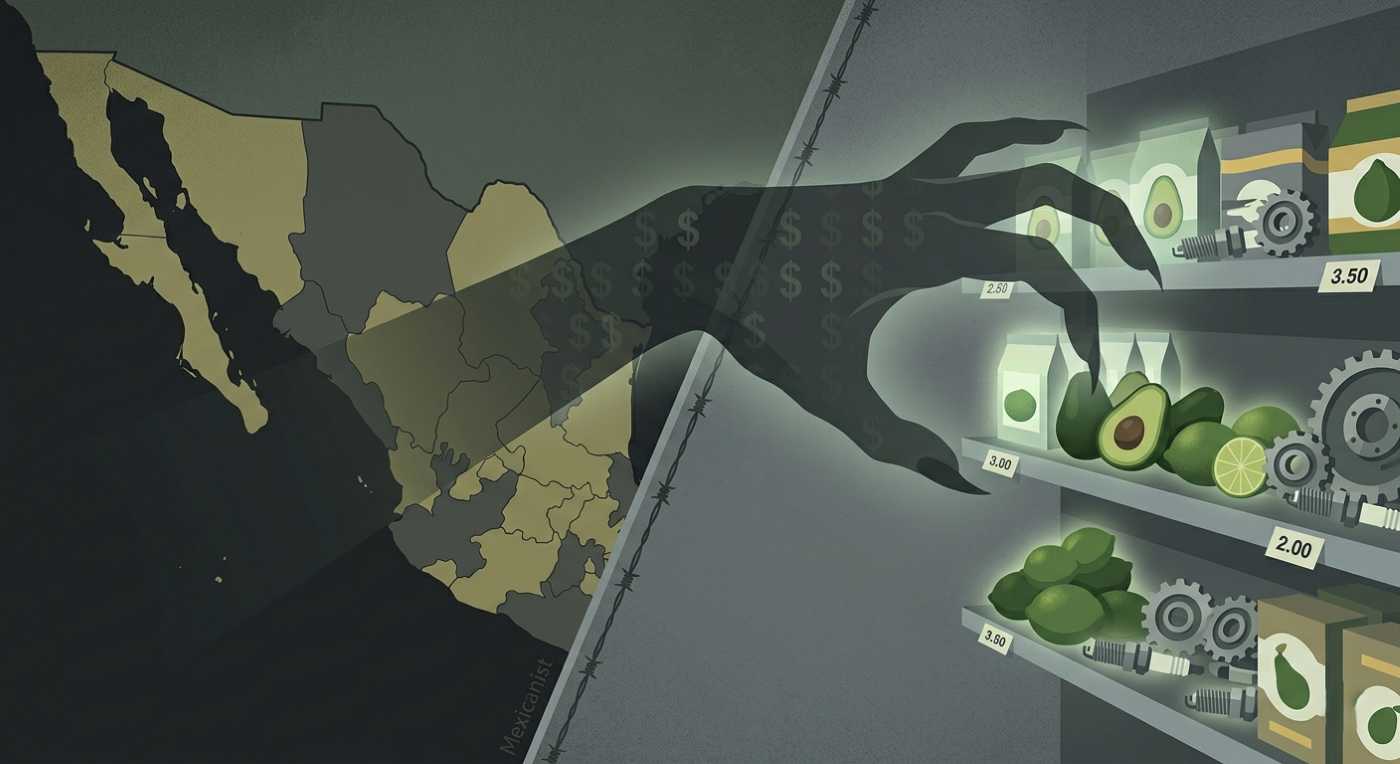
Mexico's homicide rate has dropped roughly 40% since President Claudia Sheinbaum took office in October 2024. According to government figures reported by Reuters and the Associated Press in January 2026, the country is now seeing about 34 fewer murders per day than during the peak of cartel violence under her predecessor. That's the lowest daily body count since 2016—a year before the infamous "war on the cartels" escalation under Enrique Peña Nieto.
On paper, it looks like a policy triumph. The Sheinbaum administration has pointed to the numbers as evidence that its "hugs, not bullets" successor strategy—a softer-touch approach to security—is paying dividends. Fewer gun battles in the streets. Fewer mass graves. Fewer severed heads left on highway overpasses. The data tells a story of a country inching toward normalcy.
But there's a problem. The numbers aren't lying—but they're not telling the whole truth either. Mexico's cartels haven't been defeated. They haven't even been weakened. What they've done is something far more insidious: they've mutated.
The decline in homicides isn't a sign that criminal organizations are crumbling. It's a sign that they've consolidated territorial monopolies. The brutal turf wars of 2018–2022—when the Sinaloa Cartel fractured into warring factions and the CJNG gobbled up rival territories—have largely ended. Not because the government won, but because one side won. The Cárteles Unidos, the Sinaloa remnants, and the CJNG now control vast, clearly demarcated zones with relatively little inter-cartel conflict. When you control the entire chessboard, there's no one left to fight.
The violence hasn't disappeared. It's been privatized and institutionalized. Extortion, kidnapping, forced recruitment, and the quiet coercion of daily economic life have replaced the headline-grabbing firefights. The murder rate is down. The criminal economy is not.
From Drug Traffickers to Quasi-Feudal Lords
There was a time—not so long ago, really—when Mexico's cartels were relatively simple organizations. They moved drugs. Cocaine from Colombia, methamphetamine from their own superlabs, heroin and fentanyl from precursor chemicals smuggled in from Asia. The business model was straightforward: produce or acquire illicit substances, transport them northward across the U.S.-Mexico border, distribute them through American networks, and collect billions in revenue. Violence was mostly a tool of territorial competition or a response to law enforcement pressure.
That era is over.
Today's Mexican cartels operate less like drug syndicates and more like medieval feudal lords. They've diversified into every sector of the economy where there's money to be extracted. The International Institute for Strategic Studies (IISS) 2024 Armed Conflict Survey described groups like the CJNG as "transnational criminal elites" that have moved far beyond geographic confines, operating across multiple product lines and revenue streams simultaneously.
Consider what they've sunk their claws into: agriculture—particularly avocados, limes, and berries; cargo transportation routes across Mexico's highway network; mining operations, especially iron, gold, and lithium extraction; timber harvesting in old-growth forests; and even the humble tortilla shop on the corner. Every link in every supply chain is a potential revenue source.
At the heart of this transformation is the concept of "piso"—literally "the floor." In cartel economics, the piso is the extortion payment, the tribute extracted from farmers, truckers, shopkeepers, factory owners, and anyone else operating within a cartel's territorial zone. It's a percentage of revenue, a flat fee, or simply whatever the cartel decides to demand. Refuse to pay, and the consequences range from a threatening phone call to your business burning down—or worse.
The UN Office on Drugs and Crime (UNODC) World Drug Report 2025 estimated that Mexican cartels generate approximately $12.1 billion annually from the drug trade alone. But extortion—the piso economy—adds billions more on top of that. No one knows the exact figure because most victims never report it. What's clear is that the cartels have built a parallel tax system that operates alongside—and often with greater efficiency than—the Mexican state's own revenue collection.
They control territory, extract tribute, and in a perverse twist, provide a kind of protection. Not from criminals—they are the criminals—but from rival cartels and from the chaos of a vacuum of authority. In many parts of rural Mexico, the state's presence is barely a whisper. The cartel's presence is a shout. And for many people living in those areas, the calculus is grim but simple: paying the piso is the cost of staying alive and staying in business.
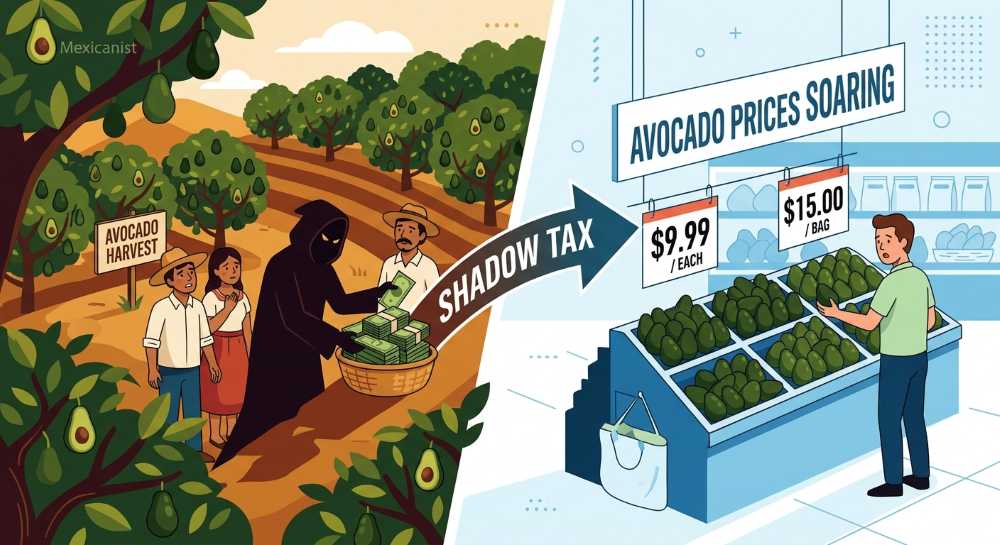
The Shadow Tax That Crosses the Border
In August 2024, Jonathan Heath, a deputy governor at Mexico's central bank (Banxico), delivered a warning that should have made front pages on both sides of the border. Extortion, he said, had become "structural" in the Mexican economy—meaning it was no longer an aberration or a localized problem, but a systemic feature embedded in the cost structure of goods and services. And it was pushing inflation upward.
Heath estimated that extortion adds approximately 20% to the prices of some goods. Let that sink in. One in every five pesos you spend on certain Mexican products isn't paying for the product itself—it's paying the cartel's cut. The concept was later dubbed "narcoinflation" by journalist Ioan Grillo in a December 2025 New York Times investigation, and the term has stuck for good reason: it's pithy, accurate, and more than a little terrifying.
The evidence is everywhere. Tortilla prices—the most basic food staple in the Mexican diet—spiked 20% in some regions. Lime prices jumped 8% in a single period in 2025, prompting protests from farmers in Michoacán who said they were being squeezed by both cartels and the rising cost of "protection." Mexico's overall inflation rate stood at 4.59% through March 2026, stubbornly above the Bank of Mexico's 3% target.
A July 2025 investigation by Fortune, drawing on data from Mexican business associations, found that extortion cost Mexican businesses an estimated $1.3 billion in 2023—and that was just the reported figure. In Mexico City alone, extortion reports nearly doubled in the first five months of 2025 compared to the same period a year earlier. The National Institute of Statistics and Geography (INEGI) has estimated that 97% of extortion cases go unreported. If the true rate is even ten times higher than reported figures—let alone the 30x multiplier some analysts suggest—the real economic toll is staggering.
For American consumers this doesn't stay in Mexico. When a Mexican farmer pays the piso on his avocado crop, that cost gets baked into the export price. When a trucking company pays "right of way" fees to move cargo through cartel-controlled highway corridors, that cost gets rolled into shipping rates. When a manufacturer in Monterrey pays a "collaboration arrangement" to keep its factory running, that cost finds its way into the price of finished goods.
Narcoinflation is a shadow tax, and the American consumer is on the receiving end of the bill—whether they know it or not.
The Avocado Pipeline - Green Gold, Dark Money
Mexico is the world's undisputed avocado king. The country produces more of the creamy green fruit than any other nation on Earth, and the industry is valued at roughly $3.1 billion. The epicenter is Michoacán, the state that produces about 5.5 billion pounds of avocados annually, supports roughly 78,000 direct jobs, and generates an estimated $2.5 billion in annual revenue. It's no exaggeration to call it the avocado capital of the world.
And it is crawling with cartel money.
The 2025–26 season was a record-breaker: approximately 2.5 billion pounds of Mexican avocados were expected to be imported into the United States, according to Avocados From Mexico and Blue Book Services. Mexico's avocado exports were forecast to hit $4 billion by the USDA. That's a staggering volume of green gold flowing northward across the border.
But that pipeline passes through a gauntlet of cartel extortion at every stage. Growers pay piso on their harvests. Packers pay piso on their facilities. Transporters pay piso for the right to drive their trucks through cartel-controlled territory. The Washington Post reported in May 2024 on how cartels had even infiltrated the tortilla business; the avocado trade is no different—it's just more lucrative.
The numbers paint a grim picture. Between 7 and 10 avocado trucks are stolen every single week in Michoacán, costing the industry an estimated $5 million annually in direct losses. The U.S. government has temporarily halted avocado imports from Mexico when a U.S. agricultural inspector was threatened—a stark illustration of how cartel violence can directly disrupt the American food supply.
When that avocado costs $1.50 at Whole Foods or $2.00 at your local bodega, a piece of that price isn't paying for the fruit, the labor, or the transportation. It's paying the cartel's shadow tax. Every time you order avocado toast, you're inadvertently participating in an economic ecosystem that funnels money to criminal organizations. Green on the outside. Dark money on the inside.
Manufacturing, Cargo Hijacking and Auto Parts
Mexico isn't just sending avocados north. In 2024, it was the number-one source of U.S. imports—a staggering $466.62 billion in total trade, according to the U.S. Census Bureau. More than 80% of all Mexican goods exports go to the United States. The bilateral trade relationship is one of the most intertwined on the planet, spanning automotive parts, electronics, agricultural products, energy, minerals, and manufactured goods of every description.
And a huge chunk of those goods travel by road—through cartel-controlled territory.
Mexico State (Estado de México) and Puebla accounted for 82% of all cargo hijackings in the first quarter of 2025, according to Borderless Coverage. Nationwide, 82% of cargo robberies in Mexico involved violence in 2025. Forbes reported in October 2025 that Mexico had become the world's worst hotspot for hijacking, surpassing traditional danger zones in South America and Africa. The high-risk industries? Automotive, energy, minerals, technology, manufacturing, agribusiness, and logistics—essentially the backbone of the U.S.-Mexico supply chain.
There was some good news: overall cargo theft in Mexico dropped 21.5% in 2025, according to Mexico Business News and EP Logistics. But the absolute numbers remain staggering. Even with the decline, Mexico still accounted for 59% of all cargo theft in North America. The country's road freight market—valued at $43.13 billion in 2024 and projected to reach $59.02 billion by 2030—operates under a persistent threat that companies simply factor into their cost of doing business.
Logistics companies pay "right of way" fees to move goods through certain corridors. Manufacturing firms—particularly in the automotive sector around Monterrey and the industrial belt between Mexico City and Puebla—maintain what are euphemistically called "collaboration arrangements" with local criminal groups. These aren't bribes, exactly. They're closer to a licensing fee for existing.
So when an auto parts shipment from a plant in Nuevo León gets hijacked on Highway 57, the insurance company pays out, the manufacturer scrambles to replace the parts, and the insurance premium for every company on that route goes up. And when those higher premiums and replacement costs are baked into the price of a Ford or GM vehicle rolling off an assembly line in Michigan or Texas, the American consumer pays. The cartel's cut doesn't disappear at the border. It's hidden in the sticker price.
Why Homicides Are Down
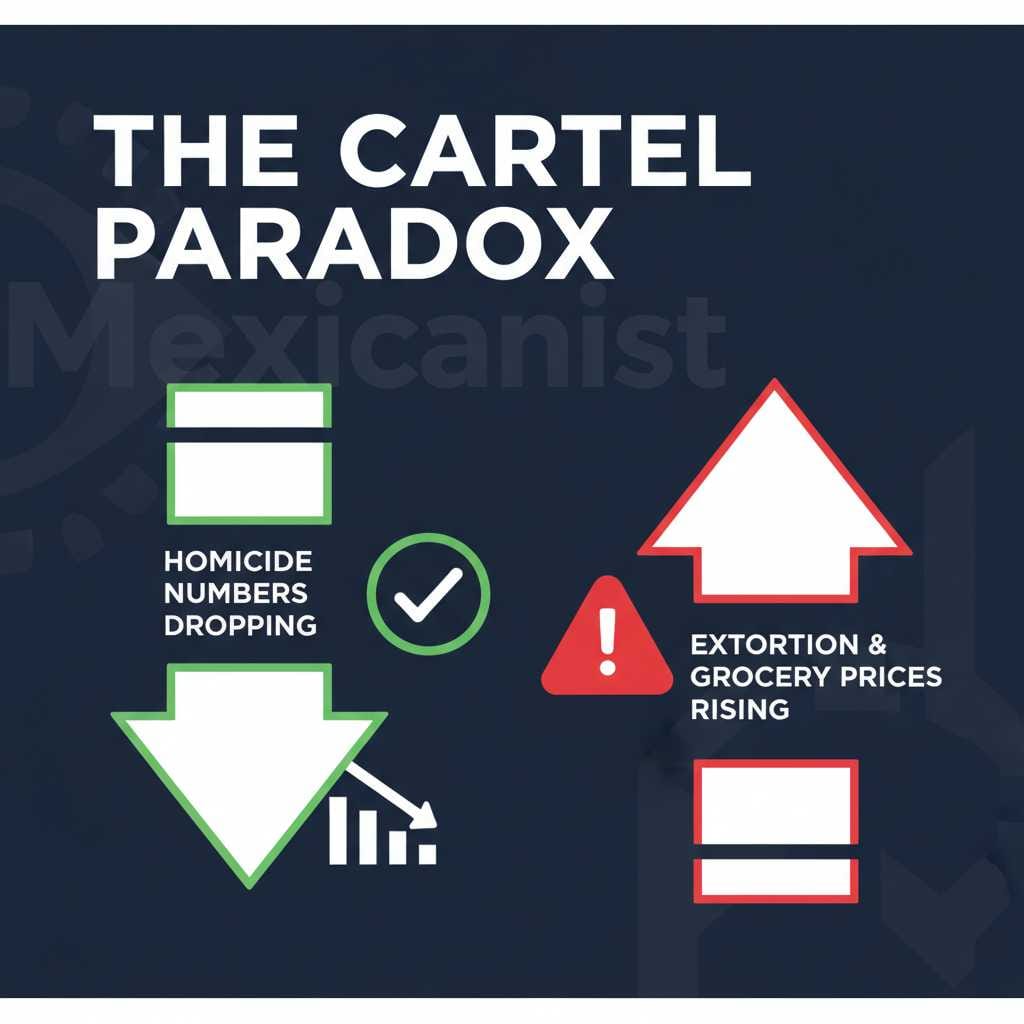
So we come back to the paradox: fewer bodies, more crime. How does that work
The answer lies in the concept of territorial monopoly. In economics, a monopoly eliminates competition—and in the cartel world, competition means violence. When the CJNG, Sinaloa, and other major organizations were fighting each other for control of trafficking routes, production facilities, and local markets, the gunfire was relentless. Thousands died in battles that made international headlines.
Today, those wars have largely settled into a cold peace. Major cartels control defined territories with relatively clear boundaries. The incentive to engage in costly, attention-grabbing violence has diminished. Instead, the organizations have pivoted to what the IISS described as exercising "territorial control"—using their dominance over specific regions to raise millions through local retail drug sales, extortion, and economic infiltration.
But while the murder rate has dropped, diversification into other criminal activities has exploded. Human trafficking—moving migrants from Central America and beyond through Mexico and into the United States—has become a multi-billion-dollar revenue stream. Arms trafficking feeds both sides of the border's criminal ecosystem. Money laundering operations have grown more sophisticated, penetrating legitimate businesses in real estate, hospitality, and cryptocurrency.
The Sinaloa Cartel's factional violence still flares—most notably in Culiacán and surrounding areas—proving that the "peace" is fragile and localized. And the Mexico Peace Index 2024, published by the Institute for Economics & Peace, delivered a sobering number: the economic impact of violence in Mexico totaled 4.9 trillion pesos—approximately $245 billion, or a staggering 19.8% of GDP. That's nearly one-fifth of Mexico's entire economic output consumed by the costs of criminality, insecurity, and the government's response to both.
The homicide metric alone is a misleading measure of cartel power. The real measure of "success" in the drug war shouldn't be the body count. It should be whether the criminal economy is expanding or contracting—and by every available indicator, it's expanding. The mutation from drug trafficking to diversified criminal extortion means that the cartels are embedded more deeply in the daily economic life of Mexico than ever before.
Rethinking the Drug War
In February 2025, the United States officially designated several Mexican cartels as Foreign Terrorist Organizations (FTOs)—a symbolic move that generated headlines but whose practical impact remains deeply unclear. Does an FTO designation enable new military operations? Expand intelligence-sharing? Or does it merely rebrand a law enforcement problem as a national security one without changing the underlying dynamics? Months later, the answer is still murky.
The Trump administration's imposition of 25% tariffs on Mexican exports added another layer of complexity. Tariffs are designed to punish Mexico—but they may end up hurting the very people the cartels extort far more than the cartels themselves. A farmer in Michoacán who's already paying piso to a cartel now faces reduced access to his primary market. A trucking company already squeezed by "right of way" fees must absorb additional trade costs. The cartels, meanwhile, adapt—finding new routes, new products, new revenue streams. They always do.
The fundamental problem is that the current metrics for measuring success in the drug war—homicide counts, drug seizure volumes, kingpin captures—miss the structural mutation that has taken place. Counting bodies tells you how many people are dying. It doesn't tell you how much money is being siphoned from the legitimate economy through extortion, intimidation, and coerced "collaboration." Drug seizures tell you what was intercepted at the border. They don't tell you what was extracted from Mexican farmers and businesses before the drugs or goods ever reached a border crossing.
What the United States and Mexico need is a new scoreboard. One that tracks extortion rates by region and industry. Business closures due to criminal intimidation. Supply chain disruption costs. The size and growth rate of the informal economy. Consumer price impacts on goods that pass through cartel-controlled supply chains. These are the metrics that actually measure whether the criminal economy is expanding or contracting—and by all of them, the cartels are winning.
The drug war's "success"—as measured by declining homicides—is an optical illusion. The violence didn't end. It was institutionalized. The cartel mutation from drug traffickers to quasi-feudal tax collectors is the defining story of organized crime in North America today. And the cost of that mutation is showing up on grocery receipts and dealership invoices across the United States—whether anyone wants to see it or not.
Sources
1. Reuters, "Mexico's murder rate down 40% under Sheinbaum," Jan 8, 2026
2. Associated Press, "Mexico boasts sharp decline in homicides," Jan 2026
3. Fortune/AP, "Mexico's cartels are taking a $1.3 billion bite out of the economy," July 11, 2025
4. Reuters, "Mexico central bank has growing inflation challenge: extortion," Aug 27, 2024
5. KJZZ/NPR, "Mexico cartels are shaking businesses down for money," Dec 17, 2025
6. New York Times, Ioan Grillo, "Cartel extortion is pushing up prices in Mexico," Dec 5, 2025
7. Prospect Journal, "From Avocados to Extortion," Feb 2025
8. EIPS, "Blood Avocados: How US tariffs and the war on fentanyl," Dec 5, 2025
9. Mexico Business News, "Mexico's Avocado Exports to Hit $4 Billion in 2025"
10. Avocados From Mexico / Blue Book Services, "Record-breaking 2.5 billion pounds," Jan 2026
12. USTR, "Mexico: United States Trade Representative," 2024
13. Borderless Coverage, "Cargo Hijacking Hotspots in Mexico: 2025 Trends," Apr 2025
14. Forbes, "Foreign Executives Need To Understand Cargo Truck Hijacking," Oct 2025
15. IISS, "The Expansion and Diversification of Mexican Cartels," Dec 2024
16. Institute for Economics & Peace, "Mexico Peace Index 2024"
17. Mexico Business News / EP Logistics, "Cargo theft in Mexico fell 21.5% in 2025"
18. UNODC, "World Drug Report 2025" (via Vallarta Daily)
19. Mexico News Daily, "Mexico's homicide rate dropped 30% in 2025"
20. Geopolitical Monitor, "Backgrounder: Evolution of Organized Crime in Mexico"
21. Reuters, "Mexico inflation spikes in March," Apr 9, 2026
22. Mexico Business News, "Mexico Battles Cargo Theft Amid Driver Shortage"
23. Washington Post, "How Mexico's cartels infiltrated the tortilla business," May 2024
24. U.S. Department of State, "FTO designations of Mexican cartels," Feb 2025