32 Fishermen on Isla Mujeres Stopped Killing Sharks — and Saved 30,000
Eleven thousand sharks are killed globally every single hour. But on a tiny island off Cancun, 32 former shark fishermen put down their nets and picked up snorkels — building a sanctuary that has protected over 30,000 sharks and become a model the entire Caribbean is scrambling to replicate.

Eleven thousand sharks killed every hour. Let that sink in. Not every year, not every month — every hour. That's the global toll, and it's been going on for decades while the world looked the other way.
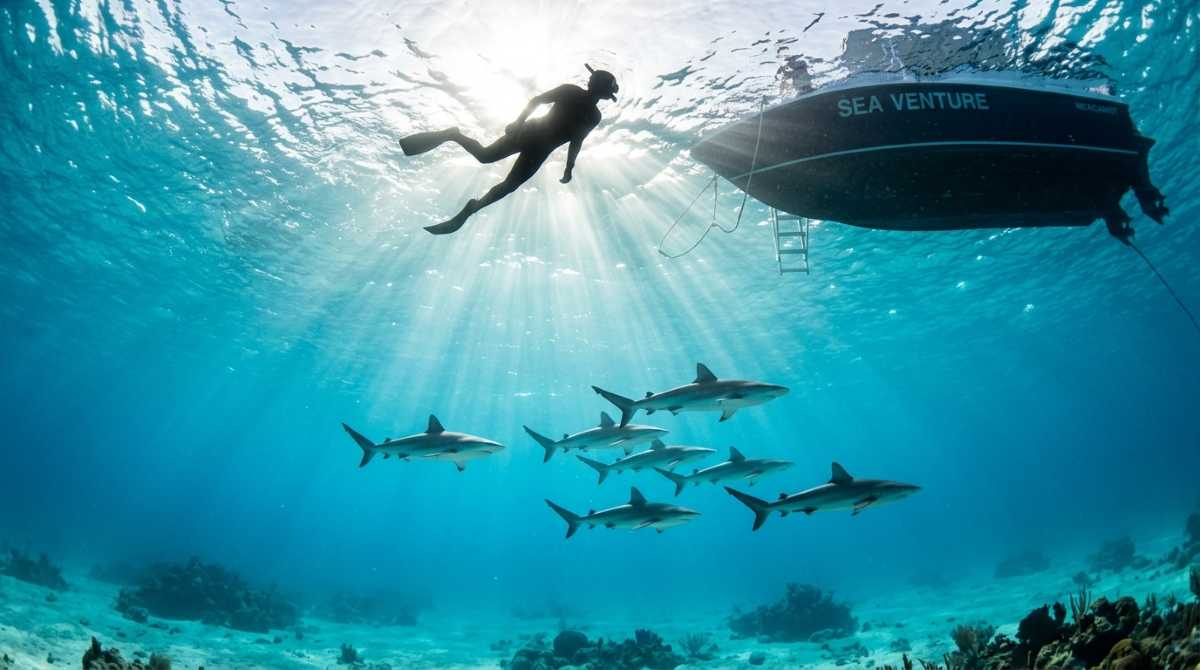
But on a tiny island off the coast of Cancún, something extraordinary is happening. Thirty-two fishermen who spent their lives pulling sharks out of the Caribbean have put down their nets, picked up snorkels, and started taking tourists to swim with the very creatures they used to kill. The result? Over 30,000 sharks protected, a model the world is now trying to copy, and a story so unlikely it sounds like fiction.
It's not. It's Isla Mujeres. And it might just be the most important conservation success story in the Caribbean.
The Killers Who Became the Guardians
The cooperative is called Kab Xok — Mayan for "shark forest" — and it's led by a fisherman named Raciel Rivero Cobá. For years, Raciel and his crew did what fishing cooperatives across Mexico's Caribbean coast have always done: they targeted sharks. Silky sharks, bull sharks, whatever came up in the nets. It was legal, it was income, and it was the only life they knew.
Then, in 2016, a group of Mexican scientists, divers, and conservationists showed up with a wild proposition: what if catching sharks was worth less than letting them live?
The organization was Saving Our Sharks (SOS), founded in 2010 by a coalition of marine biologists and divers headquartered in Quintana Roo. They didn't come with speeches or protest signs. They came with data, training, and a concrete business plan: stop killing sharks, start leading snorkeling tours, and we'll help you build the infrastructure to make it work.
It took six years of patient work. SOS provided diving certification, equipment, marine biology training, and — critically — helped the cooperative acquire its own boat, christened the Kab Xok, funded entirely through donations. The vessel now serves double duty: tourist expeditions and scientific monitoring of shark populations.
By 2022, the results were staggering. Kab Xok's fishermen had reduced their use of shark-targeting fishing gear by 80 percent. The waters around Isla Mujeres, once a killing ground, were becoming a sanctuary.
Why Sharks Matter (And Not Just for the Obvious Reasons)
Here's the thing about sharks that most people don't realize: they're basically the ocean's immune system. As apex predators, they keep fish populations in balance. Without sharks, mid-level predators explode, they overeat the herbivores that keep algae in check, and coral reefs — the same reefs that bring 30 million tourists a year to Quintana Roo — suffocate under algal blooms and die.
The Caribbean's reef system is the second-largest barrier reef in the world. It generates billions in tourism revenue for Mexico alone. Protecting sharks isn't just a feel-good environmental story — it's an economic imperative. Dead reefs mean dead tourism. No sharks, no reefs. It's that simple.
Some of the sharks protected around Isla Mujeres are migratory species that travel as far as the United States and South America. Which means this tiny Mexican fishing cooperative is doing work that has hemispheric ecological implications. A silky shark tagged near Isla Mujeres might show up in Florida six months later. Save it here, you save it there.
Tourism That Actually Fixes Things
What Kab Xok and SOS built isn't just eco-tourism. They're calling it "regenerative tourism" — and the distinction matters.
Regular eco-tourism is basically tourism that does less harm. You take a boat out, you don't throw trash in the water, you feel good about yourself. Regenerative tourism actively repairs the ecosystem while generating income. Every tourist who pays for a "Shark Safari" snorkeling expedition is funding shark monitoring, providing income that replaces fishing revenue, and contributing to a database of shark sightings that scientists use to track population recovery.
The numbers tell the story. Since the program's expansion:
- 30,000+ sharks directly protected through reduced fishing and active monitoring.
- 120 intersectoral alliances built between government, academia, civil society, and private businesses.
- 3.5 million people reached annually through education and awareness campaigns.
- 242,000 hectares of marine area currently under cooperative protection.
- 80% reduction in shark-targeting fishing gear across the cooperative.
Andrés Aguilar, Quintana Roo's undersecretary of tourism, has called the project "a pillar of regenerative tourism" for the state. That's not just political flattery — it's an acknowledgment that Isla Mujeres has stumbled onto something the entire global tourism industry is desperately trying to figure out: how to make money from nature without destroying it.
Why Scaling This Is Terrifying
Here's where the story gets complicated — and where Melodie Treviño, CEO of Saving Our Sharks Foundation, starts sounding nervous.
The model works in Isla Mujeres because it's small, community-controlled, and governed by strict scientific protocols. Every Shark Safari follows detailed operational manuals. Every interaction with sharks is monitored. The fishermen-turned-guides understand the biology because they've been trained in it.
Scale it too fast, lose the community control, and you get what Treviño calls "prácticas extractivas disfrazadas de sustentabilidad" — extractive practices disguised as sustainability. In plain English: operators who claim to offer shark ecotourism but are actually harassing, feeding, or otherwise stressing the animals for tourist Instagram shots. It's already happening in parts of the Caribbean. Bad shark tourism can be worse than no shark tourism.
SOS's 2030 plan is ambitious: consolidate the transition across 100% of fishing permit holders in the region, establish the first formal shark and ray fishery refuge, expand protected marine area from 242,000 to 4 million hectares, and build a network of 150 national and international alliances. It's the kind of plan that looks brilliant on a whiteboard and terrifying in execution.
Go See It Yourself
The world is watching this project, and not just because sharks are photogenic. Isla Mujeres has become a case study in something much bigger: how do you convince people whose livelihoods depend on killing wildlife to stop killing it?
The answer, it turns out, isn't guilt. It isn't legislation. It isn't protest. It's showing people that the living resource is worth more than the dead one — and then giving them the tools, training, and time to make the switch. It took Kab Xok six years. Thirty-two fishermen. One boat. And a group of stubborn scientists who refused to accept that the slaughter was inevitable.
The Caribbean is losing its sharks. The global number — 11,000 per hour — comes from bycatch, finning, and industrial fishing operations that stretch from Asia to the Atlantic. Isla Mujeres can't stop that. But it can prove that a different model exists, that fishermen will choose it when given a real alternative, and that the economics work.
That's the story. Not a sad environmental obituary. A blueprint.
If you're in Cancún or Playa del Carmen, the Shark Safari operates out of Isla Mujeres with departures from the island's port. You'll snorkel with silky sharks in open water under the guidance of former fishermen who know these waters better than anyone alive. The experience costs a fraction of what you'd pay for a comparable dive in the Bahamas or Galápagos — and the money goes directly to the community that's keeping the sharks alive.
Just don't touch them. Seriously. The manuals are strict for a reason.
Reporting based on sources from 24 Horas Quintana Roo and Saving Our Sharks Foundation. Mexicanist independently reviewed publicly available data from SOS's 2026 results and 2030 strategic plan.