The Sharpest Thing on Earth Came From a Mexican Volcano
Volcanic glass from Mexico was sharper than any surgical steel — and the Maya used it for surgery, sacrifice, and scrying into the spirit world. The sharpest material on Earth isn’t made in a lab.

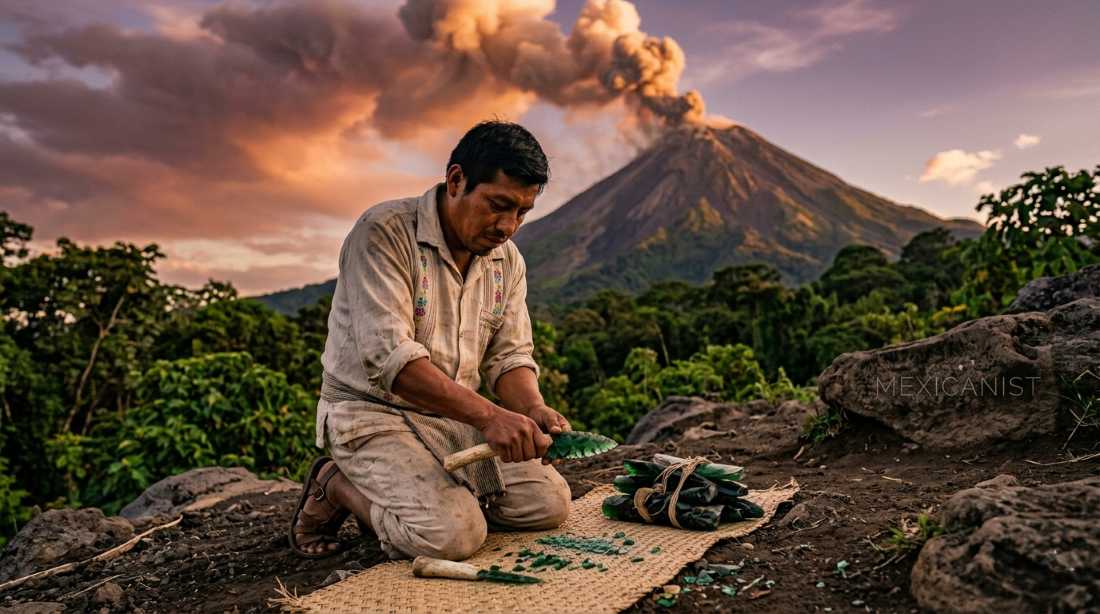
Here's a fun party trick: ask your friends what the sharpest material on Earth is. They'll say diamond, or maybe surgical steel, or some fancy nano-engineered whatever from a lab in Zurich. They're all wrong. The sharpest edge ever measured belongs to a chunk of volcanic glass that's been oozing out of the Mexican earth for millennia, and the Mesoamericans figured out how to use it before the rest of the world had even invented the wheel—well, technically Mesoamericans hadn't invented the wheel either, but you get the point.
Obsidian, the humble black stone you've seen at every flea market tourist trap from Tijuana to Tulum, is not a souvenir. It's a technological marvel, a sacred object, a surgical instrument, and a weapon so lethal that Spanish conquistadors wrote home about it with the kind of respect usually reserved for plagues and excommunication. This is the story of a stone that holds memory—memory of the earth, memory of gods, and memory of the people who bled for them.
How a Volcano Makes a Razor
Let's get the nerdy stuff out of the way first, because it actually matters. Obsidian is not technically a mineral. Geologists call it a "mineraloid"—a naturally occurring volcanic glass formed when silica-rich lava erupts from a volcano and cools so fast that atoms don't have time to arrange themselves into a crystal structure. We're talking about magma that hits the surface and goes from 1,000 degrees Celsius to solid in a matter of hours, sometimes minutes. The result is an amorphous, homogeneous material that's roughly 70 to 75 percent silicon dioxide (SiO2), and it's this lack of internal crystalline structure that gives obsidian its most remarkable property: it breaks with what geologists call a conchoidal fracture, producing edges that can be as thin as a single molecule—roughly one nanometer. For context, a human hair is about 80,000 nanometers wide.
Steel, even the fancy surgical-grade stuff, can't touch that. The best steel scalpels in any operating room have edges measuring around 300 to 600 nanometers. Obsidian edges come in at roughly 3 nanometers. That's not a small improvement; that's two orders of magnitude sharper. If you put them on a graph, surgical steel wouldn't even show up. An obsidian blade can literally cut between cells, separating tissue at a cellular level without crushing or tearing the surrounding material. Under an electron microscope, a steel blade looks like a jagged mountain range compared to the obsidian's molecularly smooth cliff face. Nature spent about 500 million years perfecting this, and honestly, she did a better job than GE or 3M.
Obsidian comes in a range of colors depending on trace mineral content—iron and magnesium give it the classic jet-black sheen, while inclusions of cristobalite or other minerals can produce the iridescent "rainbow obsidian" that jewelry makers swoon over. But for Mesoamerican civilizations, the color that really mattered was green. The vivid, bottle-green obsidian from the Pachuca source, roughly 50 kilometers northeast of modern-day Mexico City, was prized above all others. It was the color of jade, the color of life, the color of water in a world that could never get enough of it. And the civilization that controlled Pachuca controlled one of the most valuable commodities in the ancient world.
The Black Gold of the Ancient World
Imagine, for a moment, that someone cornered the market on silicon chips in 1200 BCE and used that monopoly to build an empire. That's essentially what happened at Teotihuacan, the massive metropolis just northeast of present-day Mexico City. At its peak around 450 CE, Teotihuacan was home to perhaps 200,000 people, making it one of the largest cities on the planet. And its economic engine was obsidian. The volcanic deposits around Pachuca and Otumba produced obsidian of exceptional quality, and Teotihuacan's artisans turned it into everything: blades, scrapers, arrowheads, jewelry, mirrors, ceremonial objects, and architectural ornaments. Archaeological evidence from the Workshop of the Great Compound at Teotihuacan shows industrial-scale obsidian processing that would make a modern factory look disorganized. They had specialized workstations, standard toolkits, and production lines churning out prismatic blades—long, razor-sharp flakes knapped from prepared cores—by the thousands.
Here's where it gets wild: trace-element analysis published in the Journal of Anthropological Research confirmed that the distinctive green obsidian from Pachuca has been found at Maya archaeological sites over 1,000 kilometers away. That's the distance from New York City to Miami, traded on foot and by canoe through dense jungle, across mountains, and along coastlines, without pack animals or wheels. Green Pachuca obsidian turned up at Tikal, Copan, Kaminaljuyu, and sites throughout the Maya lowlands, often in elite burials and ceremonial contexts. This wasn't just trade; this was geopolitics. When a Maya king buried his father with a cache of green obsidian blades, he was signaling an alliance with the most powerful civilization in Mesoamerica. He was saying: we are connected to the center of the world.
Teotihuacan's obsidian monopoly was so complete that when the city collapsed around 550 CE, the shockwaves rippled through every civilization in the region. Obsidian distribution patterns shifted dramatically. New trade routes emerged. Political alliances fractured and reformed. A 2023 pXRF study from Iowa State University tracking obsidian artifacts across the Maya region found that the fall of Teotihuacan caused a complete restructuring of Mesoamerican exchange networks—the ancient equivalent of what would happen if OPEC suddenly dissolved and every country had to figure out energy on their own. Obsidian wasn't just a rock. It was oil, silicon, and gold all wrapped into one gleaming, razor-sharp package.
The Scalpel That Cuts Between Your Cells
Okay, let's talk about the surgery thing, because this is where obsidian goes from "interesting" to "hold on, what." Modern surgeons have known about obsidian's superior sharpness since at least the 1970s, when a green-belted archaeologist named Don Crabtree started making experimental obsidian blades and demonstrating them at conferences. But the real proof came in 1993, when a study published in the peer-reviewed journal "American Journal of Surgery" by researchers Disa and Vossoughi compared wound healing between obsidian blades and surgical steel scalpels. The results were striking: under blinded histologic review at seven days post-incision, obsidian wounds contained fewer inflammatory cells and less granulation tissue than steel wounds. The incisions were cleaner, the healing was faster, and the scarring appeared reduced. The edge was so fine that it separated individual cells rather than tearing through clusters of them.
More recently, a 2023 study published in the journal "Bioengineering" by researchers working on nanometric-scale-polished surgical blades found that the closer a blade's edge approaches the molecular level, the less tissue inflammation and fibrosis it produces. Obsidian, as it turns out, has been at this molecular level since before humans existed. A 2024 study in the "Journal of Surgical Medicine" on nano-based zirconia blades confirmed that nano-scale sharpness accelerates wound healing—which means that obsidian has been the gold standard for surgical sharpness for, oh, about 30,000 years, and we're only now catching up with what Stone Age knappers already knew.
So why aren't surgeons reaching for obsidian scalpels today? Two words: the FDA and practicality. Obsidian blades are brittle. While the edge is spectacular, it doesn't hold up well under the kind of torque and repetition that modern surgery demands. An obsidian scalpel can chip or shatter inside a patient, which is the kind of thing that gets you sued, disciplined, and probably featured in a medical malpractice textbook. Steel blades, while less sharp, are predictable, sterilizable, and compliant with medical regulations. But in niche applications—particularly delicate ophthalmic and plastic surgery procedures where the cleanest possible cut matters more than blade longevity—a handful of surgeons have quietly used obsidian blades with excellent results. The sharpest knife on Earth is sitting in a display case at a museum gift shop while your surgeon makes do with something a hundred times duller. Make of that what you will.
The Sword That Scared Conquistadors
If you want to understand just how much respect obsidian commanded in the ancient world, consider this: when Hernan Cortes and his men arrived in Mexico in 1519, the weapon that terrified them most wasn't the atlatl (a spear-thrower that could punch through Spanish armor) and it wasn't the slingshot (which could crack a skull at 60 meters). It was the macuahuitl—a flat wooden club, roughly 70 to 100 centimeters long, embedded along both edges with razor-sharp obsidian blades set into grooves with a plant resin adhesive. Picture a cricket bat, but instead of willow, the edges are lined with broken glass. Now picture a six-foot-tall Jaguar Warrior swinging it at your head.
Spanish accounts from Bernal Diaz del Castillo's "True History of the Conquest of New Spain" describe the macuahuitl with genuine alarm. Diaz wrote that a single blow could decapitate a horse—and he wasn't exaggerating. Modern experimental archaeology has confirmed that a well-made macuahuitl can indeed cut through bone with a single strike. The obsidian blades don't so much slice as they shatter on impact, creating a devastating wound channel of glass fragments embedded in flesh and bone. It was a weapon designed not for prolonged combat but for devastating initial strikes—hit someone with this, and they're not getting back up.
The brilliance of the macuahuitl is that it combined the cutting power of obsidian with the reach and leverage of a wooden club. Obsidian alone is too brittle for a sword-length blade—it would snap on the first parry. But by setting small, replaceable blades into a wooden frame, Mesoamerican engineers created a weapon that was both deadly and sustainable. After a battle, warriors could simply pop out the broken blades and slot in fresh ones. It was, in essence, the world's first modular weapon system. The macuahuitl wasn't just a club with rocks stuck in it. It was a feat of engineering that the Spanish, for all their steel and gunpowder, couldn't replicate or improve upon.
The Ritual of Auto-Sacrifice
Now we need to talk about the part that makes people uncomfortable, because no honest account of obsidian in Mesoamerican culture can skip it. This stone was used for human sacrifice—specifically, for auto-sacrifice, the ritual practice of self-cutting or piercing to offer blood to the gods. And it wasn't some fringe practice done by a few zealots. It was central, formalized, and practiced by everyone from kings to commoners, from the Olmec period (beginning around 1200 BCE) straight through the Aztec empire's fall in 1521 CE. In the Classic Maya period (250–900 CE), bloodletting was so culturally embedded that it was recorded in hieroglyphic texts, depicted on carved stone monuments, painted on ceramic vessels, and encoded into the symbolism of royal regalia.
The ritual went something like this, based on archaeological evidence from sites like Yaxchilan, Palenque, and Tikal: a ruler or priest would use an obsidian prismatic blade, a stingray spine, or a shark's tooth to pierce soft tissue—usually the tongue, earlobes, or, in some documented cases, the penis. The blood would be collected on strips of bark paper and then burned as an offering. The smoke, carrying the blood, was believed to open a portal to the spirit world, allowing the practitioner to communicate with ancestors and gods. At Yaxchilan, the famous Lintel 24 shows Lady Xoc pulling a thorned rope through her tongue while the deity Vision Serpent rises from the burning blood-soaked paper above her. It's one of the most powerful images in all of Maya art, and it's also one of the most visceral depictions of religious devotion ever created.
A landmark 2014 study published in "Anthropological Science" analyzed temporal and spatial variation in Maya bloodletting rituals recorded in hieroglyphic texts. The researchers found that bloodletting was not static—it evolved over time, becoming more elaborate and formalized as Maya city-states competed for prestige. By the Late Classic period, bloodletting had become a kind of theological arms race, with rulers commissioning ever-more-elaborate rituals to demonstrate their proximity to the divine. The obsidian blade was the instrument that made it all possible. Its molecular sharpness meant less pain, cleaner cuts, and more blood flow—the stone wasn't just a tool, it was a technology optimized for communion with the gods. Whether you find that beautiful or horrifying probably says more about you than about the Maya.
Tezcatlipoca's All-Seeing Eye
If obsidian's most practical gift to humanity was its edge, its most mystical was its surface. When polished, obsidian produces a mirror of extraordinary depth and clarity—a black window into infinity that Mesoamerican civilizations treated not as a reflective surface but as a portal. The Aztec god Tezcatlipoca, whose name literally translates to "Smoking Mirror," was the deity most closely associated with obsidian mirrors. He was the god of the nocturnal sky, of ancestral memory, of sorcery, and of fate—and his primary attribute was a circular obsidian mirror worn on his chest or his foot that could see into the hearts and minds of mortals. To look into Tezcatlipoca's mirror was to see yourself stripped bare, with every secret, every lie, every hidden desire exposed. Kings feared it. Priests guarded it. And every Aztec ruler kept a personal obsidian mirror for divination.
A 2022 paper published in the journal "Ancient Mesoamerica" by Cambridge University researchers presented compelling evidence that mirrors and blood were regarded as a conceptually linked pair within the imperial ideology of Teotihuacan. The argument goes like this: obsidian mirrors were believed to be a surface upon which the divine could appear, and blood—offered through sacrifice—was the medium that activated them. The mirror didn't reflect your face; it reflected your fate. And the blood was the ink in which that fate was written. This isn't metaphor. Archaeological evidence from the Teotihuacan palace complex shows that obsidian disks were the preferred medium for depicting the eyes of supernatural beings, and the palace murals repeatedly pair mirror imagery with blood ritual. The "Blood Mirror Cult" of Teotihuacan, as researchers have called it, appears to have been a foundational element of the city's imperial ideology—a belief system so powerful that it helped sustain an empire for centuries.
The Maya had their own mirror traditions. A 2022 study from the University of Texas at Austin examined mirrors in Maya visual and material culture, concluding that Maya mosaic mirrors—crafted from polished pyrite and obsidian set into mosaic patterns—were employed in rituals as symbols of authority and instruments of communication with the divine and the dead. Mirrors were associated with the underworld (Xibalba), with fire, with royalty, and with the concept of "itz"—a Mayan word that roughly translates as "sacred substance" or "life force." When a Maya king gazed into an obsidian mirror, he wasn't checking his reflection. He was checking in with the ancestors. He was reading the messages written in smoke and shadow.
The power of the obsidian mirror extended far beyond Mesoamerica, by the way. In 2021, researchers from the University of Cambridge published a landmark study in the journal "Antiquity" confirming that a black obsidian mirror in the British Museum, long attributed to the Elizabethan astrologer John Dee, was in fact of Aztec origin. Dee, who served as an advisor to Queen Elizabeth I, used the mirror for scrying—a form of divination involving gazing into a reflective surface to receive visions or messages from spirits. The mirror, crafted in Mexico more than 500 years ago, had somehow made its way from the temples of Tenochtitlan to the court of England's greatest queen, where it was used to speak with angels. If that's not a testament to the enduring, almost supernatural allure of obsidian, I don't know what is.
Why the Maya Called It Sacred
So we've covered the science, the trade, the surgery, the weapons, the sacrifice, and the mirrors. But the question that ties it all together is: why? Why did Mesoamerican civilizations—the Maya in particular—consider a chunk of volcanic glass to be sacred? It's not like there was a shortage of rocks. The answer lies in the unique intersection of properties that obsidian possesses, and the way those properties aligned with Mesoamerican worldview in a way that almost seems too perfect to be coincidental.
First, there's the origin. Obsidian comes from volcanoes, and in Mesoamerican cosmology, volcanoes were among the most powerful manifestations of the earth's creative and destructive force. The Popol Vuh, the foundational creation narrative of the K'iche' Maya, describes a world shaped by divine fire. Mountains were alive, and their eruptions were expressions of divine will. When obsidian emerged from a volcano, it wasn't just a geological event—it was the earth giving birth to something sacred. The stone literally came from the heart of the world.
Second, there's the sharpness. In cultures where blood was the primary medium of divine communication, you needed tools that could draw blood cleanly and precisely. Obsidian's molecular edge wasn't just convenient—it was a technological miracle that allowed ritual practitioners to offer blood with minimal pain and maximum flow. The stone was, in a very real sense, designed by nature for the specific purpose of bloodletting. The Maya would have seen this not as coincidence but as evidence of intention—as proof that the earth had provided exactly the tool needed to maintain the covenant between humans and gods.
Third, there's the mirror. A polished obsidian surface reflects light and images with a depth and clarity that no other natural material in Mesoamerica could match. When a Maya priest looked into an obsidian mirror, he saw a dark, infinite depth—a void that could be the underworld, the sky, the realm of ancestors, or the face of a god. The mirror was a technology for seeing the unseen, and obsidian was the only material that could provide it. No other stone, no metal, no crystal could do what polished obsidian did. It was unique, rare, and irreplaceable—the very definition of a sacred object.
Finally, there's the fragility. Obsidian is hard but brittle. Its edges are spectacular but temporary. A blade that cuts like nothing else in the world will also chip, dull, and shatter with use. This transience was not a bug in Mesoamerican theology—it was a feature. Sacred objects that lasted forever were for gods. Sacred objects that broke and were renewed were for humans. The cycle of creating, using, and replacing obsidian tools mirrored the cycle of birth, death, and rebirth that lay at the heart of Mesoamerican cosmology. Every time a priest knapped a new obsidian blade for a bloodletting ritual, he wasn't just making a tool—he was reenacting the creation of the world. The stone held memory not because it remembered, but because using it forced humans to remember who they were and where they came from.
But Wait, Is It Really That Special?
Let's be fair for a second. Not every claim about obsidian holds up to scrutiny. Some popular accounts exaggerate its sharpness to absurd degrees—claims that it's "500 times sharper" than steel, for instance, appear to come from enthusiast websites rather than peer-reviewed science. The more conservative, evidence-based figure puts obsidian edges at roughly 100 times thinner than surgical steel, which is still extraordinary but doesn't require a suspension of disbelief. Similarly, while obsidian wounds do heal cleaner in controlled studies, the practical difference in clinical outcomes is small enough that no hospital has adopted obsidian as a standard surgical tool, and for good reason: the regulatory, logistical, and liability challenges are enormous.
There's also a tendency in popular writing—and yes, I'm aware I'm doing this right now—to romanticize the relationship between Mesoamerican cultures and obsidian. The reality is more complicated. Not every obsidian artifact was sacred. The vast majority of obsidian produced in Mesoamerica was used for prosaic purposes: scraping hides, cutting food, carving wood, making basic tools. The sacred uses were important, but they were also relatively rare compared to the mundane ones. The image of the noble priest holding an obsidian blade to the light is more compelling than the image of a farmer using one to gut a fish, but the farmer's use was far more common. Obsidian was extraordinary, but it was also ordinary—and the tension between those two identities is part of what makes it so fascinating.
Obsidian is still out there. It's still forming in the volcanic zones of Mexico, Guatemala, Ecuador, Japan, Iceland, and a dozen other countries. You can buy it on Etsy, pick it up at a mineral show, or find it yourself if you know where to look. The technology to work it—pressure flaking, percussion knapping—is thousands of years old and can be learned in an afternoon. Modern flintknappers produce blades that rival anything made in Teotihuacan. And yet, for all our knowledge, for all our electron microscopes and nanometric measurements, we still can't quite capture what obsidian meant to the people who used it first.
To the Maya, obsidian wasn't just a material. It was a medium—a way to communicate with gods, ancestors, and the earth itself. It cut flesh to release the blood that sustained the cosmos. It reflected the faces of the dead. It carried the green fire of Pachuca across a thousand kilometers of jungle. It armed warriors and healed wounds and crowned kings. It was the sharpest tool in the world and the most sacred stone in the Americas, and somehow it was both of those things at the same time, which shouldn't be possible but was, and is.
Sources
[1] Disa, J.J., and Vossoughi, J. (1993). "A comparison of obsidian and surgical steel scalpel wound healing." American Journal of Surgery. PMID: 8415970. Available at: https://pubmed.ncbi.nlm.nih.gov/8415970
[2] Cambridge University Press (2022). "Blood, obsidian, and the Teotihuacan cult of the mirror." Ancient Mesoamerica. Available at: https://www.cambridge.org/core/journals/ancient-mesoamerica/article/blood-obsidian-and-the-teotihuacan-cult-of-the-mirror/4278B64ABA09FDAE789A9AD4AF03FF69
[3] University of Cambridge (2021). "The mirror, the magus and more: reflections on John Dee's obsidian mirror." Antiquity, 95(383). Available at: https://www.cambridge.org/core/journals/antiquity/article/mirror-the-magus-and-more-reflections-on-john-dees-obsidian-mirror/38D4BFEA2CB9766973791029C2EE1289
[4] Smithsonian Magazine (2021). "Magic mirror used by Elizabeth I's court astrologer has Aztec origins." Available at: https://www.smithsonianmag.com/smart-news/magic-mirror-used-by-queen-elizabeth-is-court-astrologer-has-aztec-origins-180978830
[5] Getty Research Institute. "Through the Obsidian Mirror." Available at: https://www.getty.edu/research/exhibitions_events/exhibitions/obsidian_mirror/through_the_mirror.html
[6] British Museum. "Magical mirror; mirror-case (Aztec obsidian mirror of Dr. Dee)." Available at: https://www.britishmuseum.org/collection/object/H_1966-1001-1
[7] JSTOR (1996). "Commodity or Gift: Teotihuacan Obsidian in the Maya Region." Ancient Mesoamerica, 7(1). Cited by 98. Available at: https://www.jstor.org/stable/3537012
[8] National Institutes of Health / PMC (2014). "Classic Maya Bloodletting and the Cultural Evolution of Religious Ritual." Anthropological Science. PMC4177853. Available at: https://pmc.ncbi.nlm.nih.gov/articles/PMC4177853
[9] IFLScience. "The 'Blood Mirror Cult' That Inspired A Powerful Pre-Aztec Empire." Available at: https://www.iflscience.com/the-blood-mirror-cult-that-inspired-a-powerful-pre-aztec-empire-73376
[10] Mesoweb Publications. Taube, K.A. (2022). "Fire, Self Sacrifice, and the Central Mexican Cult of War." Available at: https://www.mesoweb.com/publications/Works2/Taube%5B2000%5D2022.pdf
[11] Mexicolore. "See and Be Seen: ('Smoking') Mirrors." Available at: https://www.mexicolore.co.uk/aztecs/artefacts/smoking-mirrors
[12] Tiesler, V. "Cranial Surgery in Ancient Mesoamerica." Mesoweb Publications. Available at: https://www.mesoweb.com/features/tiesler/Cranial.pdf
[13] Iowa State University (2023). "An attribute analysis and pXRF study of obsidian artifacts." Graduate Theses and Dissertations. Available at: https://dr.lib.iastate.edu/bitstreams/832c014f-477f-45ea-ab2f-c11cda84f952/download
[14] MDPI Bioengineering (2023). "Nanometric-Scale-Polished, Engineered Surgical Scalpel Blades Reduce Tissue Inflammation and Scarring." Available at: https://www.mdpi.com/2673-4095/6/2/30
[15] Journal of Surgical Medicine (2024). "Nano-based ceramic surgical blade accelerates wound healing." Available at: https://jsurgmed.com/article/view/857885
[16] Wesleyan University. "Studies of Obsidian Use and Exchange in the Maya Area." Available at: https://digitalcollections.wesleyan.edu/_flysystem/fedora/2023-03/22230-Original%20File.pdf
[17] University of Texas at Austin. "Mirrors, Divination, and The Underworld in Maya Visual and Material Culture." Available at: https://repositories.lib.utexas.edu/bitstreams/34703217-f1d3-40be-b647-62015f8e7c86/download
[18] Apollo Magazine (2021). "The Aztec origins of John Dee's famous mirror." Available at: https://apollo-magazine.com/john-dee-mirror-aztec-obsidian
[19] Galeria Contici. "The Important Roles of Obsidian in Pre-Columbian Cultures." Available at: https://galeriacontici.net/the-important-roles-of-obsidian-in-pre-columbian-cultures
[20] Wikipedia. "Mirrors in Mesoamerican culture." Available at: https://en.wikipedia.org/wiki/Mirrors_in_Mesoamerican_culture
[21] Wikipedia. "Bloodletting in Mesoamerica." Available at: https://en.wikipedia.org/wiki/Bloodletting_in_Mesoamerica
[22] Wikipedia. "Macuahuitl." Available at: https://en.wikipedia.org/wiki/Macuahuitl
[23] Harvard Divinity Bulletin. "The Obsidian Mirror." Available at: https://bulletin.hds.harvard.edu/the-obsidian-mirror