They Bought Their Dream Homes in Paradise. Now 50 Families Say They've Lost Everything
Dozens of families signed contracts, made payments, and waited for their condos. Then their properties were transferred to strangers. The SUUT real estate scandal in Playa del Carmen is a warning for every buyer in the Riviera Maya.

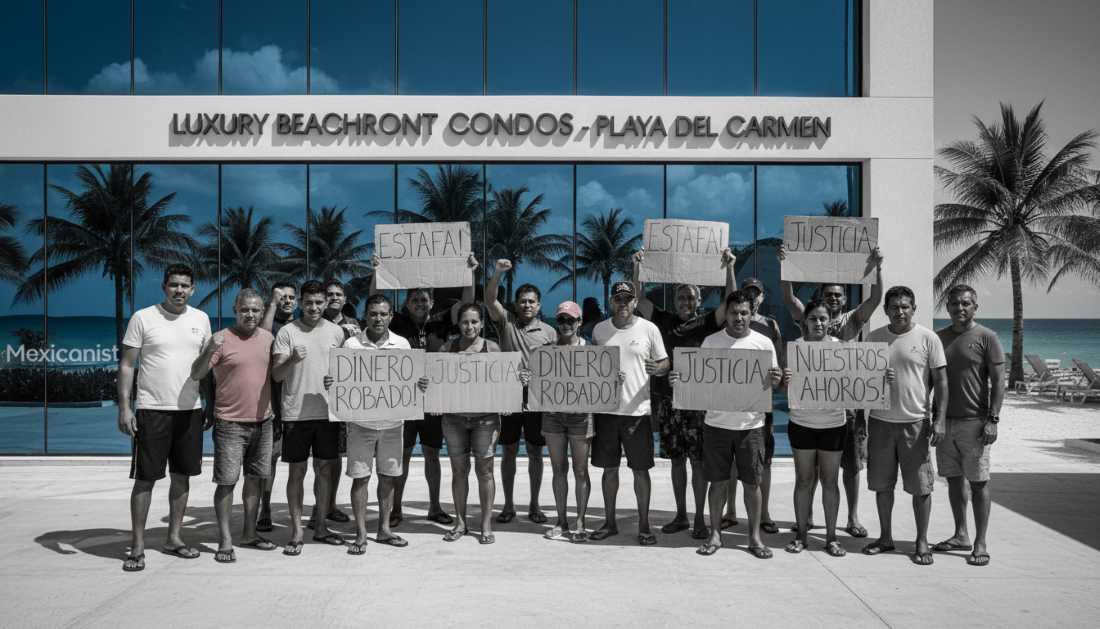
The SUUT development in Playa del Carmen was marketed as the future of Riviera Maya living — modern condos, smart design, investment returns. Dozens of families signed contracts in 2022. Three years later, they're protesting in the streets, their savings gone, their properties transferred to strangers, and the developer selling units they already paid for. If you're thinking about buying real estate in Mexico, this is the story you need to read.
Luis Andocilla had a plan. Work hard, save carefully, buy a condo in Playa del Carmen for retirement. Not a mansion — a modest place near the beach, somewhere warm, somewhere that felt like the future. He signed a contract with the SUUT development in 2022. He paid. He waited.
Three years later, Andocilla is standing in the street with more than 50 other buyers, holding handmade signs, telling anyone who will listen that his property — the one he paid for, the one he has a contract for — has been transferred to someone else. His savings, gone. His retirement dream, a nightmare. And he's not alone.
The SUUT case is the latest eruption in a real estate crisis that's been building in Playa del Carmen for years — and that has implications for anyone who's ever considered buying property in Mexico's booming Caribbean corridor.
What Is SUUT — and What Went Wrong
SUUT is a residential development project in Playa del Carmen, marketed as a modern, sustainable condo complex targeting middle-class Mexican buyers and foreign investors. The pitch was attractive: competitive pricing in a market where the average condo has skyrocketed past $150,000 USD, proximity to the beach, and the promise of capital appreciation in one of Latin America's fastest-growing tourism markets.
Dozens of buyers signed purchase contracts beginning in 2022. They made down payments. Some made progress payments. They did what you're supposed to do in a real estate transaction: signed documents, trusted the process, waited for their units to be built.
Then the transfers started.
According to the protesting buyers, properties they had contracted and paid for were transferred — through the Public Registry — to other parties. Not sold back to them. Not refunded. Transferred. As in: the title changed hands, the original buyer's name disappeared from the registry, and someone else now legally owns the property that Luis Andocilla thought was his.
The buyers allege irregularities in the Public Registry of Property (Registro Público de la Propiedad). They allege that Sedetus — the state agency responsible for urban development and land regulation in Quintana Roo — failed to provide adequate oversight. And they allege that the project was reactivated — meaning new units were put up for sale — while existing contracts remained unresolved and judicial proceedings were still pending.
Playa del Carmen's Bigger Problem
The SUUT case didn't happen in a vacuum. Playa del Carmen has been one of the fastest-growing cities in Mexico for two decades — and its real estate market has grown faster than its regulatory infrastructure could handle.
Consider the numbers: Playa del Carmen's population has grown from roughly 100,000 in 2000 to over 300,000 today. The municipality of Solidaridad, which includes Playa del Carmen, has approved thousands of residential units in the past decade. The vacation rental market — Airbnb, VRBO, Booking.com — has exploded, with the city's finance secretary Javier Regalado Hendricks recently acknowledging that vacation rental taxes will be "key" to shoring up municipal finances for 2026.
But here's what the brochures don't tell you: Mexico's real estate legal framework, particularly in rapidly developing states like Quintana Roo, has significant gaps in buyer protection.
The fideicomiso problem. Foreign buyers must purchase property through a bank trust (fideicomiso) in the restricted zone — within 50 km of the coast. These trusts are renewable every 50 years and technically mean you don't own the land directly; the bank holds title in trust for you. When disputes arise, the trust structure adds a layer of complexity that many foreign buyers don't fully understand.
The ejido problem. Much of the land in Quintana Roo was originally ejido — communal agricultural land granted to farmers after the Mexican Revolution. Ejido land cannot be privately sold without a formal conversion process (regularización). In the rush to develop, some projects were built on land that hadn't completed this process, leaving buyers with properties that have unclear legal status.
The registry problem. The Public Registry of Property, which is supposed to be the definitive record of who owns what, is operated at the state level and has historically been vulnerable to irregularities. In the worst cases, the same property has been registered to multiple parties, or transfers have been executed without the knowledge or consent of the original buyer. This is exactly what the SUUT protesters are alleging.
Who's Supposed to Be Watching This?
The state agency responsible for regulating real estate development in Quintana Roo is the Secretaría de Desarrollo Urbano y Sustentabilidad (Sedetus). In theory, Sedetus reviews development permits, ensures compliance with land use regulations, and monitors the legality of property transactions.
In practice, the SUUT buyers say Sedetus was absent. The agency's failure to provide "effective vigilance" — the protesters' words — allowed the developer to continue selling units, transferring properties, and operating despite unresolved complaints and pending judicial decisions.
This is a pattern in Mexico. Regulatory agencies are often understaffed, underfunded, and susceptible to political pressure in states where real estate development is a major economic driver. Nobody wants to be the official who slows down a $50 million development project — even when buyers are getting hurt.
The SUUT case involves primarily Mexican buyers, but the implications extend to the thousands of foreign nationals — particularly Americans and Canadians — who purchase property in Quintana Roo every year. The Riviera Maya is one of the most popular destinations for foreign real estate investment in Latin America.
If properties can be transferred out from under buyers who have signed contracts and made payments — and if the developer can simply re-list those same units for new buyers while legal proceedings are ongoing — then the entire framework of buyer protection in Quintana Roo real estate is fundamentally broken.
For foreign buyers, the risks are amplified by distance, language barriers, and unfamiliarity with Mexican legal procedures. Many discover problems only when they try to sell, when a title search reveals that their property has competing claims, irregular registrations, or was built on improperly regularized land.
What Needs to Happen
The SUUT buyers are demanding three things:
- Immediate intervention by state authorities to freeze further sales and transfers of SUUT properties until all existing disputes are resolved
- A full audit of the Public Registry transactions related to the development, to identify how properties were transferred without buyer consent
- Criminal investigation into whether fraud was committed — specifically whether the developer knowingly sold the same units to multiple parties or transferred titles in violation of existing contracts
So far, the response from authorities has been muted. The judicial proceedings are "pending" — which in Mexico can mean anything from "actively under review" to "buried in a file cabinet somewhere." And the developer appears to be continuing operations, which the protesters see as the most damning evidence of regulatory failure.
Playa del Carmen is beautiful. The beaches are real. The growth is real. The investment potential is real. And the risk is also real.
If you're buying property in Mexico — especially in Quintana Roo — the SUUT case should be required reading. Use a notario público (a specialized Mexican legal official, not a regular notary). Get independent title insurance. Verify every entry in the Public Registry. Don't trust the developer's lawyer to protect your interests. And understand that the regulatory framework protecting you is thinner than you think.
Luis Andocilla did everything a reasonable person would do. He signed a contract. He paid. He waited. And now he's standing in the street with 50 other families, holding a sign, wondering how the system that was supposed to protect him instead made his retirement disappear.
That's not a Mexican problem or a foreign problem. That's a trust problem. And until it's fixed, every property transaction in the Riviera Maya comes with an asterisk.
Sources: 24 Horas Quintana Roo — "¿Será? Alerta en Playa del Carmen" (April 16, 2026); 24 Horas Quintana Roo — vacation rental taxation and municipal finance (April 18, 2026); La Jornada Maya — Cabildo de Playa del Carmen coverage (April 18, 2026)