Trump's Tariffs Cost Mexico 227,000 Jobs. They're Costing You a Lot More.
The president who promised to bring jobs home just killed 227,000 of them south of the border — most in factories making cars for Americans. Meanwhile, two new studies prove what economists always knew: American consumers are paying nearly all of the tariff bill.

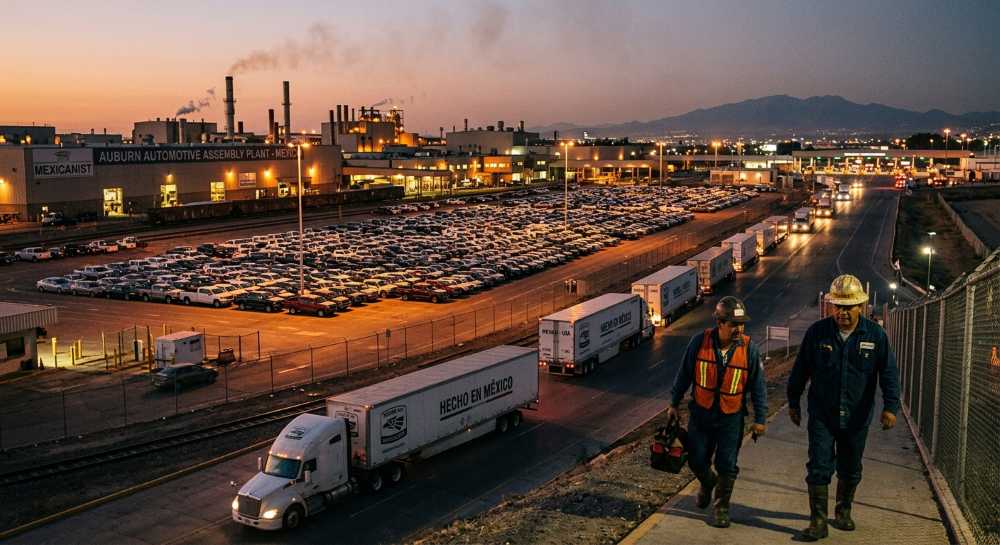
Here's a number that should make you sit up straight: 227,000. That's how many formal jobs Mexico lost in the first quarter of 2026, according to data acknowledged by President Claudia Sheinbaum during her morning press conference on April 28. Nearly a quarter-million paychecks gone in 90 days — in a country where formal employment is the difference between a middle-class life and the informal economy.
Now here's the twist. In that same quarter, Mexico's exports hit an all-time record. March alone saw $70.7 billion in outbound merchandise — a 27.7% annual increase. Non-oil exports to the United States grew 28.2%. Exports to the rest of the world surged 36.9%.
Jobs down. Exports up. The apparent contradiction contains the entire story of U.S.-Mexico trade in the age of tariffs, and it's a story that should concern every American who buys things.
Sheinbaum didn't mince words about the cause. The job losses were concentrated in two sectors: electric vehicle manufacturing and steel. The EV job cuts are directly attributable to the expiration of U.S. federal incentives for new-energy vehicle purchases — the subsidies that had made Mexican-made EVs competitive in the American market. When the incentives died, so did the factory orders.
The steel losses are simpler to explain: tariffs. The Trump administration imposed duties on Mexican steel, and the predictable happened. Mills cut production. Workers got laid off. The supply chain that had been built over three decades of integrated North American manufacturing was interrupted by executive order.
This is worth pausing on. The United States imposed tariffs on steel from Mexico — a country that makes steel partly with American scrap, partly with American demand in mind, and entirely within a trade framework (first NAFTA, now T-MEC) that the United States itself designed. The tariffs didn't protect American steelworkers. They punished the integrated supply chain that makes North American manufacturing competitive with China.
Who Actually Pays Tariffs
Two studies published in early 2026 have demolished the central claim of tariff advocates: that foreign producers absorb the cost. The research shows that between 94% and 96% of tariff costs are borne by the country that imposes them — either through reduced profit margins for importers, higher prices for consumers, or a combination of both.
Let's make that concrete. The American automotive industry — Ford, General Motors, Stellantis — spent $6.5 billion paying tariffs in 2025 alone. When you expand the calculation to all foreign-capital companies operating in the U.S. market, the tariff bill rises to $35 billion in a single year. That's $35 billion that wasn't spent on R&D, factory upgrades, worker wages, or lower sticker prices.
American consumers are already feeling it. Private vehicles — what La Jornada's editorial board aptly called "one of the pillars of the economic, social, and psychological structure" of the United States — have become unaffordable for the average worker. The average new car price in America now exceeds $48,000. Add tariff costs to a vehicle assembled using Mexican and Canadian parts, and you're adding thousands of dollars to a purchase that was already out of reach for millions of families.
Here's what makes the situation truly perverse: Trump's tariffs haven't stopped Mexico from selling to the United States. They've barely even slowed it down. Mexican exports to the U.S. grew 28.2% in the first quarter. The reason is simple: American companies need Mexican manufacturing. They can't replace it domestically without enormous cost increases, and they can't replace it with China without triggering even more tariffs and supply chain risks.
The nearshoring boom that began during COVID has become a structural reality. Companies moved production to Mexico for a reason — proximity to market, competitive labor costs, duty-free access under T-MEC (when the tariffs aren't overriding it), and a manufacturing base that's been built up over 30 years of integration. You can't undo that with a presidential order. The supply chains are too deep, the factories too built, the relationships too entrenched.
Mexico, to its credit, is reading the writing on the wall. The export diversification numbers tell the story: while sales to the U.S. grew 28%, sales to the rest of the world grew 37%. Mexico is actively reducing its dependence on a single market — a rational response to a partner whose trade policy changes with each administration.
There's a bitter historical irony here that La Jornada's editorial nailed. The affordability of American consumer goods — cars, appliances, electronics, clothing — has been built on the dispersal of supply chains to Mexico and Canada since NAFTA took effect in 1994. The treaty that Ross Perot warned would produce a "giant sucking sound" of jobs leaving America instead produced three decades of low inflation and affordable consumer goods.
American manufacturing didn't die because of NAFTA. It evolved. The low-skill assembly jobs moved south, yes. But they were replaced by higher-value work — design, engineering, logistics, marketing — that paid better and required more education. The United States kept the profitable end of the chain and outsourced the labor-intensive part to a neighbor who could do it cheaper.
Trump's assault on this system — on T-MEC and on the broader framework of global trade that Washington built — is, as the Mexican editorialists dryly observed, "a lesson in how to destroy an order from which one obtained enormous benefits."
What Mexico Is Learning
The Sheinbaum administration's response has been telling. Rather than retaliate with tariffs of its own — the classic trade war escalation — Mexico has accelerated its diversification strategy. The record export numbers to non-U.S. markets suggest it's working.
Sheinbaum herself framed the lesson clearly: the best tool against White House unpredictability is reducing dependence on the United States. It's the same conclusion that every country trading with America has been reaching since 2017, and it's slowly reshaping global commerce in ways that will outlast any single presidency.
For Mexico, the path forward involves two parallel tracks. First, develop the domestic market — 130 million consumers who currently buy far less than their purchasing power should allow, because half the economy is informal and wages are low. Second, expand trade relationships with Europe, Asia, and Latin America — a process already underway but now accelerating under the pressure of American tariff policy.
You don't need to care about Mexican factory workers to care about this story, though 227,000 lost jobs in your neighbor's economy has a way of rippling northward through migration, remittances, and regional instability.
The reason to care is self-interested: you are paying for this trade war. Every tariff on Mexican steel makes American cars more expensive. Every EV subsidy cut makes the energy transition slower. Every disruption to integrated supply chains makes consumer goods costlier. The money isn't going to American workers or American factories. It's going to the U.S. Treasury — which is to say, it's a tax on consumption disguised as a trade policy.
Mexico's exports are breaking records despite the tariffs because American companies can't function without Mexican manufacturing. The trade war isn't stopping trade. It's just making it more expensive — and you're the one paying the difference.
Sources: La Jornada — Trump: daños y lecciones | Luces del Siglo — Suben exportaciones 17% a tasa anual