Tulum Is About to Host the Biggest Weekend in Its History — and Nobody Outside Mexico Knows It
Military jets over the Caribbean. Stock cars in the jungle. The Maya Train moving thousands of spectators. Tulum is attempting something no Caribbean destination has ever done — and it starts April 23.

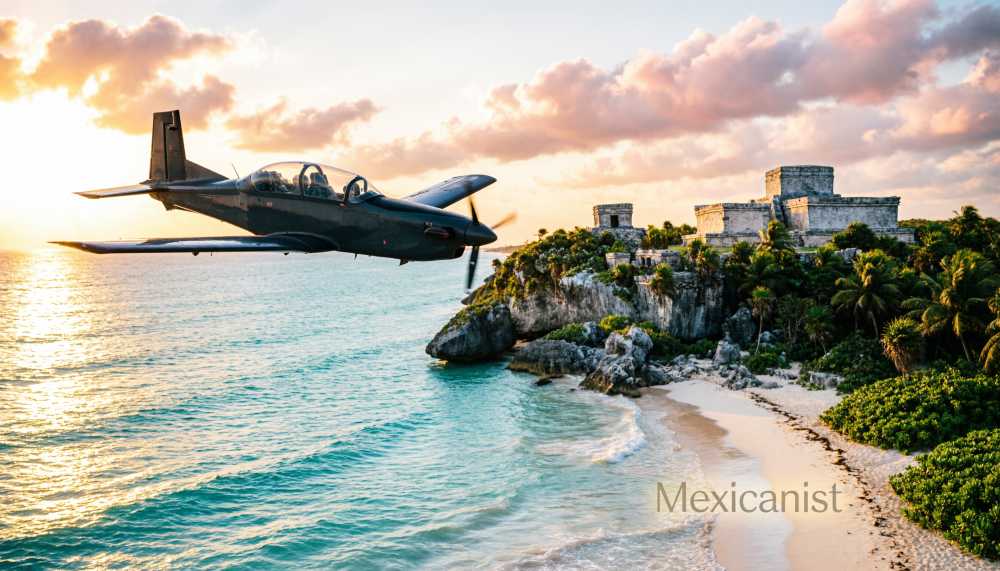
From April 23-26, Tulum becomes the stage for a military air show, a NASCAR race, and an aerial spectacle featuring Mexico's elite Águilas Aztecas aerobatic team. The Maya Train will shuttle spectators. The Mexican Navy is providing the venue. And if you're not already booked, you're probably too late.
Here's something that doesn't happen every day: the Mexican Air Force's premier aerobatic squad — the Águilas Aztecas — will be performing formation acrobatics over the Caribbean Sea while, a few kilometers away, NASCAR México holds a race in a jungle-adjacent park, and spectators arrive via a train line that didn't exist two years ago.
Welcome to Tulum, April 23-26, 2026.
The Air Show Tulum 2026 and the NASCAR México race are being staged as a joint four-day event — a logistics and tourism operation of a scale that Tulum has never attempted. And the infrastructure being mobilized to make it happen tells you everything you need to know about Mexico's ambitions for its newest tourism hub.
Military Precision Meets Caribbean Spectacle
The aerial component takes place at two venues across three days. On Thursday April 23, Friday April 24, and Saturday April 25, the action centers on Base Aérea Número 12 and the FBO terminal of Tulum's new international airport — the same airport that opened in 2023 as part of the broader Tren Maya infrastructure project.
The headliners are the Águilas Aztecas, the Mexican Air Force's (FAM) aerobatic demonstration team. Flying Pilatus PC-7 aircraft — Swiss-designed turboprop trainers used by the Mexican military for both training and light attack missions — the Águilas perform formation aerobatics that include barrel rolls, loops, Cuban eights, and the signature "bomb burst" break.
But the Air Show isn't just military hardware. Parachutists from the Mexican Army (the Fuerza Aérea and the Ejército Mexicano's parachute regiments) will conduct demonstration jumps. A rehearsal flight on April 18 already surprised Tulum residents, with formation flights visible from the beach — an appetizer that generated significant social media buzz.
On Sunday April 26, the venue shifts to Parque del Jaguar — the controversial ecological park built on Tulum's coastline — with viewing from Playa Paraíso. The juxtaposition is deliberate: military aircraft performing over the turquoise Caribbean while spectators watch from one of Mexico's most photographed beaches.
Racing in the Jungle
The NASCAR México component runs alongside the Air Show, with the headline race on Sunday April 26 at Parque del Jaguar. This is NASCAR's Mexican series — a growing motorsport property that has been gaining traction in a country better known for soccer and boxing.
The Tulum venue is unconventional for NASCAR. Unlike the purpose-built ovals of American stock car racing, NASCAR México often races on road courses and temporary circuits. Parque del Jaguar — with its jungle proximity and coastal access — offers a backdrop that no oval in North Carolina can match.
The event also serves as a statement of intent for Quintana Roo's diversification beyond beach tourism. Governor Mara Lezama's administration has been pushing to position the state as a destination for major events — sports, entertainment, conventions — that extend the tourist season beyond the traditional December-April peak and attract higher-spending visitors.
The Transportation
Here's where it gets interesting from an infrastructure perspective. Moving tens of thousands of spectators to and from military bases, airports, and coastal parks in a town of 33,000 people — with only two-lane roads connecting most points — requires a transportation plan that borders on military logistics. Which, conveniently, the military is helping with.
The transportation plan, announced by local authorities, includes:
- ADO buses departing from Tulum's main bus terminal to the Air Show venue at Base Aérea 12
- Urvan shuttles and taxis from multiple pickup points along Avenida Tulum
- Zamna parking hub — the Aldea Tulum development serving as a central parking and transit node
- Tren Maya connection — the event is explicitly leveraging the new Maya Train, with buses taking spectators from ADO/Zamna to the Tulum train station, then the train to Tulum Aeropuerto station, and then direct transport to the Air Show base
All routes will charge a "recovery fee" — a polite way of saying you're paying for transport on top of your event ticket. The Maya Train tickets are sold separately through the official platform.
The multi-modal approach — bus to train to bus — is an operational test for the Maya Train's capacity to handle event-level passenger volumes. If it works, the Tulum Air Show + NASCAR becomes a template for future mega-events along the train's route. If it doesn't, well, Tulum's already infamous traffic will achieve legendary status.
The Air Show Tulum + NASCAR event isn't just entertainment. It's a strategic move in Mexico's ongoing competition with other Caribbean destinations for tourism dollars.
The Caribbean tourism market is increasingly competitive. The Dominican Republic has been aggressively marketing its Punta Cana corridor. Jamaica is investing heavily in new resorts. Cuba — despite everything — continues to draw European and Canadian visitors with rock-bottom prices. And Florida's tourism machine never stops.
Quintana Roo's answer to this competition is differentiation. Not just beaches — everyone has beaches. But events. Experiences. The kind of thing you can't get in Punta Cana or Montego Bay. A military air show over the Caribbean. A NASCAR race in the jungle. A train ride through Maya territory to get there.
The strategy has a name in industry circles: "tourism of experiences." And it's working. Quintana Roo won an international award for community tourism at the WTM Latin America trade show in Brazil earlier this month. Cozumel just reported a 4.1% increase in cruise ship arrivals. The numbers are heading in the right direction.
The Catch
There's always a catch. In this case, it's the tension between spectacle and sustainability.
Tulum's fragile ecosystem — the cenotes, the mangroves, the reef, the jungle — is already under severe strain from overdevelopment. The town's water treatment infrastructure is inadequate for its permanent population, let alone event-day crowds. The sargazo seaweed invasion, which Zofemat is already planning to combat with additional hires starting in May, will be competing with event spectators for beach space.
And Parque del Jaguar — the Sunday venue — was itself controversial. Built on federally protected ecological land, the park faced years of legal challenges from environmental groups before opening. Hosting a NASCAR race at an ecological park is the kind of irony that writes itself.
But for one weekend in April, Tulum is going to try to pull off something extraordinary. Jets over the Caribbean. Stock cars in the jungle. The Maya Train full of spectators. If it works, it's the future of Mexican tourism. If it doesn't, it's the weekend Tulum's infrastructure finally broke.
Either way, it's going to be quite a show.
Sources: La Jornada Maya — "Cómo llegar al Air Show Tulum y NASCAR 2026" (April 18, 2026); La Jornada Maya — "Ensayo aéreo sorprende en Tulum" (April 18, 2026); 24 Horas Quintana Roo — NASCAR, Air Show coverage (April 17-19, 2026)