Mexico's Environmental Impact Assessments Are a Rubber Stamp, Here's Proof
Mexico’s Environmental Impact Assessment looks terrific on paper and operates like a speed bump made of sponge in practice — a legal framework where developers navigate 400-page documents with the enthusiasm of tourists filling out customs forms, knowing nobody’s reading too carefully.

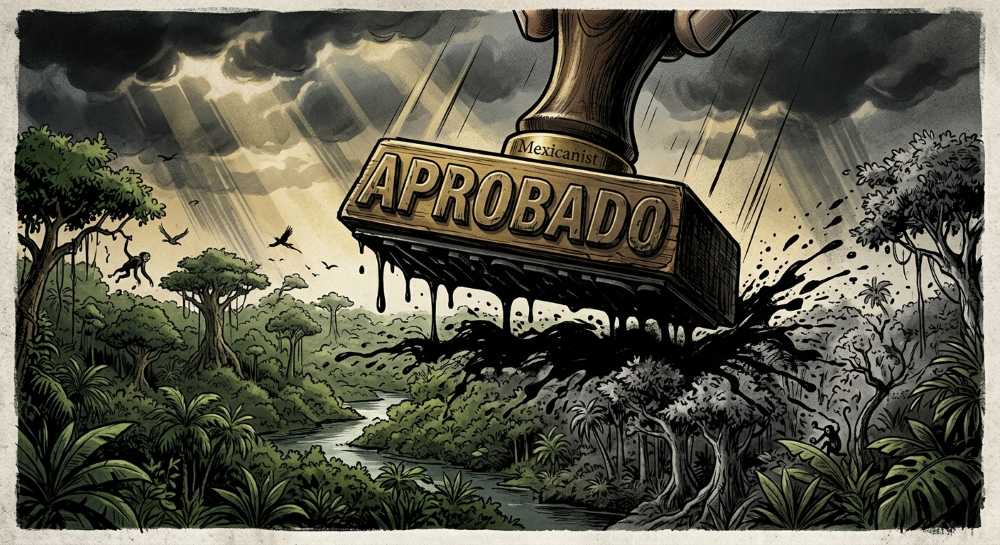
A developer walks into Mexico’s environment ministry with a 400-page document promising that their mega-project—a 1,500-kilometer railroad slicing through jungle, a refinery on mangrove coastline, an airport over subterranean rivers—will have “minimal environmental impact.”The ministry rubber-stamps it. Trees fall. Cenotes collapse. Communities howl. And the permit, that solemn-sounding Manifestación de Impacto Ambiental (MIA), turns out to be worth roughly the recycled paper it’s printed on.
Welcome to Mexico’s Environmental Impact Assessment system—a legal framework that looks terrific on paper and operates like a speed bump made of sponge in practice. Mexico has had EIA laws since 1988, and on paper they’re among the most comprehensive in Latin America. In reality, the system is a masterclass in procedural theater: a rite of passage that developers navigate with the enthusiasm of a tourist filling out a customs form, knowing full well that nobody at the other end is reading too carefully. The assessment isn’t the gatekeeper. It’s the welcome mat.
This essay digs into why. We’ll walk through what an EIA in Mexico is actually supposed to do, how the process gets gamed at every turn, why the institutions meant to enforce it have been hollowed out, and what it all means for a country that ranks among the most biodiverse on Earth—and among the most corrupt in its willingness to sacrifice that biodiversity on the altar of “national interest.”
What Is an Environmental Impact Assessment?
Mexico’s Environmental Impact Assessment is governed by the General Law of Ecological Balance and Environmental Protection (Ley General del Equilibrio Ecológico y la Protección al Ambiente), universally known by its Spanish acronym LGEEPA. First enacted in 1988 and significantly reformed in 1996 and 2012, LGEEPA requires that any project capable of altering the ecological balance must submit a Manifestación de Impacto Ambiental (MIA) to the Ministry of Environment and Natural Resources (SEMARNAT) before breaking ground. The law defines environmental impact as “the modification of the environment caused by human action or nature,”and the MIA is supposed to identify, evaluate, and propose measures to prevent, minimize, or compensate those modifications.
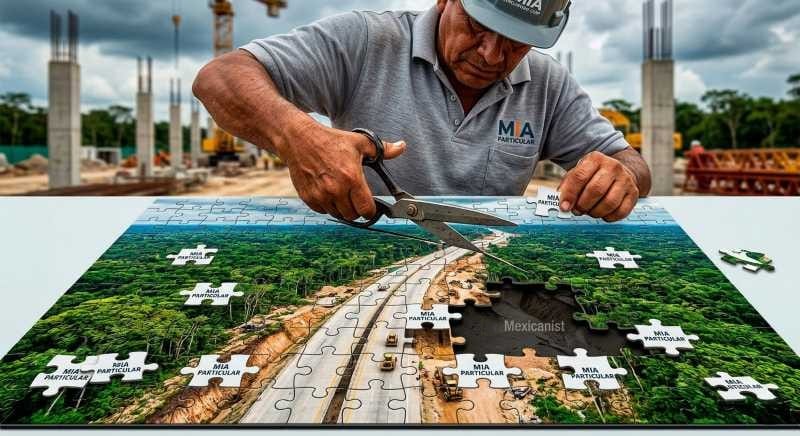
There are two main types of MIA. A Regional MIA is required for projects with significant geographical impact or those affecting multiple ecosystems—highways, railroads, large-scale tourism developments, and industrial corridors. A Particular MIA covers projects with more localized impact—a single factory, a specific mining concession, an individual real estate development. The distinction matters enormously, as we’ll see, because developers have become fiendishly creative at maneuvering their projects into the “particular” category to avoid the scrutiny that a regional assessment demands.
SEMARNAT has 60 working days to evaluate the MIA and issue one of three verdicts: approve the project, reject it, or approve it conditionally with mitigation requirements. In theory, projects cannot proceed without authorization. In practice, as we’ll explore, the “conditional approval” has become the default, the rejection rate is vanishingly small, and the conditions attached to approvals are routinely ignored.
If you think one layer of bureaucracy is enough to bog down a developer, Mexico has news for you: the EIA system operates across three tiers of government. At the federal level, SEMARNAT evaluates projects involving hydrocarbons, mining, electricity generation, federal highways, ports, and activities within natural protected areas. State governments handle their own EIA mechanisms for projects not assigned to federal jurisdiction—urban development, local roads, certain types of manufacturing. Municipalities don’t conduct EIAs themselves but must approve land-use changes and construction permits, creating what’s known as the “double gate”: a project can receive SEMARNAT’s environmental authorization and still be rejected at the municipal level for violating zoning ordinances.
This layered system sounds like belt-and-suspenders governance. In reality, it’s more like three people trying to steer a car with no engine. Jurisdictional overlap creates confusion, gaps, and—most critically for developers—opportunities. A savvy project promoter can shop around, submitting different components of the same project to different authorities, each of whom sees only a fragment of the whole. More on that particular sleight of hand shortly.
How the System Fails
So much for the theory. Now let’s talk about what actually happens when a developer wants to build something in Mexico—and how an instrument designed to protect the environment becomes, in the words of the Mexican Center for Environmental Law (CEMDA), a procedure with “grave structural failures” that prevent effective access to information and citizen participation in decision-making.
Let’s start with the most damning statistic: SEMARNAT approves virtually every MIA that crosses its desk. While the agency does not publicly publish rejection rates in a centralized, easily accessible dashboard, multiple studies and civil society organizations have documented that the approval rate for environmental impact authorizations hovers in the range of 95 to 98 percent. A 1998 landmark study by Bojórquez-Tapia and García at UNAM, which reviewed 33 environmental impact statements for highway projects already approved by SEMARNAT, found that the EISs contained “rather inadequate descriptions, and a biased and subjective assessment of impacts,”concluding that the EIA “reflected implicit values and failed to focus on the environmental conflicts likely to be generated by the projects.”More than two decades later, little has changed.
The problem isn’t that SEMARNAT’s evaluators are incompetent. Many are dedicated professionals caught in an institutional vise. The agency has been subjected to years of budget cuts: between 2015 and 2018, funding for SEMARNAT and its dependent bodies was slashed by 63.7 percent in real terms, with a further 26 percent cut between 2018 and 2020, according to research by UNAM economics professor Eduardo Vega. By 2020, the Federal Attorney’s Office for Environmental Protection (PROFEPA)—the enforcement arm—had seen its budget drop 18 percent from its 2016 peak. Fewer resources mean fewer inspectors, fewer site visits, fewer follow-ups, and a structural bias toward saying “yes” because there’s no capacity to monitor whether the “conditional” part of a conditional approval is ever met.
Project Splitting
If the rubber stamp is the passive failure of the EIA system, project splitting is the active exploitation of it. Here’s how it works: instead of submitting one comprehensive MIA for an entire project—say, a port expansion that involves dredging, a desalination plant, new roads, lighting infrastructure, and a warehouse district—the developer chops the project into pieces and submits separate MIAs for each component. Each individual MIA looks modest, even benign. The desalination plant? Just a water facility. The new access roads? Just a transportation upgrade. The dredging? Just routine maintenance.
This isn’t a fringe tactic. It’s standard operating procedure. AIDA attorney Sandra Moguel put it plainly after Mexico’s Supreme Court ruled against the practice in 2022:“This wasn’t the first case of this fragmented environmental assessment. This is constantly happening in Mexico. Developers will divide up projects and apply for several different permits—first the desalination plant, for example, then the streets, then the lighting, the dredging, and so forth—and therefore the environmental authority can’t do a complete assessment. SEMARNAT is aware that this happens, but most often grants permits anyway.”
The Supreme Court’s unanimous 2022 decision in the Port of Veracruz case was supposed to change this. The court ruled that SEMARNAT had violated citizens’ human right to a healthy environment by approving the port’s expansion “in a fragmented manner,”establishing a binding precedent that courts across Mexico must now follow. But here’s the rub: much of the construction had already been completed by the time the ruling came down. The permits were annulled, but the concrete was already poured. In Mexico, judicial victories often arrive after the environmental damage is irreversible.
Building First, Asking Later
In November 2021, President Andrés Manuel López Obrador issued a decree that should have set off alarm bells from Tijuana to Cancún. The decree required all federal agencies to grant automatic approval to any public works project the government deems “in the national interest” or “involving national security.”Regulatory agencies were given five working days to issue a year-long temporary approval. Five days. To evaluate the environmental impact of a mega-infrastructure project. As Aarón Siller of CEMDA’s southeast regional office put it at the time:“A project can’t be evaluated in five days.”
This decree was the legal mechanism that allowed the Tren Maya and the Tulum Airport to begin construction before their environmental impact assessments were complete. At the Tulum Airport, the public consultation period didn’t open until January 9, 2023, but President López Obrador himself had announced in December 2022 that construction was already 20 percent complete. Photos by the news agency Cuartoscuro confirmed it: a long swath of cleared jungle, heavy machinery deployed, 1.3 million trees destined for the chainsaw. The consultation was, as Siller described it, a simulacro—a sham. The documents were in Spanish in a region where much of the population speaks Maya. They were highly technical and required internet access to view. The outcome was preordained.
The Supreme Court placed some limits on the decree in December 2021, ruling that information about national security projects cannot be hidden from the public. But it upheld the provision requiring agencies to grant permits within five working days. The message was clear: build first, ask questions later—if there’s anyone left to ask.
The Consultation Charade
Public participation is supposed to be a cornerstone of the EIA process. LGEEPA mandates a public consultation period during which citizens can review the MIA and submit comments. In practice, this process is riddled with flaws that CEMDA has documented extensively. The consultation does not grant citizens the right to be consulted—only the right to request consultation. There is no special procedure for projects affecting indigenous territories or resources, in violation of ILO Convention 169, which Mexico has ratified. The information is published in the Gaceta Ecológica, a government gazette that nobody reads, not in mass media or community-accessible formats. The timeframes are inequitable. The developer has months to prepare the MIA; citizens have days to understand and respond to it.
Perhaps most critically, the opinions of citizens, other government agencies, and independent experts are not binding. SEMARNAT can receive a thousand objections, acknowledge each one, and then approve the project anyway. The EIA process does not evaluate social impacts or indirect damages. It does not allow negotiation over the implementation or benefits of a project. It does not verify the information provided by the developer. And the authority exercises its discretion without being bound by the precautionary principle, the principle of proportionality, or the principle of necessity. In short, the entire public participation apparatus is a Potemkin village: an impressive facade with nothing behind it.
Impunity and the Enforcement
Even when developers violate the conditions of their environmental authorizations—and they frequently do—the consequences are negligible. PROFEPA, the agency responsible for enforcing environmental law, has been gutted. Between 2006 and 2020, the Commission for Natural Protected Areas (CONANP) registered 4,264 environmental crimes in 182 protected areas. It followed up on only 834, referred 643 to PROFEPA, and resolved just 50. That translates to a 94 percent impunity rate for crimes referred to PROFEPA and an overall impunity rate of nearly 99 percent for all environmental offenses in protected areas over a 15-year period.
The budget cuts tell the story. CONANP’s budget peaked at 1.35 billion pesos in 2016; by 2020, it had fallen to 860 million—a 36 percent decline. PROFEPA dropped from 960 million to 790 million in the same period, an 18 percent cut. Both institutions continued to lose capacity throughout the López Obrador administration. Professor Vega’s research concluded that these cuts have caused “virtual ineffectiveness in many of the important areas of public action on environmental matters.”When the watchdog has no teeth, the fox doesn’t just guard the henhouse—it builds a resort hotel in it.

Case Studies
The Tren Maya
The Mayan Train is the EIA’s most spectacular failure, a case study in how political will can override every safeguard on the books. In June 2020, FONATUR (the National Fund for Tourism Development) admitted that the first four sections of the train had not been subjected to an Environmental Impact Statement—a requirement for infrastructure projects for 32 years. How did they get around it? By classifying the construction as “maintenance for rehabilitation and improvement of the existing railroad track,”arguing that since the original track was built before 1988, it was exempt from LGEEPA. This despite the fact that the project proposed doubling the tracks, significantly increasing train frequency, and clearing vegetation 20 meters on either side of the line.
By the end of López Obrador’s term, the Tren Maya had deforested more than 6,659 hectares, further fragmented the Mayan Jungle, perforated cenotes, and built a hotel inside a Biosphere Reserve. Environmental groups filed a submission under the USMCA’s Commission for Environmental Cooperation (CEC), alleging that Mexico was failing to effectively enforce its environmental laws. In April 2023, the CEC Secretariat recommended developing a factual record to investigate the EIA procedures for the project, including the alleged fragmentation of environmental impact studies.
Gustavo Alanís, CEMDA’s executive director, summed up the six-year term:“Complaints about inadequately conducted popular consultations and EIAs that were presented out of time, with erroneous data, without considering all the accumulated impacts or whose information was reserved were constant in the iconic megaprojects of the sexenio.”The Tren Maya wasn’t an exception. It was the template.
Tulum Airport
The Tulum Airport project compounded the Tren Maya’s sins. Built on top of the Holbox Fracture Zone and over a karstic system of underground rivers near the Sian Ka’an Biosphere Reserve, the airport threatened the aquifer, the subsoil, migratory birds, and the jungle ecosystem. Yet construction began before the public consultation period opened, using the same “national security” decree. When indigenous Maya leader Ángel Sulub Santos objected that the consultation didn’t guarantee the right to prior, free, and informed consent, he was stating what the law already admitted: the process was not designed to empower communities. It was designed to check a box.
The Dos Bocas Refinery, López Obrador’s other flagship project, followed a similar pattern. Built on mangrove coastline in Tabasco, it received environmental authorization despite widespread concerns about impacts on wetlands and coastal ecosystems. Eight months after beginning crude processing, the refinery still lacked an air emissions monitoring program required by the Agency for Safety, Energy, and Environment (ASEA) since 2019. Environmental organizations reported methane and benzene emissions; authorities rejected the claims without providing technical studies. By early 2026, the refinery had experienced multiple fires and oil spills, underscoring the gap between the EIA’s promises and the project’s reality.
Port of Veracruz
The Port of Veracruz expansion is the case that finally forced Mexico’s Supreme Court to acknowledge what everyone already knew: that fragmented EIAs violate the human right to a healthy environment. The project’s MIA had been split into multiple permits, each evaluating only a slice of the expansion. The court ruled unanimously that SEMARNAT’s approval“in a fragmented manner”meant“the viability of the whole of the expansion was not assessed correctly, in detriment to the principles of prevention and precaution.”The ruling annulled the environmental permits and set a binding precedent for future cases.
But here’s the bitter punchline: much of the port’s expansion was already built. The ruling was a legal victory and a practical defeat. It confirmed that the system was broken but could not undo the damage the broken system had already enabled. The endangered hawksbill and Kemp’s ridley sea turtles whose migratory routes pass through the affected waters did not get a do-over.
The Assessment That Fails to Assess
It would be intellectually dishonest to pretend that the EIA system achieves nothing. Defenders of the process point out that it does force developers to produce environmental data that would otherwise never see the light of day. Even a flawed MIA contains baseline information about ecosystems, species, and hydrology that communities and NGOs can use in legal challenges. The Supreme Court’s Veracruz ruling, after all, was built on evidence generated through the EIA process. Conditional approvals do sometimes include genuine mitigation requirements—wastewater treatment plants, reforestation programs, wildlife corridors—that wouldn’t exist without the MIA.
There’s also the question of institutional capacity, not just institutional will. Mexico is a developing country with enormous infrastructure needs and limited resources. A fully resourced SEMARNAT with a robust inspection corps and the political independence to reject major projects would be ideal, but the trade-offs are real. Every rejected project has economic consequences—jobs not created, regions not connected, energy not produced. The OECD’s 2013 Environmental Performance Review noted that Mexico had no strategic environmental assessment of policies, plans, and programs, and that cumulative impact requirements were not fully implemented. The review also warned that the government’s“better regulation”initiative—aimed at reducing bureaucratic burdens—could further erode the EIA’s effectiveness.
The April 2026 administrative simplification measures introduced by SEMARNAT illustrate this tension. The new rules merge MIA modalities, reduce requirements, shorten resolution timelines, and consolidate exemption requests into a single procedure. The government argues these changes promote efficiency and digitalization. Critics see them as the latest round of regulatory disarmament. The truth, as usual, is messier: simplification can help legitimate projects navigate genuine bureaucratic obstacles, but it also lowers the barriers for the bad actors who have always treated the EIA as a formality rather than a safeguard.
Mexico’s Environmental Impact Assessment system is not broken because it lacks rules. It is broken because the rules are selectively enforced, strategically circumvented, and systematically undermined by the very institutions charged with upholding them. The MIA process was designed as a preventive tool—to anticipate environmental damage before it occurs and ensure that development proceeds within ecological limits. Instead, it has become a post-hoc justification for decisions already made, a procedural checkpoint on a road whose destination was never in doubt.
The failures are interconnected. Project splitting evades comprehensive review. The rubber-stamp approval rate removes the deterrent effect. The national security decree creates a parallel track where EIAs are optional. The consultation process excludes the very communities most affected. The enforcement vacuum means violations go unpunished. And budget cuts ensure that the agencies responsible for all of the above lack the resources to do their jobs even when they want to.
The 2022 Supreme Court precedent on fragmented EIAs offers a glimmer of hope—but only if it’s accompanied by institutional rebuilding, budget restoration, and a genuine political commitment to treating the EIA as a binding constraint rather than a bureaucratic decoration. The 35 specialists who compiled Mexico’s Socio-environmental Agenda 2024 were blunt:“The national development policy persists in a model that has led to environmental degradation and the loss of biodiversity.”Until that model changes, the Environmental Impact Assessment will remain what it has become: a permit to destroy, dressed up as a promise to protect.
Sources
[1] Lawrbit,“Environmental Impact Authorization in Mexico: MIA Process,”March 17, 2026. https://www.lawrbit.com/article/environmental-impact-authorization-mexico
[2] Bojórquez-Tapia, L.A. & García, O.,“An Approach for Evaluating EIAS—Deficiencies of EIA in Mexico,”Environmental Impact Assessment Review 18(3):217-240, 1998.
[3] CEMDA,“Modificaciones al Procedimiento de Evaluación de Impacto Ambiental (EIA),”2022. https://cemda.org.mx/modificaciones-al-procedimiento-de-evaluacion-de-impacto-ambiental-eia
[4] Reuters,“Activists say Mexico not enforcing environmental laws related to Mayan Train project,”July 21, 2022. https://www.reuters.com/world/americas/activists-say-mexico-not-enforcing-environmental-laws-related-mayan-train-2022-07-21
[5] CEC Secretariat,“CEC Secretariat recommends Tren Maya environmental factual record under USMCA/CUSMA Chapter 24,”April 25, 2023. https://www.cec.org/news/cec-secretariat-recommends-tren-maya-environmental-factual-record-under-usmca-cusma-chapter-24
[6] Courthouse News Service,“Mexico Supreme Court sets precedent for environmental impact assessments,”February 10, 2022. https://www.courthousenews.com/mexico-supreme-court-sets-precedent-for-environmental-impact-assessments
[7] AP via Seattle Times,“Mexican president decrees automatic approval for projects,”November 22, 2021. https://www.seattletimes.com/nation-world/world/mexican-president-decrees-automatic-approval-for-projects
[8] Mexico News Daily,“As Tulum airport project’s public input period ends, critics cry foul,”February 7, 2023. https://mexiconewsdaily.com/news/proposed-tulum-airport-comments-period-ends-activists-cry-foul
[9] Mexico News Daily,“Protected areas lacking protection due to impunity, reduced resources,”August 20, 2021. https://mexiconewsdaily.com/news/protected-areas-lacking-protection-due-to-impunity
[10] Schools for Chiapas / Proceso,“Fonatur Admits that the Mayan Train has no Environmental Assessment,”June 10, 2020. https://schoolsforchiapas.org/fonatur-admits-that-the-mayan-train-has-no-environmental-assessment
[11] Schools for Chiapas,“Mexico’s environmental balance sheet in 2024,”January 14, 2025. https://schoolsforchiapas.org/mexicos-environmental-balance-sheet-in-2024
[12] Pérez-Llorca,“Administrative Streamlining of Environmental Impact Assessment Procedures,”April 8, 2026. https://www.perezllorca.com/en-mx/news/legal-briefing/administrative-streamlining-of-environmental-impact-assessment-procedures
[13] OECD, Environmental Performance Reviews: Mexico 2013. https://www.oecd.org/env/country-reviews/oecdenvironmentalperformancereviewsmexico2013.htm
[14] Mexico Business News,“Dos Bocas: Challenges, Environmental Concerns,”2025. https://mexicobusiness.news/oilandgas/news/dos-bocas-challenges-environmental-concerns
[15] Transparency International Australia,“Corruption Risks in Mining Concession Awards in Mexico,”2019. https://transparency.org.au/wp-content/uploads/2021/10/Mexico-report_EN.pdf
[16] IISD,“Mining Policy Framework Assessment: Mexico,”2022. https://www.iisd.org/system/files/2022-11/mexico-mining-policy-framework-assessment-en.pdf
[17] CEMDA,“Evaluación de Impacto Ambiental (Fragmentación),”2022. https://www.cemda.org.mx/wp-content/uploads/2022/10/evaluacion-de-impacto-ambiental.pdf