Why Sheinbaum Said Yes to Trump's World Cup Final Invite
Mexico's president will join Trump and Carney in a luxury box at MetLife Stadium for the World Cup final. The soccer is secondary.

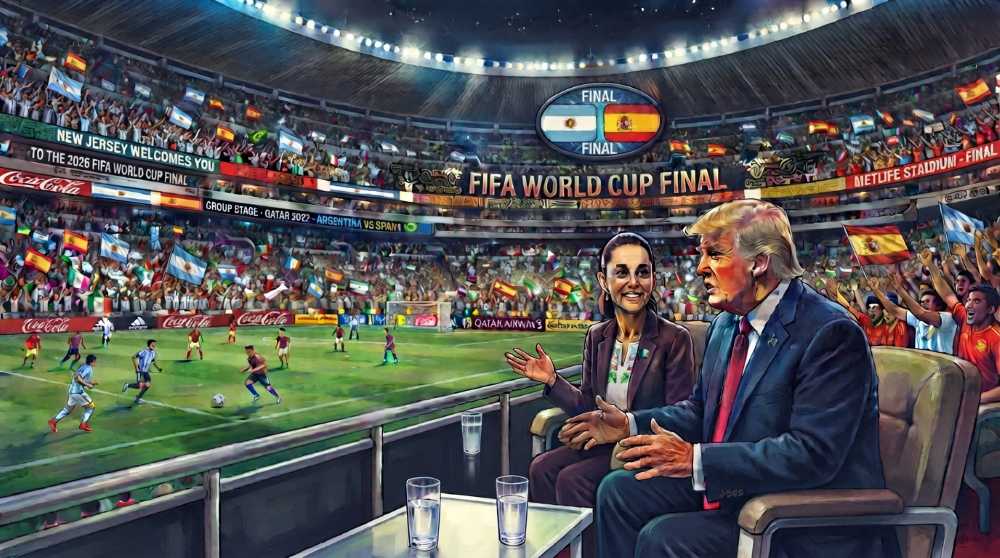
There will be three heads of state in the VIP section of MetLife Stadium on Sunday evening, and only one of them is there for the football.
Claudia Sheinbaum confirmed on Friday that she will travel to New York for the World Cup final between Spain and Argentina, accepting a personal invitation from Donald Trump. Mark Carney, Canada's prime minister, will be there too. What the public will see is a photo of three North American leaders celebrating a jointly-hosted tournament. What it actually represents is the first in-person meeting of all three TMEC heads of state since Trump returned to the White House, happening in a luxury box during a soccer match, with the future of the continent's trade architecture hanging in the balance.
Sheinbaum announced her decision during a work tour in Quintana Roo, telling reporters that she accepted because it was a direct invitation from the US president. "I made the decision to attend because it is a direct invitation from the president of the United States," she said. The statement was matter-of-fact, stripped of embellishment. No declaration of shared values, no diplomatic flourish. Just a confirmation that she would be there, which in itself tells you something about the state of the relationship.
This will be the second time the three leaders have shared a stage. The first was December 5, 2025, at the World Cup draw ceremony in the Kennedy Center in Washington, where Sheinbaum, Trump and Carney stepped onto the platform together to pull the velvet balls that decided the tournament's groups. On that occasion, Sheinbaum thanked the US for the shared hosting arrangement and emphasised the historic nature of Mexico hosting the World Cup for a third time. After the formalities, she held a private meeting with Trump, joined by Carney. She posted a photograph of the three of them and said they would continue working on trade matters.
That was seven months ago. The context has hardened since.
On July 1, just over two weeks ago, Washington confirmed that it would not renew the US-Mexico-Canada Agreement for the additional 16-year term that was available under the treaty's provisions on its sixth anniversary. Instead, the US Trade Representative, Jamieson Greer, announced that the agreement would remain in force until 2036 but would be subject to annual reviews. Trump's position, according to officials, is that the existing framework protected trade sectors from the tariffs he wanted to impose and failed to address America's trade deficits with its two partners.
The decision was a clear statement of intent. Annual reviews mean that uncertainty is now structural. Businesses that invested in North American supply chains on the assumption of long-term stability are recalibrating. The nearshoring boom that had brought manufacturing back to Mexico from Asia is now operating under a different set of assumptions about what the next year will bring. A five-year investment horizon looks very different when your trade agreement can be renegotiated every twelve months.
That is the backdrop against which Sheinbaum accepted Trump's invitation. It is not a trivial decision. In Mexico City, the political cost is already being tallied.
Critics on the left have been quick to argue that the president is validating a US administration whose migration policies have been the most aggressive in modern history. Since returning to office in January 2025, Trump has enacted what his administration calls one of the most stringent overhauls of asylum and humanitarian immigration systems in decades. Mass deportations, the expansion of the "Remain in Mexico" framework, and the deployment of active-duty military to the border have been the defining features of his second-term agenda. The human rights costs have been documented by advocacy groups and academic institutions, including the Baker Institute at Rice University, which published a policy brief in April detailing the economic strains and third-country deportation consequences for Mexico.
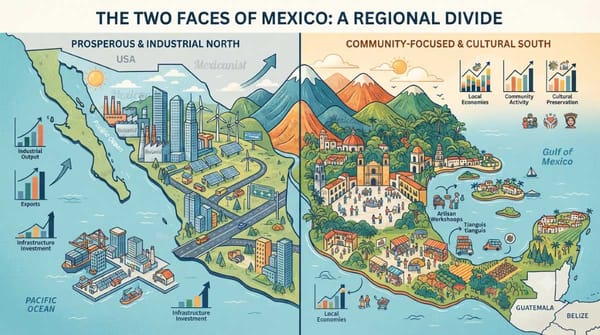
For Sheinbaum, the calculation is different. She inherited an economy deeply integrated with the United States. Roughly 80 percent of Mexican exports go to the US market, and a border relationship that, for all its tensions, is the engine of both countries' manufacturing sectors. A direct snub of Trump's invitation risked looking like unwillingness to engage rather than principled defiance. And with the third round of formal TMEC negotiations scheduled to begin in Mexico City next week, the timing of a refusal would have been catastrophic.
The trip also serves a domestic purpose. Sheinbaum has worked to position herself as a pragmatic leader who can manage the relationship with Washington without being subservient. She is not AMLO, whose relationship with Trump was transactional and often testy. She is also not a figure who can afford to be seen as avoiding the US president. The Mexican electorate, which polls show is broadly supportive of maintaining strong economic ties with the United States despite widespread disapproval of Trump's migration policies, expects its leader to show up.
Then there is Mark Carney, who in many ways has the most difficult seat in that luxury box. The former central banker became prime minister of Canada in early 2025 and has spent his tenure managing a relationship with Trump that has been uniquely antagonistic. Trump has repeatedly referred to Canada as the 51st state, a provocation that Carney addressed directly in a pointed speech at Davos in January, where he made clear that Canada would not be bullied into accepting renegotiated terms that weakened its sovereignty.
Carney's position is that of a man trying to diversify Canada's trade relationships while simultaneously preparing for a review that could fundamentally alter the agreement that has governed North American commerce since 2020. In April, he announced a 24-member Advisory Committee on Canada-US Economic Relations, drawing on what his office called "the best advice and the broadest perspectives" as the country braces for what is expected to be a bruising round of talks. The committee includes business leaders, trade lawyers and former diplomats, a sign that the Canadian government is taking the annual review mechanism seriously and building a war room for what is likely to be a sustained period of negotiation.
For Trump, the World Cup final is an opportunity to project dominance on his own terms. The invitation to Sheinbaum and Carney allows him to frame himself as the convener of North American leadership, the figure around whom the continent's political and economic order revolves. The fact that the meeting takes place during a sporting event rather than a formal summit is useful to him: it creates the appearance of cordiality while avoiding the scrutiny of a bilateral agenda. There will be no joint communiqué, no signed agreements, no formal readouts. Just three men and a woman in a box, watching football, with photographers at a distance.
What is being discussed in that box matters more than what is being watched on the pitch. Spain against Argentina is a compelling enough final, with Spain seeking its second World Cup title and Argentina looking to defend the crown it won in Qatar in 2022. The game will draw a global audience of hundreds of millions. But for the three North American leaders, the ninety minutes on the field are a backdrop for ninety minutes of conversation that could shape the trade relationship of the continent for the next decade.
The specific agenda remains unconfirmed, though the context makes the topics predictable. The annual review mechanism, the auto sector rules of origin that have been a flashpoint since the original USMCA negotiations, the digital trade provisions that have become more important as both Mexico and Canada seek to build their technology sectors, and the enforcement mechanisms for labor and environmental standards are all on the table. Mexico's energy policy, which has been a point of friction under both AMLO and Sheinbaum, will almost certainly come up. So will Canada's dairy supply management system, which Trump has repeatedly targeted as an unfair trade barrier.
Then there is migration, the issue that has defined so much of the Trump-Sheinbaum dynamic without either leader wanting to make it the centrepiece of their public interactions. Mexico has absorbed hundreds of thousands of deported migrants under Trump's second-term policies, straining resources in northern border cities and creating humanitarian pressure that Sheinbaum's administration has managed quietly, without the public confrontations that marked previous iterations of this tension. The Mexican government has expanded its own detention and processing capacity, in part to demonstrate to Washington that it is a reliable partner in migration management. Critics say this amounts to Mexico doing Trump's border enforcement for him. The administration says it is a matter of pragmatic sovereignty: managing the flow on Mexico's terms rather than having it managed by US policy.
Sheinbaum's decision to attend the final is, in that sense, consistent with her broader approach to the relationship. She does not pick fights she cannot win. She takes the meeting, she takes the photo, and she works the room. The domestic criticism will come, and she has prepared for it. The headline in Mexico City on Saturday morning was not about the optics of sitting next to Trump. It was about whether the meeting would produce anything concrete for Mexico ahead of next week's negotiations.
The answer is probably not. This is not a negotiating session. It is a get-to-know-you-better meeting in an environment where the power dynamic is visible to everyone and the advantage belongs to the host. Trump gets the setting, the timing, and the framing. Sheinbaum gets proximity and the chance to make her case in person. Carney gets to remind everyone that Canada is still at the table.
What comes next is the real test. The third round of negotiations begins in Mexico City next week, and the teams will sit down without the cameras and without the football. That is where the details will be fought over: rules of origin, dispute resolution mechanisms, market access provisions. The luxury box on Sunday is the preamble. The conference room on Monday is where the work begins.
For now, Sheinbaum has chosen to be in the room. It is a choice that carries political risk at home and strategic possibility abroad. Whether it was the right call will not be decided by the final score of Spain against Argentina. It will be decided in the weeks and months after, as the outlines of a renegotiated TMEC become visible and Mexico's position within it becomes clear.
The stadium will hold 82,500 people on Sunday. The decisive conversation will happen in a space that seats perhaps a dozen. Three leaders, their advisers, and the weight of a continent's economic architecture, conducted against the roar of a crowd that does not know what it is witnessing.