Mexico Caught the Cartel Kingpin. Then His Army Burned a Town to the Ground.
The DEA had a $5 million bounty on the man who funneled fentanyl to California, Texas, Illinois, Georgia, Washington, and Virginia. Mexico caught him in a drainpipe. Within hours, his cartel burned six stores and six vehicles in a small coastal town. This is what victory looks like.

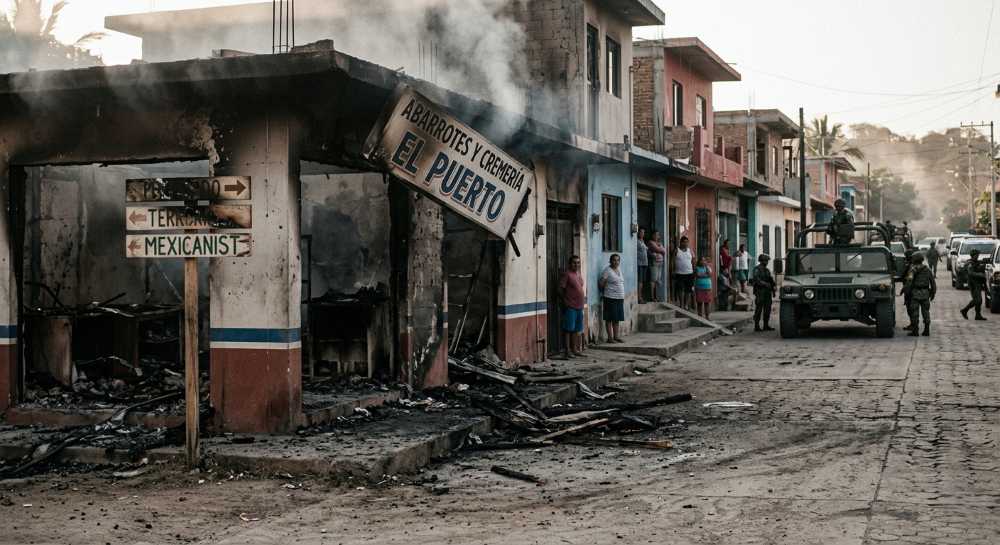
Audias Flores Silva spent 19 months running. The Mexican Navy spent 19 months chasing. On Monday morning, in the hills above the tiny Nayarit community of El Mirador, the chase ended in a storm drain.
"El Jardinero" — The Gardener — crawled into a concrete culvert trying to disappear. He'd had plenty of practice vanishing. The man had been convicted of drug trafficking in a North Carolina federal court in 2002, served five years in an American prison, was deported back to Mexico, got arrested for the ambush killing of 15 Mexican police officers in Jalisco in 2015, was acquitted, walked free, and spent the next seven years building a trafficking network that the U.S. Treasury Department described as spanning five Mexican states and six American ones.
The DEA put a $5 million bounty on his head in May 2025. His criminal record stretches across two decades and two countries. He answers to at least five aliases — "El Comandante," "El Bravo 2," "Audi," "El Mata Jefes," and a false identity: Gabriel Raigosa Plascencia.
When Mexican Marines finally cornered him, his security detail — roughly 30 vehicles and more than 60 armed men — scattered like roaches in flashlight. The government deployed four attack helicopters, two troop transports, four fixed-wing aircraft, aerial surveillance systems, 120 direct-action operators, and 400 naval support personnel. Not a single shot was fired.
It was, by every operational metric, a textbook takedown. The kind of mission you build a recruiting video around. And then the cartel burned a town.
Within hours of Flores Silva's capture, the Cártel Jalisco Nueva Generación set fire to six commercial stores and six vehicles in Tecuala, a small municipality on the Nayarit coast. Armed convoys blocked federal highways in the southern reaches of Tepic. Social media filled with panicked reports of shootings, roadblocks, and school closures — some real, many fabricated by the cartel's own propaganda machine to amplify the terror.
Nayarit's governor, Miguel Ángel Navarro, went on television to insist the state was "calm" and that highways, toll booths, schools, and businesses were operating normally. The federal security cabinet issued a statement confirming "no highway blockades" but acknowledging the fires. They urged citizens to follow only official information channels and stop spreading rumors.
The people of Tecuala — population roughly 40,000, a place where most Americans will never set foot — were left to sweep up the glass and wonder when the next retaliation would come. This is the cycle. It never stops.
The Fentanyl Pipeline
Here is why El Jardinero matters to anyone reading this in the United States. According to the U.S. Department of Justice, Flores Silva supervised trucking operations moving cocaine from Central America into Mexico, then distributed narcotics to CJNG cells in California, Texas, Illinois, Georgia, Washington, and Virginia. Six American states. That's not a drug route — that's a supply chain.
The CJNG is the cartel most responsible for flooding the United States with fentanyl, the synthetic opioid that kills more Americans annually than car accidents, gun violence, and suicide combined. Over 70,000 Americans died of fentanyl overdoses last year. The drug that killed them likely passed through a network that men like El Jardinero built and maintained.
His capture didn't shut down that network. It interrupted it. The trucks will keep moving. The labs in Michoacán and Jalisco will keep cooking. The distribution cells in Atlanta and Chicago will keep selling. The only thing that changes is the name on the organizational chart.
Mexico has been playing whack-a-mole with cartel leadership for two decades, and the body count keeps climbing. The strategy has a name in security circles: "decapitation." Remove the head, the theory goes, and the body dies. It doesn't work with cartels. It never has.
The Sinaloa Cartel lost "El Chapo" Guzmán — first to prison in 1993, then again in 2014, then again in 2016 when he was extradited to the United States. Each capture triggered a power vacuum. Each vacuum triggered a war. The most recent one — the internal split between the Guzmán family and the Zambada faction — has produced 3,148 homicides, 3,679 forced disappearances, and 10,844 stolen vehicles in Sinaloa alone since September 2024. That's 5.3 murders and 6.2 abductions per day for 19 consecutive months in a single state.
The day El Jardinero was caught, four women were gunned down inside a pet grooming shop in downtown Culiacán. Karely, 41, and her daughter Itzel, 22, died inside their pickup truck. Elizabeth, 30, and Teresa, 35, fell on the sidewalk outside. None of them were cartel operatives. They were customers. Or workers. Or just women in the wrong place when the wrong men decided to send a message.
The same day, two male cousins — Rafael Adolfo and Guadalupe — were found dead on a dirt road in the Aguaruto municipality outside Culiacán. Someone left a pig's head with a narco-message in a residential neighborhood, initially reported as a bomb threat. Four men were caught inside a shot-up house in a Mazatlán subdivision. This was an ordinary Monday in Sinaloa. Nobody in Mexico called it extraordinary.
What the U.S. Ambassador Said
Ronald Johnson, the U.S. ambassador to Mexico, celebrated the capture publicly. "I recognize the bravery and precision of the Secretary of the Navy in the operation that led to the detention of Audias Flores Silva, 'El Jardinero,'" he wrote on social media. "When we act with determination, we achieve results that make our nations safer under the leadership of President Donald Trump and President Claudia Sheinbaum."
The diplomatic phrasing is careful. Johnson credits Mexican forces, name-checks both presidents, and frames the capture as a shared victory. But the subtext is telling: the United States has been pushing Mexico to take down CJNG leadership for years, and the DEA's $5 million reward suggests American intelligence was deeply involved in the 19-month manhunt.
Sheinbaum, for her part, drew a line. "There may be information provided by a U.S. government institution," she said, "but it has to be within the framework of understanding that exists — not through ground operations with elements of any investigative agency." Translation: American intelligence is welcome. American boots on Mexican soil are not. It's the same posture every Mexican president has maintained since Felipe Calderón's deeply unpopular decision to allow DEA agents to operate freely during the 2006-2012 drug war.
In a simultaneous raid in Zapopan, Jalisco, Mexican Army Special Forces and the National Guard nabbed César Alejandro — "El Güero Conta" — identified as El Jardinero's financial operator. His job: washing cartel money through shell companies and frontmen, buying airplanes, boats, houses, ranches, and investing in tequila distilleries.
Security Secretary Omar García Harfuch called the detention "a major blow to the financial structure of this criminal group."
Maybe. But financial operators are replaceable. The cartels have been laundering money through Mexican legitimate businesses for so long that the distinction between "clean" and "dirty" capital barely exists in certain sectors. Tequila, real estate, agriculture — all have been penetration points for cartel finance for decades. Removing one accountant doesn't collapse the system any more than removing one capo collapses the trafficking network.
El Jardinero's capture is a genuine operational achievement. The intelligence work was serious. The logistics were complex. Nobody died during the arrest. The Mexican Navy deserves credit for a clean operation.
But "clean operations" don't end drug wars. They don't stop fentanyl from crossing the border. They don't prevent cartel retaliation against civilians in Nayarit or Sinaloa or anywhere else the state's monopoly on violence has collapsed.
The uncomfortable truth is that two decades of decapitation strikes have produced more violence, more fragmentation, and more competition — not less. Every time a kingpin falls, three lieutenants fight to replace him, and the resulting bloodshed makes the old boss look like a stabilizing force. The CJNG itself was born from exactly this dynamic — it emerged as a splinter group after the death of Ignacio "Nacho" Coronel, a Sinaloa Cartel boss killed by the Mexican military in 2010.
The math is simple. The man who ran drugs to six U.S. states is in a Mexican prison cell. The network that moved those drugs is still operational. The labs are still cooking. The trucks are still rolling. And somewhere in the mountains of Jalisco or Nayarit or Michoacán, the next El Jardinero is already settling into the job. This is what winning looks like. It's not enough.
Sources: Noroeste — Ingresa 'El Jardinero' a la FEMDO tras la detención en Nayarit | Noroeste — Tras detención de 'El Jardinero' en Nayarit, queman seis vehículos y seis tiendas | Noroeste — Informe diario: masacran a 4 mujeres en el Centro de Culiacán | La Jornada Maya — Detención de 'El Jardinero'